
Why Western armies wanted swimming vehicles
Western armies wanted armored vehicles that could cross rivers on their own. The French Army wanted its VAB wheeled carrier to swim so that it could get over the rivers of eastern France and Germany in a war against the Warsaw Pact [3]. Compared with the M75 it replaced, the US Army's M59 (in service from spring 1954) could swim, sat lower and cost much less to build [6]. Its successor, the M113, used aluminum armor so that it stayed light enough to fly in transport aircraft and to float [5].
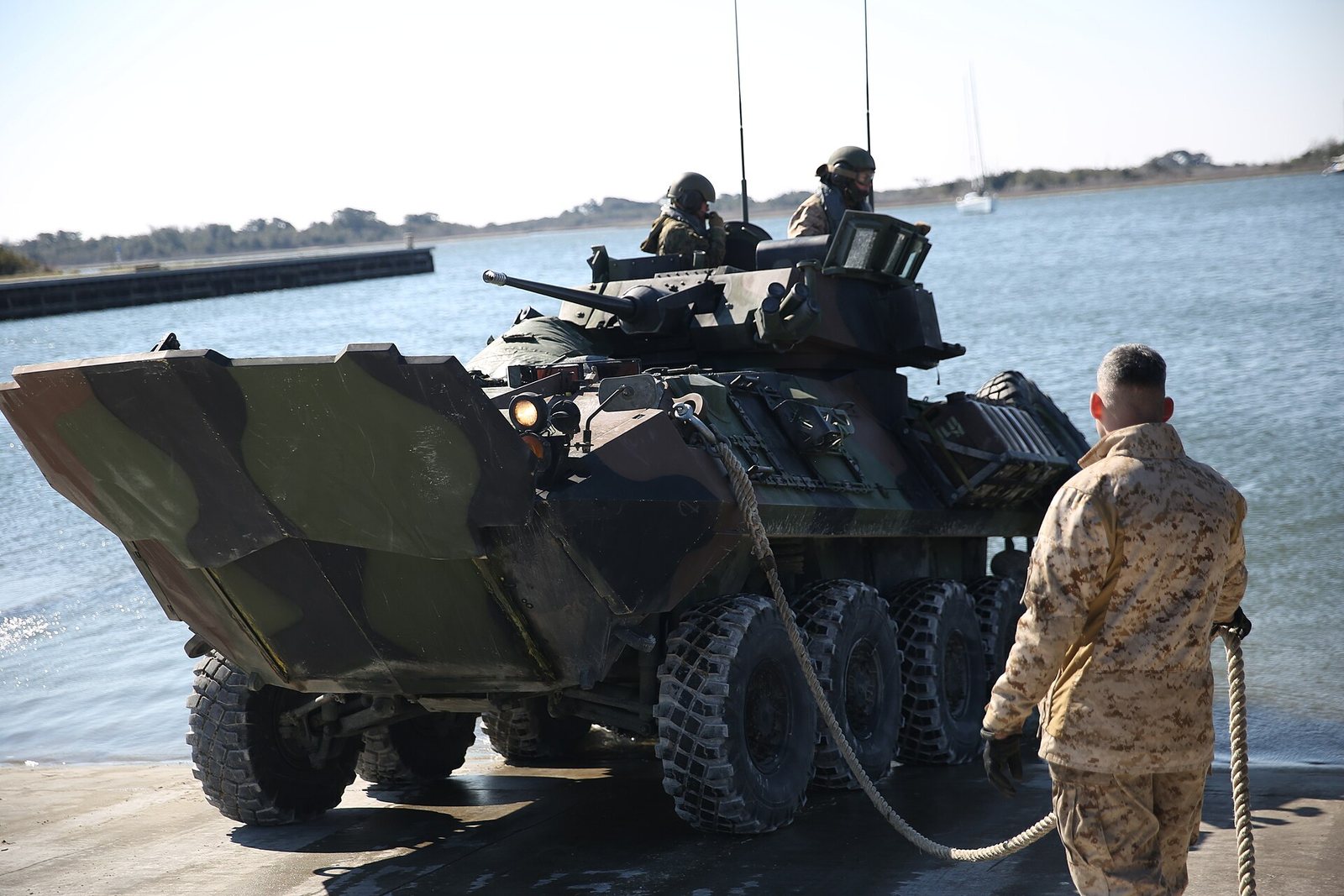
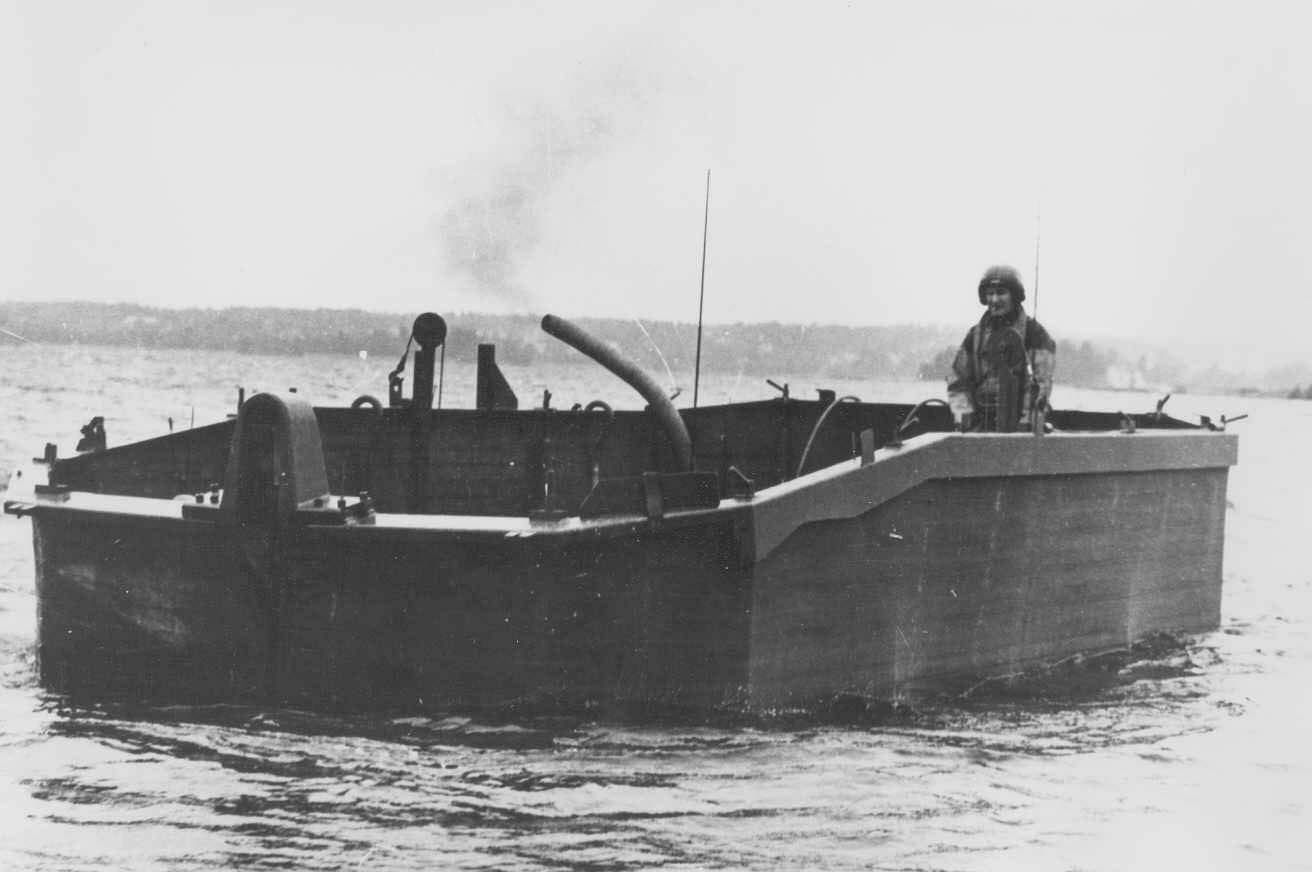
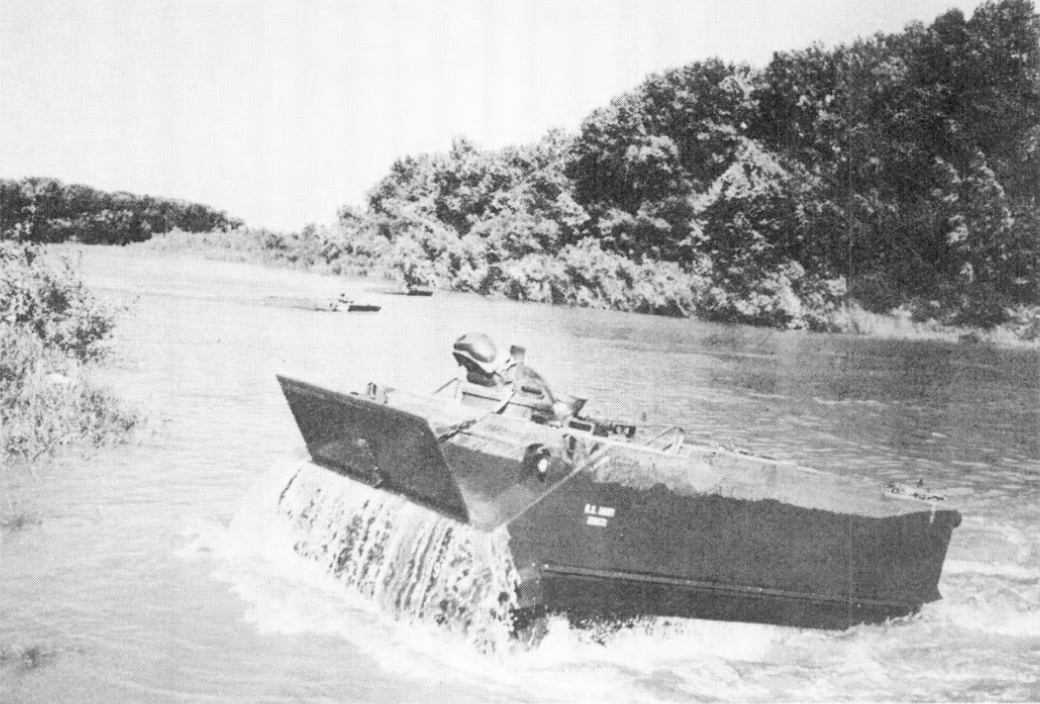
Marines also needed vehicles that could carry troops from ships to the beach. The US Marine Corps line runs from the wartime Landing Vehicle Tracked, first built in July 1941 [26], through the LVTP-5 of 1956 [7] and the LVTP-7, later the AAV7, delivered from 1971 [8], to the Amphibious Combat Vehicle chosen in 2018 [23]. Military amphibians not built as fighting vehicles, such as the LARC-V cargo lighter of 1963 [27], the M561 Gama Goat truck [29], the Alvis Stalwart load carrier [28] and the Bv206 tracked carrier [31], appear in the table for comparison.
How they swim
A vehicle floats only if its sealed hull can push aside more than its own weight of water, so a swimming design must stay light and watertight; the M113's aluminum armor was meant to keep it light enough for this [5]. The simplest drive afloat is the running gear: the tracks of the M113, K200A1 and ACV-15 move them at about 5.8 to 7 km/h (3.6 to 4.3 mph) [1][5][18][19], and wheeled vehicles such as the Gama Goat and BMR paddle with their turning wheels [29][16]. Other vehicles add a separate drive: two stern propellers on the Piranha and LAV-25 and rear propellers on the Luchs [12][13][14], one propeller on the VBL [15], or water jets on the AMX-10 RC and AAV7, and on the AMX-10P, where the 2001 Army guide lists them as optional [1][8].
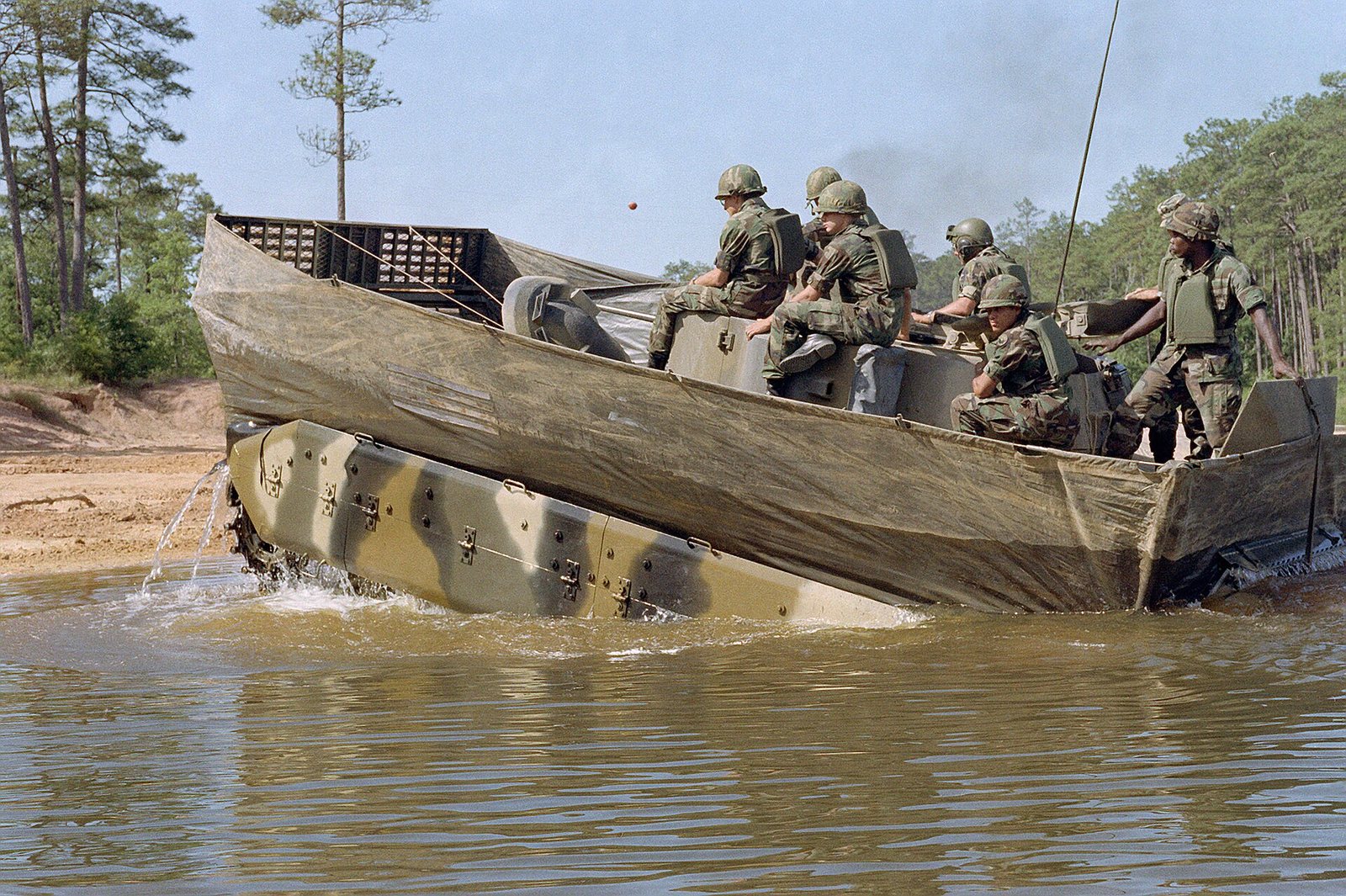
Many Western vehicles also needed some help to swim. A trim vane, a folding plate at the front of the hull, was a common fitting: the M59 carried one, original M113s swam with nothing more, and the Luchs used one with its propellers [6][5][14]. Others had to put up a flotation screen around the hull before they would float: Sweden's Strv 103 tank swam this way on its tracks, Britain's Scorpion managed about 3.6 mph (5.8 km/h) with its screen up, and the first M2 Bradleys swam inside a flotation curtain [9][11][4].
Tracks are a slow way to swim: when the Marine Corps' LVTP-7 family replaced track drive afloat with water jets, it became much quicker in the water than the LVTP-5 it succeeded [8]. Some major Western fighting vehicles did not swim at all. The US Army's equipment guide lists West Germany's Marder 1 (1971) as able to ford 1.5 m (4 ft 11 in) of water, or 2 m (6 ft 7 in) with preparation, and Britain's Warrior (1988) 1.3 m (4 ft 3 in), while it lists the Soviet BMP-1 and BMP-2 as amphibious at 7 km/h (4.3 mph) [1]. The Bradley itself was designed in large part as an answer to the Soviet BMP, which could swim [4].
United States
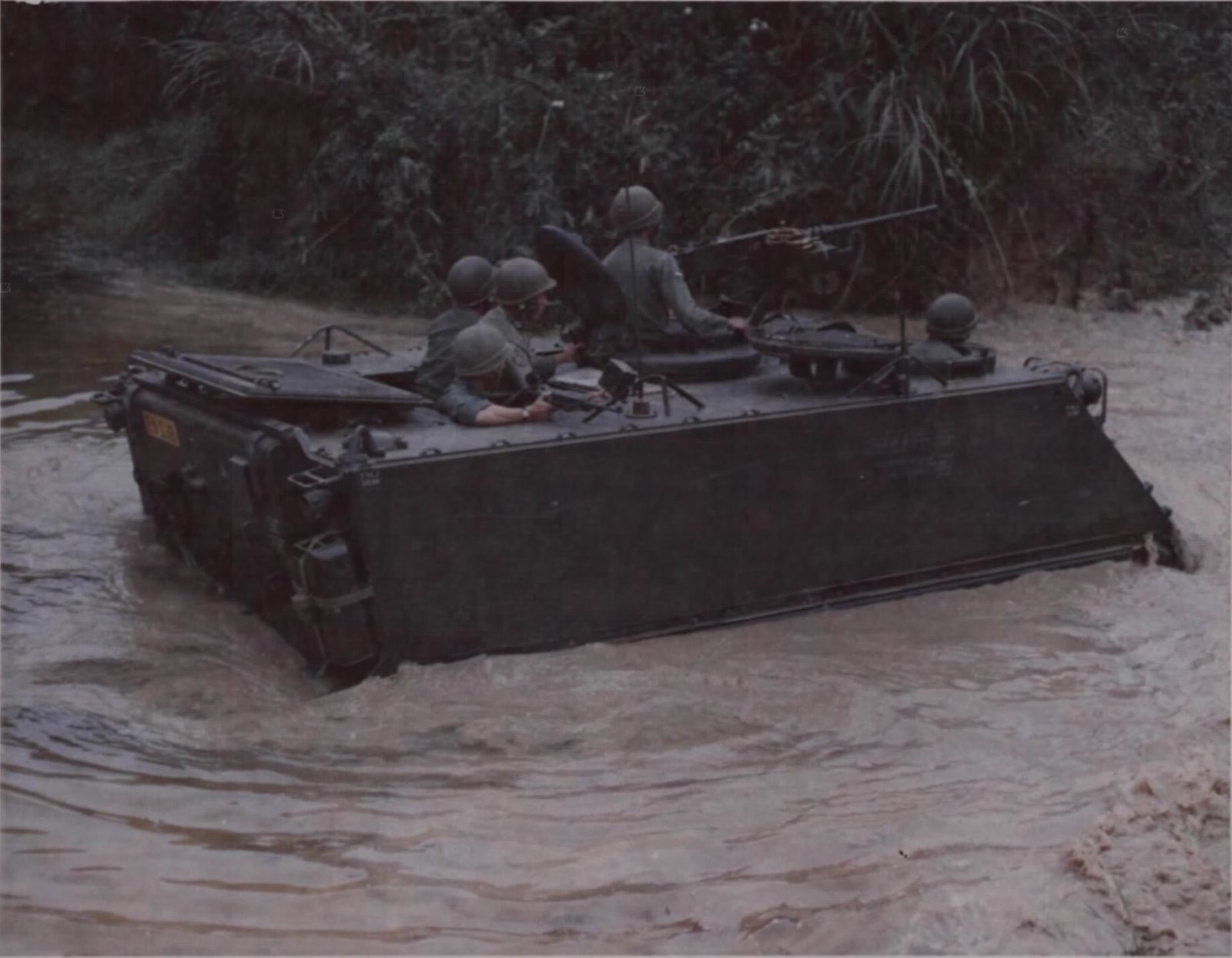
FMC's M59 was type classified in May 1953, and about 6,300 had been built when production ended in 1960 [6]. Its hatches and doors were sealed with rubber, it carried a trim vane, and it could reach 4.3 mph (6.9 km/h) afloat [6]. The M113 that replaced it entered service in 1960, and about 80,000 of all versions were built [5][6]. The US Army guide gives the diesel M113A1 of 1964 about 64 km/h (40 mph) on roads and 5.8 km/h (3.6 mph) afloat [1].
Cadillac Gage's Commando armored cars were also amphibious [1][13]; the Army guide dates the four-wheeled V-150 to 1971, after the gasoline-engined V-100, and gives it about 89 km/h (55 mph) on roads and 5 km/h (3 mph) in water [1]. The eight-wheeled LAV-25 from General Motors of Canada, based on the Swiss MOWAG Piranha, was selected on September 27, 1982 for a joint Army and Marine Corps program; after the Army pulled out, the Marine Corps ordered at least 758 for delivery from 1983 to 1987 [13]. In calm water its two stern propellers push it at about 6.5 mph (10.5 km/h) [13].
Western Europe
Hägglund & Söner developed Sweden's Pansarbandvagn 302 infantry carrier; 644 were built from 1965 to 1972, including 126 special versions; the first entered service in 1966, and the type was rated at 66 km/h (41 mph) on roads and 8 km/h (5 mph) in water [10]. Sweden's turretless Stridsvagn 103, the S-tank, was a main battle tank that could swim: 290 were delivered from 1967 to 1971, and afloat it sat inside a collapsible screen erected around the hull while its tracks moved it at about 6 km/h (3.7 mph) [9].
Britain's Combat Vehicle Reconnaissance (Tracked) family, led by the Scorpion of 1972 and including the Scimitar and Spartan, had an aluminum alloy hull and carried a flotation screen [1][11]. The US Army guide gives the Scorpion about 80 km/h (50 mph) on roads and 4 km/h (2.5 mph) in water, or 6 km/h (3.7 mph) with a propeller kit [1].
MOWAG's first Piranha, a 6x6, appeared in 1972, and the family grew to 4x4, 6x6 and 8x8 versions [12]. All of them could swim, using a pair of propellers at the stern; the 4x4 reached 9 to 10 km/h (about 6 mph) in water and 100 km/h (62 mph) on the highway [12]. West Germany's 8x8 Spähpanzer Luchs scout car, 408 of which served from 1975 to 2009, swam at up to 10 km/h (6 mph) with rear propellers and a trim vane, but only until its 1986 upgrade [14].
In France, the tracked AMX-10P infantry fighting vehicle of 1973 swam at about 7 km/h (4.3 mph), with water jets that the 2001 Army guide lists as optional, and the six-wheeled AMX-10 RC of 1979 carried two water jets [1]. The VAB carrier, introduced in 1976 and built in about 5,000 examples, swims with its wheels or with twin water jets [2][3]. Panhard's VBL, produced from 1985 to 2010, can drive into the water with no preparation and is pushed along at 5.4 km/h (3.4 mph) by one propeller at the stern [15]. Spain's six-wheeled Pegaso BMR entered production in 1979; it paddles with its wheels, and optional twin water jets give it 9 to 10 km/h (about 6 mph) [16][17].
Allied designs in Asia and Turkey
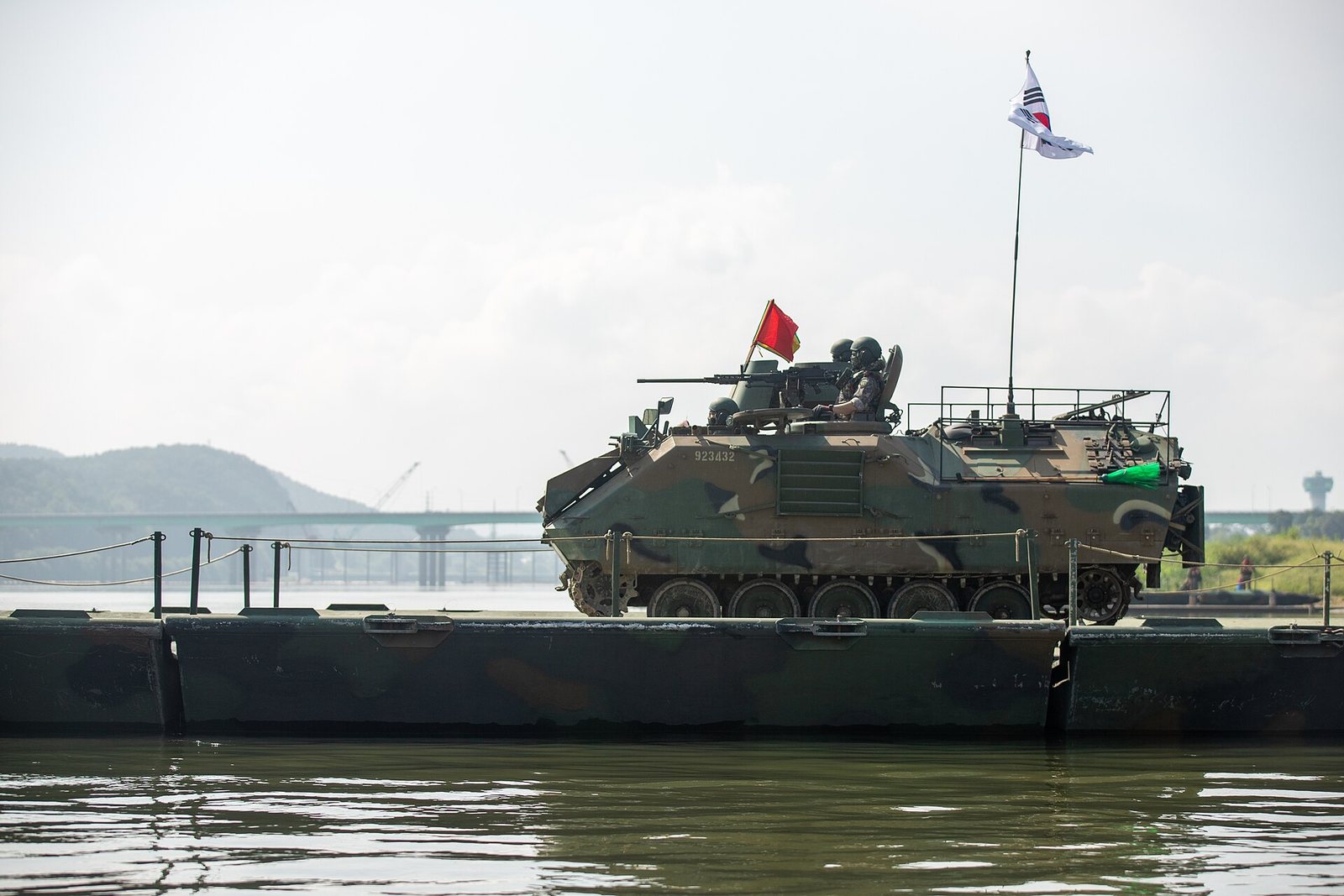
South Korea's K200 infantry fighting vehicle, based on the American AIFV with Daewoo Heavy Industries as prime contractor, entered production in 1985, and K200s were exported to Malaysia at the end of 1993 [18]. The improved K200A1 swims at about 7 km/h (4.3 mph) by turning its tracks; the US Army guide gives 4 km/h (2.5 mph) for the original K200 [18][2].
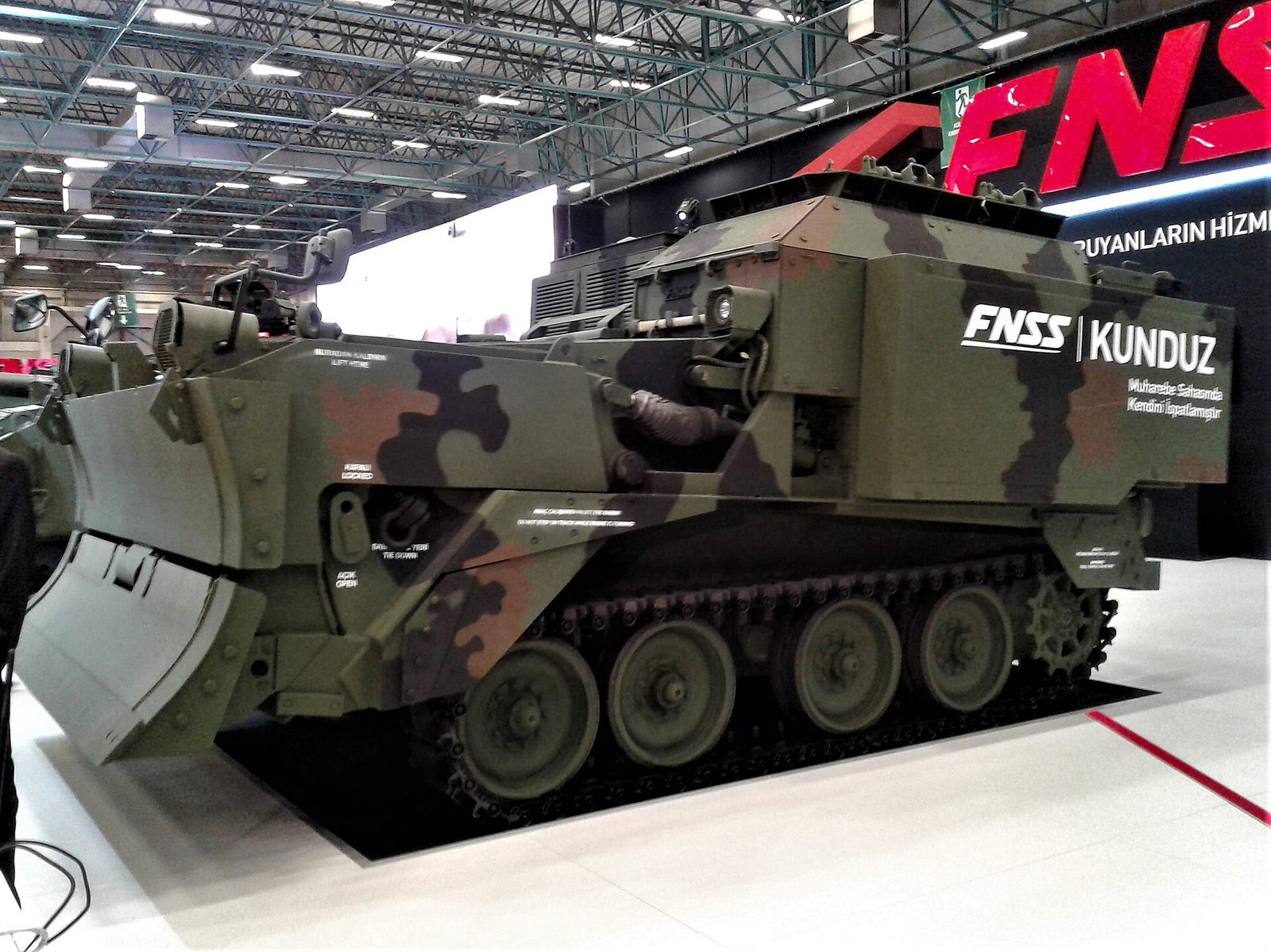
Turkey's FNSS builds the ACV-15 family, which includes an AIFV version, on the same M113-derived design; the US Army guide dates the Turkish vehicle to 1992 [2][19]. FNSS says it has built more than 2,500 and gives a top water speed of 6.3 km/h (3.9 mph) using track propulsion [19]. Its Kunduz, an armored earthmover for digging, clearing obstacles and strengthening riverbanks, swims at up to 8.6 km/h (5.3 mph) with two pump jets; the Turkish Army received its first in January 2013 [20].
Singapore's Terrex, from ST Kinetics, has served with the Singapore Armed Forces since 2010 [21]. The 8x8 Terrex 2, shown in 2015, swims at 11 km/h (6.8 mph) with two hydraulically driven propellers [21].
Marine Corps assault amphibians
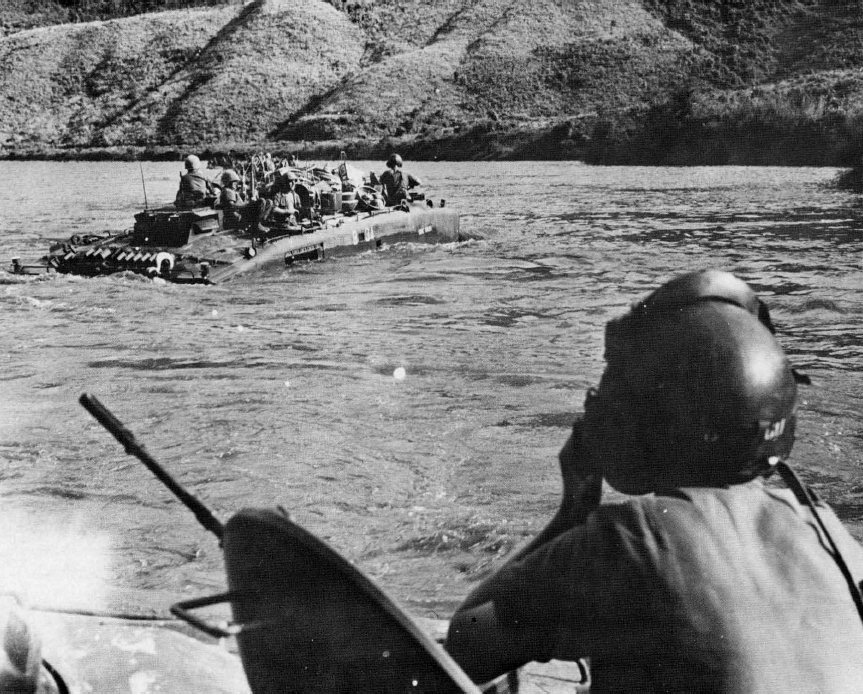
The LVTP-5, designed by Borg-Warner and built by FMC and others, entered service in 1956; 1,124 basic vehicles were built, each carrying 30 to 34 troops, plus 210 LVTH-6 fire support versions with a 105 mm howitzer [7]. It swam on its tracks at about 11 km/h (7 mph) [7][8]. Its successor, the LVTP-7 (later AAV7), first delivered in August 1971, used two water jets to reach about 13 km/h (8 mph) and served the Marine Corps until 2025 [8].
The Expeditionary Fighting Vehicle, developed by General Dynamics from 1996, used a planing hull and two water jets; test vehicles regularly exceeded 25 knots (46 km/h, 29 mph), but the program was ended in 2011 [22]. In June 2018 the Marine Corps chose BAE Systems' 8x8 Amphibious Combat Vehicle, based on an Iveco design, to replace the AAV family; it carries 13 troops and swims at about 6 knots (7 mph, 11 km/h) [23]. The Royal Marines' articulated BvS10 Viking, delivered from 2005, swims at about 5 km/h (3 mph) [33].
Turkey's FNSS ZAHA, launched in 2019, has a crew of three and, by Army Technology's count, room for 21 troops; two water jets give it up to 7 knots (8 mph, 13 km/h) [24]. South Korea's KAAV, derived from the US AAVP-7A1, manages 72 km/h (45 mph) on land and 13 km/h (8 mph) in water; its planned replacement, the KAAV-II, appeared as a prototype in May 2026 with a planing hull and a target water speed of at least about 20 km/h (12 mph) [25].
Speeds and types at a glance
Each row covers one vehicle or family, oldest first, with published speeds [1][2]. The Expeditionary Fighting Vehicle planed [22] and is classed Dual-mode. The KAAV-II is reported to have a planing hull, but it is a prototype with a target water speed of about 20 km/h (12 mph), well under 25 mph (40 km/h), and no maker figure or test yet shows it planing, so like every row except the EFV it is classed Land-first [25].
| Vehicle | Country | First built | Kind | Road speed | Water speed | Swims by | Type |
|---|---|---|---|---|---|---|---|
| LVT amtracs (wartime background) | United States | 1941 [26] | tracked landing vehicle | about 15 mph (24 km/h), LVT-1 [26] | about 4.6 mph (7.4 km/h), LVT-1 [26] | tracks [26] | Land-first |
| M59 | United States | 1953 [6] | tracked personnel carrier | about 32 mph (51 km/h) [6] | about 4.3 mph (6.9 km/h) [6] | not stated in sources; trim vane fitted [6] | Land-first |
| LVTP-5 and LVTH-6 | United States | 1956 [7] | tracked assault amphibian and howitzer carrier | about 30 mph (48 km/h) [7] | about 7 mph (11 km/h) [7] | tracks [8] | Land-first |
| M113 (M113A1 figures) | United States | 1960 [5] | tracked personnel carrier | about 40 mph (64 km/h) [1] | about 3.6 mph (5.8 km/h) [1] | tracks, with a trim vane [5] | Land-first |
| LARC-V | United States | 1963 [27] | wheeled cargo lighter | about 30 mph (48 km/h) [27] | about 8 to 9.5 mph (13 to 15 km/h) [27] | not stated in sources | Land-first |
| Alvis Stalwart | United Kingdom | 1963 [28] | 6x6 load carrier | about 40 mph (64 km/h) [28] | about 6 mph (10 km/h), unladen, Mk 2 [28] | two water jets [28] | Land-first |
| Pansarbandvagn 302 | Sweden | 1965 [10] | tracked infantry carrier | about 41 mph (66 km/h) [10] | about 5 mph (8 km/h) [10] | not stated in sources | Land-first |
| Stridsvagn 103 (S-tank) | Sweden | 1967 [9] | turretless main battle tank | about 31 mph (50 km/h) [9] | about 3.7 mph (6 km/h) [9] | tracks, with a raised flotation screen [9] | Land-first |
| M561 Gama Goat | United States | 1969 [29] | articulated 6x6 truck | about 50 mph (80 km/h) per the Army's Fort McCoy guide [34]; 56 mph (90 km/h) per Wikipedia [29] | about 3 mph (5 km/h) [30] | turning wheels, no propeller [29] | Land-first |
| Cadillac Gage Commando (V-100, V-150) | United States | 1971 for the V-150; the V-100 came earlier [1] | 4x4 armored car | about 55 mph (89 km/h), V-150 [1] | about 3 mph (5 km/h), V-150 [1] | not stated in sources | Land-first |
| AAV7 (LVTP-7) | United States | 1971 [8] | tracked assault amphibian | about 45 mph (72 km/h) [8] | about 8 mph (13 km/h) [8] | two water jets [8] | Land-first |
| CVR(T) family (Scorpion, Scimitar, Spartan) | United Kingdom | 1972 [1] | tracked reconnaissance vehicles | about 50 mph (80 km/h), Scorpion [1] | about 2.5 mph (4 km/h); about 3.7 mph (6 km/h) with a propeller kit [1] | flotation screen; optional propeller kit [1][11] | Land-first |
| MOWAG Piranha I | Switzerland | 1972 [12] | 4x4, 6x6 and 8x8 wheeled armored vehicles | about 62 mph (100 km/h), 4x4 [12] | about 6 mph (9 to 10 km/h), 4x4 [12] | two rear propellers [12] | Land-first |
| AMX-10P | France | 1973 [1] | tracked infantry fighting vehicle | about 40 mph (65 km/h) [1] | about 4.3 mph (7 km/h) [1] | water jets, listed as optional [1] | Land-first |
| Spähpanzer 2 Luchs | West Germany | 1975 [14] | 8x8 scout car | about 56 mph (90 km/h) [14] | about 6 mph (10 km/h) [14] | rear propellers and a trim vane [14] | Land-first |
| VAB | France | 1976 [2] | 4x4 and 6x6 personnel carrier | about 57 mph (92 km/h) [2] | about 5 mph (8 km/h) [2] | wheels or twin water jets [3] | Land-first |
| Bv206 | Sweden | 1979 to 1980: made from 1979 per Högman [31]; first production deliveries in 1980 per Wikipedia [35] | articulated tracked carrier | about 31 to 34 mph (50 to 55 km/h) [31][32] | about 2.5 to 2.9 mph (4 to 4.7 km/h) [31][35] | its four tracks [32] | Land-first |
| Pegaso BMR | Spain | 1979 [16] | 6x6 personnel carrier | about 62 mph (100 km/h) [17] | about 6 mph (9 to 10 km/h) with optional water jets [16][17] | wheels; optional twin water jets [16] | Land-first |
| AMX-10 RC | France | 1979 [1] | 6x6 reconnaissance vehicle | about 53 mph (85 km/h) [1] | about 2.8 to 4.5 mph (4.5 to 7.2 km/h) [1] | two water jets [1] | Land-first |
| LAV-25 | United States (built in Canada) | 1983 [13] | 8x8 light armored vehicle | about 60 mph (97 km/h) [13] | about 6.5 mph (10.5 km/h) in calm water [13] | twin rear propellers and rudders [13] | Land-first |
| K200 KIFV | South Korea | 1985 [18] | tracked infantry fighting vehicle | over 43 mph (70 km/h), K200A1 [18] | about 4.3 mph (7 km/h), K200A1 [18]; about 2.5 mph (4 km/h), K200 [2] | tracks [18] | Land-first |
| Panhard VBL | France | 1985 [15] | 4x4 scout car | up to about 59 mph (95 km/h) [15] | about 3.4 mph (5.4 km/h) [15] | one rear propeller [15] | Land-first |
| FNSS ACV-15 | Turkey | 1992 [2] | tracked infantry fighting vehicle | about 40 mph (65 km/h) [19] | about 3.9 mph (6.3 km/h) [19] | tracks [19] | Land-first |
| Expeditionary Fighting Vehicle | United States | 1996, development contract; canceled in 2011 [22] | tracked assault amphibian (prototypes) | about 43 to 45 mph (70 to 72 km/h) [22] | more than 25 knots (29 mph, 46 km/h) in tests, planing [22] | two water jets and a planing hull [22] | Dual-mode |
| BvS10 Viking | Sweden | 2005 [33] | armored articulated tracked carrier | about 40 to 43 mph (65 to 70 km/h) [33] | about 3 mph (5 km/h) [33] | not stated in sources | Land-first |
| Terrex (Terrex 2 figures) | Singapore | 2010, in service [21] | wheeled infantry carrier; Terrex 2 is 8x8 | over 56 mph (90 km/h) [21] | about 6.8 mph (11 km/h) [21] | two hydraulically driven propellers [21] | Land-first |
| FNSS Kunduz | Turkey | 2013, first delivery [20] | tracked armored earthmover | about 28 mph (45 km/h) [20] | about 5.3 mph (8.6 km/h) [20] | two pump jets [20] | Land-first |
| Amphibious Combat Vehicle | United States | 2018, selected [23] | 8x8 assault amphibian | over 65 mph (105 km/h) [23] | about 7 mph (11 km/h) [23] | not stated in sources | Land-first |
| FNSS ZAHA | Turkey | 2019, launched [24] | tracked assault amphibian | about 43 mph (70 km/h) [24] | about 8 mph (13 km/h) [24] | two rear water jets [24] | Land-first |
| KAAV-II (prototype) | South Korea | 2026, prototype [25] | tracked assault amphibian | up to about 62 mph (100 km/h), projected [25] | about 12 mph (20 km/h) or more, target [25] | planing hull reported; drive not stated [25] | Land-first |
Speeds are the maximums given by the source cited in each cell: US Army Worldwide Equipment Guide sheets (2001 and 2015 editions), a Fort McCoy Army equipment guide, maker brochures and specification pages, defense reference sites and Wikipedia. Where a source names a version, the cell does too; where sources disagree, the cell gives a range or both figures. KAAV-II figures are reported targets and projections for a prototype, not test results.
Today
Heavier armor ended swimming for several of these vehicles. The M113A2 of 1979 weighed more and sat lower in the water, so the Army dropped the requirement that it swim [5]. The M2 Bradley swam only with its flotation screen deployed, and the added armor of the M2A2 did away with the trim vane it needed; after armor upgrades it could no longer float [4]. The Luchs stopped being fully amphibious with its 1986 upgrade [14], MEXAS armor added about 2 t (4,400 lb) to the VAB and ended its amphibious capability [3], and the US Army guide notes that explosive reactive armor costs AMX-10 vehicles their swim capability [2].
Swimming has continued where it is a core task: in marine assault vehicles such as the ACV, ZAHA and KAAV-II [23][24][25], in wheeled vehicles such as the VBL and Terrex 2 [15][21], and in specialist machines such as the Kunduz armored earthmover [20].
Photos
Related entries
Sources
- Worldwide Equipment Guide (September 2001), US Army TRADOC DCSINT Threat Support Directorate (copy on Wikimedia Commons) (2001-09-24). upload.wikimedia.org/wikipedia/commons/5/53/OPFOR_Worldwide_Equipment_Guide.pdf
- Worldwide Equipment Guide, Volume 1: Ground Systems (2015 update), US Army TRADOC G-2 ACE Threats Integration (copy on Wikimedia Commons) (2016-03-16). upload.wikimedia.org/wikipedia/commons/1/1f/WorldwideEquipmentGuide_2015_Ground_Systems.pdf
- Véhicule de l'Avant Blindé, Wikipedia. en.wikipedia.org/wiki/V%C3%A9hicule_de_l%27Avant_Blind%C3%A9
- M2 Bradley, Wikipedia. en.wikipedia.org/wiki/M2_Bradley
- M113 armored personnel carrier, Wikipedia. en.wikipedia.org/wiki/M113_armored_personnel_carrier
- M59 armored personnel carrier, Wikipedia. en.wikipedia.org/wiki/M59_armored_personnel_carrier
- LVTP-5, Wikipedia. en.wikipedia.org/wiki/LVTP-5
- Assault Amphibious Vehicle, Wikipedia. en.wikipedia.org/wiki/Assault_Amphibious_Vehicle
- Stridsvagn 103 ("S-Tank"), GlobalSecurity.org. www.globalsecurity.org/military/world/europe/strv-103.htm
- Pansarskyttefordon, Sverige - 3 (Hans Högman), Hans Högman, Swedish military history. hhogman.se/pansarskyttefordon-3-sve.htm
- FV101 Scorpion, Wikipedia. en.wikipedia.org/wiki/FV101_Scorpion
- Piranha I, GlobalSecurity.org (2023-03-16). www.globalsecurity.org/military/world/europe/piranha-1.htm
- Light Armored Vehicle-25 (LAV-25), GlobalSecurity.org. www.globalsecurity.org/military/systems/ground/lav-25.htm
- Spähpanzer Luchs, Wikipedia. en.wikipedia.org/wiki/Sp%C3%A4hpanzer_Luchs
- Véhicule Blindé Léger (VBL), GlobalSecurity.org. www.globalsecurity.org/military/world/europe/vbl.htm
- BMR-600, GlobalSecurity.org. www.globalsecurity.org/military/world/europe/bmr-600.htm
- BMR-600 Specifications, GlobalSecurity.org (2013-04-15). www.globalsecurity.org/military/world/europe/bmr-600-specs.htm
- K-200 Korean Infantry Fighting Vehicle, GlobalSecurity.org (2011-07-09). www.globalsecurity.org/military/world/rok/kifv.htm
- ACV-15 Armoured Combat Vehicle (brochure), FNSS Savunma Sistemleri (2023). www.fnss.com.tr/uploads/docs/IDEF%2023%20KATALOGLAR%20ENG/1688545777_acv-15-eng-2023.pdf
- FNSS Kunduz Armoured Combat Earthmover, Army Technology (2020-02-18). www.army-technology.com/projects/fnss-kunduz-armoured-combat-earthmover
- Terrex 2 Infantry Fighting Vehicle, Army Technology (2017-03-26). www.army-technology.com/projects/terrex
- Expeditionary Fighting Vehicle (EFV), Army Technology (2008-04-27). www.army-technology.com/projects/efv
- Amphibious Combat Vehicle (ACV) 1.1, United States of America, Army Technology (2023-08-25). www.army-technology.com/projects/amphibious-combat-vehicle-acv-1-1
- Zaha Marine Assault Vehicle (MAV), Turkey, Army Technology (2019-05-15). www.army-technology.com/projects/zaha-marine-assault-vehicle
- Hanwha Aerospace unveils KAAV-II amphibious assault vehicle prototype for South Korea's Marine Corps, Army Recognition (2026-05-19). www.armyrecognition.com/news/army-news/2026/hanwha-aerospace-unveils-kaav-ii-amphibious-assault-vehicle-prototype-for-south-koreas-marine-corps
- Inventing the Amtrac: How Donald Roebling's 'alligators,' created to save lives, went to war, Defense Media Network (John D. Gresham) (2017-10-04). www.defensemedianetwork.com/stories/roeblings-gators
- LARC-V, Wikipedia. en.wikipedia.org/wiki/LARC-V
- Alvis Stalwart Amphibious Load Carrier, ThinkDefence. www.thinkdefence.co.uk/docs/alvis-stalwart-amphibious-load-carrier
- Gama Goat, Wikipedia. en.wikipedia.org/wiki/Gama_Goat
- The M561 Gama Goat: A post-apocalyptic flop (Steve Turchet), Military Trader (2025-10-14). www.militarytrader.com/the-m561-gama-goat-a-post-apocalyptic-flop
- Tracked Vehicles, Sweden - 1 (Hans Högman), Hans Högman, Swedish military history (2025-09-08). hhogman.se/tracked-vehicles-1-swe.htm
- BV 206 Tracked Carrier, Canadian Army (Government of Canada) (2022-08-03). www.canada.ca/en/army/services/equipment/vehicles/bv-206-tracked-carrier.html
- BvS10, Wikipedia. en.wikipedia.org/wiki/BvS10
- Fort McCoy Equipment Park Guide, US Army, Fort McCoy (home.army.mil) (2020-02-05). home.army.mil/mccoy/download_file/view/1011/466
- Bandvagn 206, Wikipedia. en.wikipedia.org/wiki/Bandvagn_206
Last reviewed November 2026. Spotted something to correct or add? Tell us and include a source.
About the Amphibious Encyclopedia
WaterCar has designed and built amphibious vehicles in Southern California for more than 25 years. We keep this encyclopedia so anyone curious about vehicles that cross between land and water has one place to start, with the sources listed for every fact.
Browse all entries → · The WaterCar machines → · How a WaterCar works →