
Background: Soviet roots
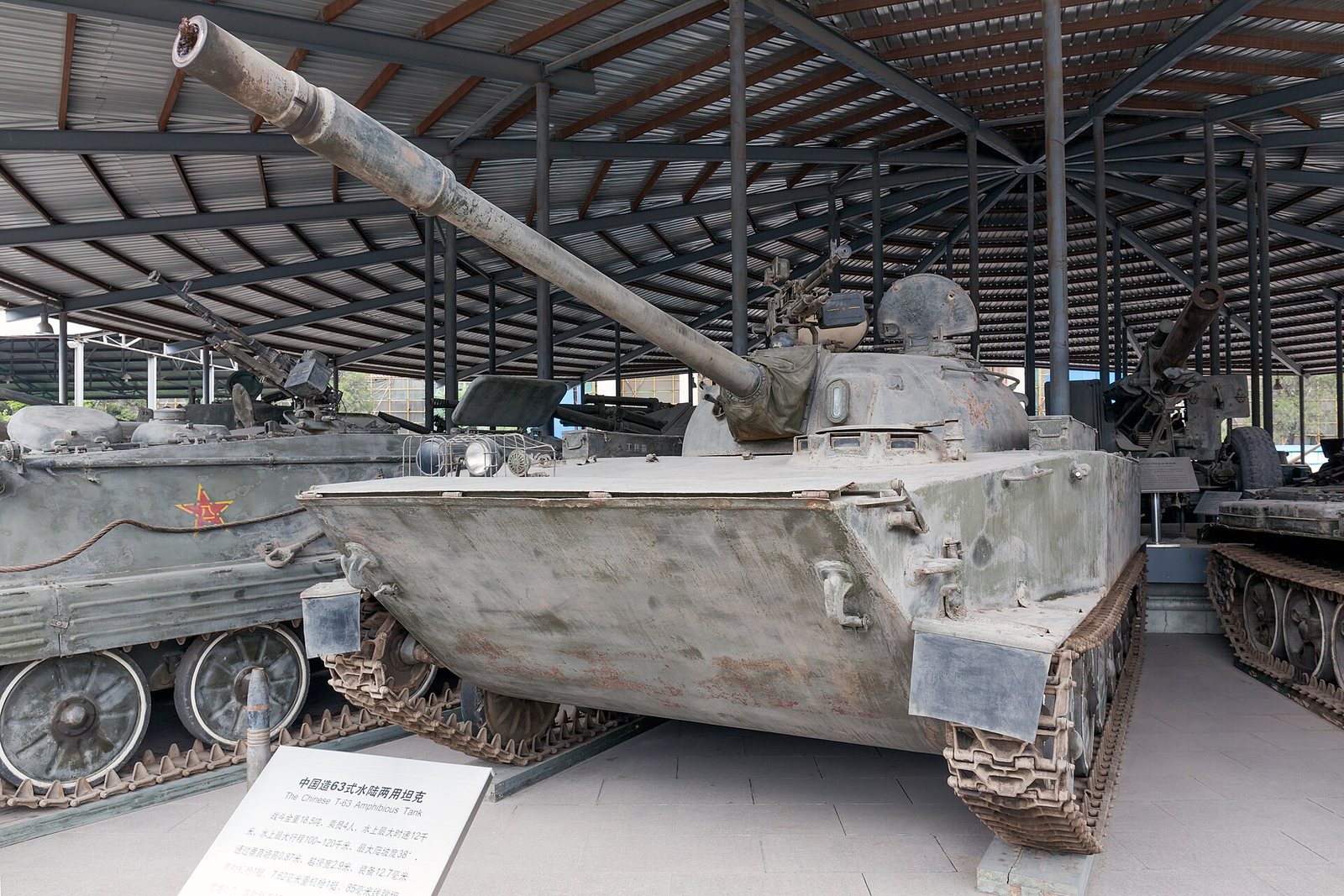
China's swimming armor began with Soviet designs. Wikipedia says China obtained several PT-76 amphibious light tanks from the Soviet Union in the mid-1950s, but the People's Liberation Army (PLA) was unhappy with them, and in October 1958 it chose to develop a home-built tank from the PT-76 design [2]. The PT-76, in Soviet service from 1952 according to Army Technology, swam on two water jets at about 6 mph (10 km/h) [3]. GlobalSecurity describes the resulting Type 63 as a Chinese copy of the PT-76 hull carrying the turret of China's Type 62 light tank, while Wikipedia says the turret was adapted from the earlier Type 60 prototype [1][2].
Both countries then built carriers on these tanks. The Soviet BTR-50 grew out of the PT-76, and China's Type 77 was built on the Type 63, which leaves the two carriers much alike; GlobalSecurity goes further and says the Type 77 is based on the BTR-50 [3][4][5]. GlobalSecurity says the Type 63 was shaped by the rice fields, rivers and lakes of southern China and by plans for landings on Kinmen and Taiwan [1].
Type 63 and Type 77
Two Type 63 prototypes were built in 1959 [1]. After trials that GlobalSecurity says included almost 200 crossings of the Yangtze River, the design was finalized in 1963, and the tank went into mass production and reached units facing Taiwan in early 1964 [1]. Wikipedia gives it a crew of four and an 85 mm gun (one GlobalSecurity passage says 76 mm) and says more than 1,550 were built [1][2]. Wikipedia notes one difference afloat: besides its two water jets, the Type 63 keeps its tracks turning to help it along, which the PT-76 does not do [2].
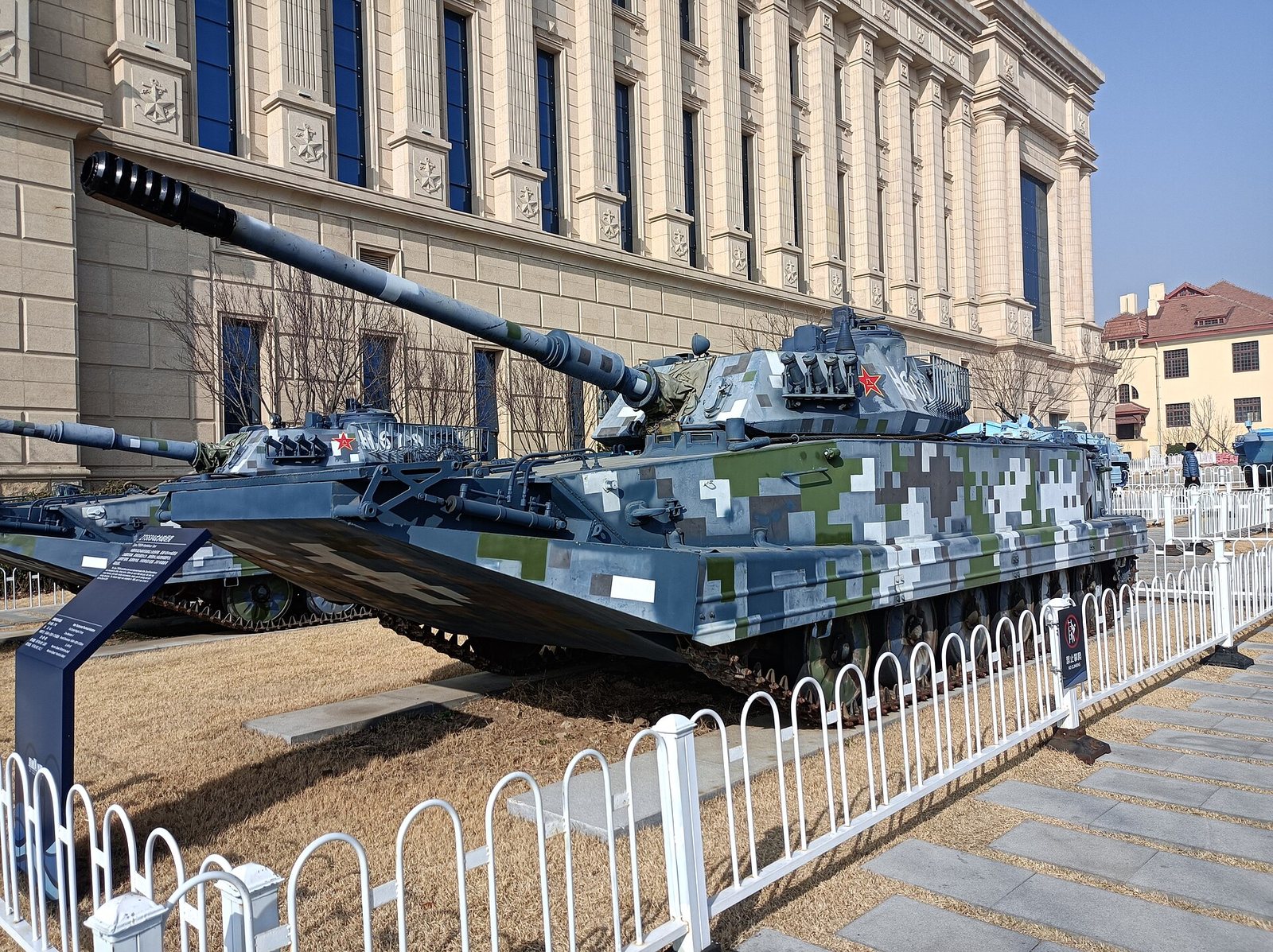
The Type 63A (ZTS-63A), in service from 1997, added a 105 mm gun, a reshaped hull with added buoyancy tanks and, according to Wikipedia, a redesigned water jet system, and was meant to be launched from landing ships up to 7 km (4.3 mi) offshore [1][2]. Its water speed is disputed: about 14 to 15 km/h (9 mph) according to GlobalSecurity and Recorded Future, a US threat intelligence company, but 28 km/h (17 mph) according to Wikipedia [1][2][11]. GlobalSecurity calls naval marine units the main users of the Type 63 [1].
Exports spread the Type 63 widely. GlobalSecurity names North Korea, Pakistan, Sudan and Vietnam among its users, and Wikipedia adds Myanmar, Cambodia and Tanzania, which received about 24 Type 63As in 2012 and 2013 [1][2]. Wikipedia records Type 63s with North Vietnamese forces in the Vietnam War and with Pakistan in the Indo-Pakistani War of 1971 [2].
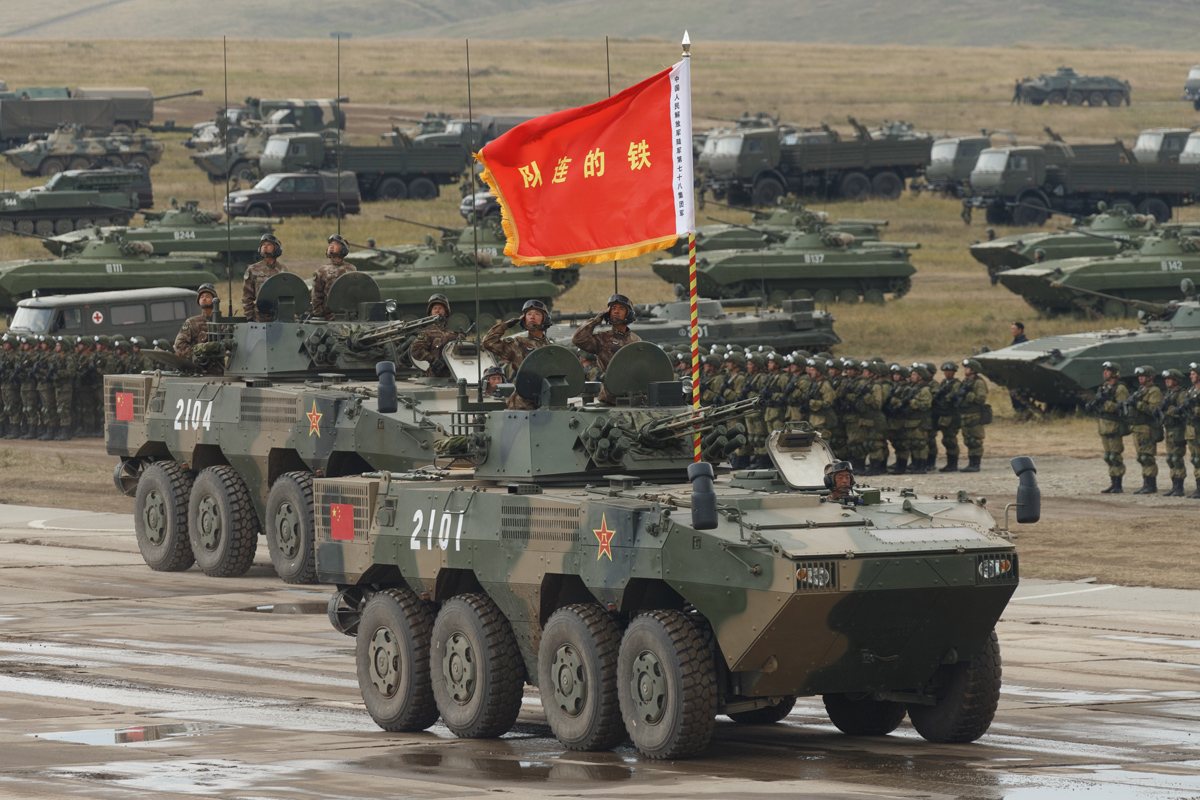
The Type 77 personnel carrier was designed and fielded in 1978, according to Wikipedia [5]. A pair of rear water jets pushes it when afloat, and some versions could carry a towed gun on the roof [4][5]. Both Wikipedia and GlobalSecurity give a weight of 15.5 t (34,200 lb); Wikipedia gives room for 2 crew and 20 troops where GlobalSecurity says 16 troops, and Wikipedia says 200 to 300 Type 77s formerly served the PLA Marine Corps [5][13].
The ZBD-04 family
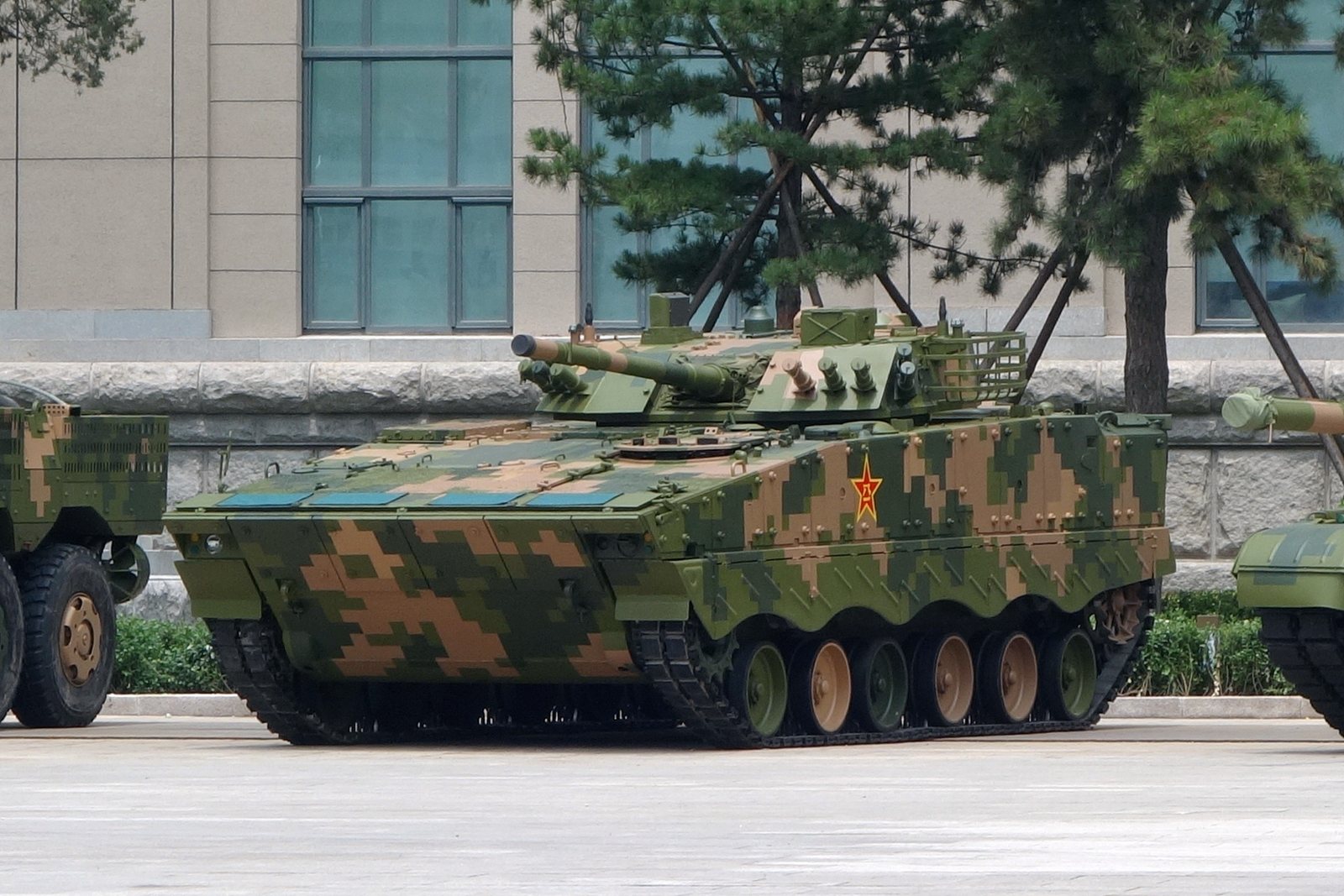
The ZBD-04, also called ZBD-97 after its 1997 prototype, is a tracked infantry fighting vehicle; Wikipedia says China licensed BMP-3 turret technology from Russia in 1996 and dates the vehicle's service to 1999 [7]. Its turret pairs a 100 mm gun-launcher with a 30 mm cannon. GlobalSecurity says the hull is aluminum, while Wikipedia lists welded steel armor, and GlobalSecurity quotes Chinese figures of about 12 mph (20 km/h) in water, driven by two large water jets at the rear [6][7].
The heavier ZBD-04A, 24 t (52,900 lb) against the ZBD-04's 20 t (44,100 lb), gave up much of its swimming ability to carry more armor, which Wikipedia says is claimed to stop 30 mm rounds from the front [7]. Wikipedia says it has no water jets and moves through water on its tracks at 6 to 8 km/h (4 to 5 mph), enough for rivers and lakes but not for the open sea [7]. Army Technology and Army Recognition, writing after its public debut at the October 1, 2019 parade, instead describe two rear water jets and a top water speed of 6 km/h (4 mph) [14][15]. Citing the IISS Military Balance 2025, Wikipedia lists more than 3,675 vehicles in the family, most of them ZBD-04As, although its infobox gives more than 3,475 [7].
Airborne and wheeled designs
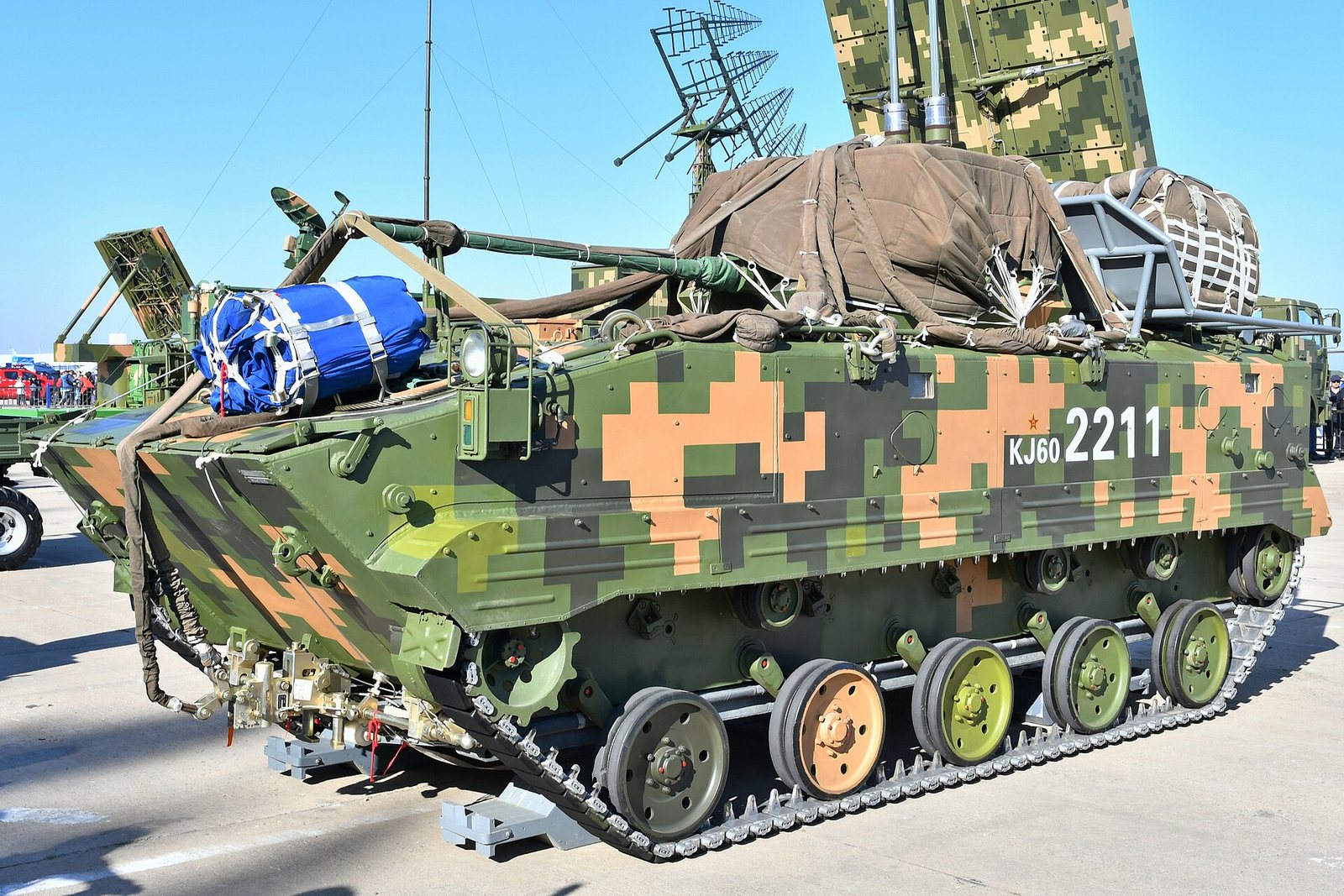
For its paratroops China built the ZBD-03, a light tracked fighting vehicle of the PLA Air Force Airborne Corps that can be dropped from Y-20 transport aircraft; Wikipedia dates its service to 2002, while GlobalSecurity gives 2005 [8][16]. At about 8 t (17,600 lb) it is fully amphibious but slow in water, reaching about 4 mph (6 km/h), and Wikipedia says it swims with its tracks [8][16].
The Type 08 is a family of 8x8 wheeled vehicles, seen on road tests in 2006 and in service from 2008, that includes the ZBL-08 infantry fighting vehicle (also called ZBL-09 or ZBD-09), the ZTL-11 assault gun and the PLL-09 howitzer [9][10]. Army Recognition says two rear propellers drive it at up to 5 mph (8 km/h), while Wikipedia describes water jets [9][10]. Recorded Future says the family lacks the Type 05's water speed and is very likely not suited to landings across open sea [11]. Wikipedia lists export users of the family as Venezuela's marines, Gabon, Nigeria (the ST1 assault gun version) and Thailand, whose army had 111 VN-1 infantry fighting vehicles by 2026 [10].
The Type 05
The Type 05 family, from a program called Project 212 in which Norinco and China State Shipbuilding Corporation took part, is now the PLA's main amphibious armored vehicle, according to Recorded Future [11]. Initial production vehicles were reportedly finished in January 2005, and the family includes the ZBD-05 infantry fighting vehicle and the ZTD-05 assault vehicle [11]. The PLA made water speed a core requirement, and the engineers reportedly answered with water jet propulsion, tracks that retract to cut drag, an aluminum alloy body and a bow flap, and possibly a stern flap, that adjusts under way to create lift [11]. Recorded Future says China could not match the engine power that the US Expeditionary Fighting Vehicle used to reach a semi-planing state, and that the adjustable flaps were its answer [11]. Reported water speeds run from 27 to 45 km/h (17 to 28 mph), and Recorded Future says the higher claims are of unclear accuracy [11]. None of the sources consulted for this encyclopedia gives a maker statement or a measured test showing that the Type 05 planes. Its own entry covers the family in detail.
Users and amphibious brigades
The PLA Ground Force has six amphibious combined arms brigades under the 72nd, 73rd and 74th group armies on the east coast, according to Recorded Future, which draws on the analysts Dennis Blasko and Joshua Arostegui [11]. Building on their per-company estimates, Recorded Future puts the six brigades at over 2,400 vehicles at full strength; these are outside estimates, not official figures [11].
The PLA Navy Marine Corps grew from two brigades to eight after reforms that began in 2017, according to Conor Kennedy of the US Naval War College [12]. IISS figures quoted by Wikipedia credit it with about 150 ZBL-08s and 50 ZTL-11s in 2024, and the PLA Air Force Airborne Corps operates the ZBD-03 [8][10].
Recorded Future judged in 2024 that swimming armored vehicles would almost surely be part of the first wave in any PLA invasion of Taiwan, and that most of them would belong to the Army's brigades rather than the marines [11]. It also noted limits: estimates it cites suggest the Navy's landing ships could carry about 670 ZTD-05s, far fewer than the brigades are thought to field, and weather and sea state in the Taiwan Strait could reduce what the vehicles achieve [11].
Speeds and types at a glance
The table sets the main Chinese types beside the Soviet PT-76. Most swim at about 4 to 12 mph (6 to 20 km/h), and no maker or test cited here shows any of them planing, so by this encyclopedia's test they are land-first amphibians [3][6][8][9]. The Type 05 is not classed, because its higher reported water speeds are of unclear accuracy and its planing is not confirmed [11].
| Vehicle | Country | First built | Kind | Road speed | Water speed | Swims by | Type |
|---|---|---|---|---|---|---|---|
| PT-76 | Soviet Union | in service 1952 [3] | Amphibious light tank; the design behind the Type 63 | about 27 mph (44 km/h) [3] | about 6 mph (10 km/h) [3] | two water jets [3] | Land-first |
| Type 63 | China | 1963 [1][2] | Tracked amphibious light tank | about 40 mph (64 km/h), estimate [1][2] | about 7.5 mph (12 km/h), estimate [1][2][11] | two water jets, helped by its tracks [2] | Land-first |
| Type 63A (ZTS-63A) | China | in service 1997 [2] | Upgraded Type 63 with a 105 mm gun and a reshaped hull | no figure found in the sources consulted | about 9 mph (14 to 15 km/h), estimates [1][11]; Wikipedia gives 17 mph (28 km/h) [2] | water jets, redesigned from the Type 63's [2] | Land-first |
| Type 77 | China | 1978 [5] | Tracked armored personnel carrier | about 37 mph (60 km/h), estimate [5][13] | about 7 to 7.5 mph (11 to 12 km/h), estimate [5][13] | two water jets [4] | Land-first |
| ZBD-04 and ZBD-04A | China | 1997, first prototype [7] | Tracked infantry fighting vehicle | about 40 mph (65 km/h), Chinese figure [6]; ZBD-04A about 47 mph (75 km/h) [7][14][15] | about 12 mph (20 km/h), Chinese figure [6]; ZBD-04A about 4 mph (6 km/h) [14][15], or 4 to 5 mph (6 to 8 km/h) per Wikipedia [7] | two water jets [6]; ZBD-04A two water jets per Army Technology and Army Recognition [14][15], its tracks per Wikipedia [7] | Land-first |
| ZBD-03 | China | 2000, production [8] | Air-droppable tracked fighting vehicle | about 42 to 45 mph (68 to 72 km/h), figures differ [8][16] | about 4 mph (6 km/h) [8][16] | its tracks [8] | Land-first |
| Type 05 (ZBD-05, ZTD-05) | China | 2005 [11] | Tracked amphibious fighting vehicle and assault gun family | about 40 mph (65 km/h), reported [11] | about 17 to 28 mph (27 to 45 km/h), reported and disputed [11] | water jets, with bow and stern flaps [11] | Not classed |
| Type 08 (ZBL-08) family | China | 2006 [10] | 8x8 wheeled armored vehicle family | about 62 mph (100 km/h), Chinese figure [9][10] | about 5 mph (8 km/h) [9] | two propellers [9]; Wikipedia says water jets [10] | Land-first |
Official Chinese specifications are scarce. These speeds come from GlobalSecurity, Army Technology, Army Recognition and Wikipedia, some of which credit Chinese sources, and from Recorded Future's 2024 report, which draws on Chinese state media and cites a US Defense Intelligence Agency estimate; treat them as estimates [1][3][6][9][11]. The Type column applies this encyclopedia's types test; the Type 05 is not classed because its planing is not confirmed by its maker or a test.
Today
Recorded Future reported in 2024 that the Type 63A may already have left service and that it is unclear whether the PLA plans to replace the Type 05 [11]. In November 2023, as summarized by Recorded Future, Janes reported a new 8x8 amphibious infantry fighting vehicle, possibly called the Type 19 [11]. An improved Type 08 chassis with a larger trim vane and pontoon boxes appeared at the 2025 Victory Day parade, and Wikipedia, citing IISS figures for 2024, lists more than 6,150 Type 08s in Chinese service [10].
Industry keeps working on water speed. In 2017 Chinese state media described a 5.5 t (12,100 lb) wheeled prototype said to reach 50 km/h (31 mph) on water, and in more than 100 Chinese patent filings from 2014 to 2023, Recorded Future found raising water speed among the main areas of interest [11].
Photos
Related entries
Sources
- Type 63 Light Amphibious Tank [LAT], GlobalSecurity.org (2023-09-04). www.globalsecurity.org/military/world/china/type-63-t.htm
- Type 63 (tank), Wikipedia. en.wikipedia.org/wiki/Type_63_(tank)
- PT-76 Light Amphibious Tank, Army Technology (2011-02-08). www.army-technology.com/projects/pt-76lat
- Type 77 / WZ 511 Armored Personnel Carrier, GlobalSecurity.org (2012-12-25). www.globalsecurity.org/military/world/china/type-77-apc.htm
- Type 77 (armored personnel carrier), Wikipedia. en.wikipedia.org/wiki/Type_77_(armored_personnel_carrier)
- Type 04 Tracked Amphibious Infantry Fighting Vehicle, GlobalSecurity.org (2011-07-11). www.globalsecurity.org/military/world/china/type-04-zbd-04.htm
- ZBD-04, Wikipedia. en.wikipedia.org/wiki/ZBD-04
- ZBD-03, Wikipedia. en.wikipedia.org/wiki/ZBD-03
- ZBD-09 or ZBL-09 or Type 07P IFV, Army Recognition (2026-05-02). armyrecognition.com/military-products/army/infantry-fighting-vehicles/wheeled-vehicles/zbd-09-china-uk
- Type 08, Wikipedia. en.wikipedia.org/wiki/Type_08
- Speeding Toward Taiwan: China's Amphibious Armored Vehicles Development (Zoe Haver, Insikt Group), Recorded Future (2024-08-15). assets.recordedfuture.com/insikt-report-pdfs/2024/ta-2024-0815.pdf
- China Maritime Report No. 15: The New Chinese Marine Corps: A 'Strategic Dagger' in a Cross-Strait Invasion (Conor Kennedy), US Naval War College, China Maritime Studies Institute (2021-10). digital-commons.usnwc.edu/cmsi-maritime-reports/15
- WZ 511 / Type 77 Specifications, GlobalSecurity.org (2011-07-11). www.globalsecurity.org/military/world/china/type-77-apc-specs.htm
- ZBD-04A Tracked Infantry Fighting Vehicle (Praveen), Army Technology (2019-10-14). www.army-technology.com/projects/zbd-04a-tracked-infantry-fighting-vehicle
- New Chinese ZBD-04A armored tracked IFV Infantry Fighting Vehicle, Army Recognition (2019-10-03). www.armyrecognition.com/archives/archives-land-defense/land-defense-2019/new-chinese-zbd-04a-armored-tracked-ifv-infantry-fighting-vehicle
- Type 03 ZLC-2000 (ZBD-03) Airborne Combat Vehicle: Specifications, GlobalSecurity.org (2021-08-01). www.globalsecurity.org/military/world/china/type-03-zbd-03-specs.htm
Last reviewed November 2026. Spotted something to correct or add? Tell us and include a source.
About the Amphibious Encyclopedia
WaterCar has designed and built amphibious vehicles in Southern California for more than 25 years. We keep this encyclopedia so anyone curious about vehicles that cross between land and water has one place to start, with the sources listed for every fact.
Browse all entries → · The WaterCar machines → · How a WaterCar works →