
Origins
The company behind the Bv206 is much older than the vehicle. Hägglund & Söner, based in Örnsköldsvik in Västernorrland, Sweden, was founded around 1898 to 1900 (sources differ) by the furniture maker Johan Hägglund, and over the following decades built buses, railway cars, cranes and military vehicles [10][11]. The Hägglund family sold the company to the Swedish engineering group ASEA in 1972 [10].
In the early 1970s the Swedish Army began looking for a successor to the Bv 202, an articulated over-snow carrier built by Volvo BM from 1964 to 1981 [2]. It wanted a vehicle that could carry more, drive better on roads, break down less often and cost less to maintain [2]. Hägglunds won the development contract in 1974, and three batches of trial vehicles were delivered between 1976 and 1978 [1][2]. The army ordered 3,500 in June 1979 and later about 1,000 more, and the first production vehicles went to the Swedish Defence Administration in 1980 [1][2]. Sweden's armed forces received at most about 4,500 [2]. The military vehicle business passed to Alvis plc in 1997 and became BAE Systems Hägglunds when BAE Systems bought Alvis in 2004 [1][10].
Design and how it swims
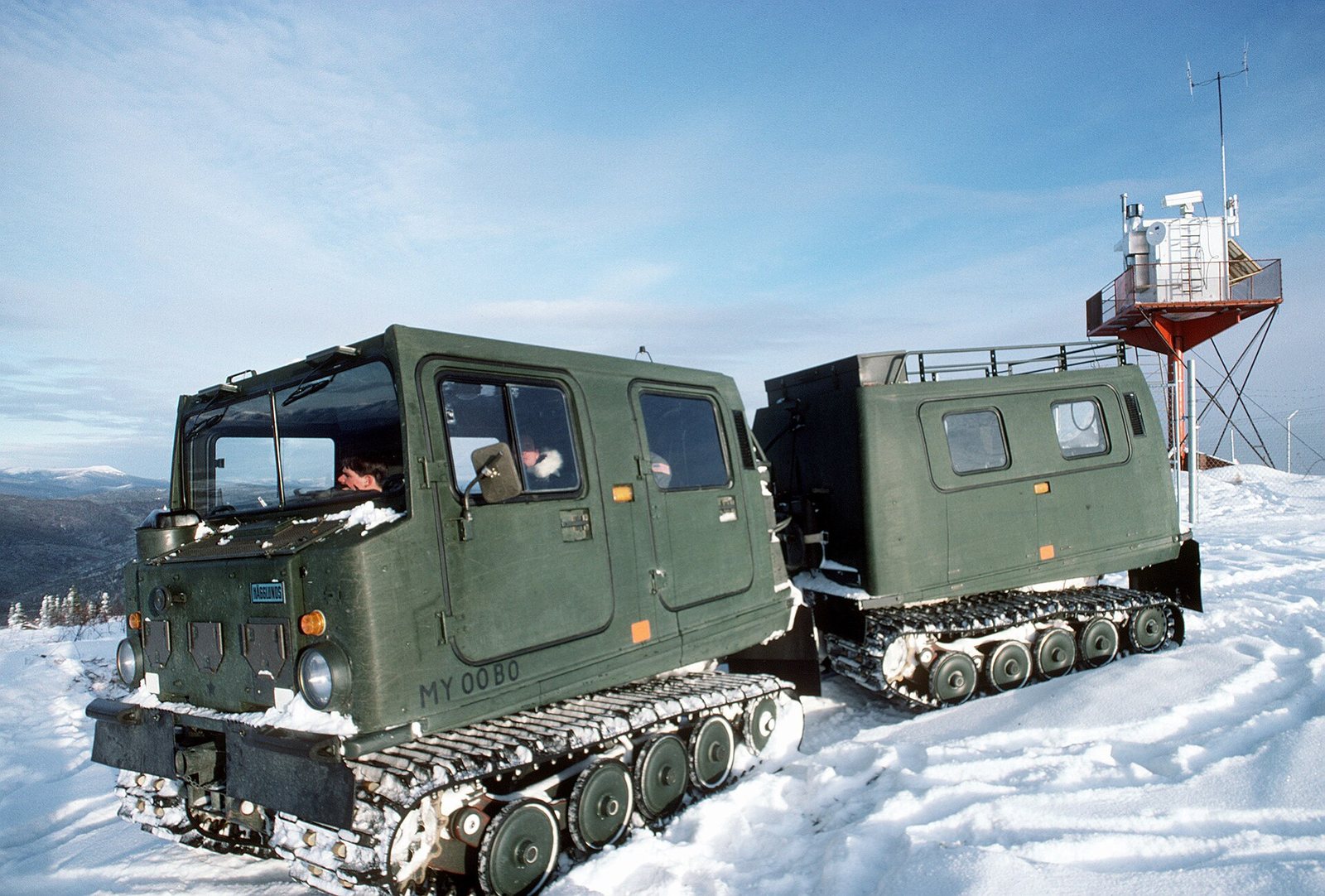
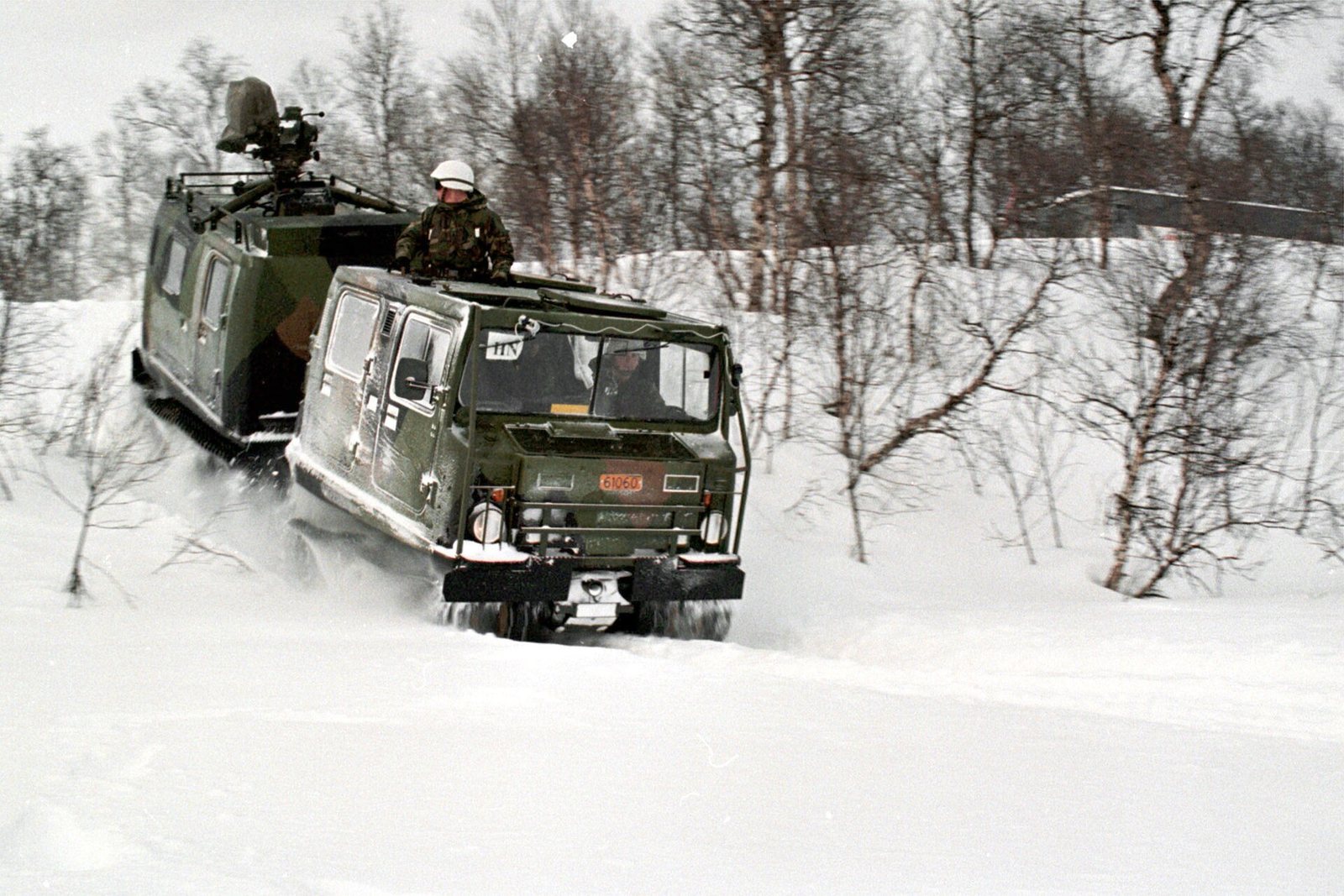
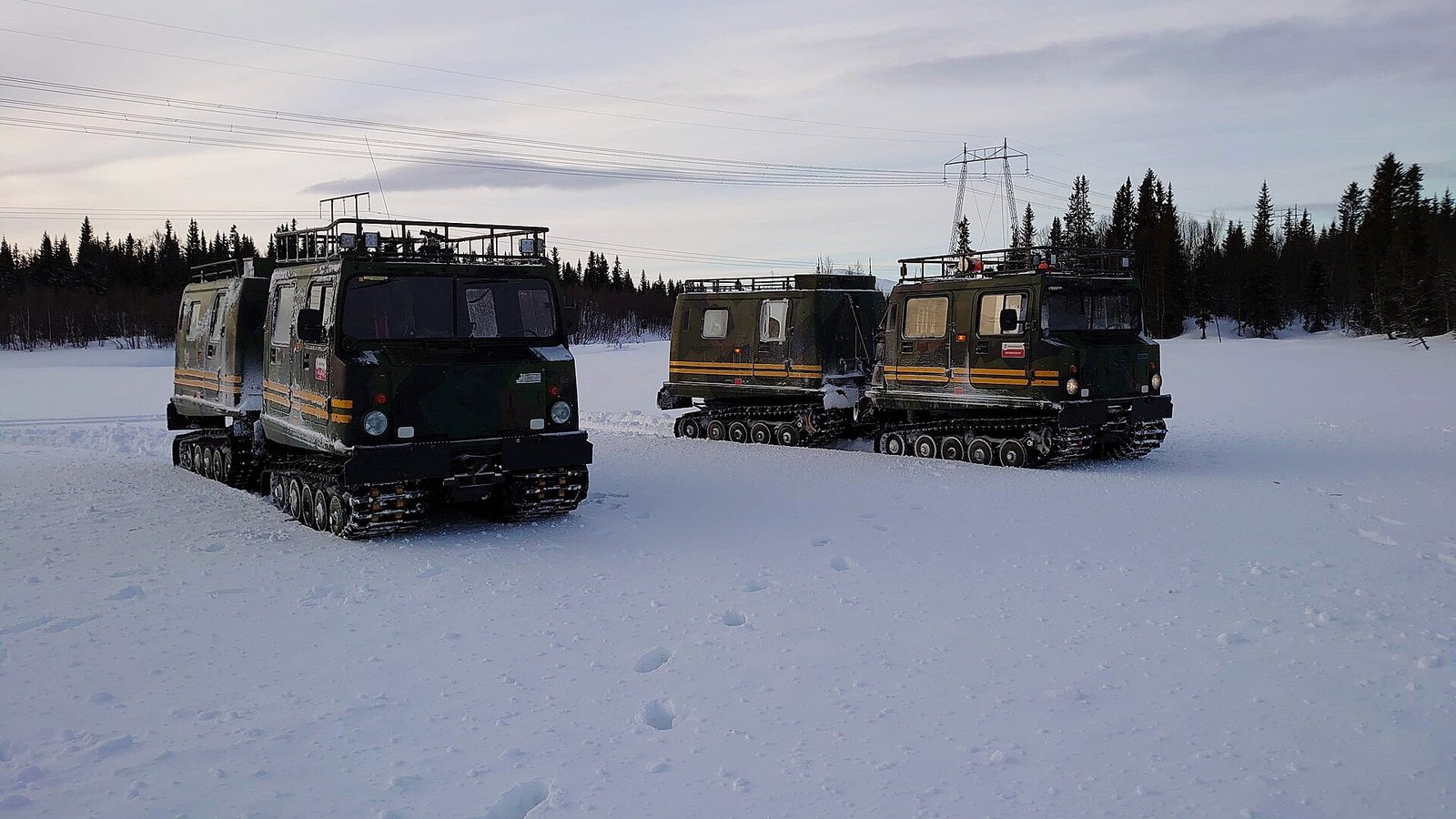
The Bv206 has two cabs, each on its own tracked chassis, joined by a central articulated steering unit; to turn, hydraulic rams swing the front and rear halves at an angle to each other [4]. All four rubber tracks are driven, and their large footprint lets the vehicle cross deep snow, bog and other soft ground [1][4][9]. The original version weighed about 4,500 kg (9,900 lb) and could carry up to 17 people, six in the front cab and eleven in the rear [1][2]. Early vehicles used a 2.8-liter Ford V6 gasoline engine of about 132 to 135 hp; later versions such as the Bv 206D, called Bv 208 in Sweden, have Mercedes-Benz turbodiesels [1][2][9]. Road speed is about 50 to 55 km/h (31 to 34 mph) according to the Canadian Army and Swedish figures, though Wikipedia lists 65 km/h (40 mph) [1][2][4].
The Bv206 is fully amphibious [3][9]. Its sealed body floats, and in water its four tracks drive it along [4][9]. The armored Bv206S swims the same way, using a trim vane that can be fitted quickly [3]. It is slow in water: figures range from 4 km/h (2.5 mph) on Hans Högman's Swedish military history site to 4.7 km/h (2.9 mph) given by Silodrome and by Army Technology (for the Bv206S), and Wikipedia's data table lists 5 km/h (3.1 mph) [1][2][3][9]. US Army versions carry a bilge pump [5]. In July 2013 soldiers at Fort Wainwright, Alaska, swam one more than 700 ft (213 m) across a lake, which the Army described as the first such amphibious test in ten years [5].
Military service and versions
The Bv206 was exported widely. Army Technology put production at about 11,000 vehicles in service in over 40 countries, while Wikipedia gives more than 37 countries [1][3]. Versions include ambulances, fire appliances, command and radio relay vehicles, mortar carriers and anti-tank vehicles armed with a 90 mm recoilless gun or TOW and BILL missiles [1]. The Netherlands still had 88 Bv206s in 2020 [8].
The US Army took the Bv206 into its inventory in 1982 as the M973 Small Unit Support Vehicle, or SUSV; it also uses ambulance, command and flatbed cargo versions [1][5]. Army Times reported in 2018 that the US military had once had 1,100 of them, but that only a few dozen remained, mostly in cold-weather units such as US Army Alaska [6]. In 2022 the Army picked BAE Systems' Beowulf, an unarmored BvS10, to replace its aging SUSVs as the Cold Weather All-Terrain Vehicle [7].
In 1990 Hägglunds and the Swedish defense materiel agency presented an armored version, the Bv206S, known in Sweden as the Bv 308 and Bv 309 [2]. It has an all-welded steel body whose windows give the same protection as the armor against 7.62 mm rifle bullets and artillery fragments, and it carries 12 people: the driver and three soldiers in front and eight in the rear [3]. France, Germany, Italy, Spain and Sweden have used it [3].
Descendants and civilian use
Hägglunds developed the larger, armored BvS10 from the Bv206 and Bv206S [8]. The BvS10 has more than twice the Bv206's engine power and is about 4 t heavier, and it first served with the British Royal Marines as the Viking [8]. Its unarmored Beowulf version was chosen in 2022 to replace the SUSV in the US Army [7].
Many Bv206s have moved into civilian hands. Rescue services, polar research stations, power companies and oil-field contractors use them, and in Alberta, Canada, surplus vehicles are rented to reach remote oil wells and to carry wildfire and tree-planting crews [1][2][9]. Ex-military vehicles are also sold and restored for private owners [9].
Photos
Related entries
Sources
- Bandvagn 206, Wikipedia. en.wikipedia.org/wiki/Bandvagn_206
- Tracked Vehicles, Sweden - 1 (Hans Högman), Hans Högman, Swedish military history (2025-09-08). hhogman.se/tracked-vehicles-1-swe.htm
- Bv206S Tracked Armoured Personnel Carrier, Army Technology (2004-02-12). www.army-technology.com/projects/bv2065
- BV 206 Tracked Carrier, Canadian Army (Government of Canada) (2022-08-03). www.canada.ca/en/army/services/equipment/vehicles/bv-206-tracked-carrier.html
- Army support vehicle swims (Maj. David Mattox), DVIDS (US Department of Defense) (2013-08-07). www.dvidshub.net/news/111537/army-support-vehicle-swims
- The Army is looking for a new all-around vehicle that can swim, climb and charge through snow (Todd South), Army Times (2018-08-30). www.armytimes.com/news/your-army/2018/08/30/the-army-is-looking-for-a-new-all-around-vehicle-that-can-swim-climb-and-charge-through-snow
- Behold Beowulf, The U.S. Army's New Tracked Arctic Troop Carrier (Dan Parsons), The War Zone (2022-08-23). www.twz.com/behold-beowulf-the-u-s-armys-new-tracked-arctic-troop-carrier
- Viking (BvS10) Amphibious Armoured All-Terrain Vehicle, Army Technology (2021-02-18). www.army-technology.com/projects/viking
- Hagglunds Bandvagn Bv206: An Amphibious All-Terrain Legend (Ben Branch), Silodrome (2023-01-11). silodrome.com/hagglunds-bandvagn-bv206-an-amphibious-all-terrain-legend
- Hägglund & Söner, Wikipedia. en.wikipedia.org/wiki/H%C3%A4gglund_%26_S%C3%B6ner
- Hagglund and Soner, Grace's Guide to British Industrial History. www.gracesguide.co.uk/Hagglund_and_Soner
Last reviewed November 2026. Spotted something to correct or add? Tell us and include a source.
About the Amphibious Encyclopedia
WaterCar has designed and built amphibious vehicles in Southern California for more than 25 years. We keep this encyclopedia so anyone curious about vehicles that cross between land and water has one place to start, with the sources listed for every fact.
Browse all entries → · The WaterCar machines → · How a WaterCar works →