
Origins and development
The Gama Goat began with Roger Gamaunt, an inventor in Fawnskin, California, who drew a six-wheeled, two-body articulated vehicle in March 1947 [3]. Chance Vought signed him on October 2, 1959, to build a full-scale prototype and took a manufacturing license [3][4]. The name combined the start of his surname with a goat's agility [4]. A prototype powered by a Chevrolet Corvair engine rolled out on September 30, 1960, and was tested for mobility, air transport and swimming, then demonstrated across the United States, in Germany and France, and in 1962 in Thailand for the Advanced Research Projects Agency [3].
The Army issued its purchase description for the XM561 1¼-ton truck in January 1962 and, of six companies that competed, chose Chance Vought, by then part of Ling-Temco-Vought (LTV), later that year [3][7]. A March 1963 contract covered two test rigs and 14 prototypes [3][4]. Testers rated an early test rig's swimming marginal, as it was slow and sat low in the water, so bilge pumps and flotation chambers were added; in 1965 a rig tested in Thailand even carried an outboard motor [3]. The design was approved for service as Standard A in June 1966 [3]. Wikipedia, citing 1970 figures from the Comptroller General's office, says the development contract ended at about $8.7 million, more than three times its starting value, and that the truck weighed almost three times the requested 2,500 lb (1,130 kg) [7].
Production went to CONDEC, the lowest of six bidders [3]. The contract, signed in June 1968, planned 15,274 trucks for the Army and Marine Corps, and Detroit Diesel was hired to supply 15,624 aluminum-block 3-53 engines [3][7]. CONDEC built the trucks in Schenectady, New York, and in Charlotte, North Carolina [5][7]; the Charlotte plant stood on a former Ford factory site [10]. The Army completed production in July 1973 [1].
How it swims
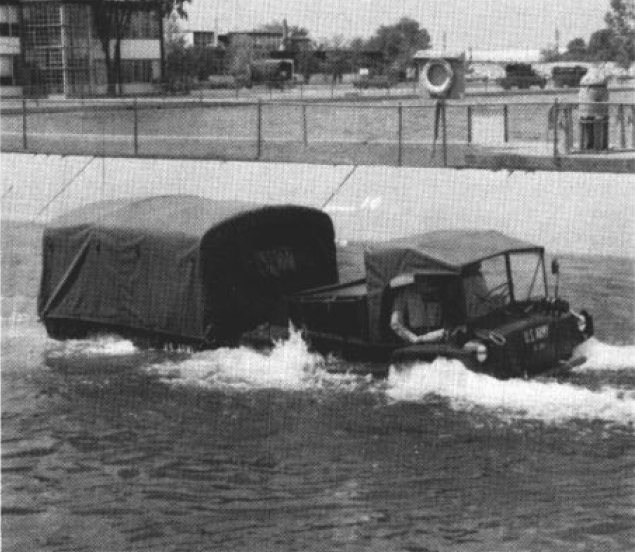
Swimming was required so that units could cross rivers and lakes at many points at once instead of queuing at bridges and ferries [1]. The hull made wide use of aluminum and fiberglass; the Army Materiel Command told GAO that such light materials were needed to meet weight limits set by the swimming and airlift requirements [1]. There was no propeller: the six spinning wheels pushed the truck through the water, and bilge pumps were standard [7]. Military Trader puts its top speed in water at about 3 mph (5 km/h) [5].
In practice the Army set strict rules. Drivers had to halt at the water's edge and check the hull for leaks, and GAO noted that many trucks had damaged tailgates that would let them sink [1]. Entry was allowed only at gentle banks with firm soil, at no more than 2 mph (3 km/h), and not at all where the current exceeded 4 mph (6 km/h) or the wind exceeded 20 mph (32 km/h) [1]. The Army Materiel Command agreed that swimming with some loads was a critical safety hazard: the truck sat bow-down in the water, and with no load its front end rode barely above the waterline [1]. Only 40 of 439 drivers interviewed by the Army had swum one, and GAO concluded that the Army's limits kept the swimming ability from being fully used [1]. Heavy add-ons such as winches, shelters or radar could leave a Goat too heavy or top-heavy to swim at all [7].
Problems, investigations and cost
Military Trader reports that the first 11 trucks from CONDEC went back for defects [5]. In August 1972 Army Times, as quoted by Vought's history and Military Trader, reported a House Armed Services subcommittee's findings: the truck cost about $10,000 more than planned, and the first 4,400 sat in depots awaiting fixes, including new gears to replace faulty ones from a foreign (Vought says British) subcontractor [3][5]. The subcommittee had held hearings on May 24, 1972, and its July 1972 report criticized the Army for issuing the truck worldwide despite many defects found in production models [1][9]. GAO had told Congress in January 1971 that the Army should not start full-scale production before the vehicle met its essential requirements [1].
Reported unit prices vary. CONDEC's winning bid averaged $8,485 for the Army's trucks [3]. Wikipedia gives $13,281, citing a 1970 statement to Congress, and elsewhere about $8,000 each in 1965 dollars [7]. Military Trader says a truck planned at $5,000 ended up costing about $15,000 [5]. For the whole fleet, GAO put the cost of over 14,000 trucks at more than $200 million, and the Defense Department's reply printed in the same report gave the acquisition cost as $231.5 million [1].
In December 1975 GAO reported on interviews with more than 200 soldiers and Marines who drove and maintained the trucks [1]. They complained of engine noise (reportedly measured at about 95 decibels) that made radio use on the move impossible, gearboxes that slipped out of gear, broken propeller shafts and universal joints, and poor access for routine maintenance [1]. In an Army survey of 520 people, 418 found the truck hard to get into and 431 hard to get out of, which raised fears of being trapped in an ambush or rollover [1]. The Army planned a $5.6 million improvement program; GAO asked for an independent test under simulated combat conditions first, and the Defense Department disagreed [1]. In November 1976 GAO told the Senate Armed Services Committee that the Army still planned no such test, had dropped some fixes and kept others, including flotation improvements, at an estimated $7.5 million [2].
Service and replacement
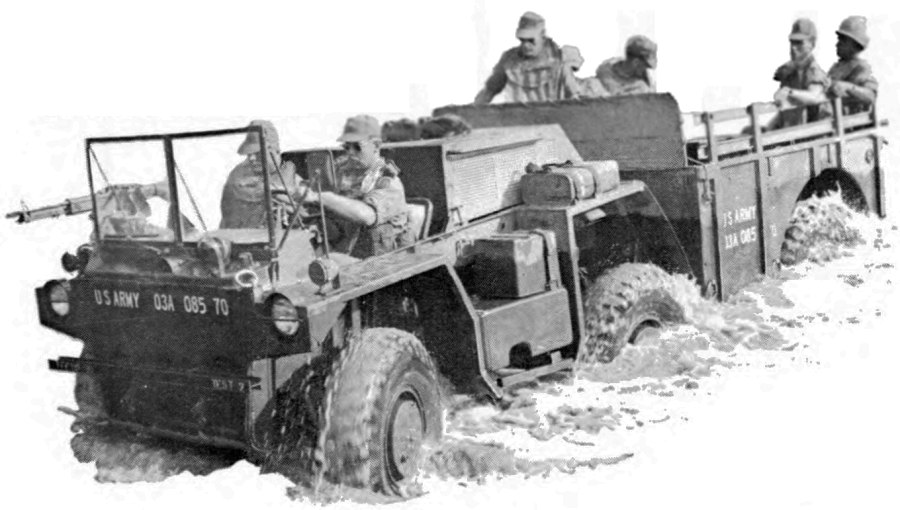
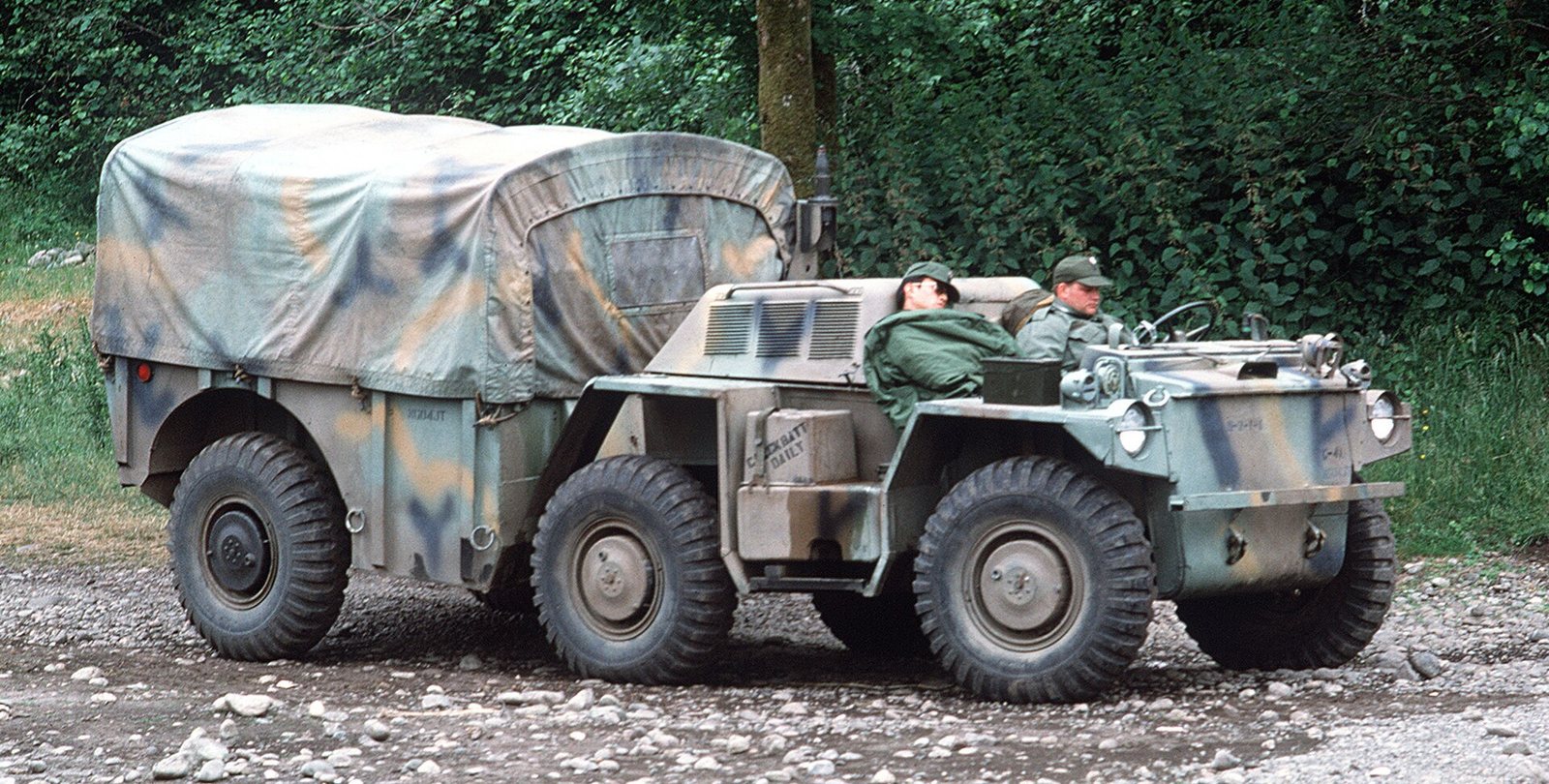
Besides carrying cargo or eight soldiers, the M561 served as a carrier for communications shelters, mortars, TOW anti-tank teams and the AN/MPQ-49 forward area radar, and the M792 was an ambulance version [6][7]. From the late 1970s the Army developed the Humvee to replace its Gama Goats and M151 jeeps [8]. Vought's history dates the Gama Goat's phase-out to the late 1980s, and the Army's Fort McCoy equipment guide lists it among the vehicles the Humvee replaced [4][6]. Wikipedia lists Mexico as an operator [7].
Photos
Related entries
Sources
- Should the Gama Goat Be Improved or Replaced? (PSAD-76-48), US General Accounting Office (1975-12-09). www.gao.gov/assets/120/114979.pdf
- Army's M561 Cargo Truck (Gamma Goat) (PSAD-77-8), US General Accounting Office (1976-11-16). www.gao.gov/assets/psad-77-8.pdf
- Gama Goat History: Chronological History of the Gama Goat Program, Vought Heritage Foundation (vought.org). vought.org/special/html/sgamaa.html
- Model Number: XM561 and M561 Gama Goat, Vought Heritage Foundation (vought.org). vought.org/products/html/gamagoat.html
- The M561 Gama Goat: A post-apocalyptic flop (Steve Turchet), Military Trader (2025-10-14). www.militarytrader.com/the-m561-gama-goat-a-post-apocalyptic-flop
- Fort McCoy Equipment Park Guide, US Army, Fort McCoy (home.army.mil) (2020-02-05). home.army.mil/mccoy/download_file/view/1011/466
- Gama Goat, Wikipedia. en.wikipedia.org/wiki/Gama_Goat
- End of an icon: the rise and fall of the Humvee (Grant Turnbull), Army Technology (2014-09-29). www.army-technology.com/features/featureend-of-an-icon-the-rise-and-fall-of-the-humvee-4381884
- Army procurement of the M561, Gama Goat (House hearing, 92nd Congress), US Government Publishing Office (govinfo) (1972-05-24). www.govinfo.gov/app/details/CHRG-92hhrg79547
- Look At This Fascinating 6x6 Military Vehicle I Saw At The Ford Event That Had Nothing To Do With Ford (Jason Torchinsky), The Autopian (2025-01-31). theautopian.com/look-at-this-fascinating-6x6-military-vehicle-i-saw-at-the-ford-event-that-had-nothing-to-do-with-ford
Last reviewed November 2026. Spotted something to correct or add? Tell us and include a source.
About the Amphibious Encyclopedia
WaterCar has designed and built amphibious vehicles in Southern California for more than 25 years. We keep this encyclopedia so anyone curious about vehicles that cross between land and water has one place to start, with the sources listed for every fact.
Browse all entries → · The WaterCar machines → · How a WaterCar works →