
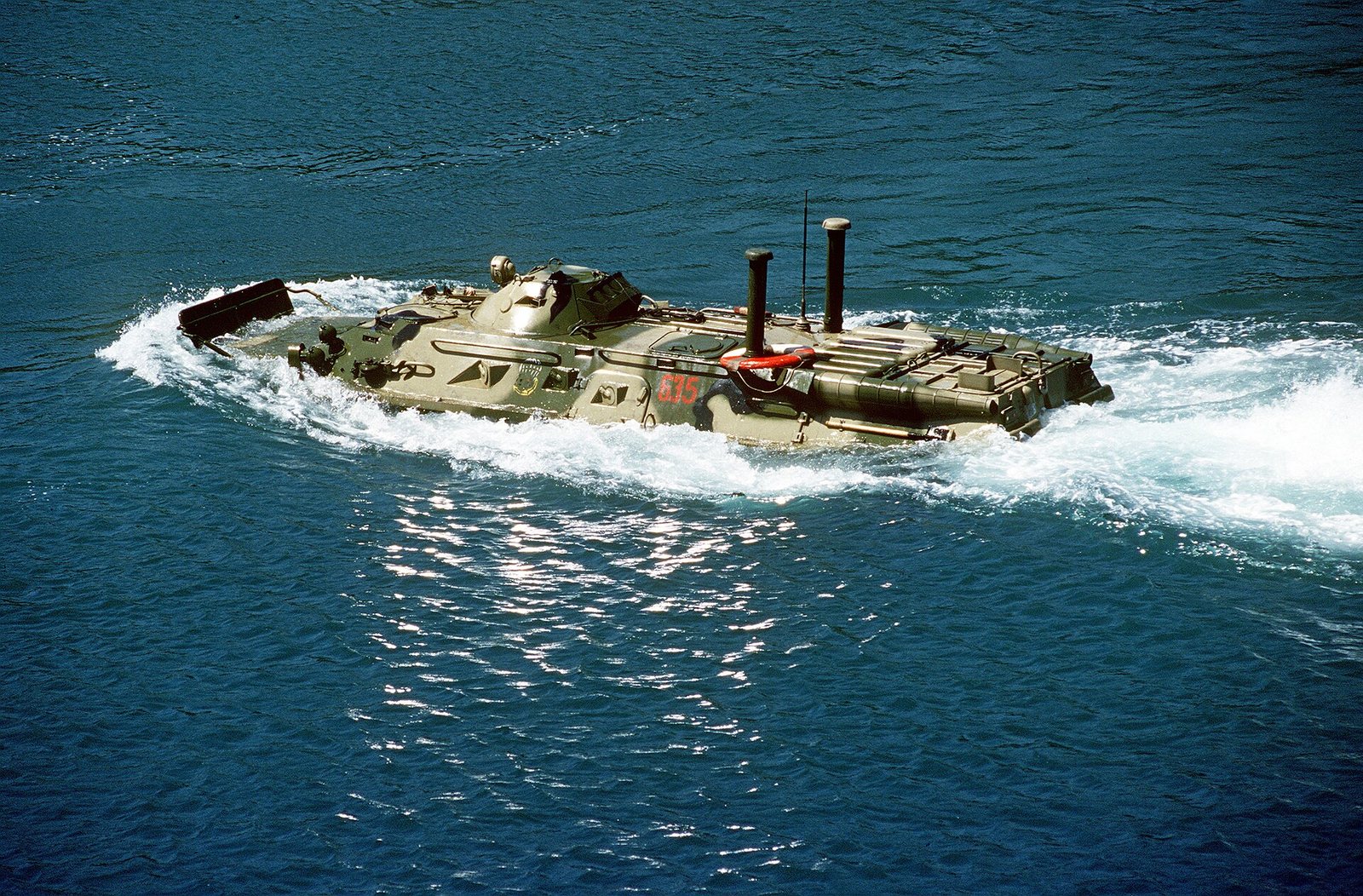
Why the Soviet Army wanted swimming vehicles
Soviet doctrine relied on fast armored columns, and in Europe that meant crossing water again and again. A 1965 Soviet study cited by the US Army found that an army advancing there would meet water obstacles up to 100 m (330 ft) wide every 35 to 60 km (22 to 37 miles), obstacles 100 to 300 m (330 to 980 ft) wide every 100 to 150 km (62 to 93 miles), and wider rivers every 250 to 300 km (155 to 186 miles) [1]. The preferred method was an assault crossing straight from the march, on a wide front and at full speed, keeping the slower prepared crossing for when the enemy left no choice [1].
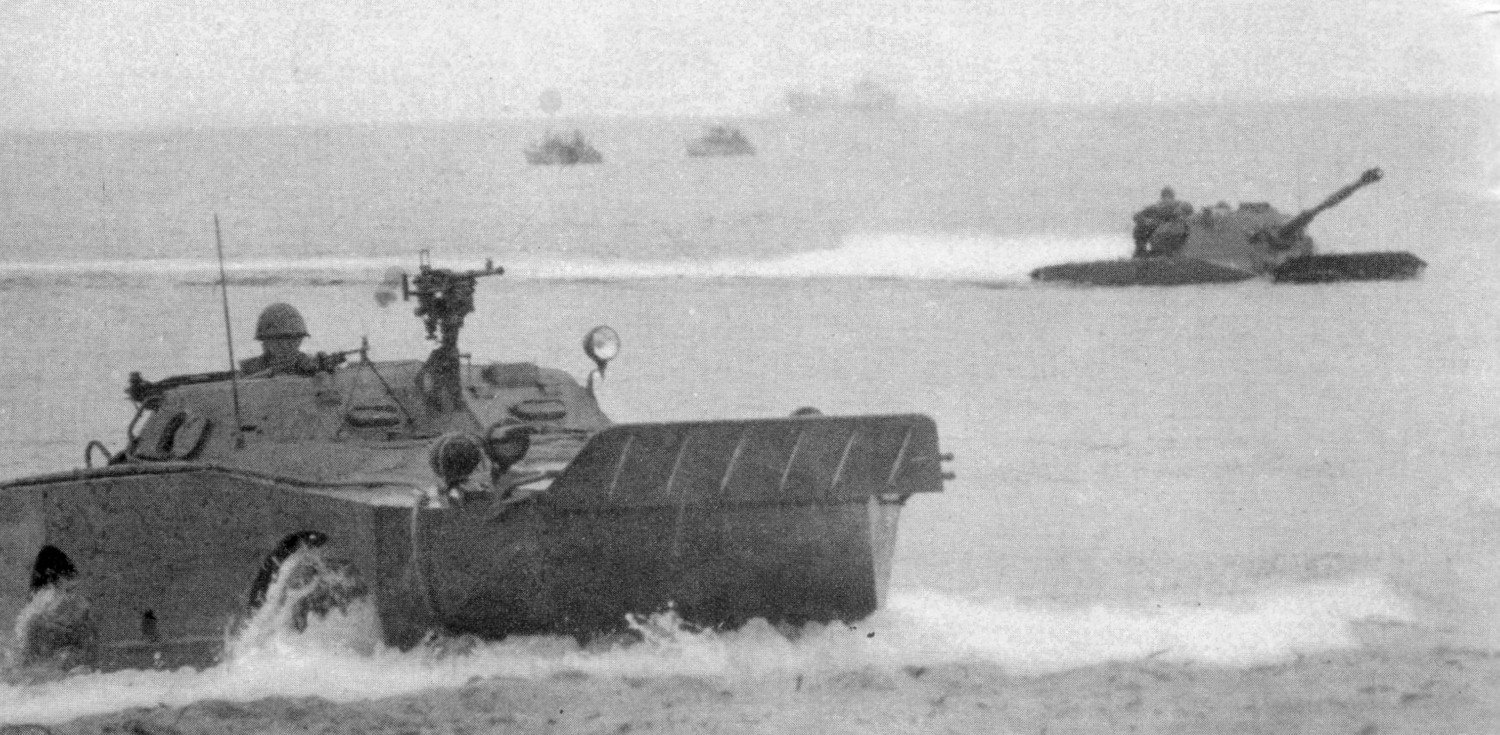
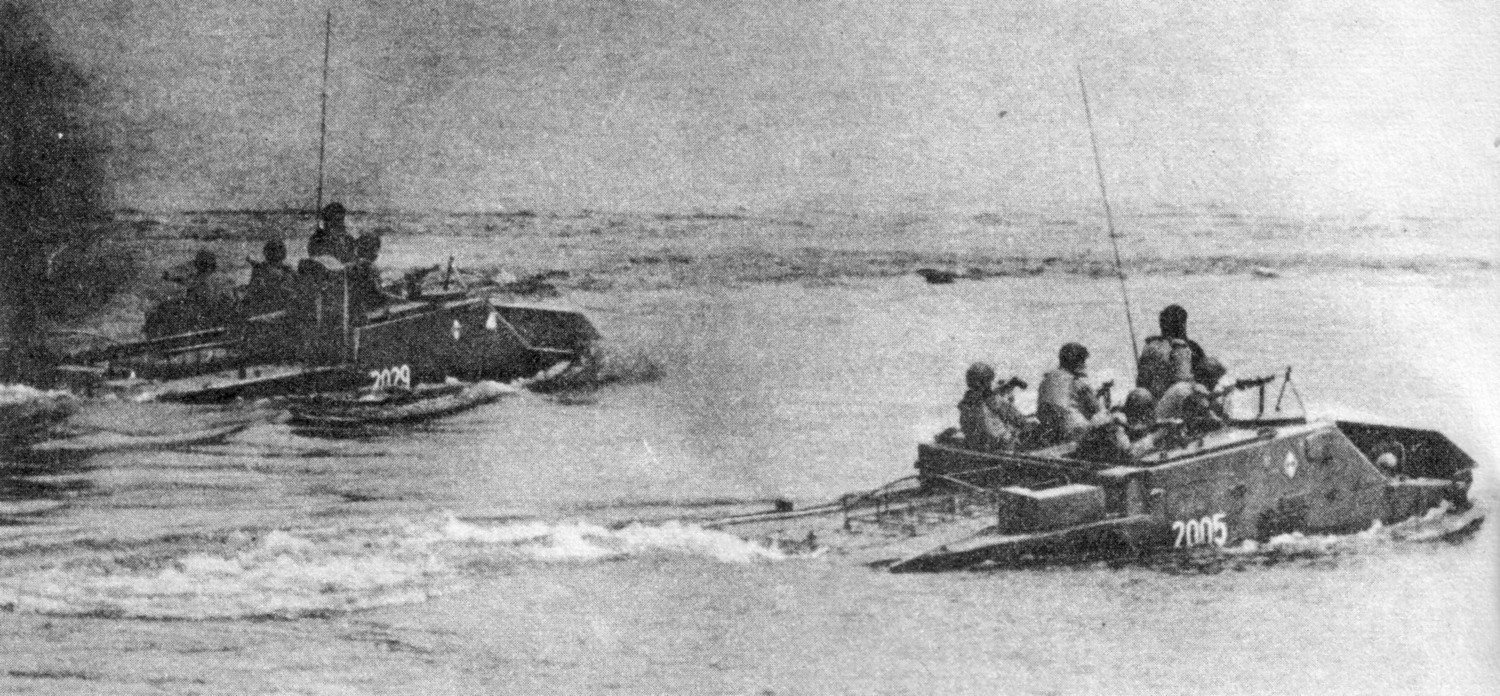
The answer was to make the infantry's vehicles swim. In 1984 the US Army reported that all Soviet armored personnel carriers, infantry and airborne fighting vehicles and scout vehicles produced since the 1960s were amphibious [1]. In an assault crossing the carriers, BMPs by preference, swam across first behind a smoke screen to take a bridgehead, and tanks then followed by ferry, by fording or by snorkeling along the riverbed [1]. Artillery crossed on tracked amphibious transporters, which replaced the BAV-485, a copy of the American DUKW built from 1952 to 1962 that has its own entry [1][12]. A 2024 US Army manual repeats the river spacing figures and says Russian units expect to force one medium river and several tributaries a day in a European offensive [4].
How they swim
These vehicles float on sealed, boat-shaped hulls and are driven through the water in one of three ways [2][5]. Wheeled carriers and scout cars such as the BRDM-2 and the BTR-60 to BTR-82 series use a single water jet at the rear; the BTR-60PB steers with a rudder in the jet outlet and with its two front pairs of wheels [2][5]. The defense writer Christopher F. Foss notes that relying on the wheels alone to move through water is impractical [5]. The PT-76, the BMD-1, the BMD-4M, the BMP-3, the Hungarian FUG and the OT-62 use two water jets [2][5][6][9][10]. The BMP-1 and BMP-2 paddle with their tracks, which is slower: about 6 to 7 km/h (4 mph), against 10 km/h (6 mph) for the jet-driven BMP-3 [2][3][5]. The OT-64 SKOT uses two propellers [8].
On types such as the BMP-3 and the FUG, the crew raises a trim vane at the front of the hull before entering the water (US manuals also call it a wave deflector), switches on the bilge pumps and closes every hatch [2][5][10]. On the BMP-3 the driver also raises a snorkel at the rear; Foss says the routine is slow and distracting, so crews should avoid it under fire [5]. The BMD-4M has a trim vane, a bilge pump and a snorkel too [6]. Medium tanks did not swim; they were sealed and fitted with snorkels to cross along the riverbed in water up to 5.5 m (18 ft) deep, and preparing them took 15 to 30 minutes [1].
These are river crossers, not seagoing craft. Foss writes that they cope only with calm lakes and slow rivers and are not suited to real assault landings from the sea, and the US Army warned that heavy surf could capsize amphibious vehicles during a beach assault [1][5]. Freeboard is small; the OT-62 floats with only 15 to 20 cm (6 to 8 in) of hull above the water [9]. The US Army's equipment guide adds that the weight of add-on reactive armor affects the BMD-3's swimming, that the up-armored BMP-2D cannot swim, and that wheeled vehicles can struggle for traction when entering or leaving the water over muddy banks [3]. For the sea, Russia built special versions such as the BMP-3F, with a lighter anti-surge vane and an air intake tube, which Army Technology says can operate in sea state 3 [6].
Wheeled carriers and scout cars
The four-wheeled BRDM-1 scout car appeared in 1959, with extra belly wheels that could be lowered to cross ditches [2][3]. The BRDM-2, first seen in 1966, moved the engine to the rear and used a larger, boxier hull that kept the boat-shaped bow; it swims with a single water jet, and by 1991 it had largely taken the BRDM-1's place in Soviet and Warsaw Pact service [2].
The eight-wheeled BTR-60 was introduced in 1960 or 1961 (sources differ) as an open-topped carrier, and the roofed, turreted BTR-60PB followed in 1965 [2][3]. Two gasoline engines drove all eight wheels [2]. The BTR-70, first seen in 1978, added side doors, and in 1984 production began of a diesel development, the BTR-80 [2]. The BTR-82 entered Russian service in 2011 with a stronger engine and better protection [4], and a version called the BTR-82AM was tested at the Black Sea Fleet's base in Sevastopol in April 2013 [6].
Tracked carriers and fighting vehicles
The tracked line began with the PT-76 amphibious light tank, which swims with two water jets and has its own entry; the US Army dates it to 1952, while other sources give its formal adoption as August 1951 [2][3][13]. Its chassis and hull became the BTR-50P, which the US Army described as the first Soviet amphibious personnel carrier; introduced in 1954, it could carry 20 soldiers according to the 1991 manual, or 18 according to the 2015 guide [2][3]. Czechoslovakia and Poland later built a developed version, the OT-62 [9].
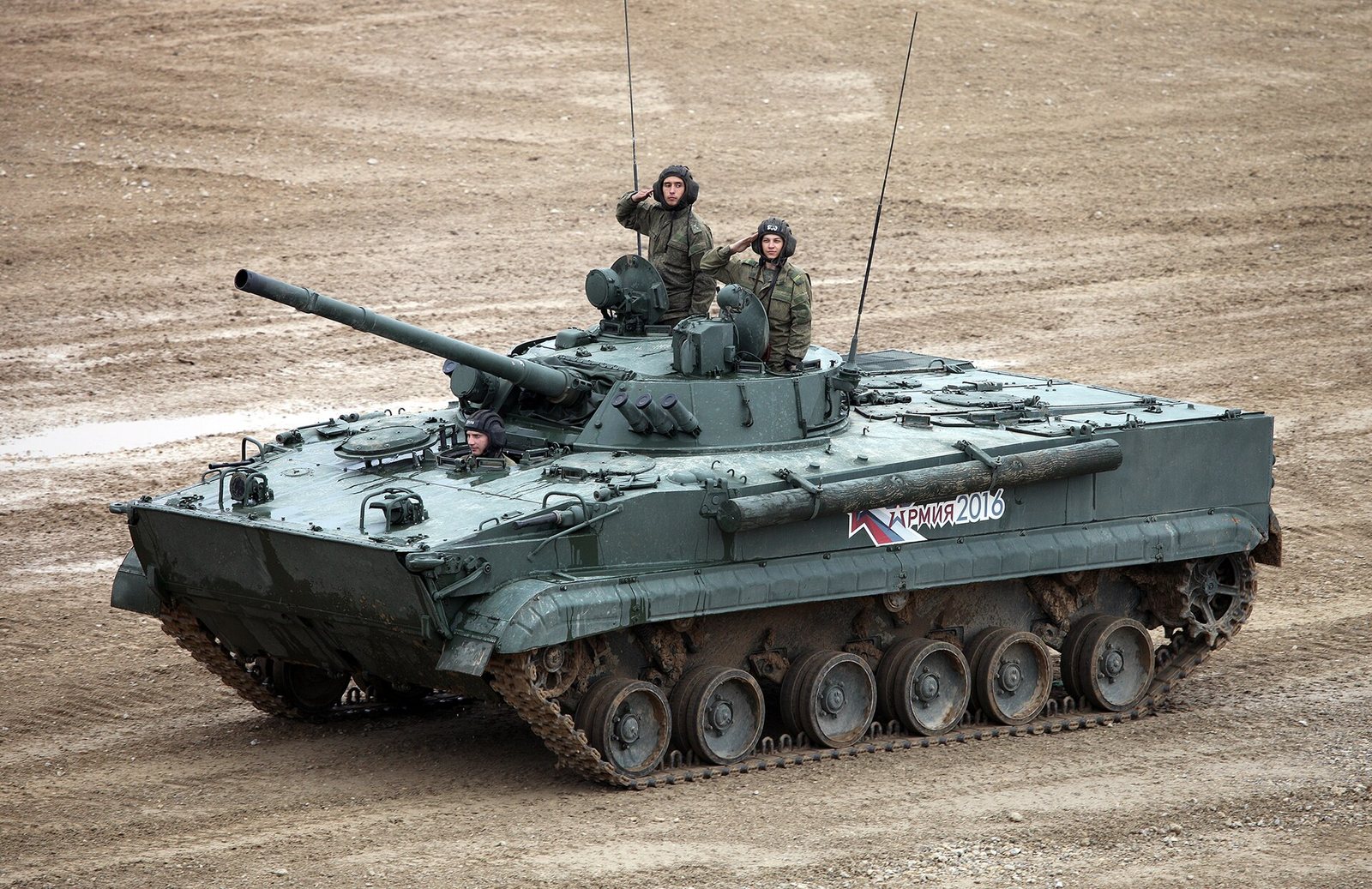
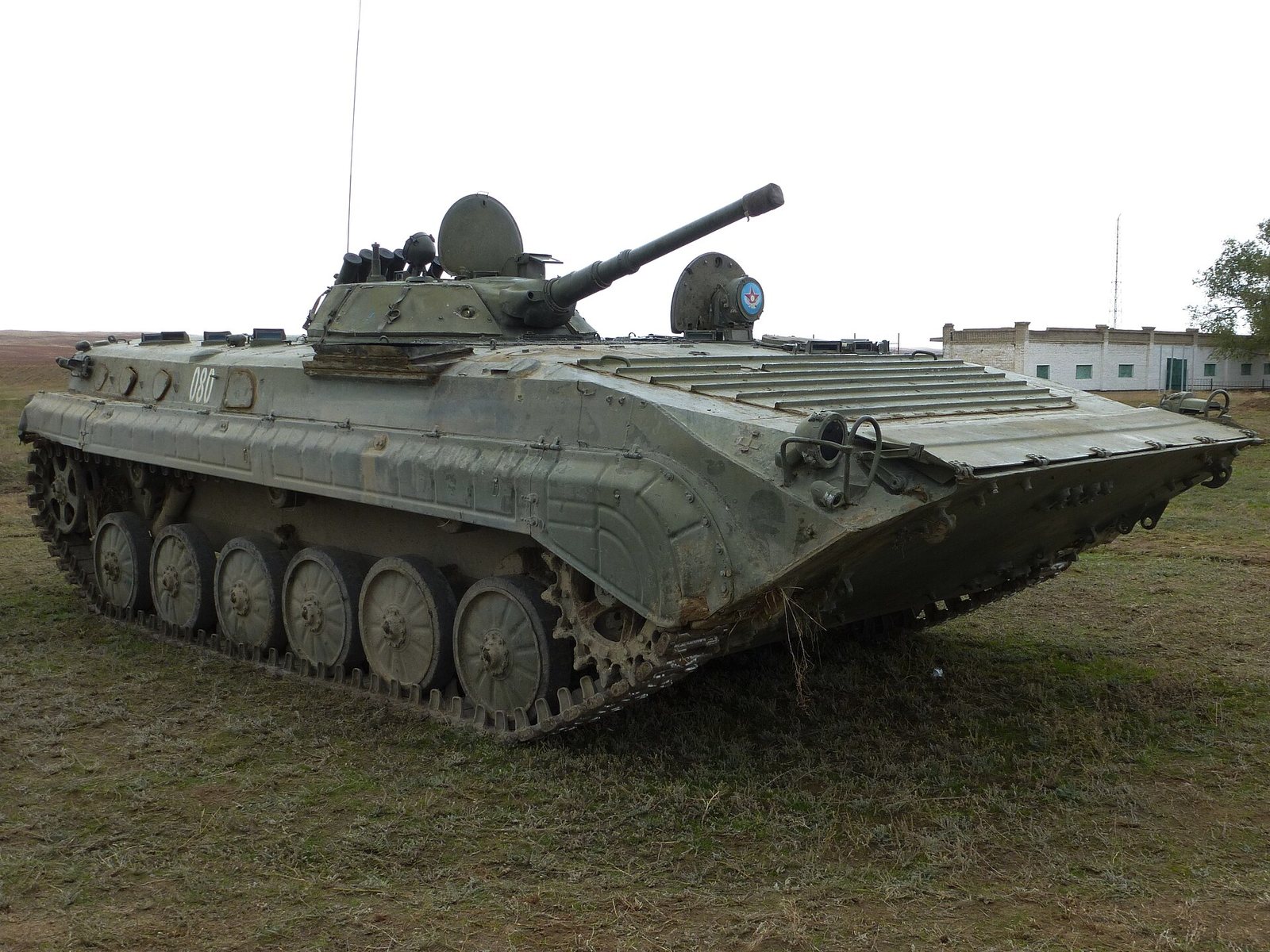
The BMP, introduced in 1967, turned the carrier into an infantry fighting vehicle with a 73 mm gun and an antitank missile [2]. It swims with its tracks; the US Army noted that its front-mounted engine hampered swimming until the BMP-1 version gained a longer bow [2]. The BMP-2 of 1980, first seen in Afghanistan in 1981, kept the tracked method and added a 30 mm gun [2][5]. The larger BMP-3 of 1990 switched to two water jets, which the US Army's guide credits with superior swimming, and a 2024 US Army manual calls it the mainstay of Russia's motorized infantry [3][4][5].
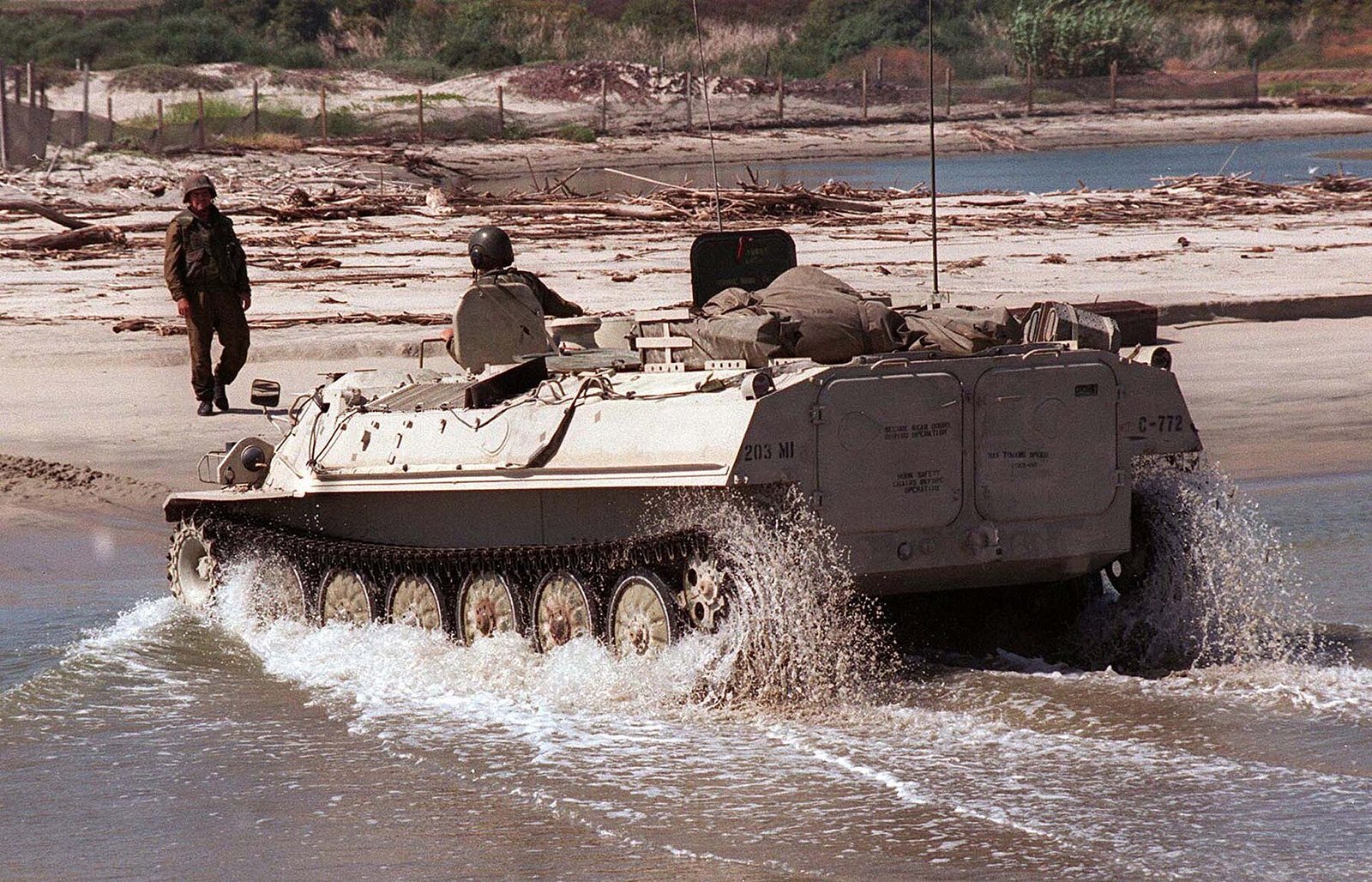
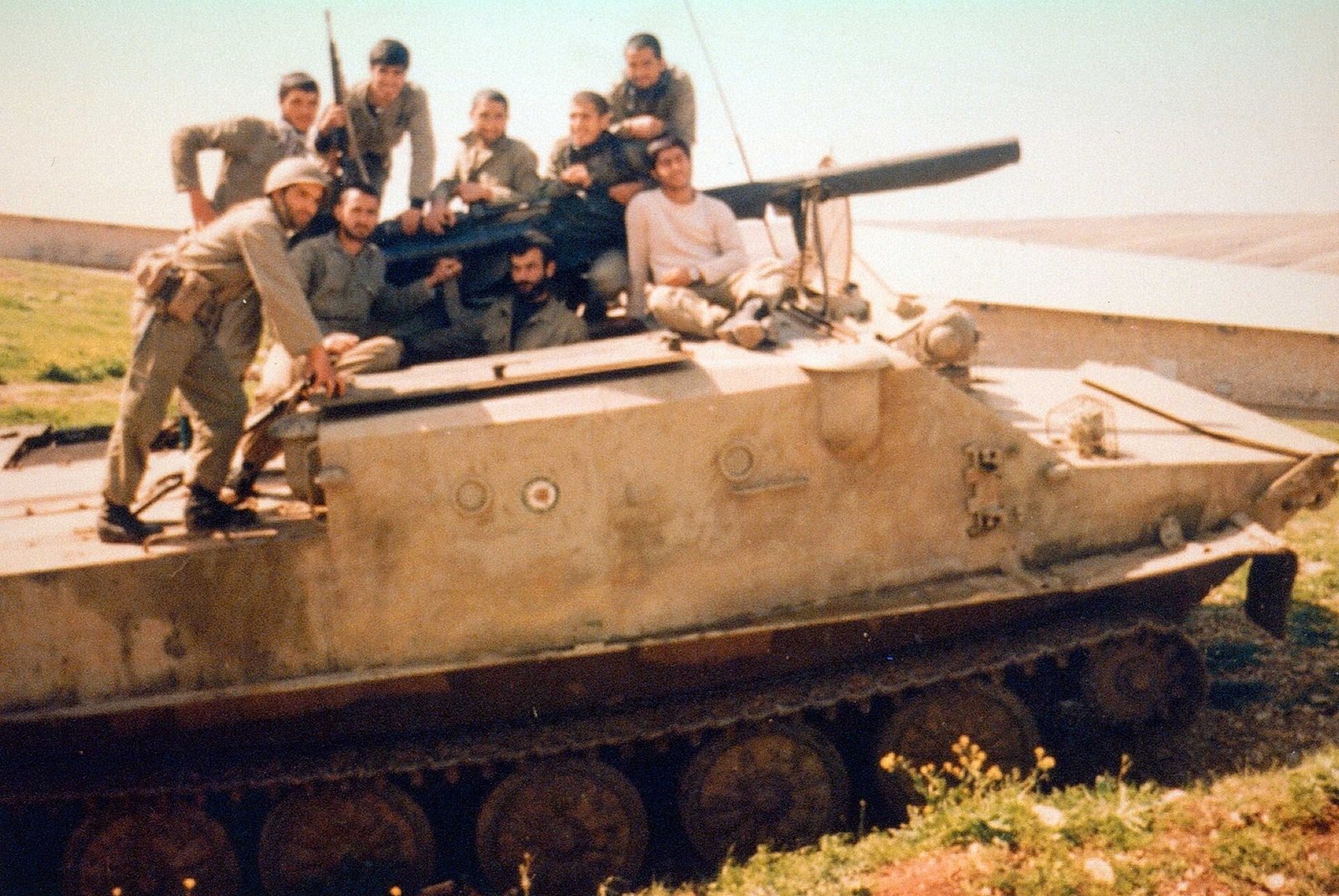
The MT-LB, first identified in the West in 1970, is a low, lightly armored tracked carrier and artillery tractor developed from the unarmored MT-L [2]. The 1991 manual says it can carry ten soldiers besides its crew (the 2015 guide and the 2024 manual say 11), a wide-track version suits snow and swamp, and the 2S1 howitzer, built on a longer chassis derived from it, swims with its tracks [2][3][4]. A 2024 US Army manual calls the MT-LB amphibious and says it is the preferred vehicle for units in Russia's northern regions [4].
Airborne vehicles
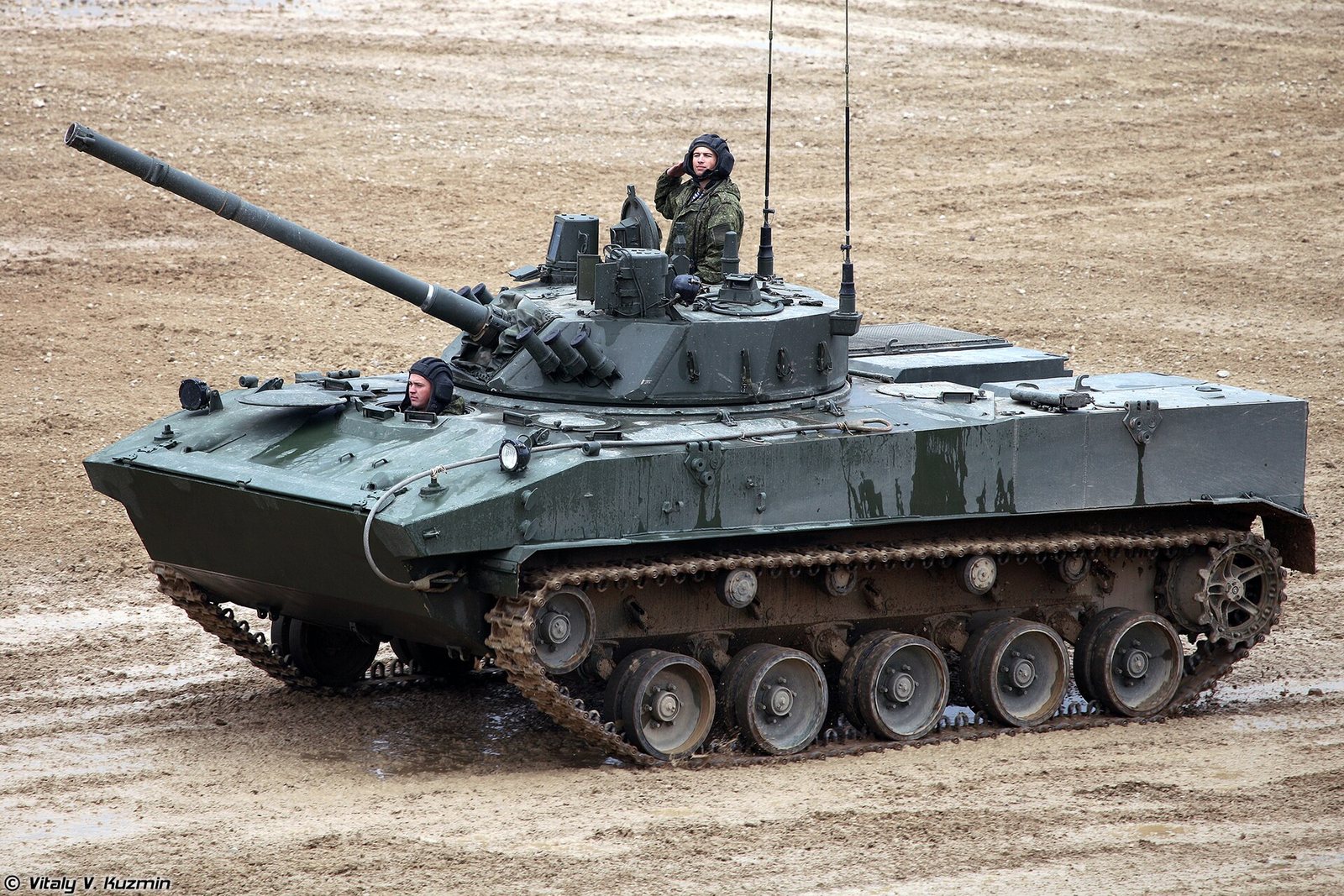
The BMD, first seen in 1970, gave Soviet airborne divisions an air-droppable counterpart to the BMP-1 [2]. At about 7.5 t (8.3 short tons) it was much lighter, and two water jets drive it afloat at an estimated 10 km/h (6 mph) [2]. The heavier BMD-3 of 1990 led to the BMD-4M, built on its chassis and armed with a 100 mm gun and a 30 mm cannon; two water jets give it a top water speed of 10 km/h (6 mph) [3][6]. In 2018 Russia ordered 132 BMD-4Ms for delivery by 2020 [4].
The amphibious 2S25 Sprut-SD, designed for airborne troops and naval infantry, mounts a 125 mm tank gun on a BMD-3 chassis with seven road wheels [3][4]. The US Army's guide dates it to 1993 and notes that its adjustable suspension can lower the hull, which also reduces its profile when swimming [3]. A newer Sprut-SDM1 is reportedly to use the BMD-4M chassis [4].
Warsaw Pact designs
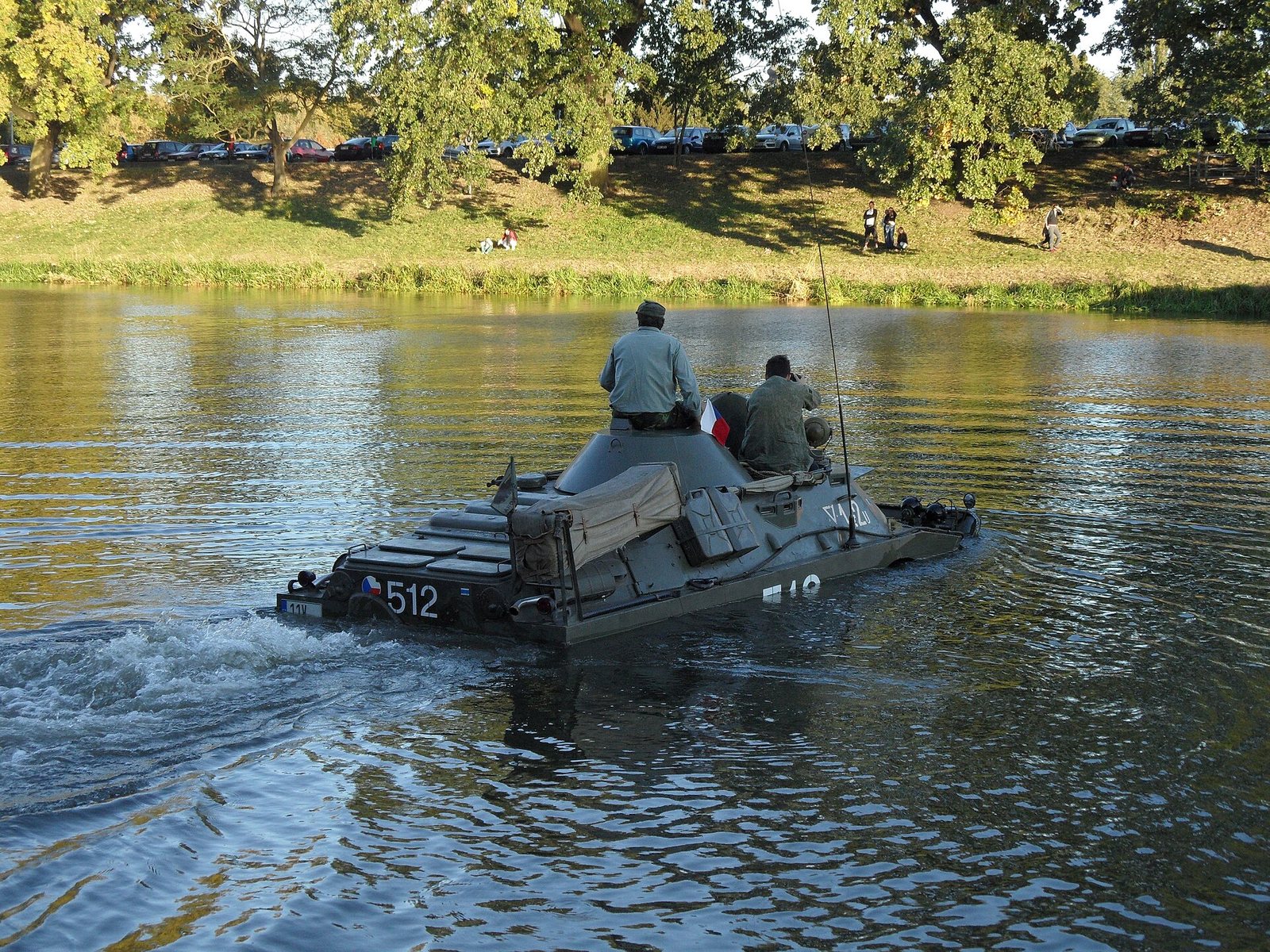
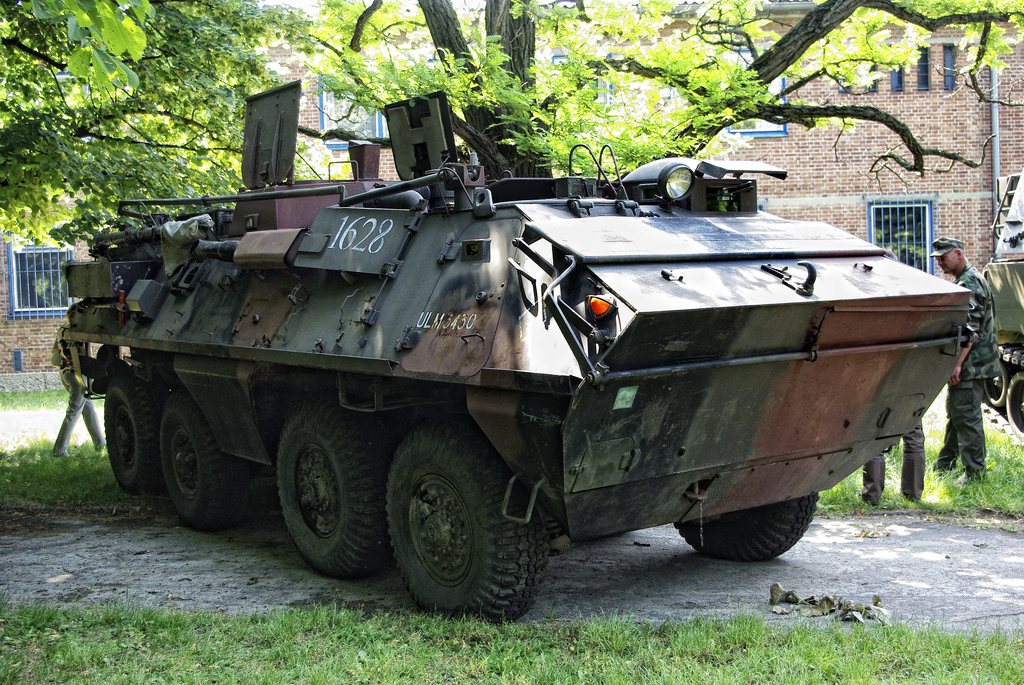
The OT-62 TOPAS grew out of a Czechoslovak license for the BTR-50 obtained in the late 1950s; it was produced from 1963 to 1972 and entered Czechoslovak service in 1964 and Polish service in 1966 [9]. Like the PT-76, it steers in the water by shutting the outlet of one of its two water jets [9]. Czechoslovakia and Poland began developing the eight-wheeled OT-64 SKOT together in 1959, with Tatra supplying the chassis and a Polish plant the armored body, and both armies fielded it from 1964 instead of the Soviet BTR-60; production ended in 1990 after about 10,300 had been built [7][8].
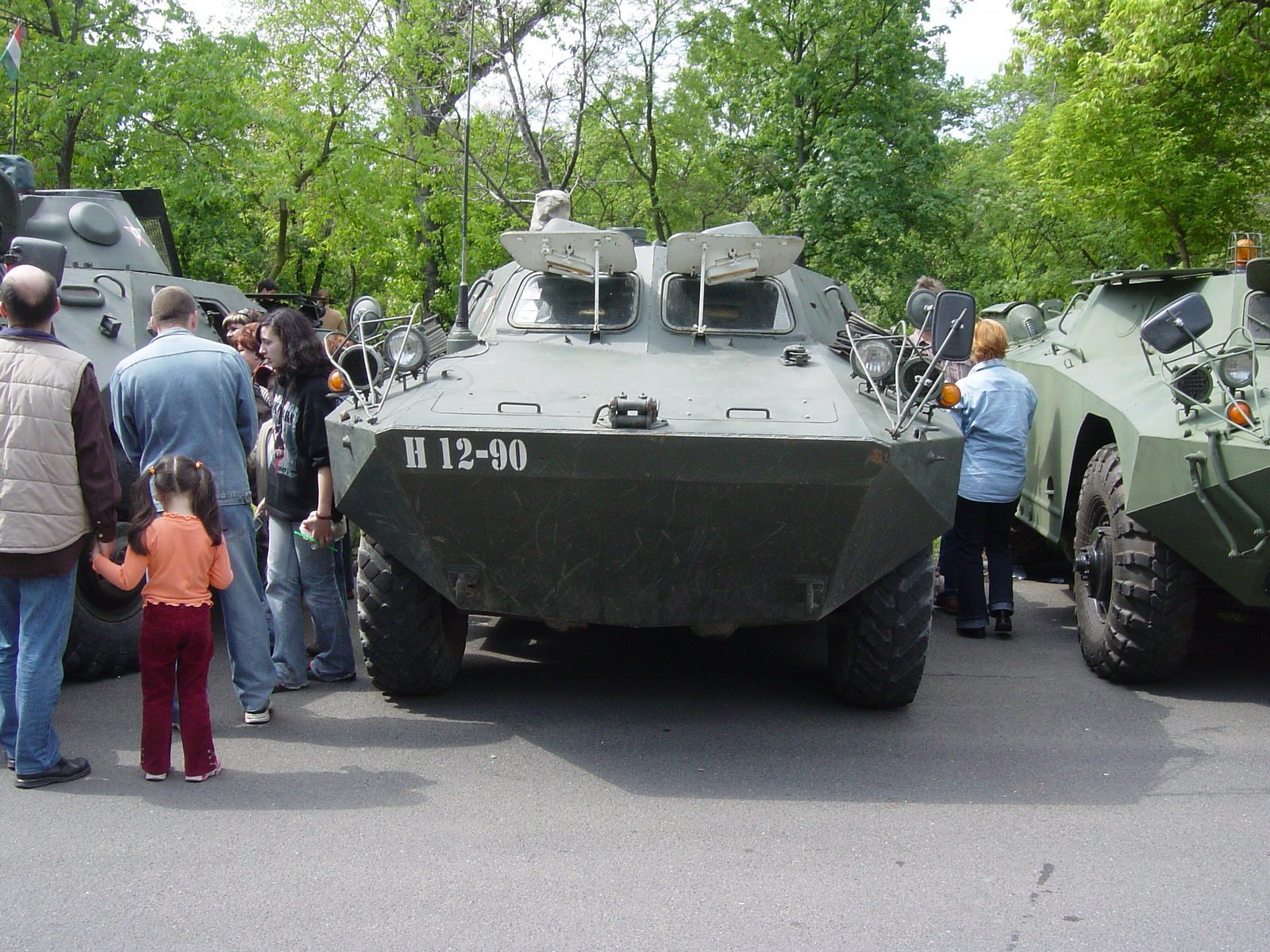
Hungary fielded its FUG scout car in 1964, and Poland and Czechoslovakia followed in 1966, the Czechs naming it the OT-65 [10]. In contrast to the BRDM-1, its engine sits at the rear and it has two water jets, and its crew raises a trim board and starts the bilge pumps before swimming [10]. A later personnel carrier, the PSZH, was at first known as the FUG-66 and then the FUG-70 [10]; a 1991 US Army manual noted that it, too, had twin water jets [2].
Romania built the TAB-71, a license-built BTR-60PB with more powerful engines, from 1970 to 1990; 1,878 were made, and the first was shown at a military parade in 1972 [11]. Romania also built the BTR-70 under license as the TAB-77 [3].
Speeds and types at a glance
The table lists each design or family with the speeds published by the sources above. Water speeds cluster around 10 km/h (6 mph), and none of these vehicles is reported to plane, so all are land-first under this encyclopedia's types test [2][3][9][12].
| Vehicle | Country | First built | Kind | Road speed | Water speed | Swims by | Type |
|---|---|---|---|---|---|---|---|
| PT-76 | Soviet Union | 1952 per the US Army [2][3]; adopted August 1951 per other sources [13] | Tracked amphibious light tank | about 27 mph (44 km/h) [2][3] | about 6 mph (10 km/h) [2][3] | two water jets [2] | Land-first |
| BAV-485 | Soviet Union | 1952 [12] | 6x6 amphibious truck, copied from the DUKW | about 45 mph (73 km/h) per Truck Encyclopedia [12]; 37 mph (60 km/h) in other sources [14] | about 7 mph (10.7 km/h) per Truck Encyclopedia [12]; 6 mph (10 km/h) in other sources [14] | propeller and rudder [12] | Land-first |
| BTR-50 | Soviet Union | 1954 [2][3] | Tracked personnel carrier on the PT-76 chassis and hull | about 27 to 28 mph (44 to 45 km/h) [2][3] | about 4 to 6 mph (7 to 10 km/h) [2][3] | not stated in the cited sources; it uses the hull of the PT-76, which swims with two water jets [2] | Land-first |
| BRDM-1 and BRDM-2 | Soviet Union | 1959 and 1966 [2][3] | 4x4 scout cars | about 50 mph (80 km/h) for the BRDM-1 [3]; about 59 to 62 mph (95 to 100 km/h) for the BRDM-2 [2][3] | about 4 mph (6 km/h) for the BRDM-1 [3]; about 6 mph (10 km/h) for the BRDM-2 [2][3] | single water jet (BRDM-2) [2][5]; not stated for the BRDM-1 | Land-first |
| BTR-60 | Soviet Union | 1960 or 1961 [2][3] | 8x8 personnel carrier | about 50 mph (80 km/h) [2][3] | about 6 mph (10 km/h) [2][3] | single water jet [2][5] | Land-first |
| BTR-70 | Soviet Union | mid-1970s; first seen 1978 [2] | 8x8 personnel carrier | about 50 mph (80 km/h) [2][3] | about 6 mph (10 km/h) [2][3] | single water jet [5] | Land-first |
| BTR-80 and BTR-82 | Soviet Union, then Russia | 1984; BTR-82 in service 2011 [2][4] | 8x8 personnel carriers | about 50 to 53 mph (80 to 85 km/h), BTR-80 [2][3]; no published figure found for the BTR-82 | about 6 mph (10 km/h), BTR-80 [2][3] and BTR-82AM [6] | single water jet [5][6] | Land-first |
| BMP-1 | Soviet Union | 1967 [2] or 1970 [3] | Tracked infantry fighting vehicle | about 40 mph (65 km/h) [2][3] | about 4 mph (6 to 7 km/h) [2][3] | tracks [2][5] | Land-first |
| BMP-2 | Soviet Union | 1980 [2][3] | Tracked infantry fighting vehicle | about 40 mph (65 km/h) [2][3] | about 4 mph (7 km/h) [2][3] | tracks [5] | Land-first |
| BMP-3 | Soviet Union, then Russia | 1990 [3][4] | Tracked infantry fighting vehicle | about 43 to 45 mph (70 to 72 km/h) [3][4] | about 6 mph (10 km/h) [3] | two water jets [5] | Land-first |
| BMD-1 and BMD-2 | Soviet Union | about 1970 [2] | Air-droppable tracked fighting vehicles | about 37 to 50 mph (60 to 80 km/h), estimate [2]; 43 mph (70 km/h) in the 2015 guide [3] | about 6 mph (10 km/h) [2][3]; the 1991 manual calls it an estimate | two water jets [2] | Land-first |
| BMD-3 and BMD-4 | Soviet Union, then Russia | 1990 (BMD-3) [3] | Air-droppable tracked fighting vehicles | about 43 mph (70 km/h), BMD-4M [6] | about 6 mph (10 km/h), BMD-3 [3] and BMD-4M [6] | two water jets, BMD-4M [6]; not stated for the BMD-3 | Land-first |
| MT-LB | Soviet Union | 1970 [2][3] | Tracked multipurpose carrier and artillery tractor | about 37 to 38 mph (60 to 61.5 km/h) [2][3] | about 3 to 4 mph (5 to 6 km/h) [2][3] | not stated in the cited sources; the 2S1 howitzer on a chassis derived from it swims with its tracks [2] | Land-first |
| 2S25 Sprut-SD | Russia | 1993 [3] | Tracked antitank gun for airborne troops, on a BMD-3 chassis | about 44 mph (71 km/h) [3] | about 6 mph (10 km/h) [3] | not stated in the cited sources; it uses a BMD-3 chassis [3] | Land-first |
| OT-62 TOPAS | Czechoslovakia and Poland | 1963 [9] | Tracked personnel carrier developed from the BTR-50 | about 36 mph (58.4 km/h) [9] | about 7 mph (10.8 km/h) [9] | two water jets [9] | Land-first |
| OT-64 SKOT | Czechoslovakia and Poland | in service 1964 [7][8] | 8x8 personnel carrier | about 58 mph (94 km/h) [7] | about 6 mph (9 km/h) [7] | two propellers [8] | Land-first |
| FUG (OT-65) and PSZH | Hungary | 1964 for the FUG [10]; no date found for the PSZH | Scout car (FUG) and 4x4 personnel carrier (PSZH) [10] | about 54 mph (87 km/h) for the FUG [10]; no published figure found for the PSZH | about 6 mph (9 km/h) for the FUG [10]; no published figure found for the PSZH | two water jets, both types [2][10] | Land-first |
| TAB-71 and TAB-77 | Romania | 1970 for the TAB-71 [11]; no date found for the TAB-77 | 8x8 personnel carriers, license-built BTR-60PB and BTR-70 [3][11] | about 59 mph (95 km/h) for the TAB-71 [11]; no published figure found for the TAB-77 | about 6 mph (10 km/h) for the TAB-71 [11]; no published figure found for the TAB-77 | not stated in the cited sources; the BTR-60 and BTR-70 they copy use a single water jet [5] | Land-first |
Speeds are published maximums, mostly from two US Army reference works, FM 100-2-3 (1991) and the TRADOC Worldwide Equipment Guide (2015); other figures come from the sources cited in each cell [2][3]. The 1991 manual calls its BMD speeds estimates. Where sources differ, the range or both figures are given. First built is the year of introduction, first production or first sighting named by the cited source. Where a row covers two models and a figure is named for only one, no figure for the other was found in the cited sources; the same applies to a Swims by cell marked not stated. None of these vehicles is reported to plane, so all are Land-first under this encyclopedia's types test.
Today
Russia still values swimming. Foss describes the ability of nearly all of Russia's lighter armored vehicles to get across rivers and lakes, if only in a limited way, as an inheritance from Soviet days [5]. A 2024 US Army manual describes the BTR-80, BMP-3, MT-LB and 2S25 as amphibious, covers them with the BTR-82 and BMD-4M in its survey of Russian ground force vehicles, and counts about 4,000 BMPs in regular units and 8,500 more in storage [4].
Many older designs spread around the world; in 2015 the US Army's guide counted BTR-60s and BMP-1s in at least 44 countries each [3]. Their limits are unchanged: they can handle slow rivers and calm lakes, but landings from the open sea need special versions such as the BMP-3F, or ships and landing craft [5][6].
Photos
Related entries
Sources
- FM 100-2-2, The Soviet Army: Specialized Warfare and Rear Area Support, Headquarters, Department of the Army (copy on Wikimedia Commons) (1984-07-16). commons.wikimedia.org/wiki/File:Fm100-2-2_-_The_Soviet_Army,_Specialized_Warfare_and_Rear_Area_Support.pdf
- FM 100-2-3, The Soviet Army: Troops, Organization, and Equipment, Headquarters, Department of the Army (copy on Wikimedia Commons) (1991-06-06). commons.wikimedia.org/wiki/File:Fm100-2-3_-_The_Soviet_Army,_Troops,_Organization,_and_Equipment.pdf
- Worldwide Equipment Guide, Volume 1: Ground Systems (2015 update), US Army TRADOC G-2 (copy on Wikimedia Commons) (2015-12). commons.wikimedia.org/wiki/File:WorldwideEquipmentGuide_2015_Ground_Systems.pdf
- ATP 7-100.1, Russian Tactics, Headquarters, Department of the Army (copy on Wikimedia Commons) (2024-02). commons.wikimedia.org/wiki/File:ATP_7-100.1_-_%22Russian_Tactics%22_(February_2024).pdf
- A buoyant market? The use cases for amphibious AFVs (Christopher F. Foss), Shephard Media (2025-07-10). plus.shephardmedia.com/analysis/decisive-edge-a-buoyant-market-the-case-for-amphibious-afvs
- Over land and sea: the world's best amphibious assault vehicles, Army Technology (2014-05-27). www.army-technology.com/features/featuredoubly-assail-the-worlds-best-amphibious-assault-vehicles-4278546
- History: Armoured Personnel Carrier OT-64, Ministry of Defence and Armed Forces of the Czech Republic. acr.mo.gov.cz/scripts/detail.php?id=6042
- OT-64 SKOT, wheeled armoured personnel carrier, Army Guide. www.army-guide.com/eng/product1067.html
- OT-62 TOPAS, Wikipedia. en.wikipedia.org/wiki/OT-62_TOPAS
- FUG / OT-65, wheeled armoured personnel carrier, Army Guide. www.army-guide.com/eng/product1427.html
- TAB-71, Wikipedia. en.wikipedia.org/wiki/TAB-71
- BAV-485 (1952), Truck Encyclopedia. truck-encyclopedia.com/coldwar/ussr/BAV-485.php
- PT-76, Wikipedia. en.wikipedia.org/wiki/PT-76
- BAV 485, Wikipedia. en.wikipedia.org/wiki/BAV_485
Last reviewed November 2026. Spotted something to correct or add? Tell us and include a source.
About the Amphibious Encyclopedia
WaterCar has designed and built amphibious vehicles in Southern California for more than 25 years. We keep this encyclopedia so anyone curious about vehicles that cross between land and water has one place to start, with the sources listed for every fact.
Browse all entries → · The WaterCar machines → · How a WaterCar works →