
Origins
The EFV began as the Advanced Amphibious Assault Vehicle (AAAV), meant to replace the Assault Amphibious Vehicle that the Marine Corps had fielded in 1972 [4][6]. A 1988 Marine Corps mission area analysis judged the older vehicle short on water and land speed, firepower, armor and survivability, and that year defense officials signed the papers to start concept work on a successor [1][6]. Planners wanted a vehicle that ships could launch from over the horizon, where they would be less exposed to enemy fire, and that could then race to the beach [1][7]. The program entered its risk-reduction phase in 1995 and won two Defense Department awards for managing cost and technology, and in June 1996 General Dynamics Land Systems received a contract for full-scale engineering development of its design [1][4].
System development began at the end of 2000, and a cost-plus contract signed in 2001 assumed it would be finished by October 2003, a schedule the Government Accountability Office (GAO) later found too short [1][2][6]. On 10 September 2003, at the program's facility in Woodbridge, Virginia, the vehicle was renamed the Expeditionary Fighting Vehicle [6]. General Dynamics Amphibious Systems was then building nine second-generation prototypes, and the Marines hoped to start fielding the EFV in fiscal 2008 [6].
Design and how it works
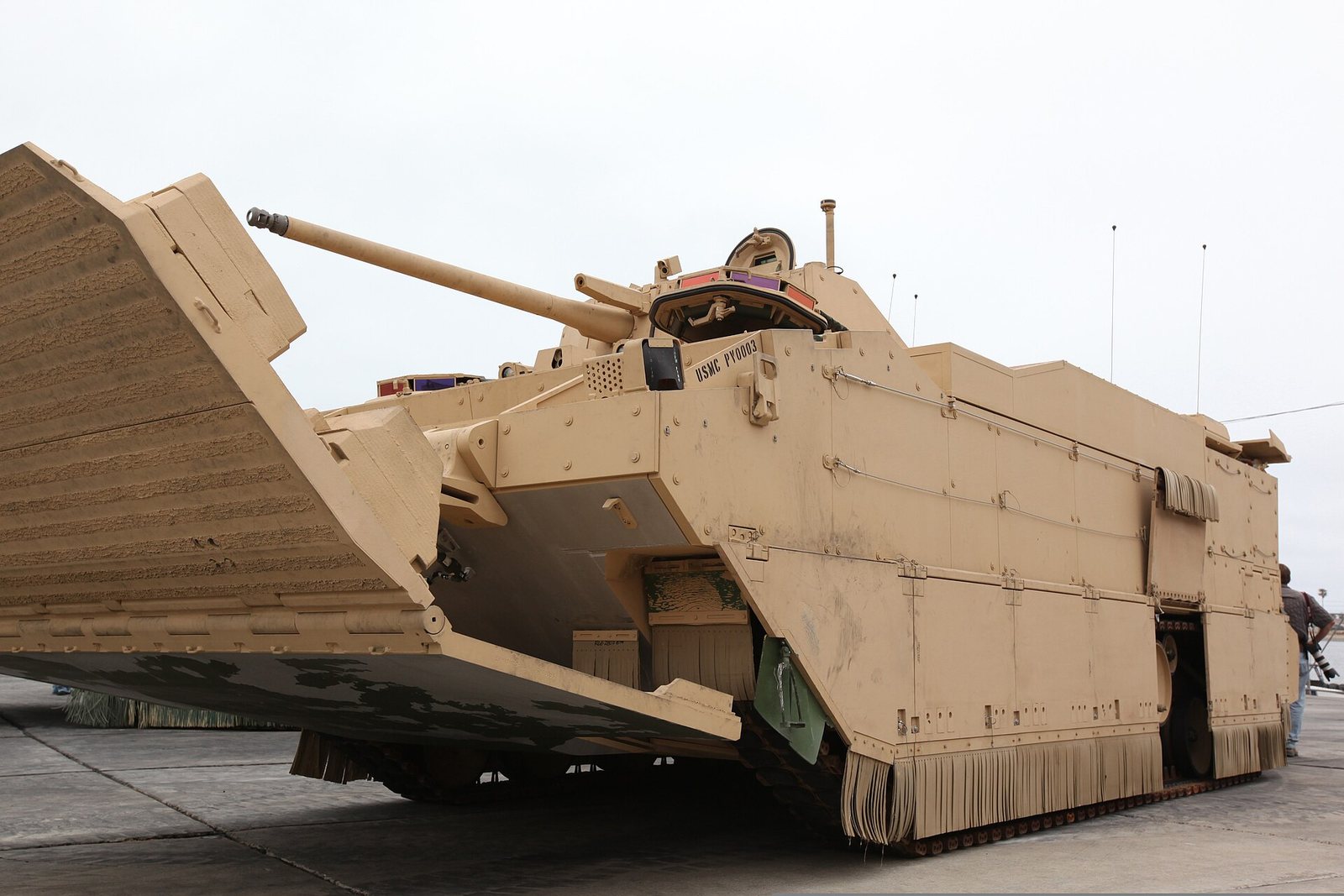
The EFV was a tracked armored vehicle with a hull of high-strength aluminum alloy, shaped to plane on the water [4]. It had a crew of three [1]. The personnel version, EFV-P1, carried 17 combat-equipped Marines, who boarded by a rear ramp, and had a two-man turret with a 30 mm Mk44 Bushmaster cannon and a 7.62 mm machine gun; the command version, EFV-C1, carried a commander and staff [1][4]. Combat loaded, it weighed about 80,000 lb (36 t) [1].
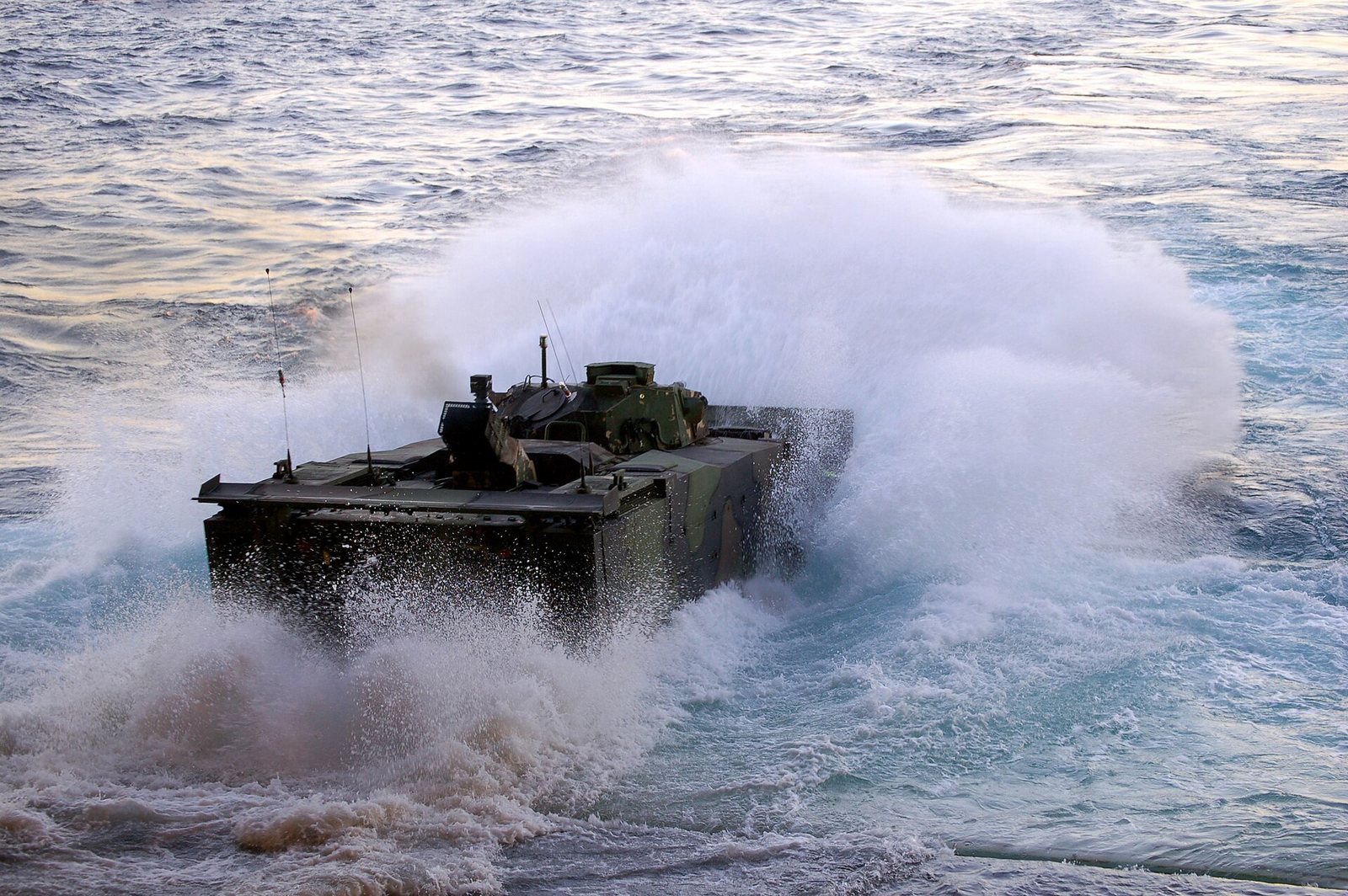
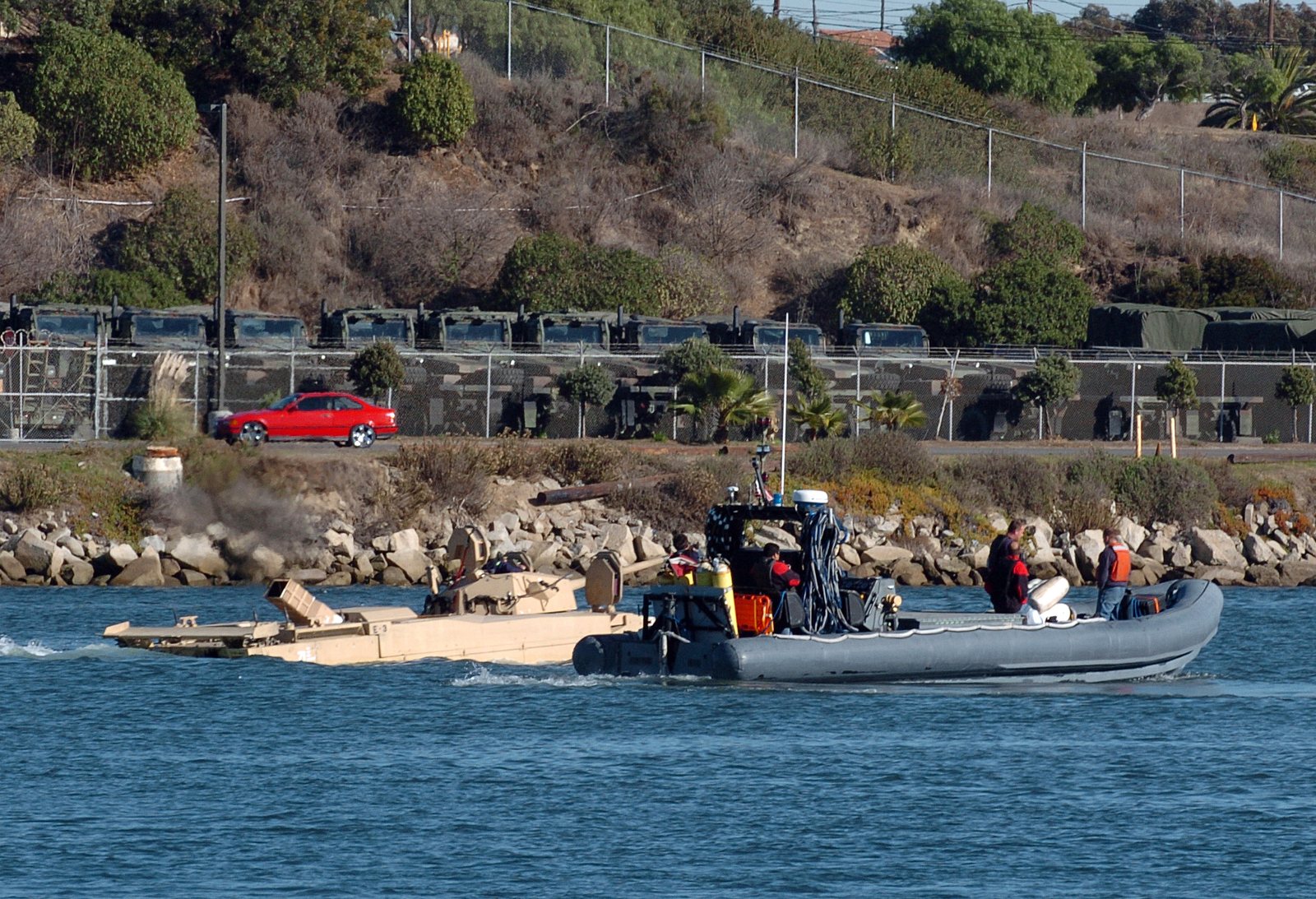
Speed on water shaped the whole design [1]. A 12-cylinder MTU MT883 diesel of about 2,700 hp sat in the middle of the hull [4]. Afloat, a bow plate swung forward to add lift, covers over the two side-mounted 23 in (58 cm) Honeywell water jets opened, and the hydropneumatic suspension pulled the road wheels up so the vehicle could rise and plane across the surface [1][4]. The requirement was 20 knots (23 mph, 37 km/h), and test vehicles went faster than 25 knots (29 mph, 46 km/h) in waves over 2 ft (0.6 m) high [1][4]. That would have let ships launch EFVs 25 miles (40 km) or more offshore, compared with about 2 miles (3 km) for the AAV, which swims at about 8.5 mph (14 km/h) [1][5].
On land the EFV was designed for about 45 mph (72 km/h) on roads and cross-country mobility at least equal to an M1 tank [4][5]. A power transfer module shared engine power between the water jets and the tracks, easing the risky move from water to land over obstacles such as coral [4]. Members of Congress worried that the flat bottom needed for planing was more vulnerable to buried bombs than a V-shaped hull; program officials said a V-hull would keep the vehicle from meeting its key performance requirements, and the Marines planned bolt-on belly armor for use ashore [1][5].
Testing problems and redesign
Development ran into trouble early [2]. The schedule was reset in November 2002 and March 2003, adding a year each time [1]. In 2004 prototypes suffered failures of the hull electronics unit, the vehicle's main computer, which could freeze the steering in water, along with problems with the bow flap and the hydraulics [1][2]. The Marines lowered the reliability requirement from 70 hours to 43.5 hours between operational mission failures, and a third reset in March 2005 added two more years [1][2].
A 2006 operational assessment went badly [1][3]. The prototypes ran only about 4.5 hours between breakdowns, needed about 3.4 hours of repair for every hour of running, and completed just 2 of 11 attempted amphibious tests; they were also about 1,900 lb (860 kg) too heavy to reach the target water speed [1]. In February 2007 the program reported a critical Nunn-McCurdy unit cost breach, and in June 2007 it was restructured to repeat the whole system development phase [1][3]. General Dynamics received $143.5 million for a redesign, and a second development contract signed in 2008 covered seven new prototypes with almost 400 design changes, and the redesigned vehicle passed a critical design review that December [1].
Cancellation
Costs rose as the planned fleet shrank. GAO calculated that the program unit cost grew from $8.8 million at the start of development to $24.3 million, both in fiscal 2011 dollars, while the planned buy fell from 1,013 vehicles to 574 [3]. The Congressional Research Service (CRS) gave the figures as 1,025 and 573 and noted fears that the EFV could take up to 90 percent of the Marines' ground equipment budget [1]. Defense Secretary Robert Gates publicly questioned the need for it in 2009 and 2010 [1][7].
On 6 January 2011 Gates announced that, on the advice of the Secretary of the Navy and the Commandant of the Marine Corps, he would recommend ending the program [1][5]. He said the EFV had already cost more than $3 billion to develop and would need about $12 billion more to build, and that the most plausible missions did not require "the exquisite features of the EFV" [1]. The Commandant, Gen. James Amos, said he had personally recommended cancellation because the vehicle's purchase and running costs were too high for likely Marine Corps budgets [7]. The Marines put the cost of ending the contract at about $185 million [1].
Legacy
Gates promised to fund a cheaper successor and to refit the existing AAVs with new engines, electronics and weapons [1][5]. The Marines had asked to drop the EFV in favor of extending the AAV's life and buying a wheeled Marine Personnel Carrier, which became the first phase of the Amphibious Combat Vehicle program [1][7]. No EFV entered service [1][7]. The idea of a fast planing assault amphibian lived on elsewhere: South Korea's KAAV-II prototype, shown in 2026, uses a planing hull that Army Recognition compared closely to the EFV's [8].
Photos
Related entries
Sources
- The Marines' Expeditionary Fighting Vehicle (EFV): Background and Issues for Congress, RS22947 (Andrew Feickert), Congressional Research Service, via EveryCRSReport (2011-01-18). www.everycrsreport.com/files/20110118_RS22947_70a771f3a1ec2e47637985c947daedfe4380914b.html
- Defense Acquisitions: The Expeditionary Fighting Vehicle Encountered Difficulties in Design Demonstration and Faces Future Risks (GAO-06-349), US Government Accountability Office (2006-05-01). www.gao.gov/assets/a250024.html
- Expeditionary Fighting Vehicle (EFV) Program Faces Cost, Schedule and Performance Risks (GAO-10-758R), US Government Accountability Office (2010-07-02). www.gao.gov/assets/a96889.html
- Expeditionary Fighting Vehicle (EFV), Army Technology. www.army-technology.com/projects/efv
- Expeditionary Fighting Vehicle (EFV), GlobalSecurity.org. www.globalsecurity.org/military/systems/ground/aaav.htm
- Latest version of Marine Corps' amphibious fighting vehicles has new name, Marine Corps News, via GlobalSecurity.org (2003-09-12). www.globalsecurity.org/military/library/news/2003/09/mil-030912-mcn01.htm
- Expeditionary Fighting Vehicle, Wikipedia. en.wikipedia.org/wiki/Expeditionary_Fighting_Vehicle
- Hanwha Aerospace unveils KAAV-II amphibious assault vehicle prototype for South Korea's Marine Corps (Jérôme Brahy), Army Recognition (2026-05-19). www.armyrecognition.com/news/army-news/2026/hanwha-aerospace-unveils-kaav-ii-amphibious-assault-vehicle-prototype-for-south-koreas-marine-corps
Last reviewed November 2026. Spotted something to correct or add? Tell us and include a source.
About the Amphibious Encyclopedia
WaterCar has designed and built amphibious vehicles in Southern California for more than 25 years. We keep this encyclopedia so anyone curious about vehicles that cross between land and water has one place to start, with the sources listed for every fact.
Browse all entries → · The WaterCar machines → · How a WaterCar works →