
How screw propulsion works
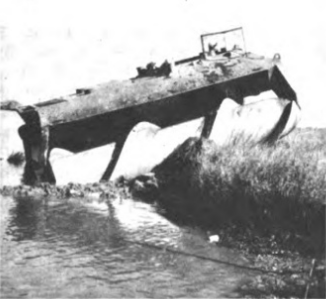
A screw-propelled vehicle rests on two long, sealed drums, each wrapped in a helical blade, one spiraling left and one right. Turned in opposite directions, their sideways pushes cancel and the machine screws itself forward along the line of the drums [1][2]. On Chrysler's Marsh Screw Amphibian the blades had a lead of 48 in (1.2 m), so with no slip the vehicle moved 4 ft (1.2 m) per turn [1]. Slowing and braking one rotor turns the machine, much as a tracked vehicle steers, and turning both the same way moves it sideways [1][10].
The drums also keep the machine afloat. The Marsh Screw's rotors were filled with polyurethane foam in case of a puncture [1]. Kolesa notes that such screws are usually hollow or filled with polymer, which makes screw vehicles amphibious by default, and the Soviet ZIL-4904's aluminum-alloy screws were no exception [10]. In water the turning blades drive the vehicle along: Joseph Jean de Bakker's 1967 US patent describes the ribs carrying water upward and flinging it off to both sides [8].
Hard ground is the weak point. According to Kolesa, screw vehicles cannot run on asphalt, concrete or even gravel, because the screws are damaged and the surface torn up, and they have no suspension [10]. A 1977 report by the US Army Engineer Waterways Experiment Station (WES), summing up earlier tests by Chrysler, WES and the Army, lists the Marsh Screw at 20 mph (32.2 km/h) on wet, soft clay and 9.8 mph (15.8 km/h) in open water with only a driver aboard, but 2 mph (3.2 km/h) on dry soil and sand [1]. WES devoted a section of its 1977 report to the highway trailers needed to carry screw machines to the job [1].
Early screws and snow motors
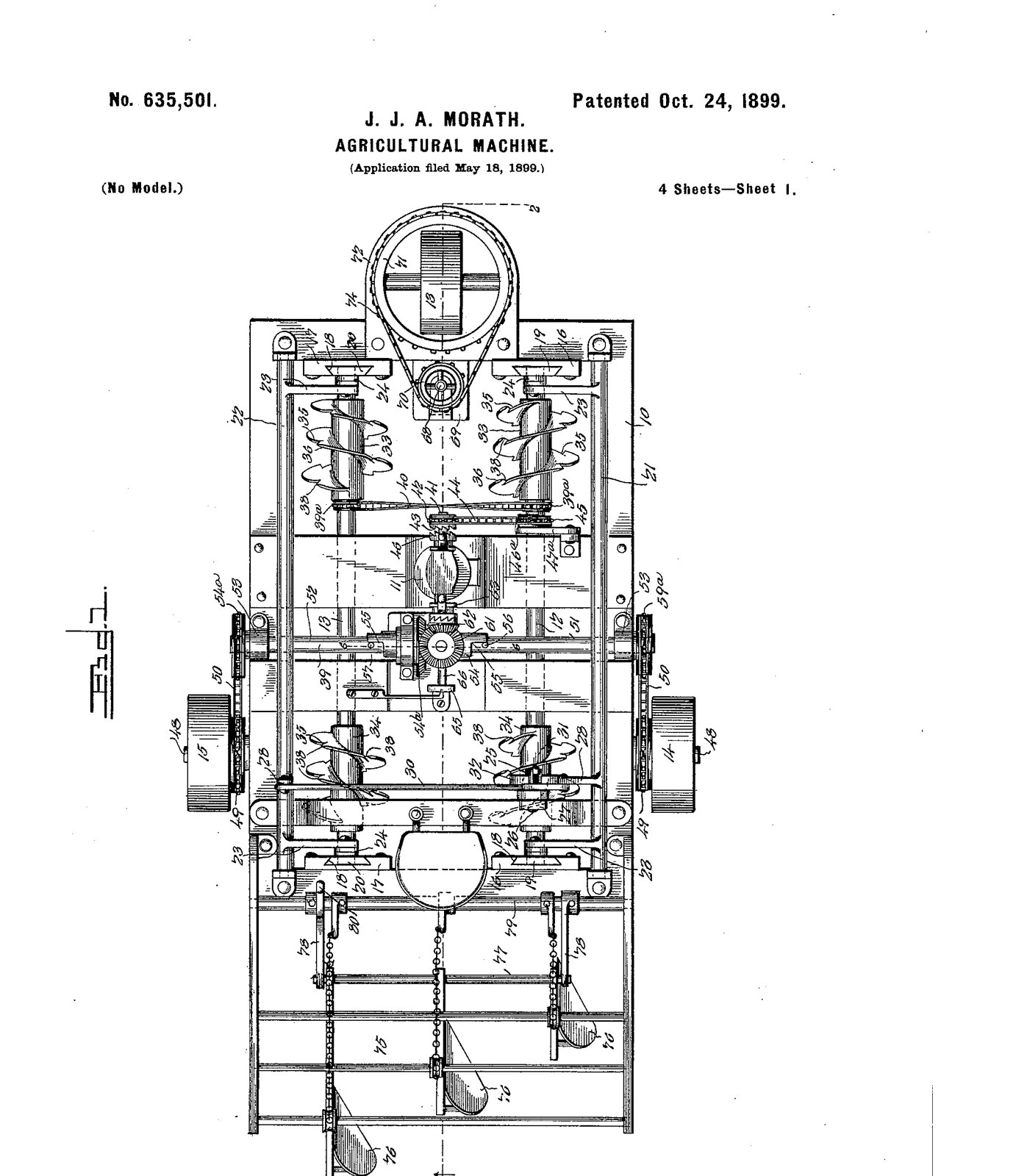
In October 1899 Jacob Morath of Clayton, Missouri, patented a farm machine that pulled itself and a plow along on four cone-shaped augers with root-cutting notches; on roads the augers lifted clear and wheels took over [3].
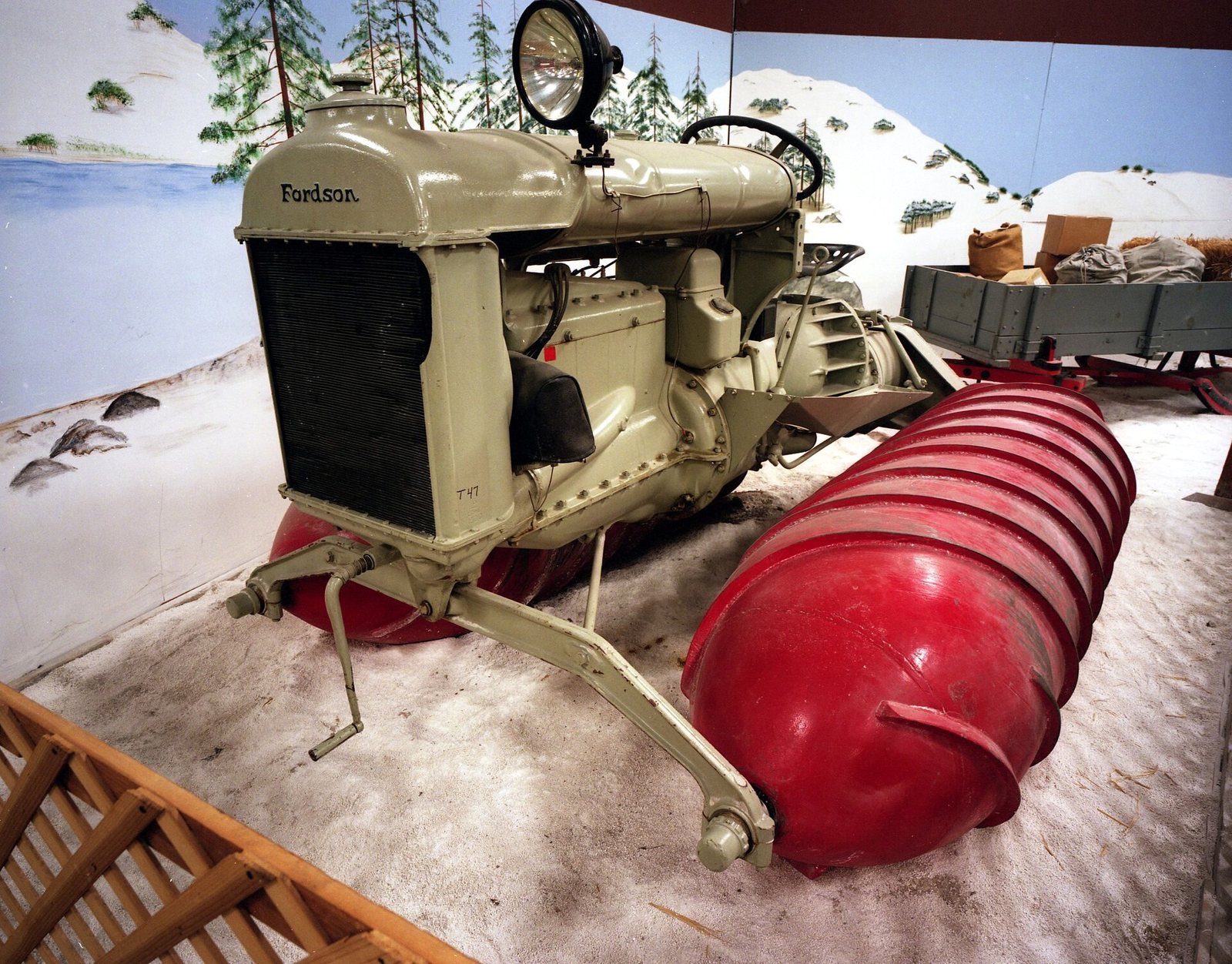
Snow gave the idea an early commercial run. The Armstead Snow Motor, based on a 1920 patent by Frederick R. Burch of Seattle, replaced a Fordson tractor's wheels with two spiral-ribbed cylinders, each with its own clutch worked by the steering wheel [4][5]. In January 1926 Time reported that Detroit carmakers had formed Snow Motors Inc. to sell a machine that could cross deep snow at 6 to 8 mph (10 to 13 km/h) [2][6]. A promotional film showed the kit fitted to a Fordson tractor and to a Chevrolet car [2][6]. Snow motors proved slow and thirsty in the dry snow of interior Alaska in 1926 [5], but examples survive in museums in Alaska, Montana and California [4]. WES notes that the US Army later tried a screw-driven Weasel in Greenland in the early 1950s [1].
Chrysler's marsh screws
In the 1960s Chrysler's defense engineering arm produced two prototype Marsh Screw Amphibians for the US Navy, and Chrysler's own test program ran one in conditions chosen to match Southeast Asia [1]. The tested vehicle was 13.7 ft (4.16 m) long, weighed 2,860 lb (1,297 kg) with driver and fuel and carried 1,094 lb (496 kg); a 116 hp (87 kW) Chrysler slant-six drove its aluminum rotors [1]. Mac's Motor City Garage says as many as 10 were built, that the government passed on the design and that Chrysler featured the machine in Life magazine advertisements [7].
In June 1975 WES tried an overhauled Marsh Screw in southern Louisiana as a carrier for herbicide sprayers in stump-filled swamps choked with water hyacinth. Observers found it underpowered, slow in water and hard to steer anywhere but on water and vegetation, yet judged screw propulsion worth more study [1].
Chrysler's larger Riverine Utility Craft, also built for the Navy, applied those lessons. About 20 ft (6.1 m) long, it weighed 13,085 lb (5,935 kg) with cargo and had two 440 cu in (7.2 L) Chrysler engines [1]. WES listed 17.2 mph (27.7 km/h) on water, 20.1 mph (32.4 km/h) on swamp and tidal flats and 20.7 mph (33.3 km/h) on snow, but only 3.4 mph (5.5 km/h) on a hard surface, rolling sideways [1].
The Dutch Amphirol
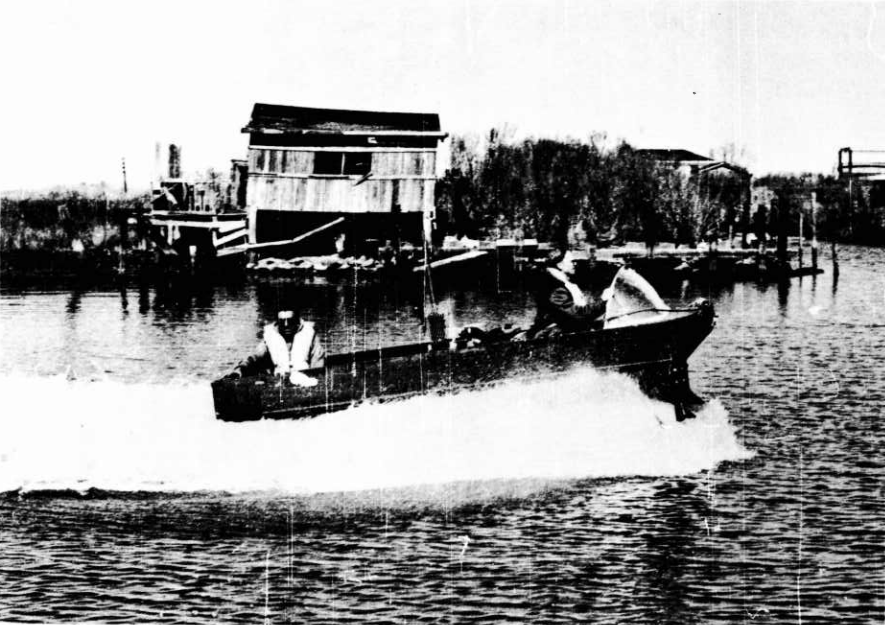
Joseph Jean de Bakker of Hulst, in the Netherlands, filed a Dutch patent in January 1965 for an amphibian on two torpedo-shaped pontoons with opposite-handed ribs, and his US patent followed in August 1967 [8]. Counter-rotating, the pontoons drive it through water and marsh. Turned the same way, they roll it sideways over hard ground, and the pontoons' front ends swing in or out to steer [8].
Wikipedia says he built it to reach fishing grounds across tidal mud, using two modified DAF Variomatic transmissions [2]. Carstyling dates it to 1966 and notes that it was a private build, not a DAF product [9]. By 1977 a Hulst firm was marketing the Amfirol for civil work. WES listed it as 18.4 ft (5.6 m) long and 7,700 lb (3,500 kg) empty, with 5 to 6 mph (8 to 10 km/h) in water and 12 to 19 mph (20 to 30 km/h) on hard or dry ground [1]. Later jobs included surveying and grooving newly drained polders [2].
Soviet screw vehicles
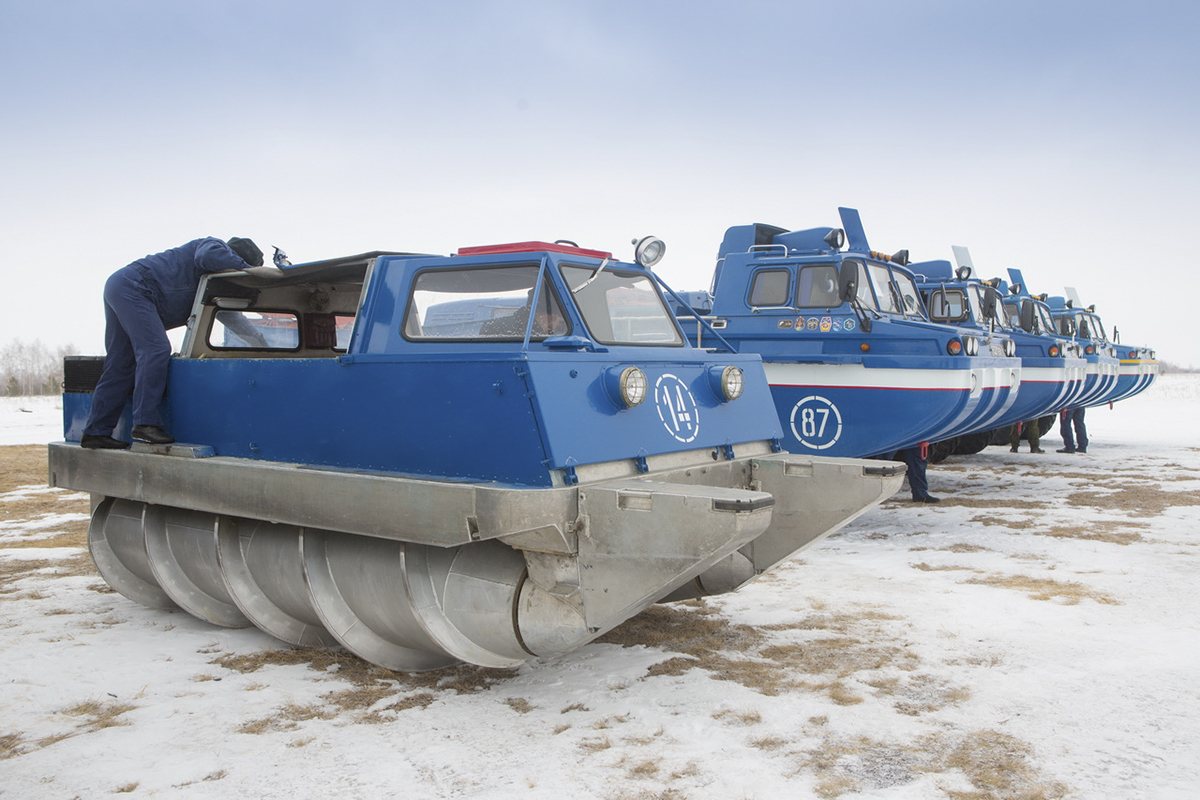
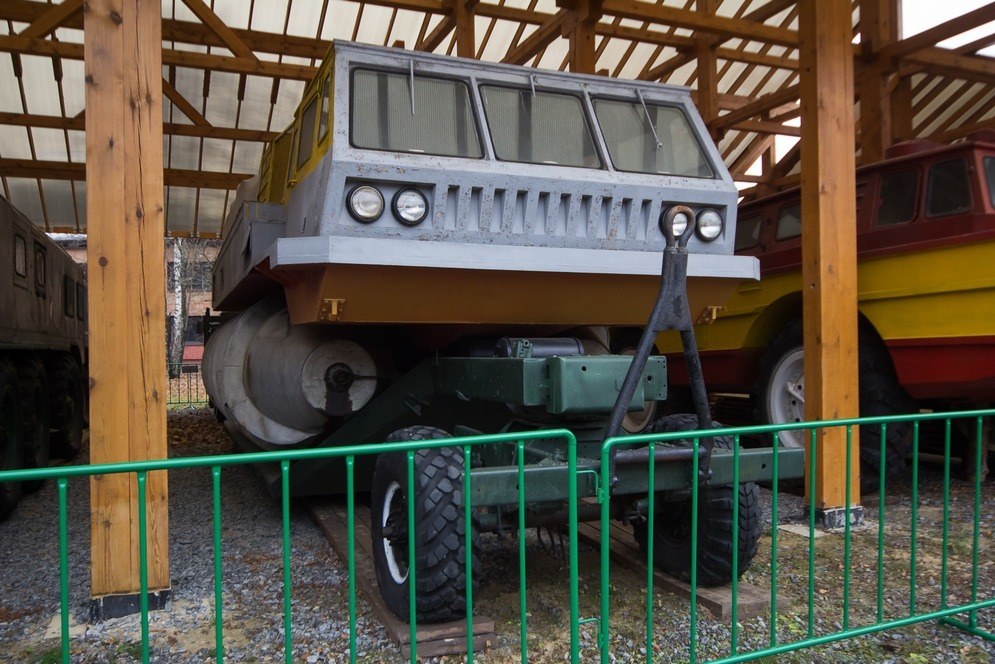
In 1965 the Voskhod 2 crew came down in deep taiga, and Sergei Korolev asked the ZIL special design bureau for a vehicle that could reach any landing site [11]. From the mid-1960s the bureau studied screw rotors among other ways of getting there [11][12]. Its giant ZIL-4904, completed in 1972 and meant for rescue services, geologists, oil workers and researchers in the far north, was built only once [10]. Two 180 hp (132 kW) ZIL-375 V8 engines turned screws 19.7 ft (6 m) long and 4.9 ft (1.5 m) across. Weighing more than 7 tonnes (15,400 lb) empty, it reached 9.9 mph (16 km/h) on snow, 6.5 mph (10.5 km/h) in water and 4.5 mph (7.3 km/h) in swamp [10]. In 2014 it belonged to the State Military-Technical Museum [10].
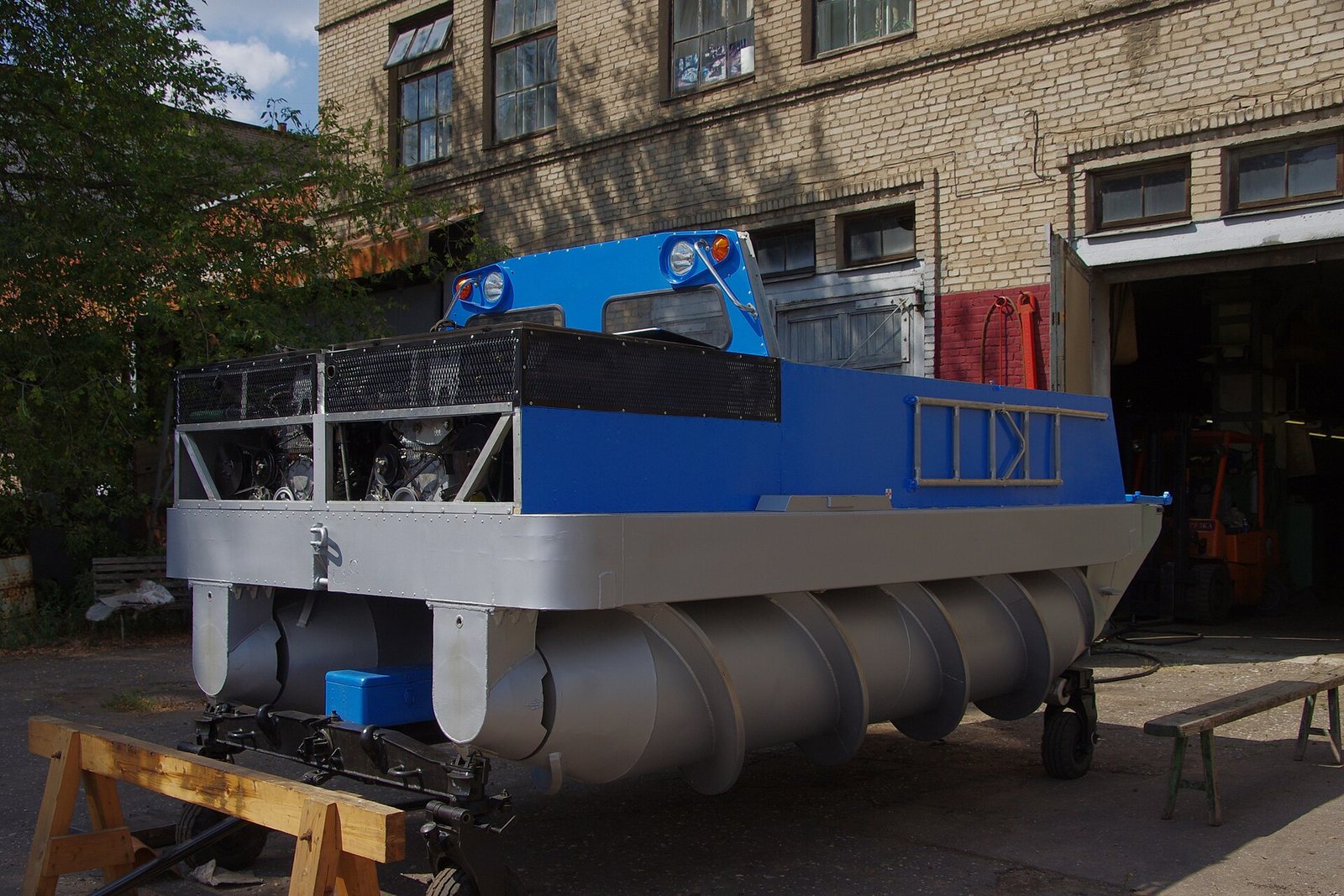
The smaller ZIL-2906 of 1975 failed its trials and was replaced in 1979 by the largely new ZIL-29061, of which five were built [11][12]. It is 16 ft (4.9 m) long, weighs 1,900 kg (4,190 lb) and has two VAZ car engines [12]. It rides on the wheeled ZIL-4906 crane vehicle, pulls descent capsules out of water, bog and deep snow, and tows them to the ZIL-4906 or a helicopter [11][12]. In 2018 Kolesa reported that it was rarely used but still kept in working order [13].
Mining machines and later builds
Screw machines found steady civilian work in mining. In a 2010 paper, engineers D. D. Smirk and S. Jackson explained that mines drying their tailings by mud farming had switched from swamp bulldozers to screw tractors called MudMasters, which plough each freshly laid layer so it drains and dries [14]. By their estimate the machines were then used on about 25 percent of the bauxite residue produced worldwide [14]. Phibion builds each MudMaster in Brisbane [15]. Its first machine for Chile shipped in 2021, and it launched a driverless version in 2023 [16][17].
Restorers and hobbyists keep the idea alive. In 2017 The Drive reported that a Russian plant had restored the ZVM-2901, a screw vehicle reportedly built for the Soviet military in the 1970s, and tested it in a swamp near Nizhny Novgorod [18]. In 2018 Hackaday described a mostly 3D-printed, radio-controlled screw-drive model that handled beach sand well [19].
| Machine | Country | Year | Built for | Speed | Type |
|---|---|---|---|---|---|
| Morath agricultural machine | United States | patented October 1899 [3] | Pulling plows and harrows on farmland [3] | not stated | Not classed |
| Armstead Snow Motor (Fordson conversion) | United States | 1920s; patent 1920 [4]; company reported by Time in January 1926 [6] | Hauling loads over snow and ice [5][6] | 6 to 8 mph (10 to 13 km/h) on snow and ice [6] | Not classed |
| Marsh Screw Amphibian | United States | 1963 [1] | US Navy; marsh and swamp transport [1] | 9.8 mph (15.8 km/h) in open water; 2 mph (3.2 km/h) on dry soil and sand [1] | Land-first |
| Amphirol (Amfirol) | Netherlands | 1966 per Carstyling [9]; Dutch patent filed 1965 [8] | Crossing tidal mudflats; later survey and polder work [2] | 5 to 6 mph (8 to 10 km/h) in open water; 12 to 19 mph (20 to 30 km/h) on hard or dry ground [1] | Land-first |
| Riverine Utility Craft (RUC) | United States | 1969 per Wikipedia [2]; WES test report 1970 [1] | US Navy river and swamp utility craft [1] | 17.2 mph (27.7 km/h) on water; 3.4 mph (5.5 km/h) rolling sideways on a hard surface [1] | Land-first |
| ZIL-4904 | Soviet Union | 1972 [10] | Search and rescue and work in roadless northern regions [10] | 6.5 mph (10.5 km/h) in water; 9.9 mph (16 km/h) on snow [10] | Land-first |
| ZIL-2906 and ZIL-29061 | Soviet Union | 1975 and 1979 [12] | Recovering spacecraft capsules from water, bog and snow [12] | up to 19 mph (30 km/h) on snow per Russian Wikipedia [12]; about 16 mph (25 km/h) per Kolesa [11] | Land-first |
| MudMaster | Australia | Series IV in use by 2010 [14] | Dewatering mine tailings and bauxite residue [14][16] | not published | Not classed |
Type follows the encyclopedia's types guide. None of these machines is known to plane, so the amphibious ones are Land-first. The Morath machine, the snow motor and the MudMaster are not classed because no cited source shows them swimming in open water.
Photos
Related entries
Sources
- Evaluation of Herbicide Application Platforms for Use in Aquatic Plant Control, Report 1: Evaluation of the Marsh Screw Amphibian (MSA), Technical Report A-77-1 (Edgar S. Rush and William E. Willoughby), US Army Engineer Waterways Experiment Station (1977-02). apcrp.el.erdc.dren.mil/elpubs/pdf/tra77-1.pdf
- Screw-propelled vehicle, Wikipedia. en.wikipedia.org/wiki/Screw-propelled_vehicle
- US 635,501: Agricultural Machine (Jacob J. A. Morath), Google Patents (1899-10-24). patents.google.com/patent/US635501A/en
- Another Fordson Snow Motor (Nancy DeWitt), Fountainhead Antique Auto Museum (2011-12-14). www.fountainheadmuseum.com/fountainheadauto/2011/12/another-fordson-snow-motor.html
- Snow Devils!, Fountainhead Antique Auto Museum (2009-12-13). www.fountainheadmuseum.com/fountainheadauto/2009/12/snow-devils.html
- Snow-Motors Inc. Conversion, Gas Engine Magazine (2012-04-10). www.gasenginemagazine.com/equipment/snow-motor-conversion
- Video: The 1964 Chrysler Marsh Screw Amphibian, Mac's Motor City Garage (2014-12-18). macsmotorcitygarage.com/video-the-1964-chrysler-marsh-screw-amphibian
- US 3,333,563: Amphibian vehicle (Joseph Jean De Bakker), Google Patents (1967-08-01). patents.google.com/patent/US3333563A/en
- DAF Amfirol 1966, Carstyling.ru. carstyling.ru/en/entry/DAF_Amfirol_1966
- Kogda tonut tanki: shnekovyi vezdekhod ZIL-4904 (When tanks sink: the ZIL-4904 screw-propelled all-terrain vehicle, Innokenty Kishkurno), in Russian, Kolesa.ru (2014-11-24). www.kolesa.ru/article/kogda-tonut-tanki_-shnekovyj-vezdehod-zil4904-2014-11-24
- Vzlet i padenie Sinei ptitsy: istoriya sovetskikh vezdekhodov dlya kosmonavtov (Rise and fall of the Blue Bird: Soviet all-terrain vehicles for cosmonauts, Innokenty Kishkurno), in Russian, Kolesa.ru (2014-12-06). www.kolesa.ru/article/vzlet-i-padenie-sinej-pticy-istorija-sovetskih-vezdehodov-dlja-kosmonavtov-2014-12-06
- ZIL-29061, in Russian, Wikipedia (Russian). ru.wikipedia.org/wiki/%D0%97%D0%98%D0%9B-29061
- I v ogne pochti ne gorim: test-drayv ZIL-49061 Sinyaya Ptitsa (ZIL-49061 Blue Bird test drive, Mikhail Balandin), in Russian, Kolesa.ru (2018-04-18). www.kolesa.ru/test-drive/i-v-ogne-pochti-ne-gorim-test-drajv-zil-49061-sinyaya-ptitsa
- In situ foundation improvement for upstream raising of embankments using dried tailings (D. D. Smirk and S. Jackson), Mine Waste 2010, Australian Centre for Geomechanics (2010). papers.acg.uwa.edu.au/d/1008_22_Smirk/22_Smirk.pdf
- The MudMaster, Phibion. www.phibion.com/the-mudmaster
- Queensland company exporting local resources innovation to South America, Australian Manufacturing (2021-06-28). www.australianmanufacturing.com.au/queensland-company-exporting-local-resources-innovation-to-south-america
- Phibion releases first autonomous MudMaster, Miners News (2023-07-03). minersnews.net/phibion-releases-first-autonomous-mudmaster
- This Fully-Restored, Screw-Driven, Amphibious Truck Is Practically Unstoppable (Kyle Cheromcha), The Drive (2017-10-10). www.thedrive.com/watch-this/14987/this-fully-restored-screw-driven-amphibious-truck-is-practically-unstoppable
- Screw Drive Tank Is Radio Controlled, 3D Printed (Zoe Skyforest), Hackaday (2018-02-25). hackaday.com/2018/02/25/screw-drive-tank-is-radio-controlled-3d-printed
Last reviewed November 2026. Spotted something to correct or add? Tell us and include a source.
About the Amphibious Encyclopedia
WaterCar has designed and built amphibious vehicles in Southern California for more than 25 years. We keep this encyclopedia so anyone curious about vehicles that cross between land and water has one place to start, with the sources listed for every fact.
Browse all entries → · The WaterCar machines → · How a WaterCar works →