
What the terms mean
An amphibious all-terrain vehicle, or AATV, is a small all-wheel-drive off-road vehicle that can also float [1]. Six-wheel amphibians sold from the early 1960s were at first simply called ATVs. When cheaper straddled three- and four-wheelers took over that name, the original type became known as the amphibious ATV [1].
A 2025 Gibbs Technologies patent describes an ATV as an off-road machine that one rider sits astride, and a UTV (utility task vehicle, or side-by-side) as one the driver sits in, with occupants side by side, usually a roll cage, and a cargo area [5]. Six- and eight-wheel amphibious ATVs fall between the two: several people sit inside, and the driver usually steers with two control sticks [1][5]. An amphibious truck is a cargo vehicle built around a boat-like hull [8].
Six- and eight-wheel amphibious ATVs
After the Jiger appeared in the early 1960s, many companies followed, and by 1970 almost 60 were building amphibious six-wheelers [1]. Sales fell sharply in the early 1970s, after the 1973 oil crisis and the arrival of three-wheelers costing $600 to $800 when a six-wheeler cost about $1,500 [1]. Vintage makes included the Amphicat and Attex. Argo and Max are among the makers active today [1][2].
These machines float on a watertight tub of hard plastic or fiberglass, helped by balloon tires run at around 3 psi (21 kPa) [1]. Argo's Frontier 8x8 has a one-piece polyethylene body [2]. Every wheel is driven, and the driver turns by slowing or braking one side, as on a tracked vehicle, which is called skid steering [1]. In water the spinning tires push the vehicle along slowly, and Argo says its chevron tread works as a paddle. An outboard motor can be added for longer trips [1][2].
They are used for hunting, recreation and industrial work, from farms to oil fields. In 2006 an Argo 8x8 helped with searches in New Orleans after Hurricane Katrina [1]. Capacity drops afloat: the Argo Frontier 750 8x8 seats six on land but four in water [2].
Large-tire and tracked utility amphibians
Larger amphibians are built for heavy work in remote country. The Sherp, which a 2020 US Department of Defense report attributes to Quadro International of Kyiv, Ukraine, rides on ultra-low-pressure tires 63 in (1.6 m) tall. Each tire has a volume of about 800 liters (210 US gal), and together with the sealed body they keep it afloat [3]. The report lists a load capacity of 2,204 lb (1,000 kg) and top speeds of 24.5 mph (39 km/h) on land and 3.7 mph (6 km/h) in water [3].
Hydratrek's D2488B has a marine-grade aluminum hull, hydrostatic drive, 24 in (61 cm) rubber tracks and two rear propellers for deep water. The maker aims it at wetland work in the utility, pipeline and construction industries and at flood response [4]. Other current makers include Land Tamer, MUDD-OX and ZZGT, whose ranges include 8x8 and tracked models [1].
Planing amphibious ATVs and UTVs
A faster approach treats the vehicle as a boat whose wheels fold away. The Gibbs Quadski, a rare straddled amphibious ATV, combines a quad bike with a personal watercraft [1][6]. Gibbs says its wheels retract in under 5 seconds, its water jet puts it on the plane in under 3 seconds, and it reaches 45 mph (72 km/h) on land and on water. Gibbs built 1,000 Quadski and Quadski XL units in Michigan from 2013 to 2016 [6].
The 2025 Gibbs patent applies the idea to a high-speed amphibian with side-by-side seating and UTV capability on land, using retracting wheels and a planing hull [5].
Amphibious trucks
The best-known amphibious truck is the World War II DUKW, or Duck, a Roderick Stephens design built by GMC with a hull wrapped around a 6x6 truck chassis [8]. The United States built about 20,000. DUKWs first saw combat in Sicily in 1943 and let supplies drive straight from ships onto beaches [7].
The US Army later built larger wheeled amphibians for the same ship-to-shore job. The 35 ft (10.7 m) LARC-V made about 10 mph (16 km/h) in water. The BARC, or LARC-LX, was a 62 ft (19 m) giant with four diesel engines and a 60-ton capacity [8].
The Soviet Union, which received 589 DUKWs through Lend-Lease from 1944, built its own version, the BAV-485, from 1952 to 1962. It used ZIS-151 truck components and added a folding tailgate for loading heavy equipment, and afloat it could carry 28 troops or 3 tons of cargo [9].
Surplus DUKWs became tour vehicles as early as 1946, when operators began using them for water tours [7]. Today's fleets mix refurbished military vehicles with replicas. A replica that capsized on Table Rock Lake at Branson, Missouri, killed 17 people [7].
How the types differ
Speed on water shows the main divide. Most of these vehicles are slow afloat, from 3.7 mph (6 km/h) for the Sherp to about 10 mph (16 km/h) for the LARC-V, while the planing Quadski is rated at 45 mph (72 km/h) [3][6][8].
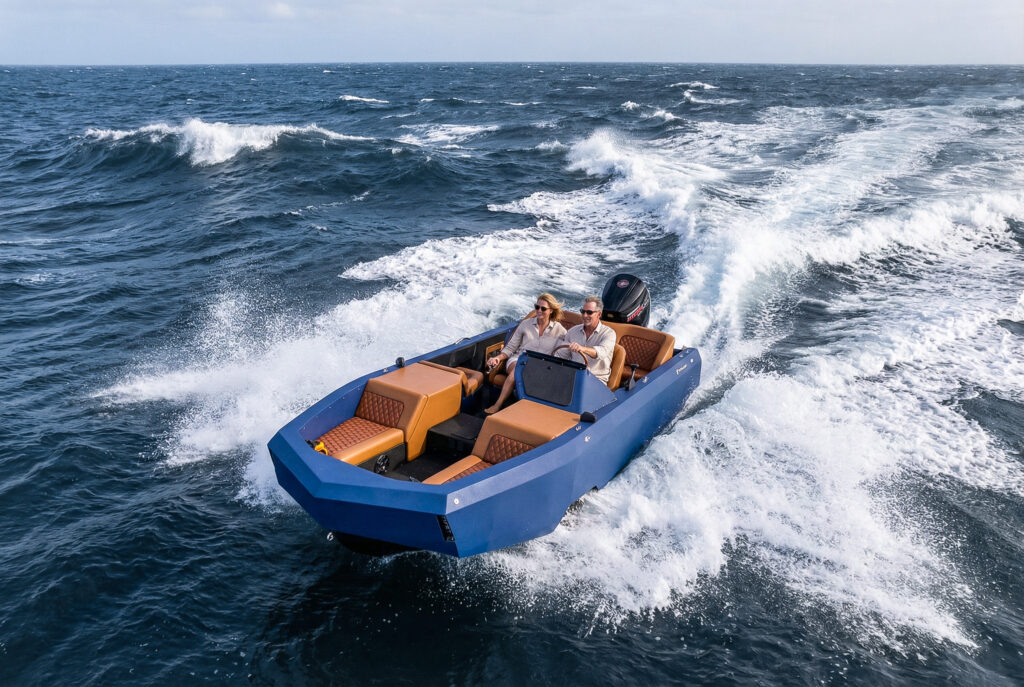
A boat-first design reverses the usual order. WaterCar presents its current vehicle as a boat first that drives itself to the water [10]. It has a 19.5 ft (5.94 m) welded aluminum V-bottom tri-hull, a 115 hp Mercury outboard, a 48-volt battery-powered land drive and hydraulic wheel retraction [10]. On the road it is certified as a low-speed vehicle (LSV) under the federal FMVSS 500 standard, with a top speed of 25 mph (40 km/h). WaterCar lists about 35 mph (56 km/h) on water [10].
Safety and rules
Amphibious ATVs are classed as off-highway vehicles in many countries [1]. Argo says its machines must never be driven on public roads, and that riders must wear a helmet and, in water, a properly fitted personal flotation device [2]. A road-going amphibian may need two registrations: WaterCar says its vehicle is titled as an LSV for the road and registered as a vessel for the water [10].
Related entries
Sources
- Amphibious ATV, Wikipedia. en.wikipedia.org/wiki/Amphibious_ATV
- 2027 ARGO Frontier 750 8x8, Arctic Cat (ARGO). www.arcticcat.com/argo/2027/frontier-750-8x8
- SHERP Amphibious All-Terrain Vehicles (DSIAC Technical Inquiry Response Report DSIAC-2020-1230, Scott Armistead), Defense Systems Information Analysis Center (DSIAC), US Department of Defense (2020-02-13). dsiac.dtic.mil/wp-content/uploads/2020/05/TI-Response_Sherp-ATVs_Armistead.pdf
- D2488B, Hydratrek, Inc.. www.hydratrek.com/d2488b
- US 12,415,393 B2: Amphibian, Google Patents (Gibbs Technologies Ltd) (2025-09-16). patents.google.com/patent/US12415393
- Quadski, Gibbs Amphibians. gibbsamphibians.com/platform/quadski
- Duck Boats Offered a Unique Solution to a World War II Problem (Becky Little), History.com (2018-07-23). www.history.com/articles/duck-boats-world-war-ii-d-day
- Gators, Goats, Otters, and DUKW's: The U.S. Army At Sea...And On Land (David Doyle), Military Trader (2008-07-14). www.militarytrader.com/military-vehicles/gators-goats-otters-and-dukws-the-us-army-at-seaand-on-land
- BAV-485 (1952), Truck Encyclopedia. truck-encyclopedia.com/coldwar/ussr/BAV-485.php
- Specs, WaterCar. www.watercar.com/specs
Last reviewed November 2026. Spotted something to correct or add? Tell us and include a source.
About the Amphibious Encyclopedia
WaterCar has designed and built amphibious vehicles in Southern California for more than 25 years. We keep this encyclopedia so anyone curious about vehicles that cross between land and water has one place to start, with the sources listed for every fact.
Browse all entries → · The WaterCar machines → · How a WaterCar works →