
Louisiana marsh buggies
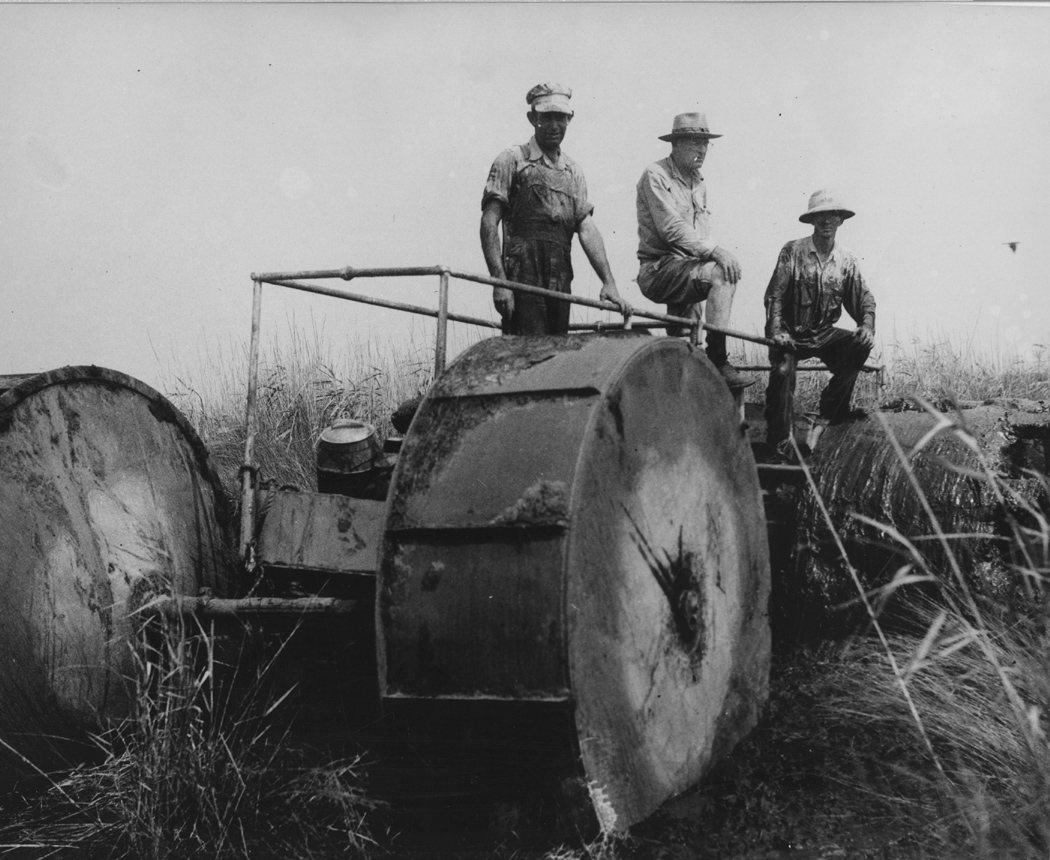
On the Louisiana coast the marsh buggy began with trappers. In the 1930s trappers in the Mermentau Basin rebuilt light Model A Ford trucks with long axles and wagon wheels fitted with wooden slats 4 to 5 ft (1.2 to 1.5 m) wide [3]. These slat-wheel buggies flattened a path through marsh grass, but they could not float, and in deep, soft spots they sank and had to be dug out [3][5]. Marsh work was costly for oil companies: in 1939 Shell estimated that a seismograph crew cost $350 a day in the marsh, against $250 a day on dry land [3].
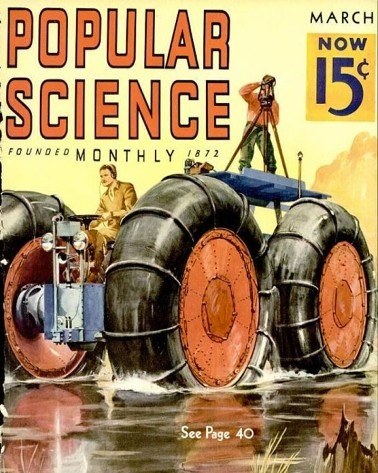
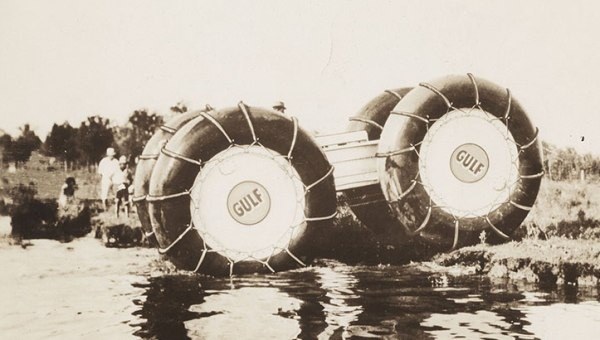
Gulf Oil tackled the floating problem in the mid-1930s with a buggy on rubber tires 10 ft (3 m) tall and 3 ft (0.9 m) thick, known as the Gulf Marsh Buggy or balloon buggy-boat [3][5]. Mac's Motor City Garage, drawing on a Popular Science cover story of March 1937, credits the idea to Abbot A. Lane of Gulf Research and Development. It reports an eight-cylinder car engine and speeds of 35 mph (56 km/h) on pavement, 10 mph (16 km/h) on swampland and six knots (about 7 mph, 11 km/h) in water [6].
A description of a ten-foot-tired Louisiana marsh buggy in the British part-work Wonders of World Engineering explains how such a machine swam. Its aluminum wheels were hollow, watertight drums, buoyant enough to keep the 7,500 lb (3,400 kg) buggy afloat even with every tire flat. The tires ran at only 3 to 5 psi (21 to 34 kPa), the buggy drew less than 2 ft (0.6 m) of water, and afloat it steered by driving the wheels on one side [7]. That article names no maker, but it gives a Ford V8 engine and much the same speeds as the Gulf buggy [6][7].
Gulf never patented the design or sold it, and roughly a dozen competitors soon built their own versions [3][5]. The McCollum Exploration Company of Houston built a propeller-driven version, which a Louisiana columnist calls a likely ancestor of the airboat [3][5]. After World War II Andrew Cheramie patented a buggy made from a tractor on giant pontoon wheels, whose ribbed treads drove it at up to 10 mph (16 km/h) in marsh and water and 30 mph (48 km/h) on land [3]. Trappers complained that buggy wheels tore up the marsh and their traps [3][5]. Tracked buggies on flotation pontoons later took over, and their descendants are covered under amphibious excavators [3].
Florida swamp buggies
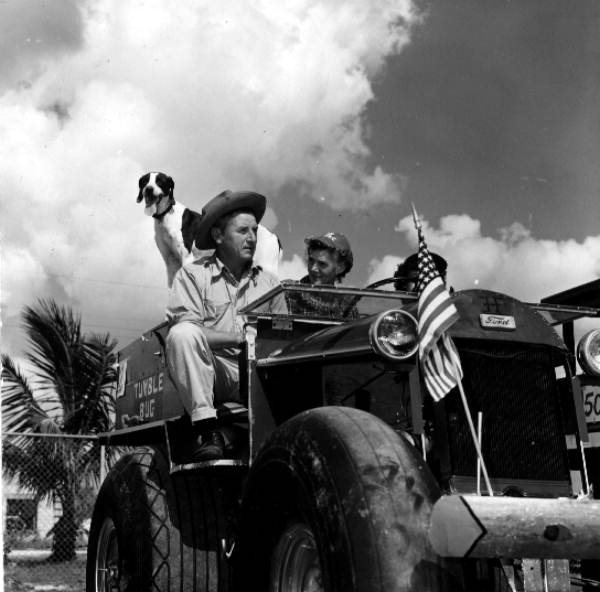
In southwest Florida the swamp buggy is credited to Ed Frank, a self-taught Naples machinist with a garage on Fifth Avenue South [2][9]. The City of Naples dates his first buggy to 1921 and PBS to about the 1920s, while the Florida Historical Society and Wikipedia give no build date and describe buggies in use in the Everglades in the 1930s and 1940s [1][4][8][9]. His tall Tumble Bug rode on huge balloon tires and carried hunting parties deep into the Everglades, where the water could be chest-deep [1][2][9]. Builders used Model A parts and orange crates for seats and, after World War II, surplus aircraft tires and Jeep parts [2][9].
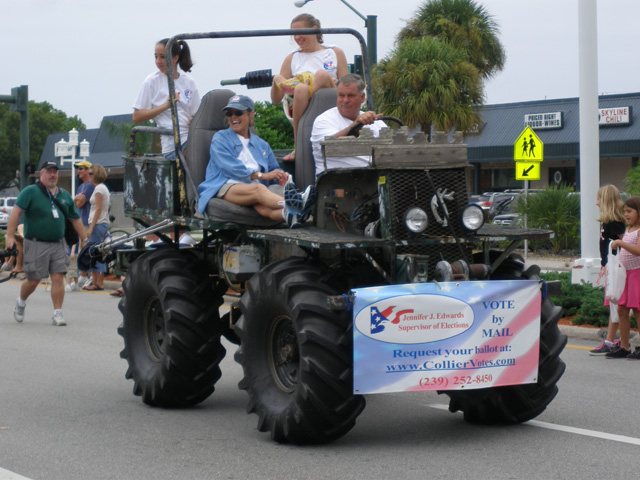
Most buggies were either built from scratch or made by rebuilding an ordinary vehicle [4]. Wikipedia describes two regional styles: the low, Jeep-like Glades buggy and the Palm Beach buggy, a raised platform on four big wheels [1]. The race organizers say that by the 1950s the State of Florida used swamp buggies for law enforcement in rough country [2].
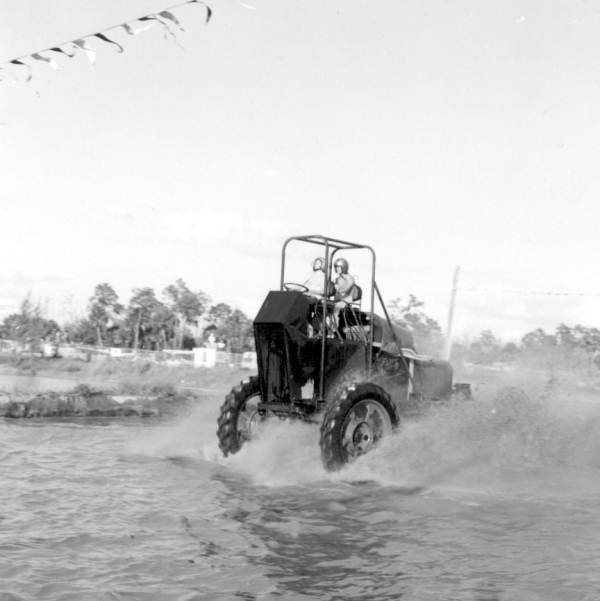
Swamp buggies cross water by wading as well as floating. Wikipedia notes that they can push through deep mud and water and may also float [1]. Height does much of the work for a racing buggy: on the Naples course it charges through about 2 ft (0.6 m) of water and two holes about 5 and 6 ft (1.5 and 1.8 m) deep [9]. The Gulf-style marsh buggy, by contrast, was designed to float on its tires and wheels [3][7].
The Naples Swamp Buggy Races
Hunters were racing their buggies for fun by the early or mid-1940s; the organizers say informal contests ran on Raymond Bennett's potato farm from about 1943 [2][4][10]. The first official Swamp Buggy Races were held in Naples on November 12, 1949, with 50 competitors, according to the organizers [2]. PBS says local businessmen asked the hunters to stage a race and parade for visiting journalists [9]. The second annual race followed on October 28, 1950 [4].
The races moved to the Florida Sports Park, on the edge of Naples, in 1986 [1][9]. Its course is nicknamed the Mile O' Mud: a seven-eighths-mile (1.4 km) oval crossed by a one-eighth-mile (200 m) diagonal lane [10]. In 2015 Slate reported three race events a year, each drawing thousands of spectators [10]. Tractor tires had replaced aircraft tires by the 1980s, and race buggies became too specialized, loud and fast for hunting [1][2][10]. Classes now include Pro-Mod, Jeep, air-cooled, four-cylinder, six-cylinder and V8 Sportsman [9]. PBS puts the top buggies above 60 mph (97 km/h), while Slate said the fastest could pass 100 mph (160 km/h) [9][10].
Tradition counts as much as speed. Naples high school students vie each year for the title of Swamp Buggy Queen [10]. The winner of the main race and the queen end up in the mud pit together, a custom Wikipedia traces to 1957 [1][9]. In 2008 Amy Chesser became the first woman to win the big feature race, according to PBS [9].
Photos
Related entries
Sources
- Swamp buggy, Wikipedia. en.wikipedia.org/wiki/Swamp_buggy
- History, Swamp Buggy Races (official site). www.swampbuggy.com/history
- History of the Offshore Oil and Gas Industry in Southern Louisiana, Volume I: Papers on the Evolving Offshore Industry (OCS Study MMS 2008-042; Diane Austin, Tyler Priest and others), US Minerals Management Service (2008). espis.boem.gov/final%20reports/4530.pdf
- Naples Swamp Buggy Races, Florida Historical Society. myfloridahistory.org/node/2716
- Jim Bradshaw: Slat-wheeled Model A's helped open the oil patch, St. Mary Now (2017-05-19). www.stmarynow.com/node/195474
- Strange Cargo: The 1936 Gulf Marsh Buggy, Mac's Motor City Garage (2020-06-24). macsmotorcitygarage.com/strange-cargo-the-1936-gulf-marsh-buggy
- Marsh Buggy, Wonders of World Engineering. wondersofworldengineering.com/marsh_buggy.html
- Fun facts: 1920s, City of Naples Centennial. www.naplescentennial.com/fun-facts-category/1920
- Swamp Buggy Fever!, PBS (2026-01-22). www.pbs.org/video/swamp-buggy-fever-xdwpfe
- Only Floridians Could Come Up With a Sport Like Swamp Buggy Racing (Jordan G. Teicher), Slate (2015-07-07). www.slate.com/blogs/behold/2015/07/07/malcolm_lightner_photographs_swamp_buggy_races_in_florida_in_his_book_mile.html
Last reviewed November 2026. Spotted something to correct or add? Tell us and include a source.
About the Amphibious Encyclopedia
WaterCar has designed and built amphibious vehicles in Southern California for more than 25 years. We keep this encyclopedia so anyone curious about vehicles that cross between land and water has one place to start, with the sources listed for every fact.
Browse all entries → · The WaterCar machines → · How a WaterCar works →