
Origins in the Louisiana marshes
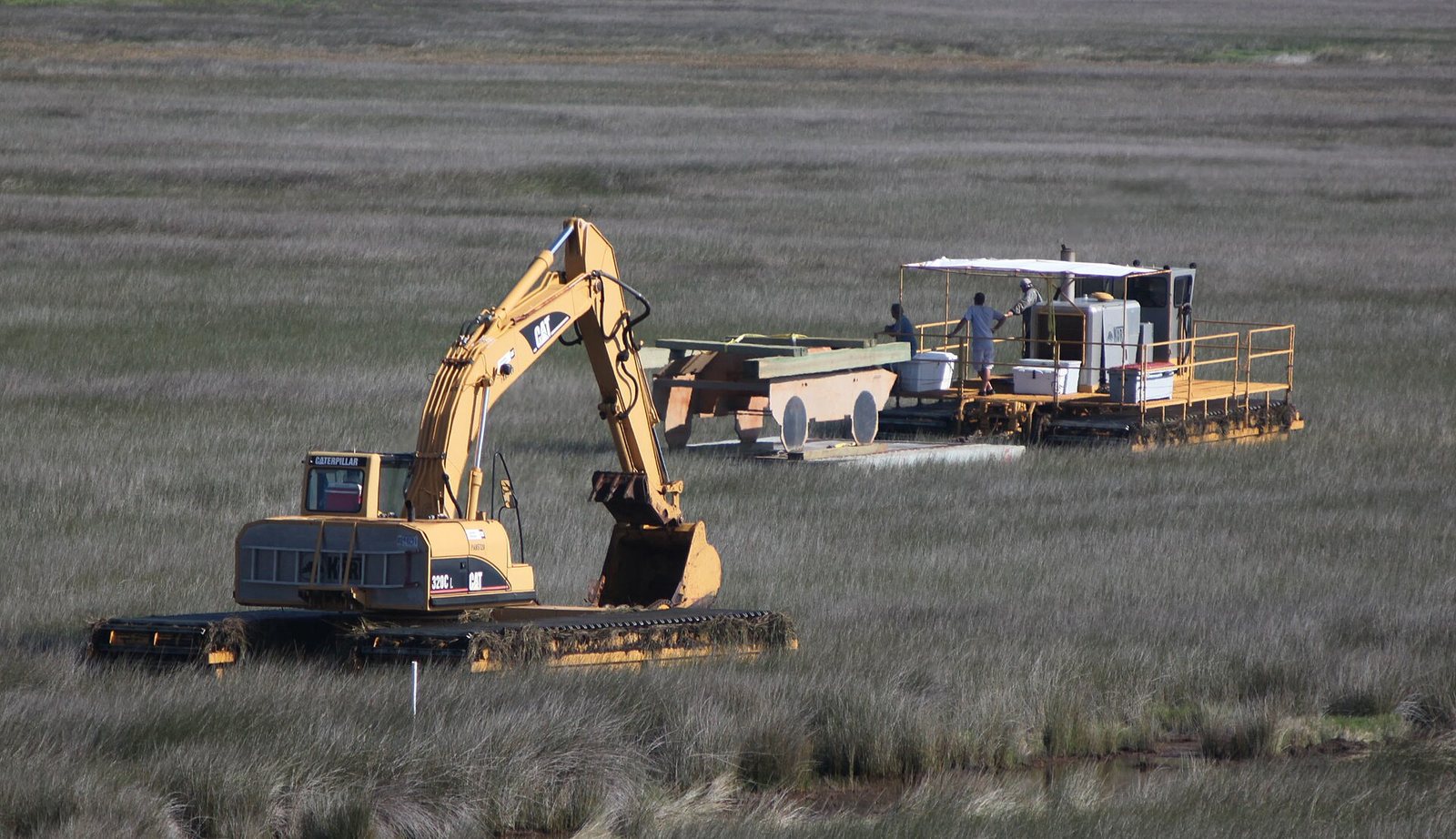
The machines trace their roots to oil exploration in the wetlands of southern Louisiana. A 2008 history prepared for the US Minerals Management Service describes how trappers in the 1930s used light Model A Ford trucks fitted with long axles and wagon wheels carrying wide wooden slats to cross marsh grass, and how Gulf Oil in the mid-1930s designed a buoyant buggy on rubber tires 10 ft (3 m) in diameter [1]. Higgins Shipyards in New Orleans and several oil companies built their own designs during and after World War II, and some builders ran tracks around flotation pontoons. By 1960 exploration crews had largely moved to track-type buggies, which did less damage to the marsh [1].
Mounting a full excavator on this kind of undercarriage came later. According to Construction Equipment magazine, the Kori amphibious undercarriage was invented by Huey J. Rivet, a contractor from Harvey, Louisiana, who wanted a better tool for swamp work, and it first carried a 25-ton excavator in the 1970s [2]. By 2011 Kori undercarriages were made for excavators of 6 to 50 metric tons and shipped worldwide [2]. In the US trade the finished machine is still often called a marsh buggy [3].
Pontoon-track excavators
The pontoon-track design replaces an excavator's crawler tracks with two buoyant pontoons, each wrapped in a cleated track, joined by a frame that carries the excavator's upper structure [5]. A standard machine can be converted: for the South Carolina utility Santee Cooper, technicians removed a Cat 326F's crawler, fitted a new center frame and attached an EIK pontoon undercarriage with a long-reach arm [5]. Because the weight is spread over long pontoons, ground pressure is very low. Construction Equipment reported about 1.5 psi (10 kPa) for a Kori-mounted excavator, with the counterweight removed [2].
These machines are meant for shallow water. An EIK manager told The Waterways Journal in 2016 that makers generally limit work to water about 1.5 m (5 ft) deep for stability, and that side pontoons fitted with spuds allow occasional work in up to about 4 m (13 ft) [4]. The pontoons can be pulled closer together for road transport, and EIK's drive, patented in the United States in 2014, uses hydraulic motors at both ends of each pontoon instead of a single chain drive [4]. According to the maker, EIK, based in Malaysia, developed its first amphibious excavator, the AM200, in 2006 [6].
Typical jobs include pipeline and marsh work, shoreline and bridge projects, and clearing ash ponds and dredged-material sites. In 2017 a contractor used an EIK-mounted long-reach machine to cut dewatering channels 3,000 ft (about 910 m) long in a dredged-material site at Matagorda Bay, Texas [5]. In New Jersey a marsh buggy placed rock-filled gabion baskets under the bridges to Long Beach Island, where the water was too shallow for a barge and too deep for an ordinary excavator [3].
Amphibious dredgers: Watermaster and Amphibex
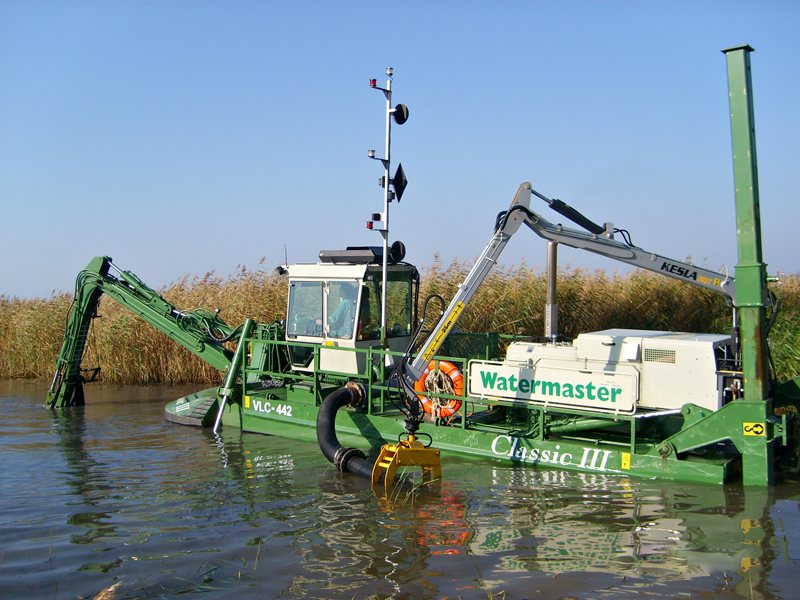
A second family is built as a small self-propelled vessel with an excavator arm and legs. Finland's Watermaster, made by Aquamec, was developed from 1986, and a fourth generation appeared in 2011 [11]. It walks from land into water using two tilting rear legs and its arm, anchors itself on four legs, and works from dry ground to about 6 m (20 ft) deep with a cutter pump, bucket, rake or pile driver [11]. The water utility of Barranquilla, Colombia, used one from September 2013 to May 2014 to clean a 22,000 m2 (26,300 sq yd) river intake to a depth of 4 m (13 ft) [11]. An Australian example delivered in 2020, Hall Contracting's Maroochy River, is 11 m (36 ft) long without its boom, displaces 19.5 tonnes and has a 205 kW (275 hp) Caterpillar diesel [12].
Canada's Amphibex comes from Normrock Industries of Terrebonne, Quebec, founded in 1987 by Norman Grant [7][8]. The Waterways Journal reported that Grant had used barge-mounted excavators to break rock while working in Africa, bought a small Finnish machine on his return, and then built his own model, the AE300 [7]. By 2018 the range ran to nine models, from the AE400 with a 350 hp (260 kW) Cat C9 engine to the AE1200, 60 by 28 ft (18 by 8.5 m), with a 1,350 hp (1,007 kW) Cat C32 and a dredging depth of 38.5 ft (11.7 m) [7]. Four tilting spuds steady the hull and let it launch itself, and two outriggers with floats add stability [7]. The journal counted 27 Amphibex machines working for Iraq's river dredging authority on the Tigris and Euphrates [7].
Ice breaking became an unplanned specialty. Normrock's first ice job came in early 1990, when Terrebonne asked whether the machine could free river ice that threatened to flood the city [8]. Manitoba uses Amphibex machines on the Red River north of Winnipeg each winter; in 2015 its fleet included four AE 400 icebreakers, described as 24-ton machines, run by a corporation formed by local municipalities [9]. Remote-controlled cutters first score the ice. The Amphibex then raises itself on its arm and drops its weight onto the ice, opening a channel about 100 m (330 ft) wide over 28 km (17 mi), from Selkirk to the Netley-Libau Marsh [10].
Small amphibious tool carriers
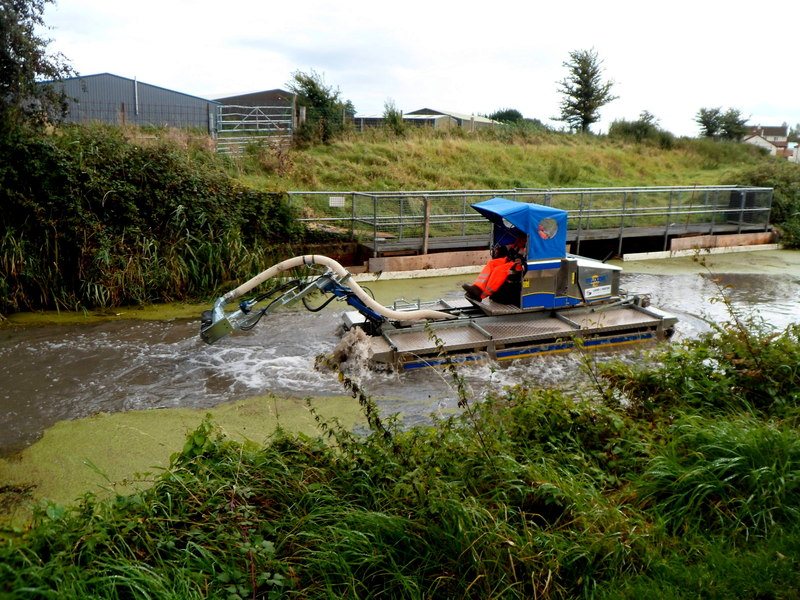
At the light end are compact machines such as the Truxor, made by Truxor Wetland Equipment of Dorotea, Sweden. According to the maker, the business began with a reed cutter about 30 years ago, it has built amphibious wetland machines since 1994, and its tools cover cutting, raking, digging and dredging [14][15]. Local governments use such machines for weed control. In 2019 Bundaberg Regional Council in Queensland hired a Truxor from Fraser Coast Regional Council to rake invasive salvinia out of Baldwin Swamp; its bucket could lift up to about 250 kg (550 lb) [13].
Photos
Related entries
Sources
- History of the Offshore Oil and Gas Industry in Southern Louisiana, Volume I: Papers on the Evolving Offshore Industry (OCS Study MMS 2008-042), US Department of the Interior, Minerals Management Service, Gulf of Mexico OCS Region (2008-09). espis.boem.gov/final%20reports/4530.pdf
- Let Me Run Something Bayou..., Construction Equipment (Frank Raczon) (2011-12-22). www.constructionequipment.com/home/blog/10727504/let-me-run-something-bayou
- Unique Situations, Challenges: Percy Ransome's Specialty, Construction Equipment Guide (2017-04-19). www.constructionequipmentguide.com/unique-situations-challenges-and-percy-ransomes-specialty/33848
- New Design Gives 'Four Wheel Drive' to Amphibious Excavator Tracked Pontoons, The Waterways Journal (2016-09-27). www.waterwaysjournal.net/2016/09/27/new-design-gives-four-wheel-drive-to-amphibious-excavator-tracked-pontoons
- Amphibious Vehicles Needed to Work Large Dredged Material Sites, The Waterways Journal (2018-01-17). www.waterwaysjournal.net/2018/01/17/amphibious-vehicles-needed-to-work-large-dredged-material-sites
- Milestones, EIK Engineering (maker). eikengineering.com/about-us/milestones
- Normrock's Amphibex Machines are Versatile and Portable for Environmental Jobs, The Waterways Journal (2018-01-17). www.waterwaysjournal.net/2018/01/17/normrocks-amphibex-machines-are-versatile-and-portable-for-environmental-jobs
- Ice Breaker, Design Engineering (Treena Hein) (2011-04-27). www.design-engineering.com/features/ice-breaker
- Four Amphibex Icebreaking Machines Working to Protect Manitobans: Premier Selinger, Province of Manitoba (news release) (2015-02-17). news.gov.mb.ca/news/print,index.html?item=34052
- Sign of spring? Amphibex fleet set to begin breaking ice near Selkirk, CBC News (2023-02-16). www.cbc.ca/lite/story/1.6750272
- Watermaster Dredge Works to Clean Colombian River, The Waterways Journal (2015-01-29). www.waterwaysjournal.net/2015/01/29/watermaster-dredge-works-to-clean-colombian-river
- Vessel review: Maroochy River, Hall Contracting's newest amphibious dredger to take on challenging shallow-water projects, Baird Maritime (2020-11-24). www.bairdmaritime.com/work-boat-world/marine-projects-world/dredging-and-land-reclamation/vessel-review-maroochy-river-hall-contractings-newest-amphibious-dredger-to-take-on-challenging-shallow-water-projects
- Water weeds removed from Baldwin Swamp, Bundaberg Now (Bundaberg Regional Council) (2019-10-01). www.brcnow.bundaberg.qld.gov.au/2019/10/01/water-weeds-baldwin-swamp
- Truxor Wetland Equipment AB: About Us, Truxor Wetland Equipment (maker). truxor.com/en/content/about-us
- Making Wetland Equipment & Amphibious Machines Since 1994, Truxor Wetland Equipment (maker). truxor.com
Last reviewed November 2026. Spotted something to correct or add? Tell us and include a source.
About the Amphibious Encyclopedia
WaterCar has designed and built amphibious vehicles in Southern California for more than 25 years. We keep this encyclopedia so anyone curious about vehicles that cross between land and water has one place to start, with the sources listed for every fact.
Browse all entries → · The WaterCar machines → · How a WaterCar works →