
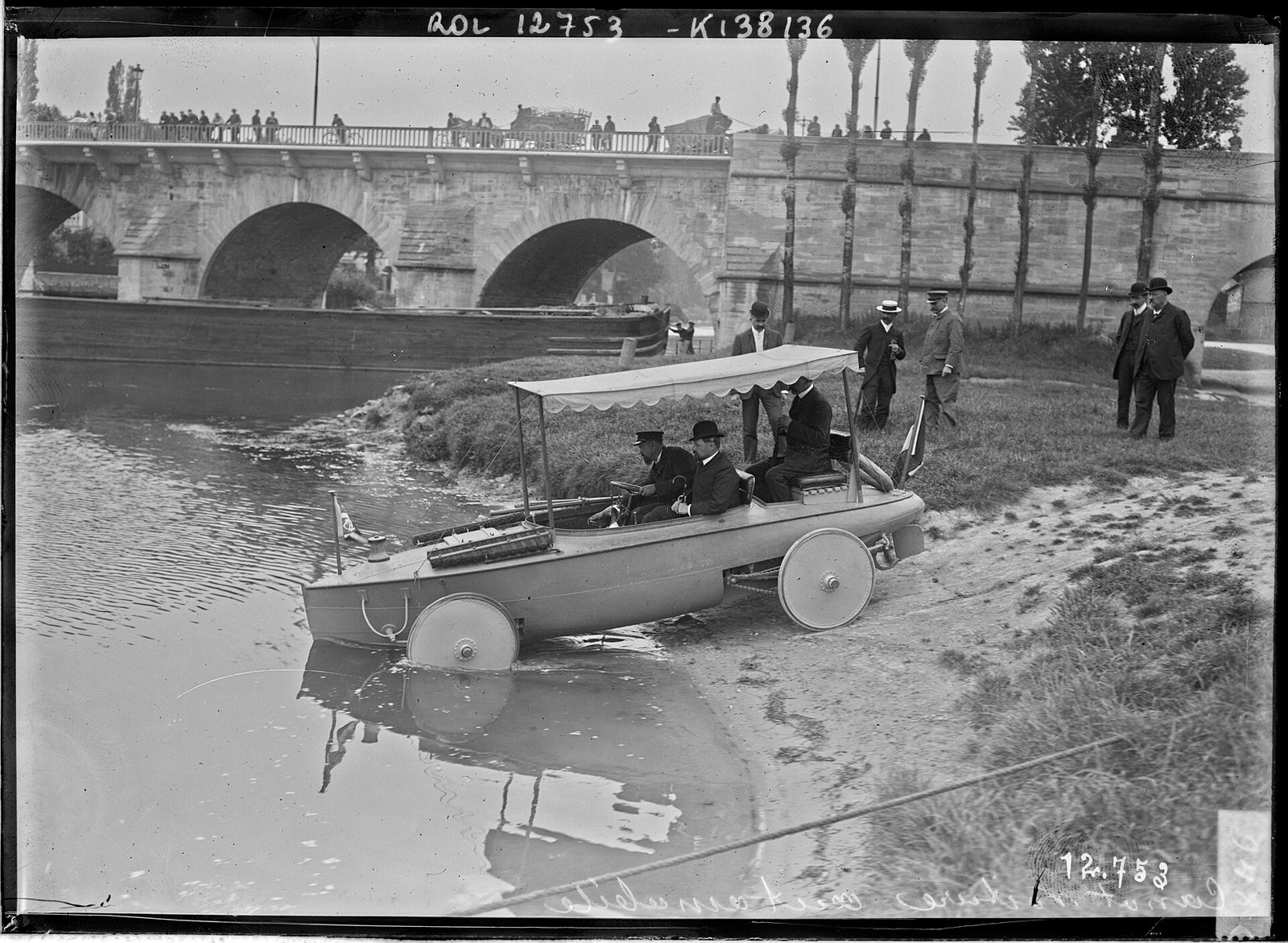
Wheels on boats, boats on wheels
Machines that could cross land and water are older than the motor car: Oliver Evans's steam-driven Oruktor Amphibolos of 1805, which has its own entry, came long before it [1]. Once the motor car arrived, many more attempts followed, and German Wikipedia notes that until the mid-1920s most of them came down to mounting a chassis on a boat [5]. Some of the results worked, some stayed on paper and some are known only from a line in a collector's list, so the evidence for each machine is given below [3][4].
Steam tugs and a paddling carriage
In Canada the West and Peachey foundry at Simcoe, Ontario, began making steam alligator tugs in 1889. They towed log booms with a winch and pulled themselves overland from lake to lake, and more than 230 had been built by 1932; they have their own entry [15].
A Danish machine called the Magrelen Amphibium, dated 1899 and said to have a combustion engine, heads an archived online list of amphibious cars attributed to René Pohl, with no picture [3]. German Wikipedia calls it the first known motorized amphibious vehicle but cites nothing for it [5].
Better recorded is the carriage that T. Richmond built at Jessup, Iowa, in 1905 [1][2]. It ran on three wheels: the single front wheel steered on land and in water, and a three-cylinder gasoline engine drove two oversized rear wheels [1]. Drawing on Pohl's 1998 book, Wikipedia calls its boat-shaped hull one of the first integral bodies on a car [1]. It swam with its wheels. Wikipedia describes fins or buckets fixed to the rear spokes, while a caption from Floyd Clymer's motoring scrapbook, quoted on the Antique Motorcycle Club of America forum, says hinged paddles opened and closed by themselves as the wheels turned [1][2]. The same caption adds a winter option: ice-boat spikes could be fitted and a runner placed under the front wheel, a change it says took only a few minutes [2]. Human-powered amphibious tricycles of the same era are covered separately.
Patents and paper amphibians
Patent offices saw the idea early. Edward Fournier of North Yakima, Washington, applied in March 1904 for an automobile boat and received US patent 802,852 in October 1905 [6]. His boat hull was bolted into sprung cradles on the axles of a wheeled land attachment, and one engine and one steering wheel served both the road wheels and a screw propeller and rudder [6]. Karl Maisch applied in 1906 for a Swiss patent on land and water automobiles, published in 1907 [7][5]. German patent 208,869, with a priority date of June 1907, claimed an ordinary car frame joined to a removable boat hull closed on every side [8]; German Wikipedia credits it to Jean Rech of Mehlem [5]. Jules Julien Ravaillier's boat-car, tested in Paris and patented in the United States in 1907, has its own entry [5].
Claims could outrun the hardware. In November 1921 American Automobile Digest described the Auto-Boat of the New Yorker Paul Panketan, a five- or seven-seat boat-bodied car said to reach nearly 90 mph (145 km/h) on land and an estimated 35 mph (56 km/h) afloat after lifting its wheels in 15 seconds [12]. Revisiting it in 2015, Old Cars Weekly judged the photos of it in the water to look retouched and found no sign that it went into production [12].
Boat-cars of the 1910s and 1920s
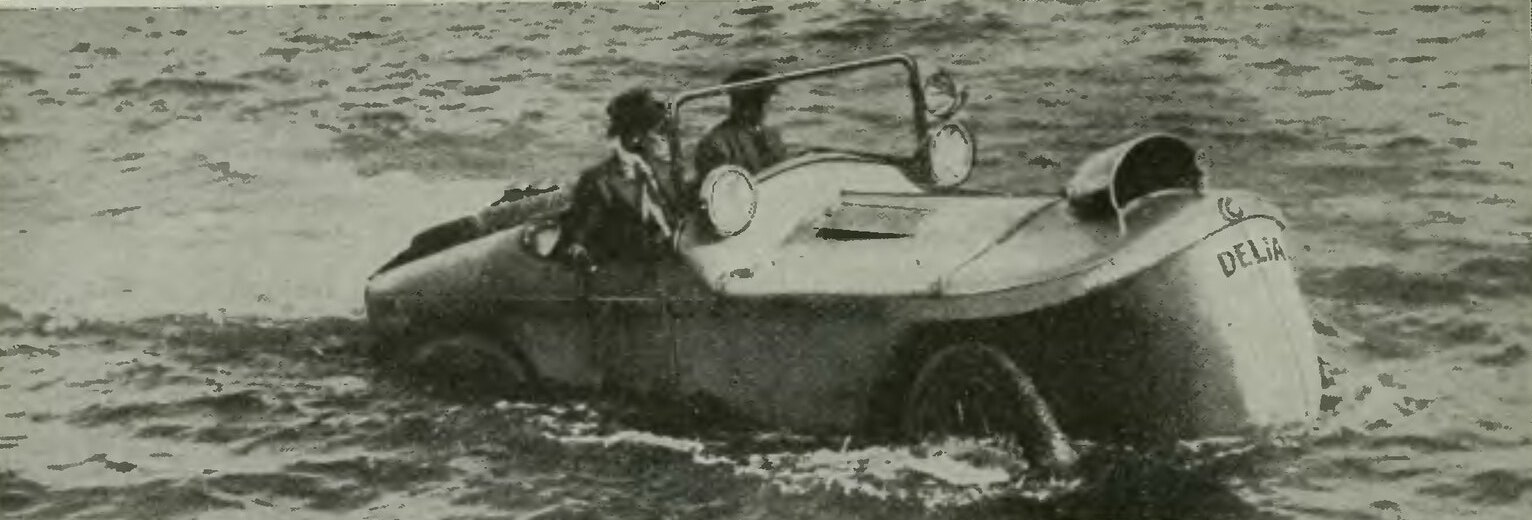
In 1916 Popular Science Monthly reported that Delia, a car with a boat body, had driven off a busy beach near San Francisco into the sea, toured the harbor briefly and returned to land [9]. The wheels passed through openings in the hull. In the water the drive was switched from the wheels to a propeller at the stern, and the steering wheel turned a rudder [9]. Shaft-style packing sealed the axle holes, the springs sat inside the hull, and the magazine gave a speed of about 10 mph (16 km/h) in water, adding that it was not meant for rough weather [10]. The magazine named Michael de Cosmo of San Francisco as the inventor [10]. Pohl's list gives the car as the Hydromotor (Delia), a small production of perhaps a handful of cars between 1914 and 1917, with no other record of that production found [3].
In England, Pohl lists the Mathieson Seacar of 1922 to 1924 as rescue boats on Ford Model T chassis, followed in 1923 by a larger version, the Barnes Amphibian, and another copy, the Robinsons Silver Spray; no other record of these three was found [3]. Others pushed themselves with an air propeller instead of paddles or a screw: Pohl lists the Garbaccio from Switzerland (1913), the Metcalf Amphiglyder from England (1920) and the McLaughlin Maine Mobile from the United States (1926), without further detail and with no other record found [3][4].
Survey boats, naval trials and a Channel crossing
In 1928 the volcanologist Thomas A. Jaggar used two amphibians, the Ford-based, paddle-wheeled Ohiki in Hawaii and the twin-screw steel Honukai in Alaska, which are covered in their own entry [13][14]. The Honukai came from George Powell, who, Jaggar wrote, already advertised a Ford-based mobile boat so fishermen could drive to inland lakes [13]. The USGS names the builder as the Powell Mobile-Boat Corporation of Chicago [14].
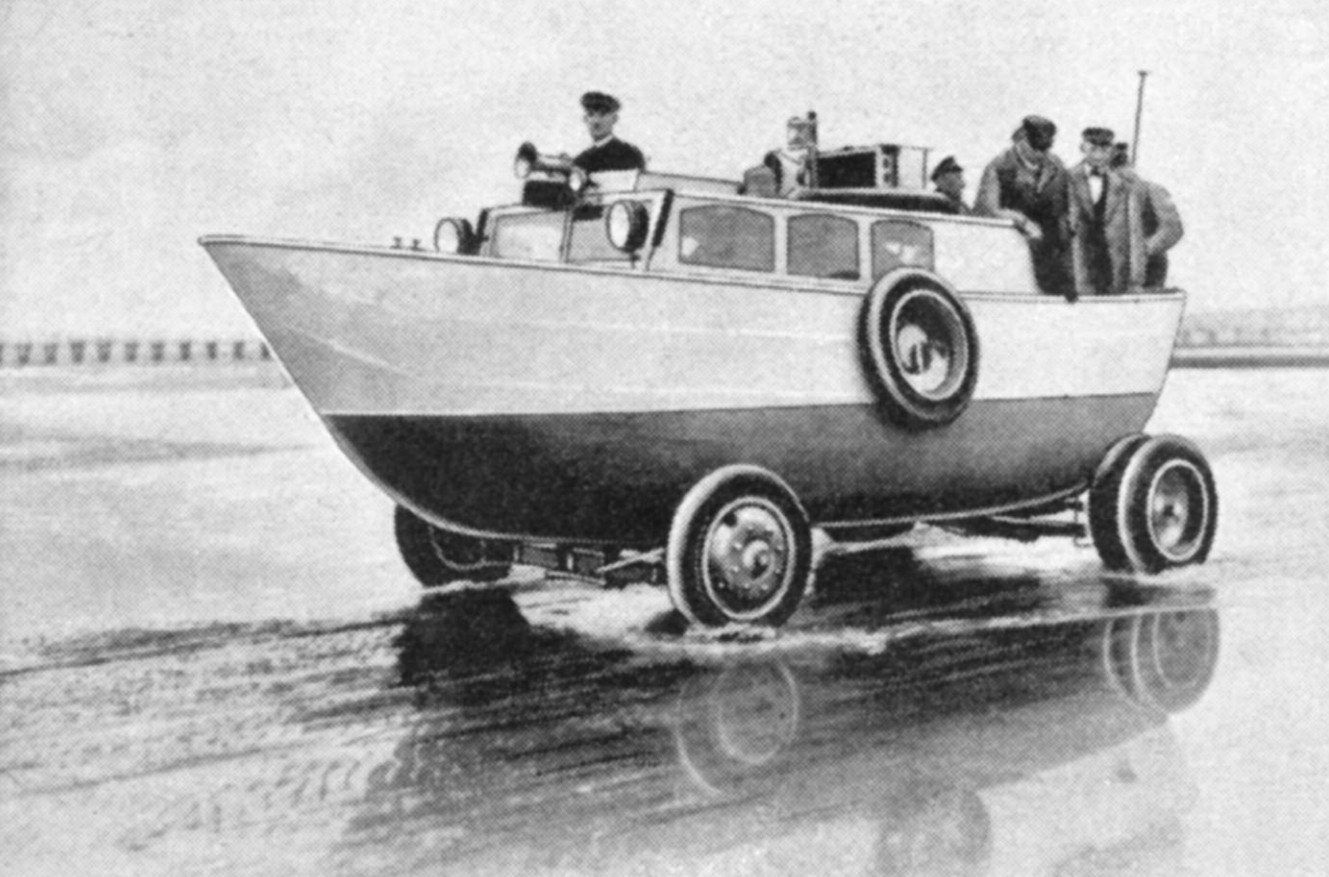
In Germany the Cuxhaven firm Hoppe und Krooss built an amphibious test vehicle in 1929 at the German navy's request, which the press called the Auto-Schiff, or car-ship [11]. The vehicle, which weighed about 4 tonnes (8,800 lb), joined a boat hull to a four-wheel-drive chassis with swing axles made under a patent of the Berlin firm Voran [11]. A 40 PS (39 hp) Opel four-cylinder drove the wheels through an Opel three-speed gearbox, and afloat it turned a three-blade propeller while the front wheels steered [11]. It made about 11 km/h (7 mph) in water and at most 24 km/h (15 mph) on land, was photographed on the North Sea in autumn 1929 and remained a single prototype [11].
Pohl's list also records a sea crossing in the mid-1930s: a Baulig amphibious car, dated 1935, that crossed the English Channel from Calais to Dover [4]. The same list puts Hans Trippel's first Land-Wasser-Zepp amphibians in 1934 and 1935; Trippel has his own entry [4].
Machines covered
The table lists the machines and patents described above in date order. Many rest on a single collector's list, and those rows say so [3][4].
| Machine | Country | Year | What it was | How it swam |
|---|---|---|---|---|
| Alligator warping tugs | Canada | 1889 [15] | Steam logging tug that towed log booms and winched itself overland between lakes [15] | Paddle wheels [15] |
| Magrelen Amphibium | Denmark | 1899 [3] | Engine-powered amphibian known only from later mentions [3][5] | Not recorded |
| Fournier automobile boat (US patent 802,852) | United States | applied 1904, granted 1905 [6] | Patent for a boat hull bolted onto sprung axles [6] | Screw propeller and rudder sharing the road engine and steering wheel [6] |
| Richmond amphibious carriage | United States | 1905 [1][2] | Three-wheeled gasoline carriage with a boat-shaped body [1] | Paddles or buckets on the rear wheels [1][2] |
| Ravaillier canot-voiture | France | 1907 [5] | Gasoline boat-car tested in Paris and patented in the United States [5] | See its entry |
| Rech land and water vehicle (German patent 208,869) | Germany | priority date 1907 [8] | Patent for a removable closed boat hull bolted to an ordinary car frame [8] | Not stated in the claim |
| Garbaccio | Switzerland | 1913 [3] | Amphibious car listed by Pohl [3] | Air propeller [3] |
| Delia (Hydromotor) | United States | 1916 [9]; listed 1914 to 1917 [3] | Boat-bodied car demonstrated near San Francisco [9] | Stern propeller driven from the wheels; about 10 mph (16 km/h) [9][10] |
| Metcalf Amphiglyder | United Kingdom | 1920 [3] | Amphibian listed by Pohl [3] | Air propeller [3] |
| Auto-Boat (Paul Panketan) | United States | 1921 [12] | Boat-bodied car with lifting wheels; a 1921 claim of nearly 90 mph (145 km/h) on land is unverified [12] | Not described; an estimated 35 mph (56 km/h) afloat was claimed [12] |
| Mathieson Seacar | United Kingdom | 1922 to 1924 [3] | Rescue boats on Ford Model T chassis, listed by Pohl [3] | Not recorded |
| McLaughlin Maine Mobile | United States | 1926 [4] | Amphibian listed by Pohl [4] | Air propeller [4] |
| Ohiki | United States (Hawaii) | 1928 [14] | Wooden work skiff built on a Ford by the Hawaiian Volcano Observatory [13][14] | Paddle wheels and a 5 hp outboard; about 4 mph (6 km/h) [14] |
| Honukai | United States (built in Chicago, used in Alaska) | 1928 [13][14] | Steel survey boat on wheels from George Powell's firm [13][14] | Twin screws [13][14] |
| Hoppe und Krooss Auto-Schiff | Germany | 1929 [11] | Four-tonne navy test vehicle on a four-wheel-drive chassis [11] | Three-blade propeller, steered by the front wheels; about 11 km/h (7 mph) [11] |
| Trippel Land-Wasser-Zepp | Germany | 1934 [4] | Hans Trippel's first amphibious cars, as listed by Pohl [4] | See its entry |
| Baulig amphibious car | Germany | 1935 [4] | Amphibious car listed by Pohl [4] | Not recorded; listed as crossing the English Channel from Calais to Dover [4] |
Rows marked as listed by Pohl rest only on an online list of amphibious cars attributed to René Pohl (archived copies from 2005), with no second source found. Years are those given by the cited source.
Photos
Related entries
Sources
- Amphibious vehicle, Wikipedia. en.wikipedia.org/wiki/Amphibious_vehicle
- 1905 Land & Water Trike Sighted in Iowa (forum thread quoting Floyd Clymer's motor scrapbook, volume 5, page 34), Antique Motorcycle Club of America forum. forum.antiquemotorcycle.org/bboard/forum/other-manufactures/pre-16-motorcycles/4449-1905-land-water-trike-sighted-in-iowa
- Most complete list of amphibious cars, 1899 to 1924 (archived copy; attributed to René Pohl), mitglied.lycos.de/amphicar, via Internet Archive (2005-08-30). web.archive.org/web/20050830135953/http://mitglied.lycos.de/amphicar/englisch/carlist.html
- Most complete list of amphibious cars, 1925 to 1949 (archived copy; attributed to René Pohl), mitglied.lycos.de/amphicar, via Internet Archive (2005-02-24). web.archive.org/web/20050224173242/http://mitglied.lycos.de/amphicar/englisch/carlist2.html
- Amphibienfahrzeug, Wikipedia (German). de.wikipedia.org/wiki/Amphibienfahrzeug
- US802852A, Automobile boat (Edward Fournier), Google Patents (United States Patent Office) (1905-10-24). patents.google.com/patent/US802852
- CH37971A, Land and water automobiles (Karl Maisch), Google Patents (Swiss patent office) (1907-08-31). patents.google.com/patent/CH37971A/en
- DE208869C, vehicle usable on water and land, Google Patents (German patent office). patents.google.com/patent/DE208869C/en
- Delia the Motor Duck (Popular Science Monthly, volume 88, page 422), Popular Science Monthly, via Wikisource (1916). en.wikisource.org/wiki/Page:Popular_Science_Monthly_Volume_88.djvu/450
- Delia the Motor Duck, continued (Popular Science Monthly, volume 88, page 423), Popular Science Monthly, via Wikisource (1916). en.wikisource.org/wiki/Page:Popular_Science_Monthly_Volume_88.djvu/451
- Hoppe & Krooss 1929, Archiv Axel Oskar Mathieu. www.archiv-axel-oskar-mathieu.de/pdfs/Hoppe_Krooss.pdf
- 1921 Auto-Boat: Floating along 40 years earlier than the Amphicar, by Angelo Van Bogart, Old Cars Weekly (2015-07-17). www.oldcarsweekly.com/blogs/1921-auto-boat-floating-along-40-years-earlier-than-the-amphicar
- My Experiments with Volcanoes, by Thomas A. Jaggar (Hawaiian Volcano Research Association, 1956), eBook 69830, Project Gutenberg (1956). www.gutenberg.org/ebooks/69830
- Thomas A. Jaggar, Jr., and the Hawaiian Volcano Observatory, by Russell A. Apple (USGS Professional Paper 1350, chapter 61), U.S. Geological Survey (1987). pubs.usgs.gov/pp/1987/1350/pdf/chapters/pp1350_ch61.pdf
- The Alligator Tug (historical plaque text, Simcoe, Ontario), Ontario's Historical Plaques (2010-09). ontarioplaques.com/Plaques/Plaque_Norfolk14.html
Last reviewed November 2026. Spotted something to correct or add? Tell us and include a source.
About the Amphibious Encyclopedia
WaterCar has designed and built amphibious vehicles in Southern California for more than 25 years. We keep this encyclopedia so anyone curious about vehicles that cross between land and water has one place to start, with the sources listed for every fact.
Browse all entries → · The WaterCar machines → · How a WaterCar works →