
History
Grumman designed the Mallard for short harbor-to-harbor airline flights along the US East Coast. The prototype first flew on April 30, 1946, and the first production aircraft entered service that September [1]. Production ended in 1951 after 59 were built, as Grumman turned to the larger SA-16 Albatross [1]. Surplus postwar aircraft and a shortage of suitable small airports limited its market, so most Mallards were sold for corporate use [1].
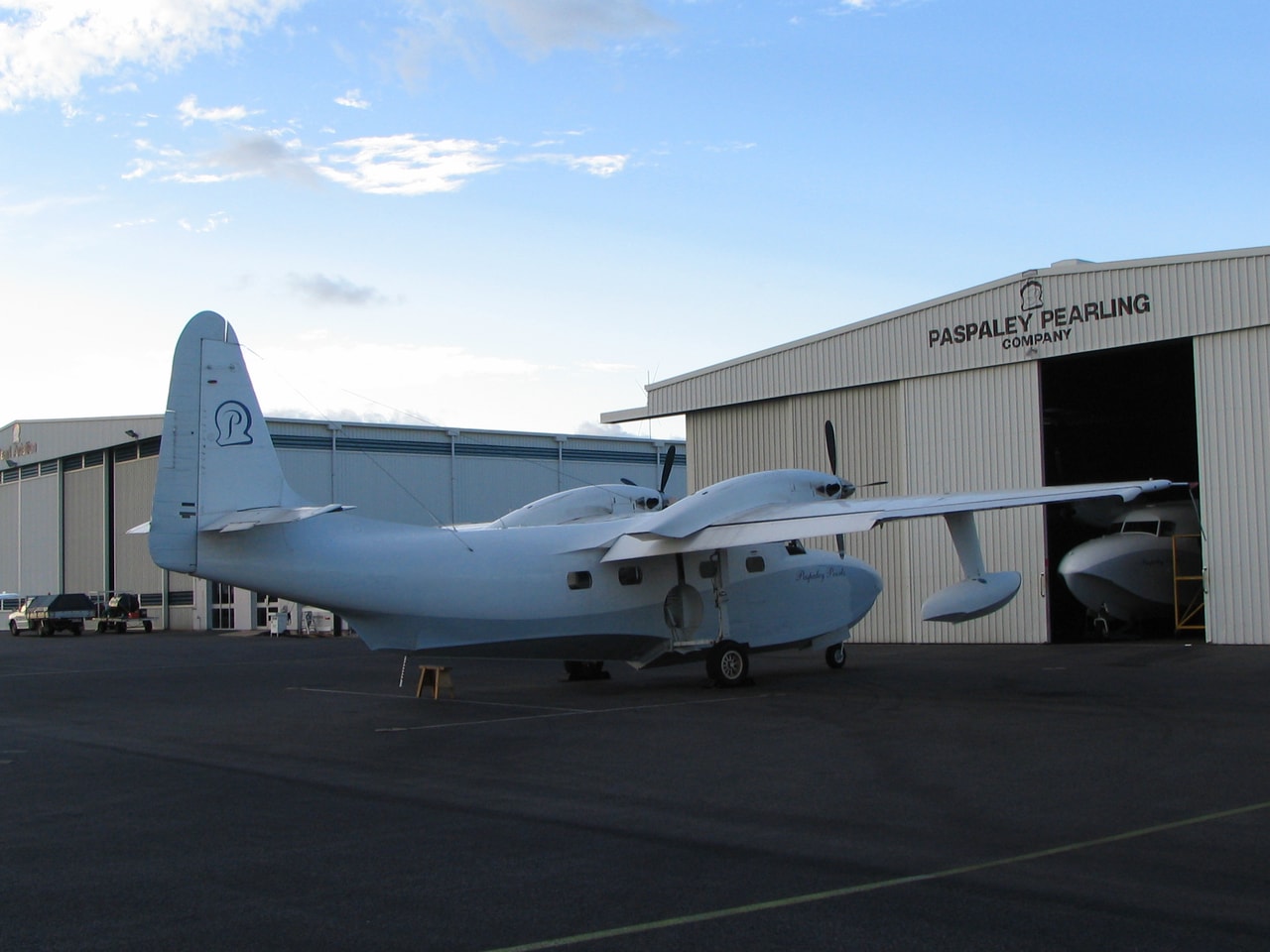
Chalk's Ocean Airways is listed as its historic primary user, and the type also flew with Antilles Air Boats and the Virgin Islands Seaplane Shuttle in the United States, with Nordair and Pacific Western Airlines in Canada, and with Air Whitsunday, Pearl Aviation (a Paspaley Pearling company) and Trans Australia Airlines in Australia [1]. The Royal Egyptian Air Force used one in its royal flight, and the Aga Khan is among its other notable users [1].
Design and how it works
The Mallard has a two-step hull, tricycle landing gear, stressed-skin construction and fuel tanks at the wingtips, which set it apart from the smaller Goose and Widgeon [1]. Grumman's two 600 hp (450 kW) Wasp radial engines gave a top speed of 215 mph (346 km/h) and a cruise speed of 180 mph (290 km/h), with a range of 1,380 mi (2,220 km) in the original version, using 1948 figures [1].
In the 1970s Frakes Aviation refitted several airframes with Pratt & Whitney Canada PT6A turboprop engines, raising capacity to 17 passengers. These became the Turbo Mallard (G-73T) [1]. Paspaley Pearling later worked with Aeronautical Engineers Australia to re-engine and modernize its Mallards for pearling work in northern Australia, and the fleet is in a life-extension program [1]. About 30 Mallards remain registered in the United States [1].
Accidents
On December 19, 2005, a Turbo Mallard operated by Flying Boat, Inc., as Chalk's Ocean Airways Flight 101, crashed into a shipping channel next to the Port of Miami shortly after taking off from the Miami Seaplane Base for Bimini, Bahamas [2]. All 20 people aboard died, two crew and 18 passengers [2][3]. The National Transportation Safety Board found that the right wing separated in flight because the airline's maintenance program failed to find and properly repair fatigue cracks in the wing. It also cited the Federal Aviation Administration's failure to detect and correct deficiencies in that maintenance program [2][3].
On January 26, 2017, a radial-engined Mallard crashed during an Australia Day display over Perth Water on the Swan River in Western Australia, killing the pilot and a passenger [1][4]. The Australian Transport Safety Bureau's final report, released November 19, 2019, found that the aircraft stalled at a height from which it could not recover, after the pilot flew an unplanned third pass using steeper bank angles and lower altitudes than the standard procedure. It also found that the Civil Aviation Safety Authority lacked an effective framework to approve and oversee air displays [4].
Related entries
Sources
- Grumman G-73 Mallard, Wikipedia. en.wikipedia.org/wiki/Grumman_G-73_Mallard
- In-flight Separation of Right Wing, Flying Boat, Inc. Flight 101 (DCA06MA010), National Transportation Safety Board. www.ntsb.gov/investigations/Pages/DCA06MA010.aspx
- NTSB Faults FAA, Airline In Fatal Chalk's Crash, AVweb. avweb.com/news/ntsb-faults-faa-airline-in-fatal-chalks-crash
- ATSB releases Swan River investigation report, Australian Flying (2019-11-19). www.australianflying.com.au/latest/atsb-releases-swan-river-investigation-report
Last reviewed November 2026. Spotted something to correct or add? Tell us and include a source.
See how to register a low-speed vehicle or boat in your state.
About the Amphibious Encyclopedia
WaterCar has designed and built amphibious vehicles in Southern California for more than 25 years. We keep this encyclopedia so anyone curious about vehicles that cross between land and water has one place to start, with the sources listed for every fact. New to the subject? Start with our guide, What is an amphibious vehicle?
All amphibious vehicles → · The WaterCar machines → · How a WaterCar works →