
History
Grumman's first Navy work was building floats that turned land planes into amphibians, and it used the same retractable undercarriage on its FF fighter, which first flew in December 1931 [1]. The two-seat JF followed in 1933, joining the FF's wings and fuselage to a large float faired into the fuselage; 47 were built, and the Coast Guard ordered 14 of them as the JF-2 [1][2]. Coast Guard aviators Elmer Stone and Richard Burke used a JF-2 to set three world records for amphibians [2].
The J2F kept the JF fuselage but used a longer float and unlinked ailerons [1]. The J2F-1 first flew on April 2, 1936 [3]. Variants included the J2F-3, 20 executive transports built in 1939, and the J2F-5, the last Grumman-built version, which was the first officially called Duck [1][3]. After the United States entered World War II, Grumman turned to fighters and Columbia Aircraft built 330 J2F-6 aircraft, the most numerous version [1][3]. Wikipedia's variant counts add to 585, one more than its stated total of 584 [3].
Service
Ducks flew utility transport, scouting, antisubmarine patrol, air-sea rescue, mapping, reconnaissance and target-towing missions [3]. The J2F-4 was used for rescue in Greenland, Iceland, Trinidad, Alaska and the Pacific [1]. Japanese air attacks destroyed J2Fs at Mariveles in the Philippines on January 5, 1942, and a repaired J2F-4 was the last aircraft to leave Bataan, on April 9, 1942, according to Wikipedia [3].
The Coast Guard used ten Navy J2F-4, J2F-5 and J2F-6 aircraft in the war [2]. A Coast Guard J2F-6 aboard the icebreaker Northwind flew reconnaissance, supply and standby rescue flights during Operation High Jump, the Navy's 1946 to 1947 Antarctic expedition [2]. In 1948 the Air Force converted surplus Navy Ducks to the OA-12 for air-sea rescue, and Argentina, Colombia, Mexico and Peru also flew the type [3].
Design and how it works
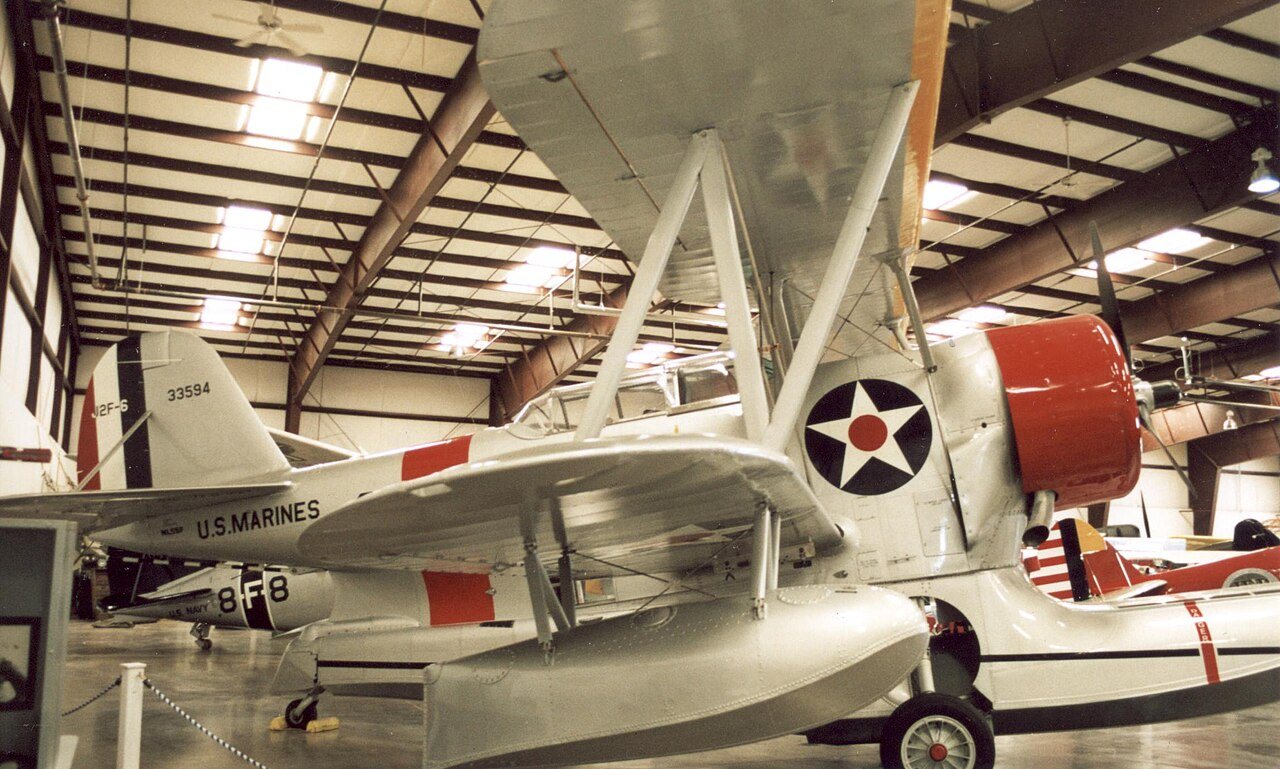
The Duck is a single-bay biplane. Its large central float holds the retractable main wheels, with small stabilizing floats under each lower wing [1][3]. The same type of main float appeared earlier on the Loening OL amphibian [1]. Crews sat in tandem cockpits, with space behind for two passengers or a stretcher [3].
For the J2F-6, Wikipedia lists a length of 34 ft (10.4 m), a wingspan of 39 ft (11.9 m), a gross weight of 7,700 lb (3,493 kg), a top speed of 190 mph (306 km/h), a cruise speed of 155 mph (249 km/h) and a range of 780 miles (1,255 km) [3]. HistoryofWar gives 1,050 hp for its Wright R-1820-54 engine, while Wikipedia's specification table lists 900 hp [1][3].
Survivors
Wikipedia lists nine surviving airframes, four of them airworthy, one under restoration, three on static display and one OA-12 in storage [3].
Related entries
Sources
- Grumman J2F Duck, HistoryofWar.org (Rickard) (2023-05-01). www.historyofwar.org/articles/weapons_grumman_J2F_duck.html
- 1934: Coast Guard Obtains the Grumman JF-2 Duck, Coast Guard Aviation History (Coast Guard Aviation Association). cgaviationhistory.org/?p=4057
- Grumman J2F Duck, Wikipedia. en.wikipedia.org/wiki/Grumman_J2F_Duck
Last reviewed November 2026. Spotted something to correct or add? Tell us and include a source.
See how to register a low-speed vehicle or boat in your state.
About the Amphibious Encyclopedia
WaterCar has designed and built amphibious vehicles in Southern California for more than 25 years. We keep this encyclopedia so anyone curious about vehicles that cross between land and water has one place to start, with the sources listed for every fact. New to the subject? Start with our guide, What is an amphibious vehicle?
All amphibious vehicles → · The WaterCar machines → · How a WaterCar works →