
History
The Seabee began as the Spencer Air Car, a small amphibian that Percival Spencer first flew on August 8, 1941, from the water of Great South Bay on Long Island [3]. In the fall of 1943 Spencer demonstrated it to Republic Aviation officials. Republic bought the production rights and kept Spencer as a design consultant and test pilot, and its engineers redesigned the aircraft in all-metal form [3]. The resulting Republic RC-1 first flew on November 30, 1944, and the name Seabee was chosen in early 1945 [3].
Republic expected a boom in private flying after the war. By the end of 1944 it reported 1,972 civilian orders at $3,500 each, and another source puts the figure near 2,000 by mid-1945 [1][2]. The RC-3 prototype first flew on December 1, 1945, with Spencer at the controls [1]. The price rose to $4,495 on July 15, 1946, and to $6,000 on November 15, 1946 [1]. The expected lightplane boom did not arrive, and Republic announced the end of production on October 4, 1947 [1][3]. It sold its last new Seabee in 1948 [1]. Sources give 1,060 as the total built [1][2][3].
Design and how it works
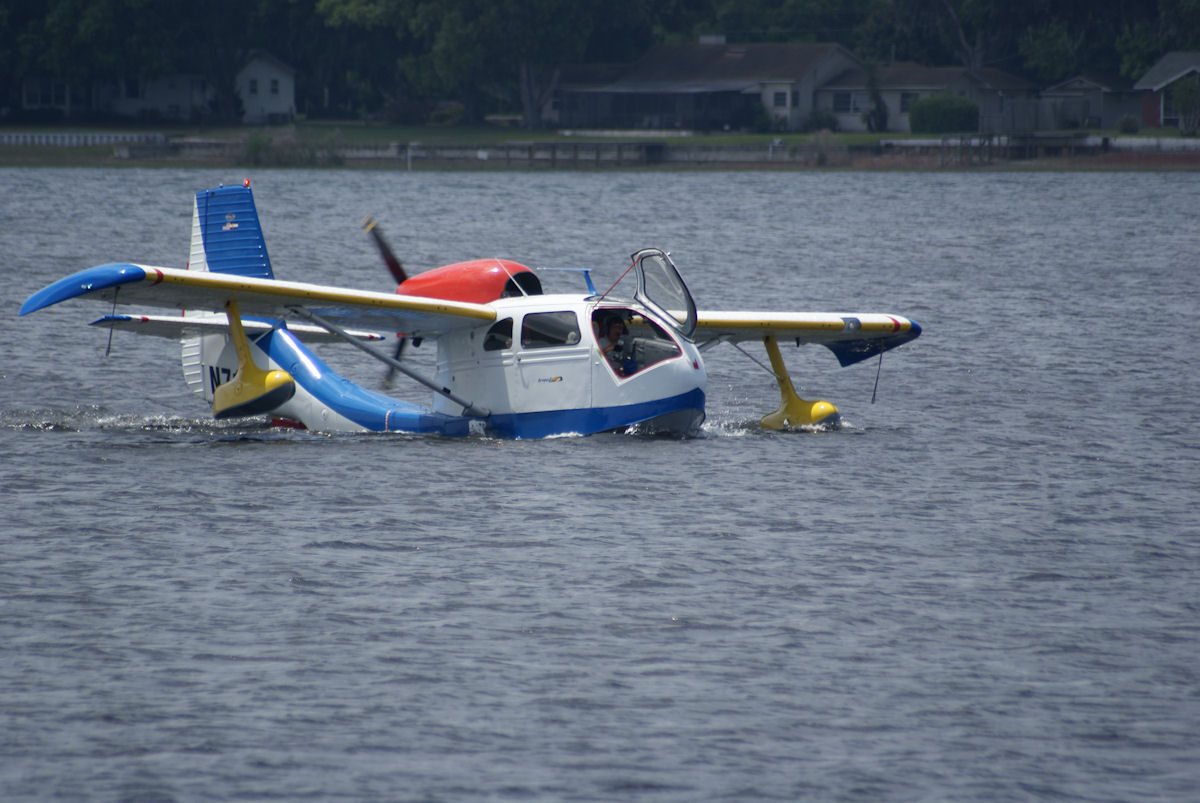
The Seabee has a single 215 hp Franklin six-cylinder engine [1]. Its raised engine nacelle keeps the propeller clear of the main float, and the wings sit above most spray [3]. The landing gear is operated by hand and rotates aft for water operations, and a door in the left side of the windscreen lets the pilot reach a dock [3].
The wings have no ribs. Instead, heavy corrugated aluminum skin supplies the stiffness [1][2]. Republic gave a top speed of 120 mph (190 km/h), a cruise speed of 103 mph at 75 percent power and a range of 560 mi (900 km), with room for a pilot and three passengers [1]. After production ended, Republic sold its remaining Franklin engines to Preston Tucker, who used them in his automobiles [2].
Use and survivors
Seabees went to private owners, air charter firms and small feeder airlines [1]. Military users included the Israeli Air Force (101 Squadron) and the Republic of Vietnam Air Force [1]. Twenty-three were converted to the twin-engine Twin Bee [1].
A 2006 count found more than 250 still registered and flying, and the Cradle of Aviation Museum on Long Island, which displays an airworthy Seabee, says more than 250 remain airworthy [1][2]. One history describes it as the most-produced single-engine civil amphibian of any type [3].
Related entries
Sources
- Republic RC-3 Seabee, Wikipedia. en.wikipedia.org/wiki/Republic_RC-3_Seabee
- What it's like to fly a Seabee (Curator's Choice Video Collection), Cradle of Aviation Museum (2015-07-28). www.cradleofaviation.org/plan_your_visit/virtual-museum/curators-choice-video-collection/what-its-like-to-fly-a-seabee.html
- Percival Spencer's Air Car: Everyman's Amphibian, HistoryNet. historynet.com/percival-spencers-air-car-everymans-amphibian
Last reviewed November 2026. Spotted something to correct or add? Tell us and include a source.
See how to register a low-speed vehicle or boat in your state.
About the Amphibious Encyclopedia
WaterCar has designed and built amphibious vehicles in Southern California for more than 25 years. We keep this encyclopedia so anyone curious about vehicles that cross between land and water has one place to start, with the sources listed for every fact. New to the subject? Start with our guide, What is an amphibious vehicle?
All amphibious vehicles → · The WaterCar machines → · How a WaterCar works →