
History
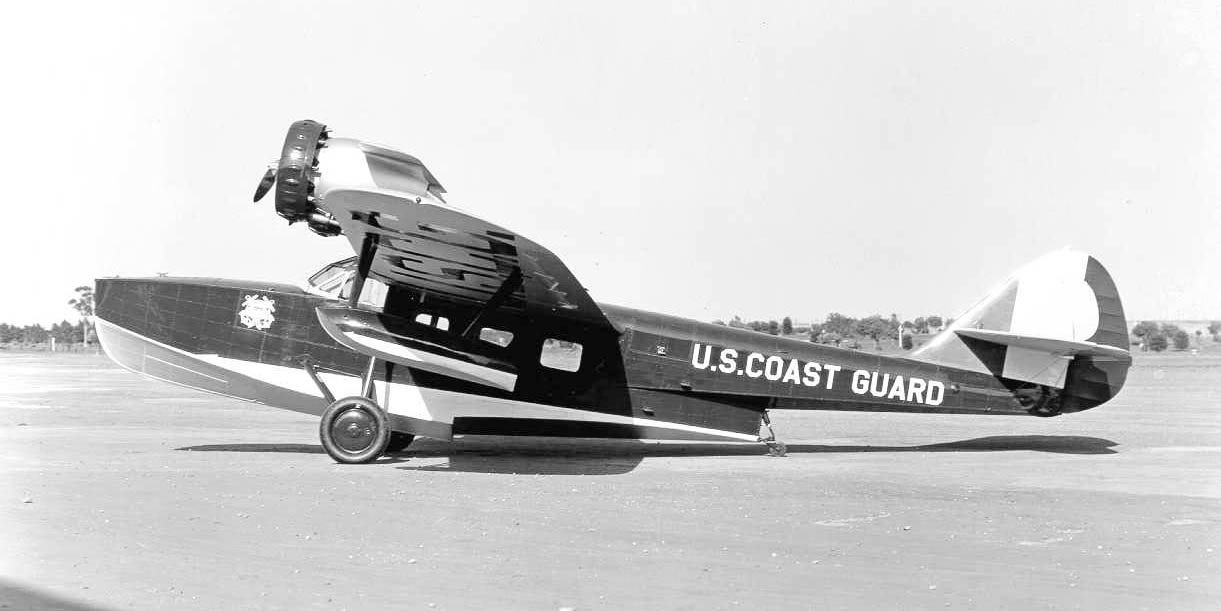
The Dolphin began as the Douglas Sinbad, a wheel-less flying boat meant for sale as an air yacht, which first flew in July 1930 [1][2]. Douglas added retractable wheels in 1931 and renamed it the Dolphin [1]. The Great Depression held back sales, and the Coast Guard bought the Sinbad and 12 Dolphins, 13 aircraft in all, which it named after stars [1][3].
Private buyers included William Boeing, Powel Crosley Jr., Philip K. Wrigley and William K. Vanderbilt II [1]. The Wilmington-Catalina Airline bought the first two to fly passengers between Los Angeles and Santa Catalina Island; Wikipedia calls them Douglas's first successful airliners [1]. Pan American Airways also bought Dolphins for China National Aviation Corporation [1].
Military service
The Army ordered eight Y1C-21 aircraft on August 10, 1931, to lead bombers over water and to rescue crews [2]. The bombers proved too fast to lead, so the aircraft became staff transports, later redesignated OA-3, and a larger Army batch followed as the C-26 and OA-4 [2]. Some C-21s were loaned to the Treasury Department for Prohibition-era border patrol as the FP-1 [2]. The last Army aircraft was withdrawn in March 1940 [2]. The Navy bought RD-series transports, and the Royal Australian Air Force and Argentine Naval Aviation also flew the type [1][2].
The Coast Guard used its Dolphins mainly for search and rescue [3]. The National Naval Aviation Museum says Dolphin pilots won the first Distinguished Flying Crosses given to Coast Guardsmen, for open-sea rescues of fishermen [3]. Wikipedia reports that the Navy's last RD-2 was the first aircraft bought for a US president, Franklin D. Roosevelt, though he reportedly never used it [1]. Coast Guard RD-4 V-126 was destroyed near the Farallon Islands off San Francisco on August 5, 1941, and its three crew members died, Wikipedia says [1].
Design and how it works
The Dolphin has an all-metal hull and a plywood-covered wooden wing, with its two engines carried on struts above the wing [2]. The main wheels attach to the hull sides and to the wing and retract above the waterline [2]. The pilot and co-pilot sit side by side in an enclosed cockpit ahead of the passenger cabin [2].
Specifications vary by version. The RD-3 had a wingspan of 60 ft (18.3 m), a gross weight of 9,734 lb (4,415 kg), a top speed of 149 mph (240 km/h) and a range of 692 miles (1,114 km), according to Wikipedia [1]. The Army C-21 used smaller 350 hp Wright engines and a top speed of 140 mph (225 km/h) [2].
Survivor
Wikipedia reports that the only surviving Dolphin is Dolphin 117, built for Boeing as the Rover [1]. The National Naval Aviation Museum says Boeing bought it in 1934 and that it later flew with Alaska Airlines [3]. It is shown in Coast Guard markings at the museum in Pensacola, Florida [1][3].
Related entries
Sources
- RD-4 Dolphin, National Naval Aviation Museum. navalaviationmuseum.org/aircraft_exhibits/rd-4-dolphin
- Douglas OA-3 Dolphin (C-21), HistoryofWar.org (Rickard). www.historyofwar.org/articles/weapons_douglas_OA-3_dolphin.html
- Douglas Dolphin, Wikipedia. en.wikipedia.org/wiki/Douglas_Dolphin
Last reviewed November 2026. Spotted something to correct or add? Tell us and include a source.
See how to register a low-speed vehicle or boat in your state.
About the Amphibious Encyclopedia
WaterCar has designed and built amphibious vehicles in Southern California for more than 25 years. We keep this encyclopedia so anyone curious about vehicles that cross between land and water has one place to start, with the sources listed for every fact. New to the subject? Start with our guide, What is an amphibious vehicle?
All amphibious vehicles → · The WaterCar machines → · How a WaterCar works →