
History
The Supermarine Walrus began as the Seagull V, an amphibian developed from the earlier three-seat Seagull [2]. The prototype first flew on 21 June 1933 with test pilot Joseph Summers at the controls [1]. Australia ordered 24 Seagull Vs in August 1934, and the British Air Ministry ordered 12 in May 1935 [2]. The type was renamed Walrus around the time the first aircraft for the RAF flew, a date given as 16 March 1936 by Wikipedia and 18 March 1936 by Historyofwar.org [1][2]. A larger order for 168 aircraft followed in July 1936 [2].
Supermarine did not build them all. Saunders-Roe produced about 270 Walrus I aircraft and 191 Walrus II aircraft [1][2]. Sources do not agree on the total: Wikipedia gives 740 and Historyofwar.org gives 746, and the variant counts in both do not add up cleanly [1][2].
Design and how it works
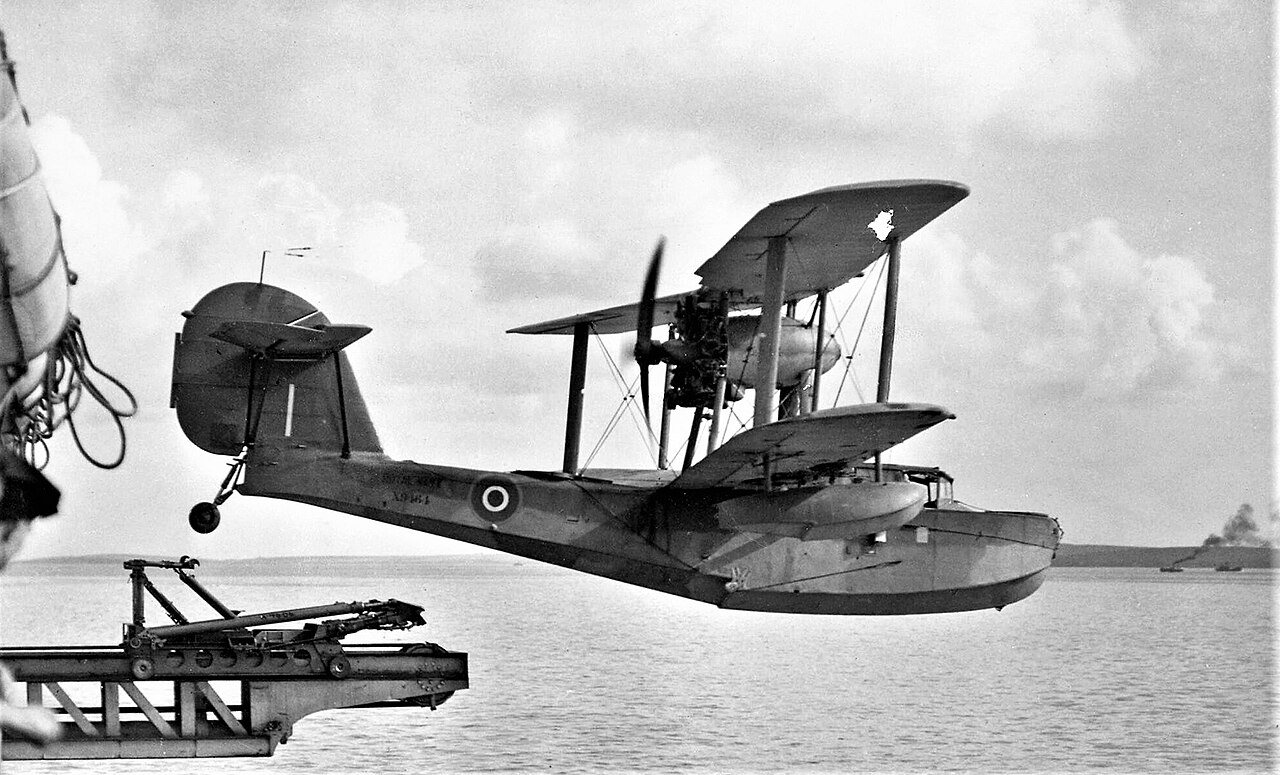
The Walrus had a boat hull for alighting on water and wheels for use on land [1]. The wheels had to be raised for a water landing. In October 1935 a Seagull V carrying Admiral Roger Backhouse landed in Portland Harbour with its wheels unretracted, the hull flooded and the aircraft flipped over, and the crew escaped with minor injuries [1]. On 24 November 1937 the Walrus K8541 of HMS Leander overturned while landing in Wellington Harbour. The crew survived and the aircraft was written off [3].
The Walrus I had a metal hull. The Walrus II had a wooden hull, which was heavier but easier to repair [2]. Power came from a single Bristol Pegasus VI radial engine of 750 hp (560 kW) [1][2]. Top speed was 135 mph (217 km/h) and range about 600 mi (970 km) [1][2]. Armament was a Vickers K gun in the nose, one or two more in beam positions, and either 600 lb (270 kg) of bombs or two depth charges [2].
Service at sea and in rescue
Cruisers and battleships carried the Walrus as a spotter and scout. It was launched by catapult, and after its mission it touched down alongside the ship and was lifted aboard by crane [1]. HMS Leander and HMS Achilles of the New Zealand Division were among the ships fitted with them [3]. Shipborne use ended by the end of 1943, after which the RAF was the main operator [2].
The RAF used the Walrus for air-sea rescue. No. 276 Squadron at Harrowbeer was the first to receive it for that role, and Historyofwar.org says at least 1,000 British and Allied airmen were rescued, mostly from RAF Bomber Command and the US Eighth Air Force [2]. Wikipedia credits No. 277 Squadron with 598 rescues [1]. Military operators included Argentina, Australia, Canada, Egypt, France, Ireland, New Zealand and Turkey [1]. Civil operators listed include Amphibious Airways in Australia, Kenting Aviation in Canada and United Whalers in the United Kingdom [1].
Legacy
Wikipedia states that the Seagull V was the first piloted aircraft in the world launched by catapult, flown by Flight Lieutenant Sydney Ubee at Farnborough [1].
Related entries
Sources
- Supermarine Walrus, Wikipedia. en.wikipedia.org/wiki/Supermarine_Walrus
- Supermarine Walrus, Historyofwar.org (J. Rickard) (2008-10-30). www.historyofwar.org/articles/weapons_supermarine_walrus.html
- Supermarine Walrus K8541, New Zealand Navy Museum. navymuseum.co.nz/explore/by-themes/aviation/supermarine-walrus-k8541
Last reviewed November 2026. Spotted something to correct or add? Tell us and include a source.
See how to register a low-speed vehicle or boat in your state.
About the Amphibious Encyclopedia
WaterCar has designed and built amphibious vehicles in Southern California for more than 25 years. We keep this encyclopedia so anyone curious about vehicles that cross between land and water has one place to start, with the sources listed for every fact. New to the subject? Start with our guide, What is an amphibious vehicle?
All amphibious vehicles → · The WaterCar machines → · How a WaterCar works →