
History
By the late 1800s Ontario loggers had cleared much of the timber that stood close to the rivers and lakes, so crews worked farther inland, where moving logs took longer and cost more [1]. Logs traveled in floating booms. On still lakes and sluggish rivers crews used a crib and cage, a raft carrying a capstan: an anchor was rowed out ahead and dropped, then men or horses walked the capstan round to wind in the line, slow work that a light wind could undo [2].
The lumberman Joseph Jackson, once a member of Parliament for Norfolk County, took the problem to West and Peachey, a Simcoe foundry that made boilers, engines, farm implements and logging equipment [3][2]. Sources date his visit to 1878 or 1887 [2][3]. John Ceburn West, called Joe on the Simcoe plaque, worked out a steam tug, and the firm had a prototype by 1889 [1][3][4]. Norfolk County's heritage service describes its trial in Simcoe: with a cable made fast to an anchor point across the Lynn River, the engine wound it in, the boat moved down the road, slid into the river and paddled across [3].
West and Peachey began manufacturing the tug in 1889 [1]. The Ontario plaque says more than 230 had been built when production ended in 1932, and Duckworks gives 230 for the years 1889 to 1932 [1][2]. Other counts are lower: a 1924 Simcoe history gave 188, and Norfolk County's heritage pages say over 210 had been built when orders faded in 1937 [8][3]. A 1901 Simcoe Reformer profile described the firm building them to order for companies in Northern Ontario and the Yukon [7].
Design and how it works
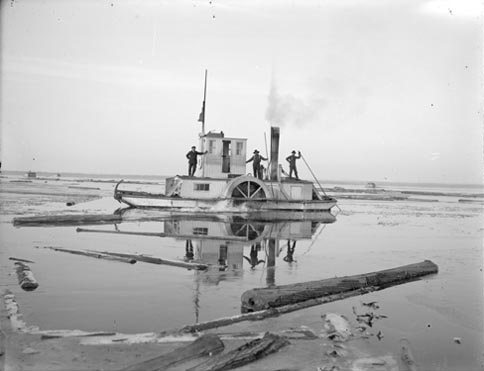
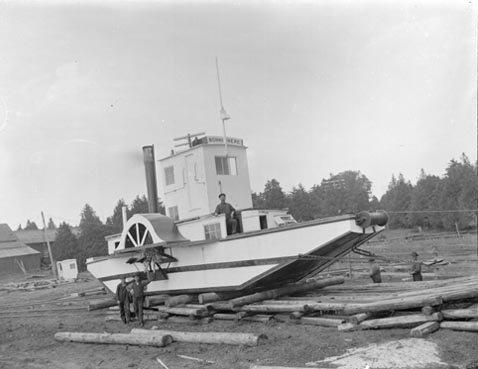
The typical alligator was a flat, shallow scow driven by two side paddle wheels and a steam engine of about 20 hp, and it carried a big anchor and a cable winch [2]. In effect it replaced the men and horses of the crib and cage with steam, and it could pull a boom of about 60,000 logs across a lake unless the wind was very strong [2][3]. They were built mostly of wood, with steel plating on the hull and iron-shod runners underneath, and on the William M. the boiler pivots and has a leveling screw so it could be kept level as the tug hauled itself overland [5].
On a portage the tug winched itself over the ground at 1 to 2.5 miles (1.6 to 4 km) a day, up slopes as steep as 20 degrees [2]. Sizes varied. The Mistango, built by Captain John A. Clark for Lake Nipissing, was 66.8 ft (20.4 m) long and carried a crew of eleven [2][4]. In February 1897 the Simcoe Reformer reported that West and Peachey were building their biggest alligator yet, bound for South America: 115 ft (35 m) long with a 20 ft (6.1 m) beam and two engines [7]. Later tugs used screw propellers, and many were built for or converted to diesel [2].
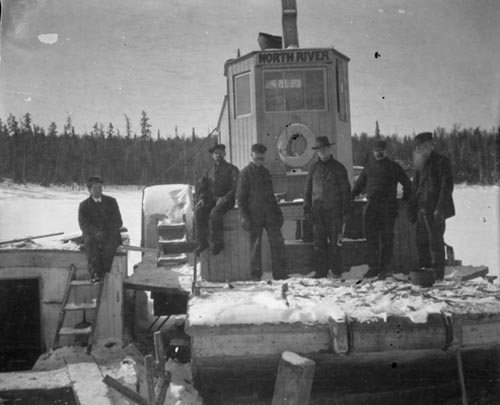
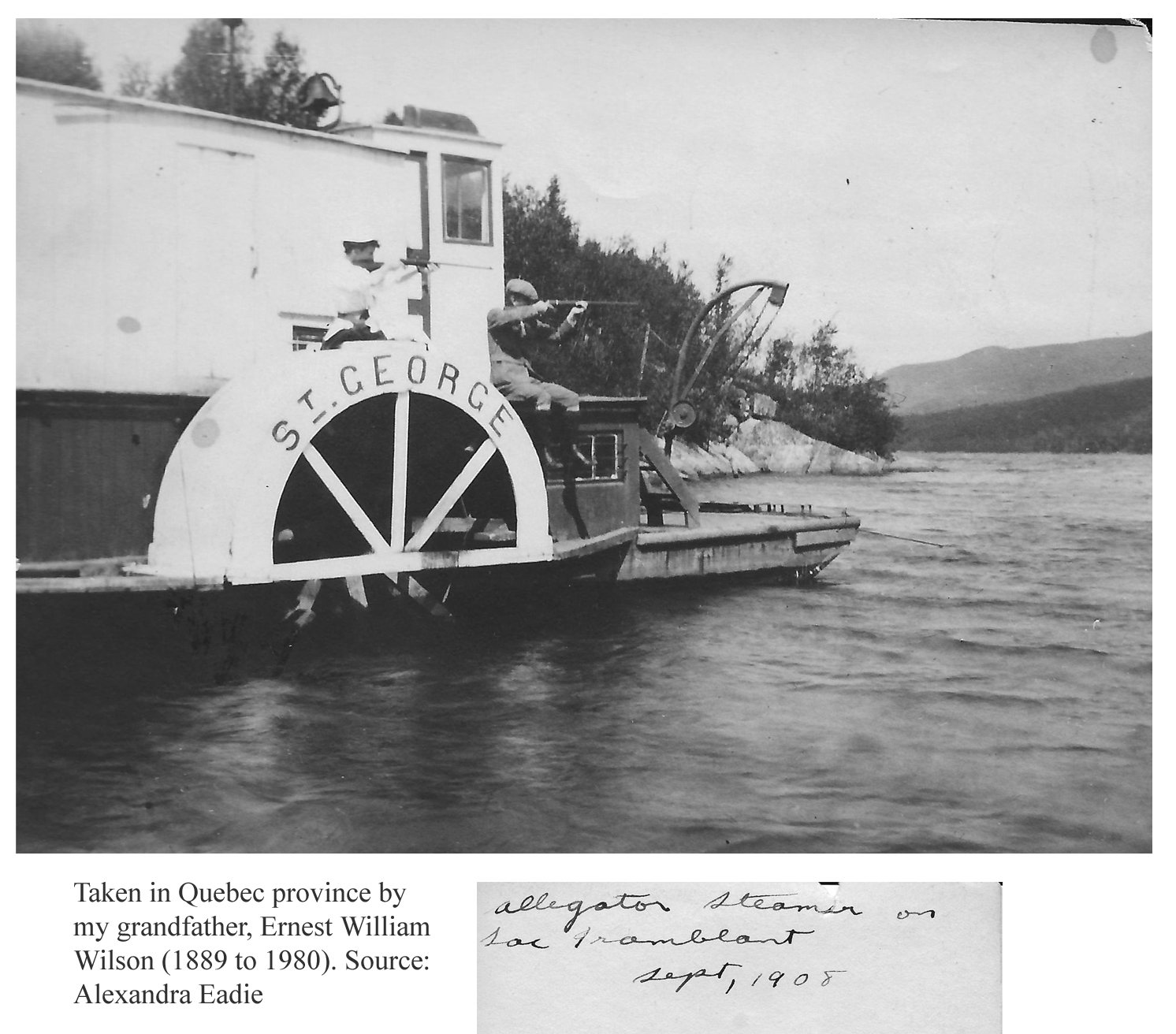
Alligators worked across Ontario and Quebec and were sold to Manitoba, the Yukon and the northern United States from Maine to Wisconsin; one was shipped in pieces to Colombia and assembled there [2][4]. Besides warping booms, they towed supply barges and, where there were no roads, carried freight and passengers [2].
Decline and survivors
Around 1930, gasoline-powered warping tugs from Russel Brothers, a firm that started at Fort Frances and later built at Owen Sound, began to replace the steam alligators [5][4]. Railways, new mills nearer the timber and, after World War II, trucks and logging roads took away the rest of their work. By the late 1950s most had been abandoned on lakeshores or taken apart for parts and burned [2].
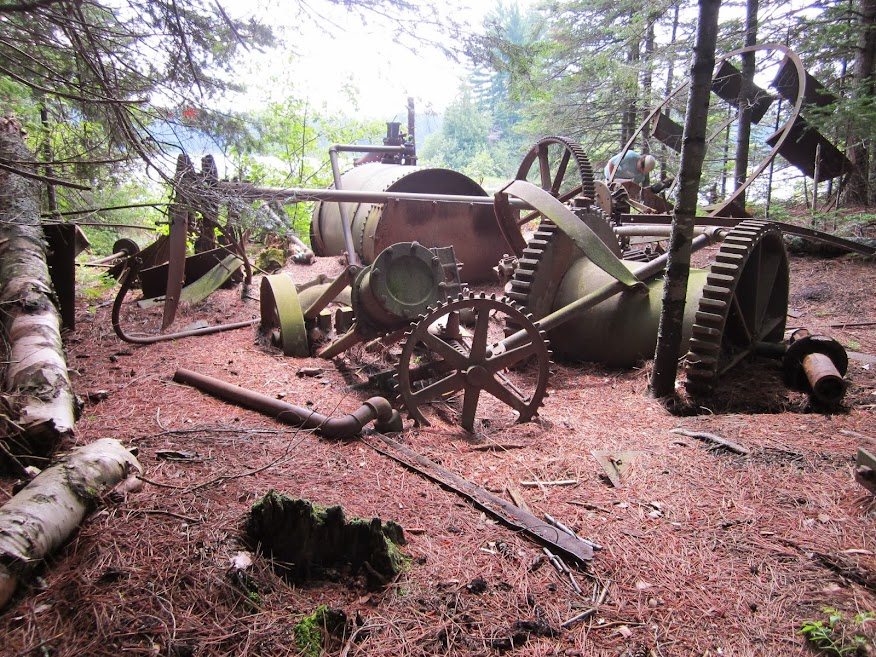
Three survive in rebuilt form. In 1991 a Great Alligator Hunt found the remains of one in northern Ontario, near Atikokan by Norfolk County's account and on Clearwater West Lake by Duckworks' [3][2]. The old hull was hauled back to Simcoe on a trailer, but it could not be reused, so volunteers built a new working boat from 1993 [3][2]. Named the W.D. Stalker, it was launched on the Lynn River in July 1997, and in spring 1998 it was handed to the town as a licensed and inspected steam vessel [2]. The William M. at the Algonquin Logging Museum started life in 1905 as the Max, hauled itself out of Cedar Lake for the last time in 1946 and was rebuilt for display in the winter of 1972 to 1973 around its original boiler, engine, winch and paddle wheels [5][2][6]. The Fairy Blonde is kept at Wakami Lake Provincial Park near Chapleau, Ontario, and the remains of others lie on Catfish Lake and Burntroot Lake in Algonquin Park [2][4][5].
Wikipedia also lists a tug named Missinaibi at the Canadian Museum of Civilization as an alligator, but a Russel Brothers vessel record describes the Missinaibi as a steel tug that firm built at Owen Sound in 1952, years after West and Peachey had stopped making alligators [4][9][1][3].
Photos
Related entries
Sources
- The Alligator Tug (historical plaque text, Simcoe, Ontario), Ontario's Historical Plaques (2010-09). ontarioplaques.com/Plaques/Plaque_Norfolk14.html
- The Alligator, or Steam Powered Amphibious Warping Tug, by Bryant Owen (archived copy), Duckworks Magazine, via Internet Archive (1999). web.archive.org/web/20080630024409/http://www.duckworksmagazine.com/04/s/articles/alligator/index.cfm
- Alligator Tug, Norfolk County Heritage and Culture. norfolkheritage.ca/explore/alligator-tug
- Alligator boat, Wikipedia. en.wikipedia.org/wiki/Alligator_boat
- Alligators of Algonquin Park, Bob and Diana McElroy, Bush Log and Notes (mcelroy.ca). mcelroy.ca/notes/alligators_algonquin.html
- Algonquin Logging Museum, Algonquin Provincial Park (algonquinpark.on.ca). www.algonquinpark.on.ca/visit/locations/algonquin-logging-museum.php
- West & Peachey: two business profiles (Simcoe Reformer, February 4, 1897, and September 26, 1901, transcribed), Norfolk Genealogy (John Cardiff). nornet.on.ca/~jcardiff/b-m-d/etc2/westpeachey.html
- Alligator Steam Warping Tugs (caption from Simcoe and Norfolk County, Pearce Publishing, 1924, transcribed), Norfolk Genealogy (John Cardiff and Norfolk Historical Society). nornet.on.ca/~jcardiff/transcipts/bios-photos/places/scenes/alligatortugs.html
- Missinaibi, Russel Brothers Limited (russelbrothers.ca). russelbrothers.ca/boatmissinaibi.html
Last reviewed November 2026. Spotted something to correct or add? Tell us and include a source.
About the Amphibious Encyclopedia
WaterCar has designed and built amphibious vehicles in Southern California for more than 25 years. We keep this encyclopedia so anyone curious about vehicles that cross between land and water has one place to start, with the sources listed for every fact.
Browse all entries → · The WaterCar machines → · How a WaterCar works →