
What they are
In the strict sense an amphibious cycle is a pedal machine that works on land and on water [1]. Some can be ridden straight into a lake or river; others need a short conversion first [1]. This entry also covers a motor scooter and small motor trikes built on the same idea [7][11]. Builders have used three main ways to keep them afloat: buoyant hollow wheels, floats that fold down or clamp to the frame, and a boat-shaped body [1][4][9][11]. Most are moved on water by the rider's pedaling, sent to paddles on the wheels, blades on the spokes or a small propeller [1][4][9][10].
Patents go back at least to July 20, 1869, when David J. Farmer of Wheeling, West Virginia, received US patent 92,807 for a land and water velocipede [2]. It rested on floats at the front and rear, and swiveling blades on the rear-wheel spokes pushed it along; the floats could be taken off for riding on land [2].
Nineteenth-century water tricycles
In 1883 a rider named Terry took a tricycle along the road and across the sea [1][3]. Its two big front wheels split into halves that became the frame of a folding rowing boat, roughly 3.6 m (11 ft 10 in) by 1.2 m (3 ft 11 in) [1]. Switching from road to water took about 30 minutes, and afloat it was used as a rowing boat [1]. Wikipedia names him as the Englishman William Terry, while Dover Museum's list of Channel crossings gives Terah Terry and describes the machine as a tricycle on a canoe body [1][3]. Wikipedia, drawing on an 1884 Scientific American report, says the ride ran from London to Saint-Denis, short of the original goal of Paris, and gives 13 hours for the first 58 miles (93 km), to Canterbury, and 8 hours for the Channel crossing [1]. Dover Museum records it as the first crossing of the Channel by bicycle [3].
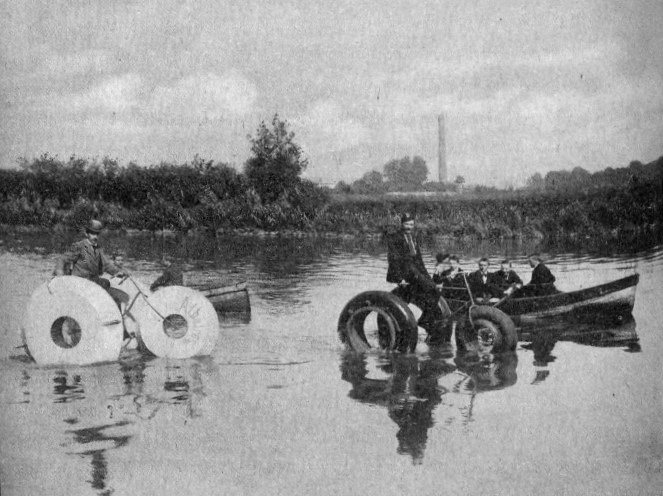
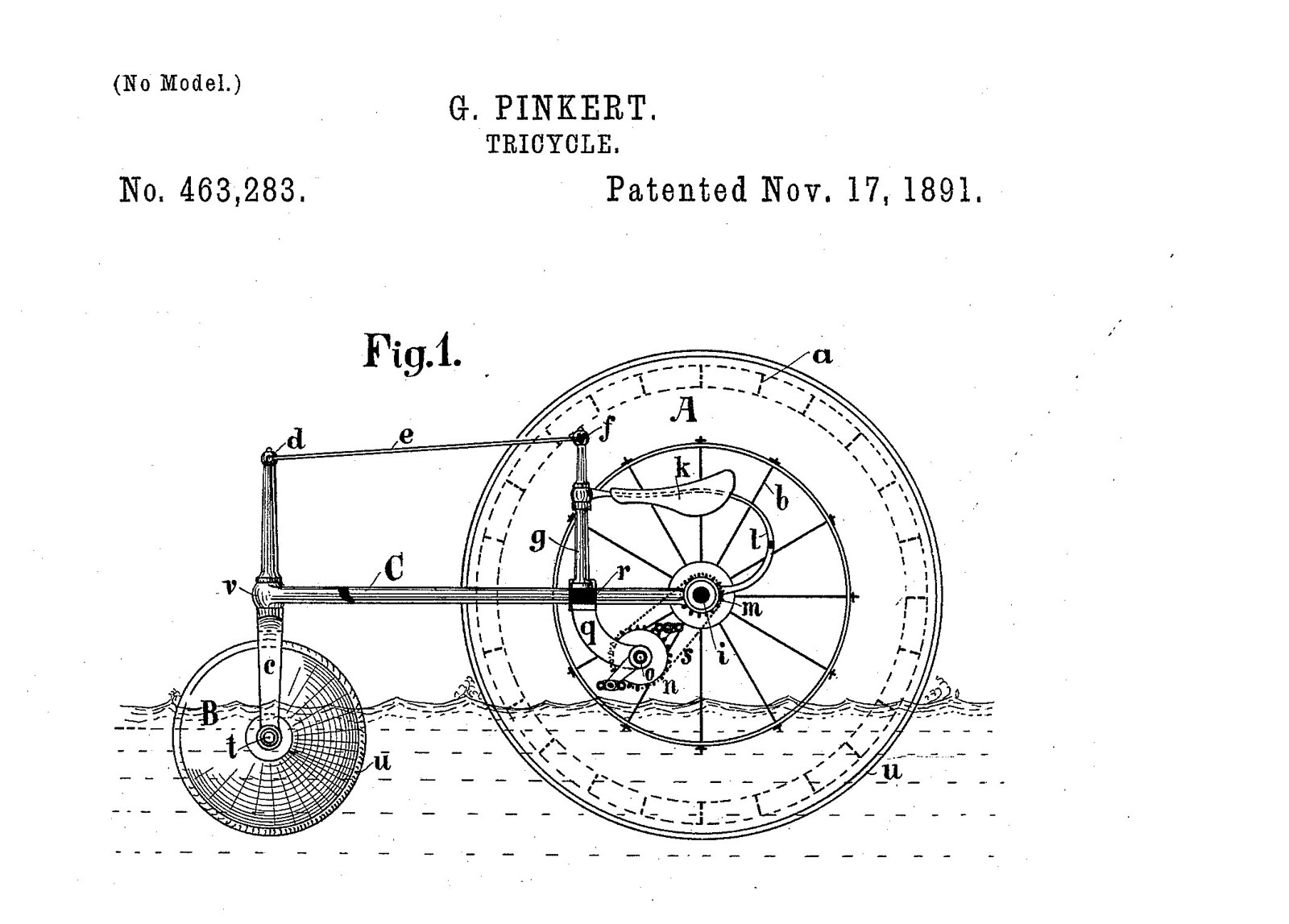
Georg Pinkert of Munich chose wheels that float. His US patent 463,283, issued November 17, 1891, describes a tricycle whose two rear driving wheels are sealed, hollow sheet-metal rings with paddles around the rim, and whose steering front wheel is a sealed, hollow, lens-shaped body; each wheel also carries a projecting rim that serves as a tire on the road [4]. Pedals drive the rear axle by chain, so the same wheels roll on land and paddle in water [4]. According to Wikipedia, citing Scientific American, Pinkert tried to cross the Channel in 1894 and got about halfway [1]. Near Hannover, Max Wenkel built water tricycles in 1895 with small paddles on the rear wheels [1].
Floats, propellers and a Channel scooter
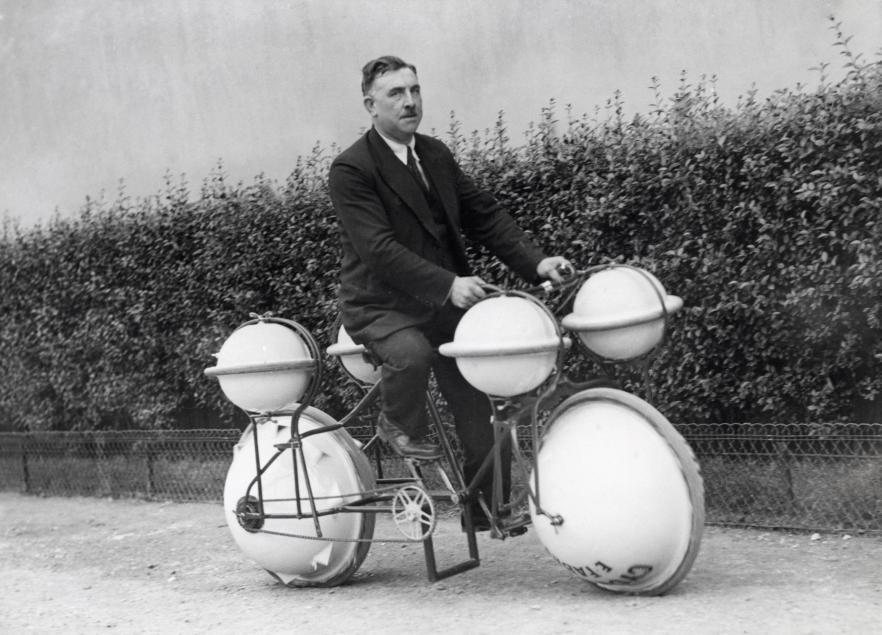
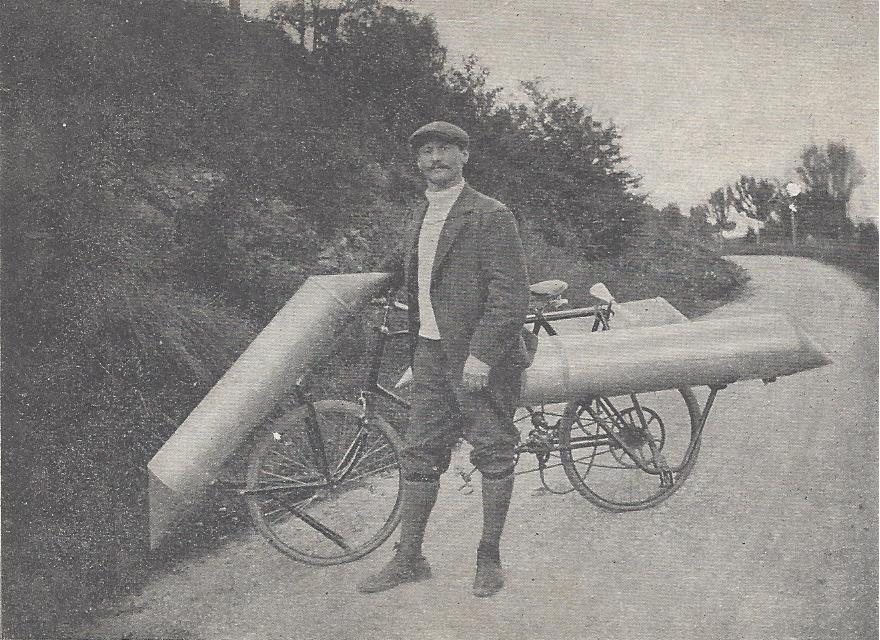
Later designs kept an ordinary bicycle and added floats. A postcard sent in 1911 shows the water and road bicycle of Baumgartner and Hirth of Aispel, near Waldshut in Germany [5], and Wikipedia describes three floats that folded down for the water and a propeller drive [1]. In Paris in 1932, E. Fabri showed the Cyclomer, a two-wheeler that, according to Wikipedia, lowered four extra ball-shaped wheels on the water to keep it upright [1][6]. The Spaarnestad Photo caption for a 1932 picture of it, now held by the Dutch National Archives, says it could carry up to 120 kg (265 lb) on land and water [6].
Small motors arrived as well. In October 1952 the French racer Georges Monneret crossed from Calais to Dover on a 125 cc Vespa scooter strapped to a wooden platform between two aluminum pontoons [7][8]. The scooter's rear wheel turned rollers linked to a propeller and the front wheel worked a rudder; waves broke the drive shaft on a first attempt, and the second crossing took about nine hours [7][8]. Accounts differ on the purpose: Vintag.es ties the trip to a Paris to London race that it says he won, taking about 15 hours overall, while Jalopnik describes the Paris to London trip as a stunt and does not mention a race [7][8]. Dover Museum also records a 1962 crossing by Ronald Brooks and James Wood on a tandem mounted on floats, in 7 hours 50 minutes [3].
Kits and grassroots designs
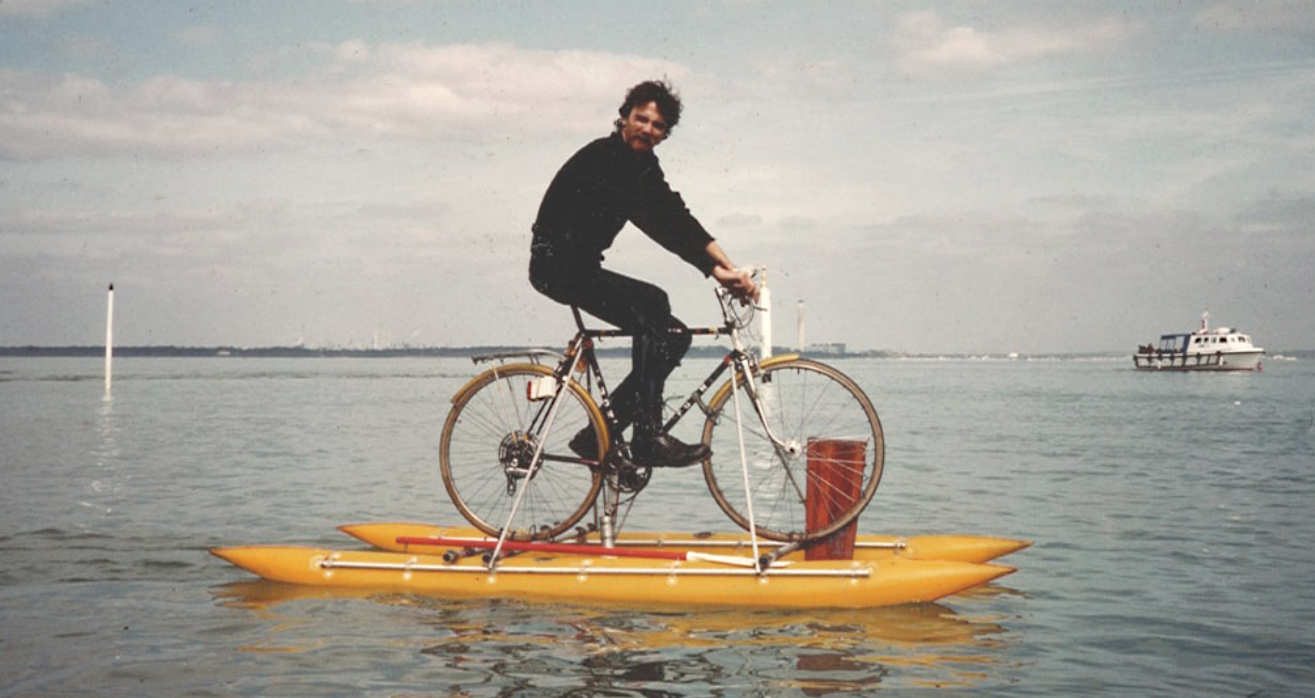
In 2004 New Atlas described the Shuttle-Bike of the Italian company SBK Engineering, a project begun in 1992 in Vigevano near Milan: a kit carried in a backpack that clamps inflatable floats to a bicycle [9]. A roller pressed against the rear tire drives a propeller and rudder at the front through a flexible shaft, so the handlebars steer on water [9]. New Atlas reported a kit weight of 11 kg (24 lb), a top speed afloat of 10 km/h (6 mph) and a safe load of 125 kg (276 lb) [9]. Theo Schmidt's Amphiped of 1984 used a similar idea: an inflatable catamaran that carries a standard bicycle, with a propeller driven from the chainwheel [1].
In India, Mohammad Saidullah of Purvi Champaran district in Bihar built an amphibious bicycle after a 1975 flood in the area [10]. India's National Innovation Foundation says four rectangular air floats hold it up, while fan blades fixed around the rear-wheel spokes drive it forward as he pedals, and that he rode it across the Ganges at Patna; his work was recognized at the foundation's third National Grassroots Innovation awards in 2005 [10]. Wikipedia also describes a 2008 University of Southampton student trike with four floats and a paddle wheel, which averaged 1.12 m/s (about 2.5 mph, 4 km/h) on water [1].
Motor trikes for floods and camping
The Salamander, launched in the Philippines in January 2015, is a three-wheeled passenger trike with a boat hull, meant to keep moving when flood-prone villages are under water [11][12]. New Atlas credited it to a Filipino startup, and BusinessMirror described it as the latest creation of Atoy Llave of A-toy Bodykits [11][12]. According to New Atlas, the hull is made of two layers of high-density polyethylene divided into compartments, a propeller at the back takes its power from the engine or motor that also turns the wheels, and the trike carries six people on land and four afloat [11]. Both reports quoted up to 80 km/h (50 mph) on land, New Atlas for the gasoline version, and 6 knots (7 mph, 11 km/h) on water [11][12]. Reports differ on the power: a 200 cc gasoline engine or a 3,000 W electric motor in New Atlas, 250 cc or 5 kW in BusinessMirror [11][12].
The Latvian design studio Zeltini built its first Z-Triton prototype in 2020, and CleanTechnica described it that June as an electric tricycle that doubles as a tiny camper and a boat, with pedals, a 250 W motor on each rear wheel and an electric outboard [13][14]. A market version followed in February 2022 with a 1,000 W trike motor, a 1,150 W boat motor raised and lowered from the cabin, and room for two to sleep [14]. Renamed BeTriton, it was described as weighing 250 kg (551 lb) unloaded and reaching 25 km/h (16 mph) on land and 5 km/h (3 mph) on water; boat mode is for fresh water only, and it can be rowed if the battery runs flat [15].
Much faster on water are the Gibbs Biski (two wheels) and Triski (three wheels), shown as concepts at the AIMExpo in Orlando in October 2015 [16]. On the Biski the wheels retract when it enters the water and jet drive takes over; Gibbs quoted 37 mph (60 km/h) on water and 80 mph (129 km/h) on land for it [16]. Both are covered in the Gibbs Biski entry.
At a glance
The table lists the pedal and small motor machines described above in date order. Among the water speeds quoted for them, the highest is 6 knots (7 mph, 11 km/h) for the Salamander [11].
| Machine | Country | Year | Powered by | How it floats | Type |
|---|---|---|---|---|---|
| Terry amphibious tricycle | England [1] | 1883 [1][3] | Pedals on land, oars on water [1] | Front wheels form the frame of a folding rowing boat [1] | Land-first |
| Pinkert water tricycle | Germany [4] | 1891, patent [4] | Pedals, chain drive to paddle wheels [4] | Sealed hollow metal wheels [4] | Land-first |
| Baumgartner and Hirth bicycle | Germany [5] | about 1910 [1][5] | Pedals, propeller [1] | Three fold-down floats [1] | Land-first |
| Cyclomer | France [1][6] | 1932 [1][6] | Pedals [1][6] | Not fully described; four fold-down ball wheels steady it [1] | Land-first |
| Monneret amphibious Vespa | France [7] | 1952 [7][8] | 125 cc scooter engine turning a propeller through rollers [7][8] | Two aluminum pontoons [7][8] | Land-first |
| SBK Shuttle-Bike kit | Italy [9] | by 2004 [9] | Pedals, roller-driven propeller [9] | Inflatable floats clamped to the frame [9] | Land-first |
| Saidullah amphibious bicycle | India [10] | recognized 2005 [10] | Pedals, blades on the rear-wheel spokes [10] | Four rectangular air floats [10] | Land-first |
| Salamander | Philippines [11] | 2015 [11][12] | Gasoline engine or electric motor, rear propeller [11][12] | Compartmentalized polyethylene boat hull [11] | Land-first |
| Zeltini Z-Triton (BeTriton) | Latvia [14] | 2020 [13] | Pedals and electric motors [13][14] | Cabin body works as a small freshwater boat [14][15] | Land-first |
Years are the earliest patent, demonstration or showing in the sources cited. Speeds and loads in the text are the makers' or builders' figures unless stated otherwise.
Photos
Related entries
Sources
- Amphibious cycle, Wikipedia. en.wikipedia.org/wiki/Amphibious_cycle
- US92807A: Improvement in land and water-velocipede (David J. Farmer), Google Patents (1869-07-20). patents.google.com/patent/US92807A/en
- Channel Crossing Biography, Dover Museum. dovermuseum.co.uk/Information-Resources/HPAC-Biographical/Channel-Crossing-Biography.aspx
- US463283A: Tricycle (Georg Pinkert, Munich), Google Patents (1891-11-17). patents.google.com/patent/US463283A/en
- Early amphibious bicycle by Baumgartner and Hirth, Aispel, Germany, about 1910 (postcard; file description), Wikimedia Commons. commons.wikimedia.org/wiki/File:Amphibious_bicycle_Baumgartner.jpg
- Amphibious bike 'Cyclomer'. Paris, 1932 (Spaarnestad Photo, inventory SFA002005344), Nationaal Archief (Dutch National Archives), via Wikimedia Commons. commons.wikimedia.org/wiki/File:Amfibiefiets_Amphibious_bicycle.jpg
- This 1952 Vespa Sailed Across The English Channel (Yes, Really) (Shane Schmid), Jalopnik (2025-10-25). www.jalopnik.com/2003938/1952-amphibious-vespa-crossed-english-channel
- In 1952, Georges Monneret Built an "Amphibious Vespa" for the Paris-London Race and Successfully Crossed the Channel on It, Vintag.es (2018-01-25). vintag.es/2018/01/in-1952-georges-monneret-built.html
- Shuttle-Bike: convert a bike to a pedal-power boat (Mike Hanlon), New Atlas (Gizmag) (2004-06-04). newatlas.com/go/2505
- The Amphibious Bicycle and Other Technological Contributions (Mohammad Saidullah), National Innovation Foundation, India. nif.org.in/innovation/amphibious_bicycle/297
- Amphibious three-wheeler could keep flood-stricken Filipinos mobile (Ben Coxworth), New Atlas (2015-04-10). newatlas.com/salamander-amphibious-trike/36947
- Pinoy-made 'amphitrike' launched (Kris C. Lim), BusinessMirror (2015-01-29). businessmirror.com.ph/2015/01/29/pinoy-made-amphitrike-launched
- Zeltini Z-Triton Zero Emissions Adventure Vehicle (Steve Hanley), CleanTechnica (2020-06-15). cleantechnica.com/2020/06/15/zeltini-z-triton-zero-emissions-adventure-vehicle
- Z-triton launches market-ready version of electric camper, trike and boat combo, designboom (2022-02-21). www.designboom.com/design/z-triton-market-ready-electric-camper-boat-trike-02-21-2022
- BeTRITON: The amphibious camper trike with space for your pot plant (Jessica Palmer), RV Daily (2022-04-29). rvdaily.com.au/betriton-the-amphibious-camper-trike-with-space-for-your-pot-plant
- Gibbs Technologies developing amphibious motorcycles (Gary Gastelu), Fox News (2015-10-16). www.foxnews.com/auto/gibbs-technologies-developing-amphibious-motorcycles
Last reviewed November 2026. Spotted something to correct or add? Tell us and include a source.
About the Amphibious Encyclopedia
WaterCar has designed and built amphibious vehicles in Southern California for more than 25 years. We keep this encyclopedia so anyone curious about vehicles that cross between land and water has one place to start, with the sources listed for every fact.
Browse all entries → · The WaterCar machines → · How a WaterCar works →