
History
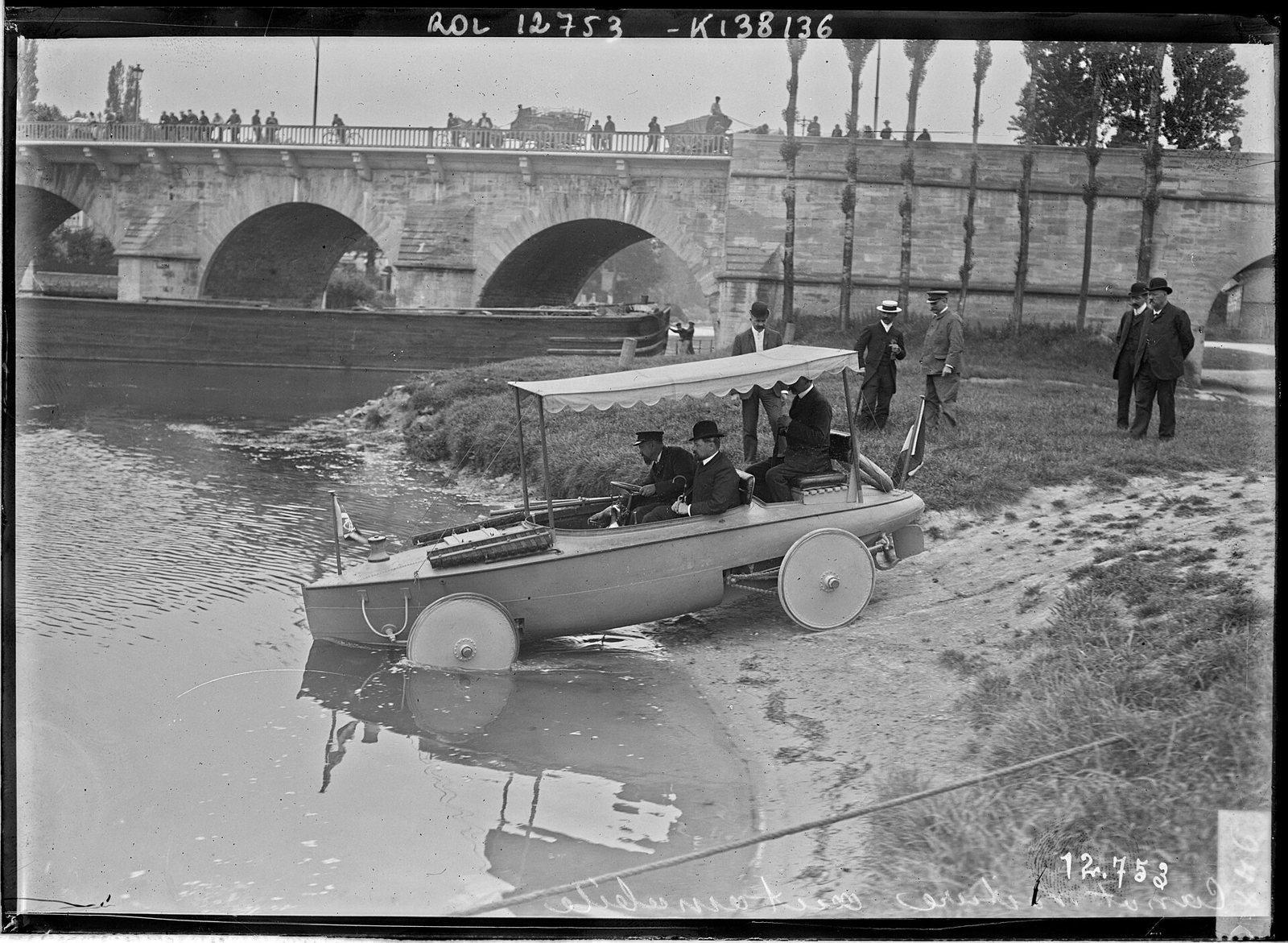
Jules Julien Ravaillier was a civil engineer who lived on the Boulevard Raspail in Paris [1][3]. The magazine The Rudder reported in November 1907 that he had spent years developing his combined launch and automobile [7]. The inventor called it a canot-voiture, or boat-car [1][4]. Jacques Boyer's account credits the construction of the steel hull and its axle mountings to the naval architect Gustave Pitre of Maisons-Laffitte, and says the motor, built at Vincennes, sat near the bow [2].
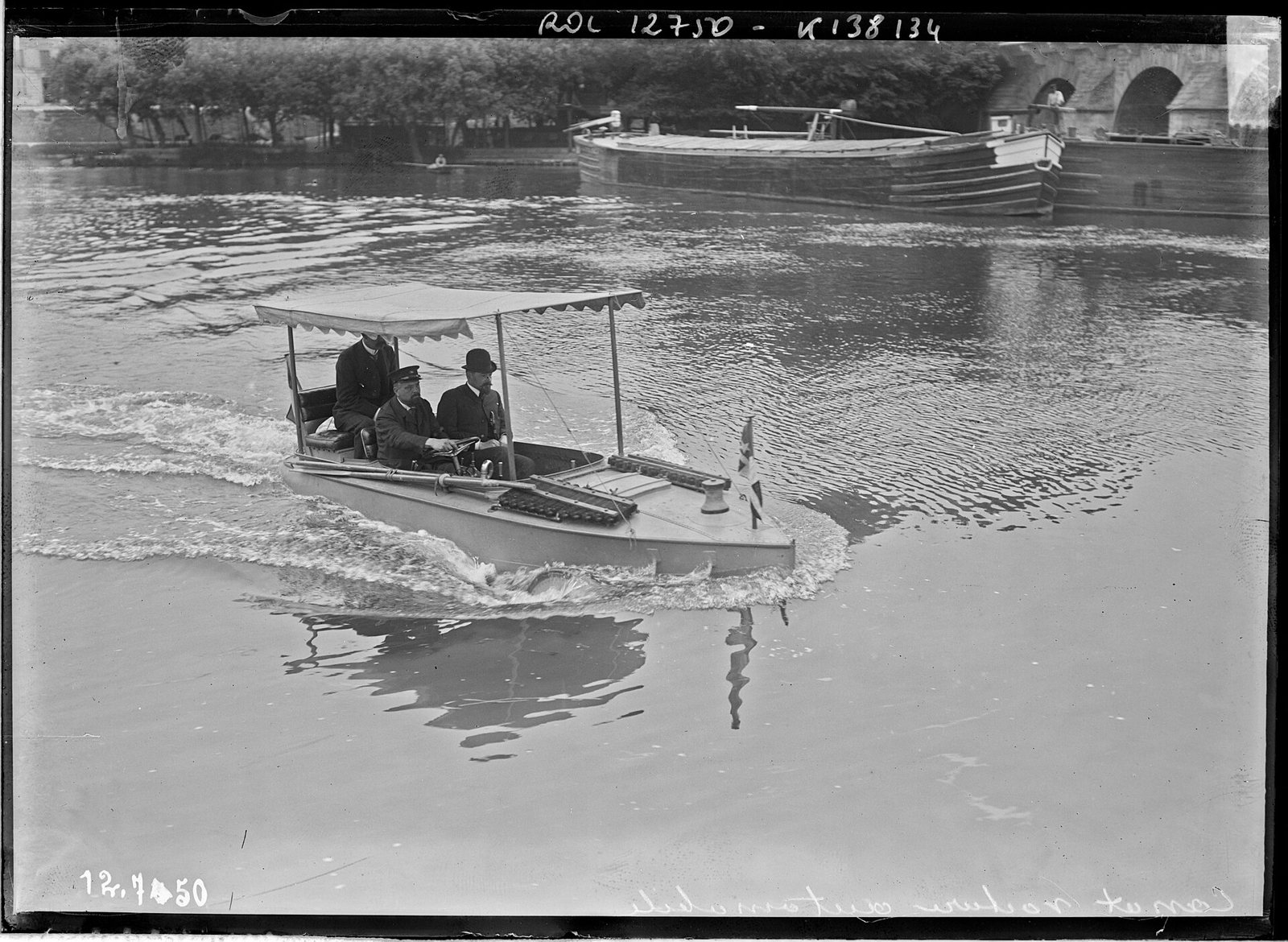
By June 1907 the machine was being shown on the Seine. Le Messager, a French-language paper in Lewiston, Maine, printed a report on June 13, 1907, describing an outing at Suresnes in which Ravaillier drove along the riverbank, launched into the water and came back ashore several times; his passengers included the wives of the French ministers of marine and of public works [1]. An article by Jacques Boyer, credited to Scientific American, said that official tests attended by the minister of public works, M. Barthou, had been a complete success, and it illustrated the boat-car under way on the Seine [2]. The Rudder added that the Paris trials, on the Seine and on the roads, drew the interest of the French War Department [7].
Late in 1907 the machine was shipped to New York on a freight ship, and Ravaillier followed on the French Line steamer La Gascogne, which arrived from Le Havre on November 4, 1907 [4]. Reporting his arrival, the Evening World gave his claims that it could reach 40 mph (64 km/h) on land and 19 knots (22 mph, 35 km/h) on water, and that the French government had ordered 60 of the machines for warships and lifesaving stations [4]. No other source found confirms that order.
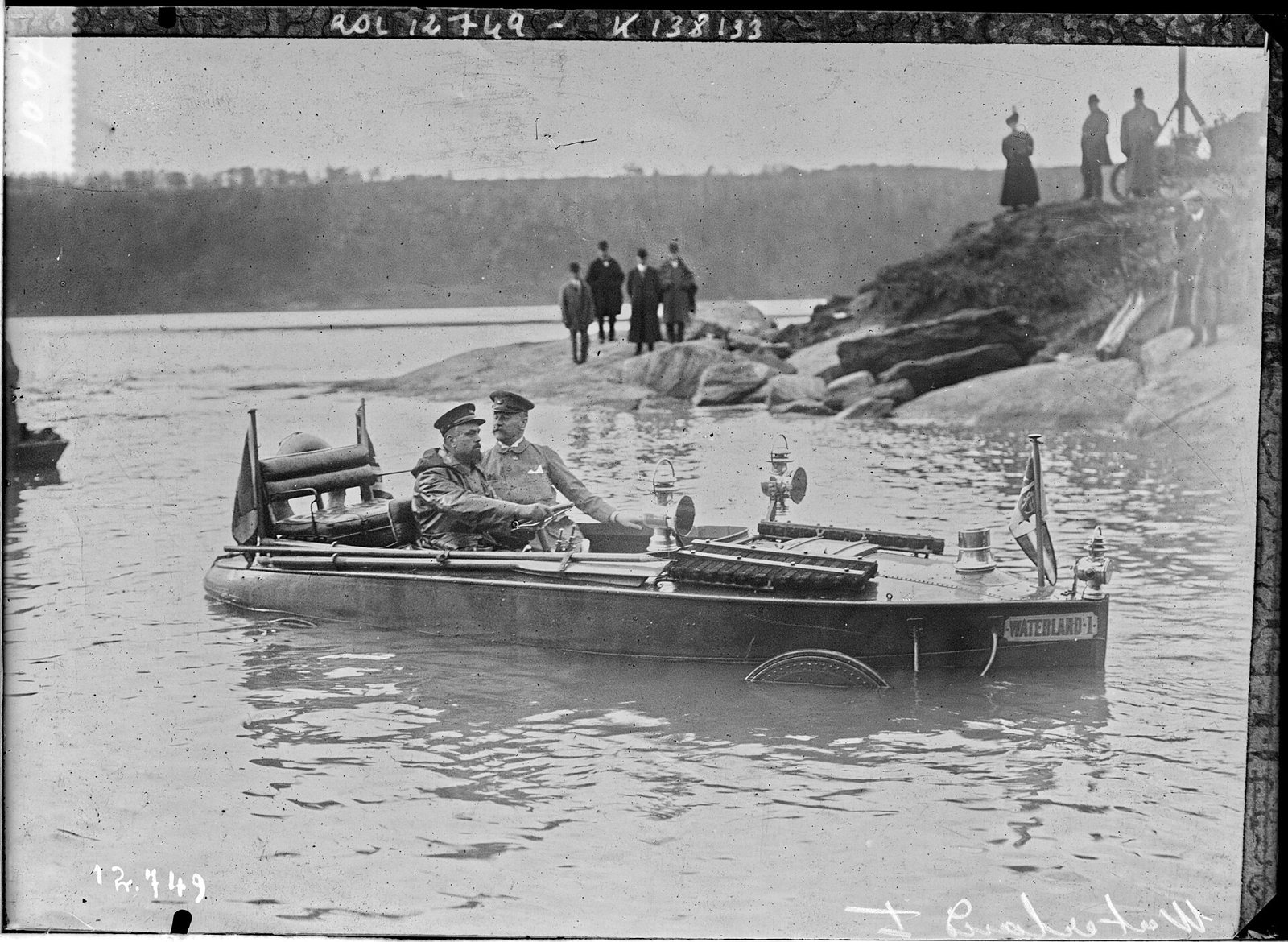
The first public trial in America took place on November 12, 1907 [5][6]. The Sun reported that General John T. Cutting drove the car up Broadway from 51st Street and along Lafayette Boulevard to the Hudson, where it entered the river flying French and American flags [5]. A wire report placed the launch at Fort Washington, with 50 or more automobile and motorboat experts looking on. In that account the car went in and out of the river for about half an hour and then cruised on it, before climbing out, crossing the New York Central tracks and taking the hill up to Riverside Drive [6]. According to the wire report, the experts called the trial a success but could not yet see a commercial use for it. Both reports gave the machine's name as Waterland I [5][6].
The Rudder reported that George E. Crater of Stanhope, New Jersey, had bought the machine and the world patent rights and planned to run it on the roads and waters around New York, and Boyer's article also said an American had bought it with its patents [7][2]. Ravaillier's US patent for a canoe-carriage, filed on January 28, 1907, was granted on December 31, 1907, as No. 875,210 [3]. The sources consulted do not record what became of the machine afterward.
Design and how it works
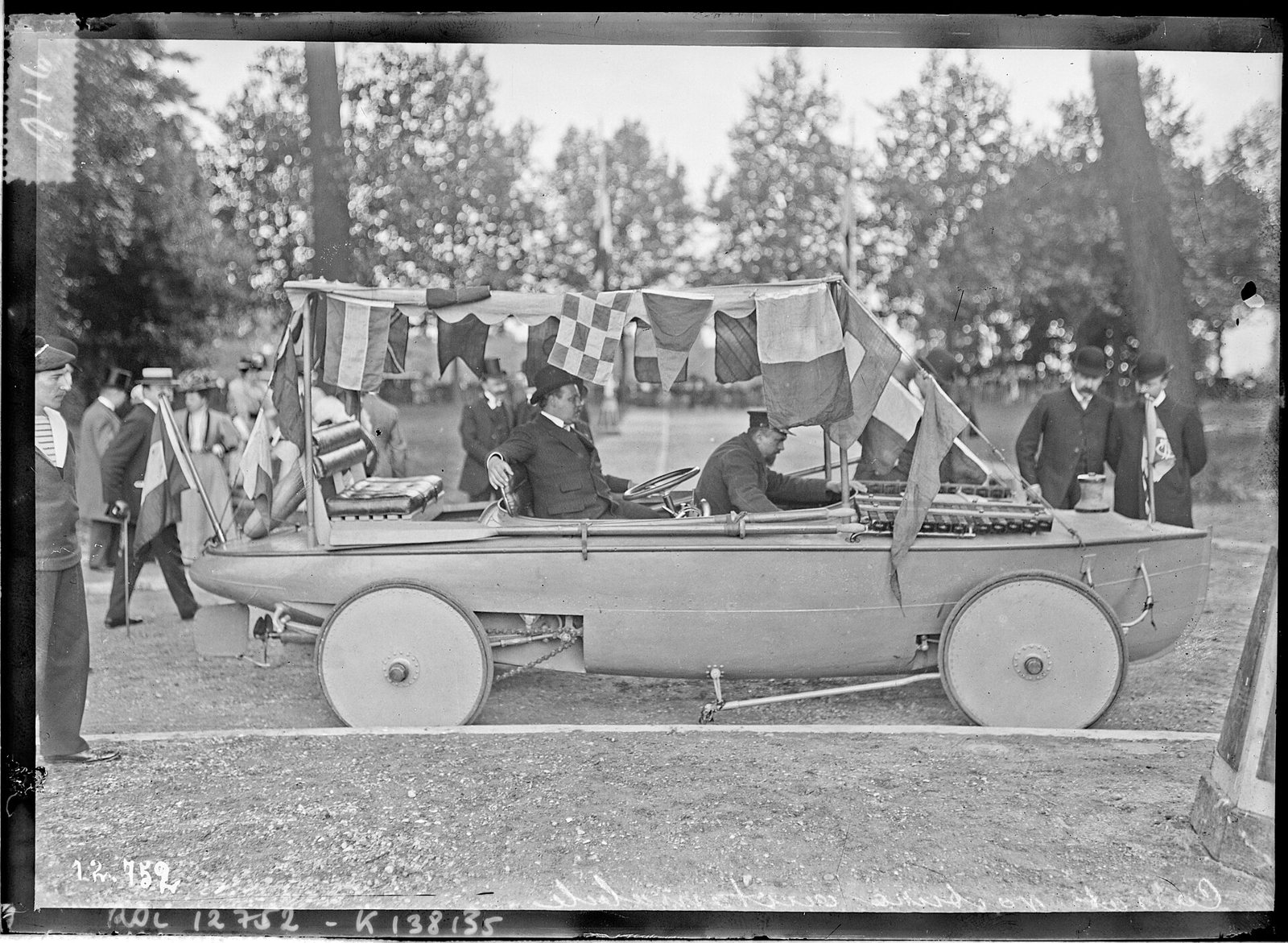
The hull was made of steel plates riveted to T-section steel ribs and rode on springs over the axles, which passed through watertight tubes in the hull [2][7]. The wheels were steel discs (pressed steel in Boyer, galvanized steel in The Rudder) with solid rubber tires, although one New York wire report described them as wood thinly plated with steel [1][2][7][6]. On land a variable-speed shaft with three forward speeds and reverse drove the rear wheels by chain [2][7]. A lever beside the driver connected the engine to a screw propeller at the stern, and the wheels, propeller and capstan could be used separately or together [2]. One steering wheel turned both the front wheels and the rudder [2][7]. The boat also carried a bilge pump, an anchor, a buoy and a pair of oars in case the motor failed afloat [2].
On reasonably firm ground the car could drive out of the water up a grade of about 15 percent [2][7]. On steeper or softer banks, an engine-driven capstan at the bow wound in a rope tied to a stake, tree or rock [2][7]. At the Hudson, The Sun reported that it hauled itself up the sloping bank this way [5].
The patent drawings differ from the machine described in the press. They show two screw propellers with a rudder between them, rear wheels whose spokes were shaped as angled blades, and a windlass for pulling the vehicle ashore [3]. The demonstrated car used a single stern propeller and disc wheels [1][2][5].
Conflicting reports
Reported performance varies widely. Boyer gave 35 km/h (21.75 mph) on land and 9 km/h (5.6 mph) on water as the result of numerous trials, and The Rudder gave 22 mph (35 km/h) on the road and 5.5 mph (8.9 km/h) afloat [2][7]. Le Messager gave 25 milles an hour on the road and 5 on the water, without saying which mile it meant [1]. The New York wire report printed in the Deseret Evening News gave much higher figures, 55 mph (89 km/h) on land and 15 nautical miles an hour (17 mph, 28 km/h) afloat [6]. The Evening World gave the inventor's claim of 40 mph (64 km/h) and 19 knots (22 mph, 35 km/h), although its own headline said 18 knots [4]. The engine is described as a 12 hp two-cylinder De Dion in The Sun and as a 20 hp four-cylinder in The Rudder [5][7]. Sizes differ too: Le Messager gave a length of 4 m (13 ft), while the wire report gave 30 ft (9.1 m) with a 6 ft (1.8 m) beam [1][6].
Photos
Related entries
Sources
- Automobile amphibie (Le Messager, Lewiston, Maine, page 8), Le Messager, via Library of Congress, Chronicling America (1907-06-13). www.loc.gov/resource/sn83045313/1907-06-13/ed-1/?sp=8
- A New Automobile Boat, by Jacques Boyer, credited to Scientific American (The Morris County Chronicle, Morristown, New Jersey, page 2), The Morris County Chronicle, via Library of Congress, Chronicling America (1908-02-18). www.loc.gov/resource/sn85035816/1908-02-18/ed-1/?sp=2
- US875210A, Canoe-carriage (Jules Julien Ravaillier), Google Patents (United States Patent Office) (1907-12-31). patents.google.com/patent/US875210
- French Inventor Arrives to Tell of His Amphibious Auto Cart (The Evening World, New York, page 16), The Evening World, via Library of Congress, Chronicling America (1907-11-04). www.loc.gov/resource/sn83030193/1907-11-04/ed-1/?sp=16
- Amphibious Car Has First Trial in America (The Sun, New York, page 8), The Sun, via Library of Congress, Chronicling America (1907-11-13). www.loc.gov/resource/sn83030272/1907-11-13/ed-1/?sp=8
- Amphibious Automobile: Plunges Into Hudson, Cavorts in Water, Comes Out, Whizzes Away (Deseret Evening News, Salt Lake City, page 1), Deseret Evening News, via Library of Congress, Chronicling America (1907-11-13). www.loc.gov/resource/sn83045555/1907-11-13/ed-1/?sp=1
- An Early Amphibicar, 1907 (transcription of The Rudder, November 1907, page 847), Hydroplane History. hydroplanehistory.com/other/an_early_amphibicar_1907.html
- Ravailler, Wikipedia. en.wikipedia.org/wiki/Ravailler
Last reviewed November 2026. Spotted something to correct or add? Tell us and include a source.
About the Amphibious Encyclopedia
WaterCar has designed and built amphibious vehicles in Southern California for more than 25 years. We keep this encyclopedia so anyone curious about vehicles that cross between land and water has one place to start, with the sources listed for every fact.
Browse all entries → · The WaterCar machines → · How a WaterCar works →