
Why a volcanologist wanted a boat on wheels
Thomas Augustus Jaggar, a geologist born in Philadelphia in 1871, founded the Hawaiian Volcano Observatory and became its director on January 17, 1912 [4][5]. His idea for an amphibian came from Alaska. On a 1907 expedition to the Aleutian Islands his party relied on a sailing vessel and found no anchorage at Umnak Island, and he concluded that volcano work there needed a boat on wheels that could land on any beach and serve as a camp [2].
In 1927 he shipped a low-geared Ford runabout to Kodiak and King Cove to test driving on Alaskan beaches [2]. He tried fitting winch spools to its drive wheels so it could haul itself off the beach, and drove along the shore until a rocky headland blocked the way; that, he wrote, set the plan for the boat body [2].
The Ohiki
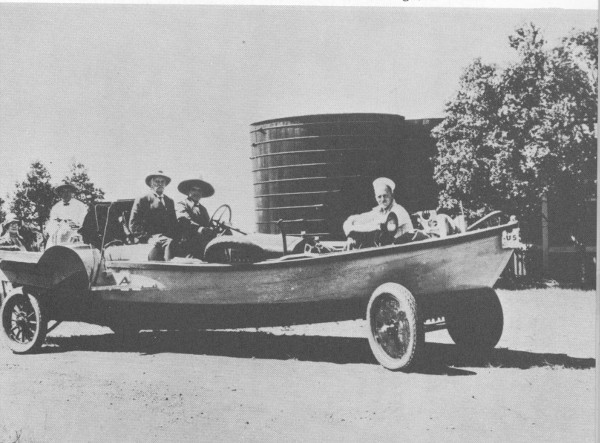
The observatory machine shop built the first boat around that same Ford, which Jaggar's truck builder, Boyrie, reworked [1][2]. The Ohiki was a wooden work skiff, 21 ft (6.4 m) long by Jaggar's account and 22 ft (7 m) by the USGS, with two paddle wheels; the USGS gives its weight as 3,800 lb (1,700 kg) and its width across the paddle boxes as 7 ft (2.1 m) [2][1][4]. Its name is Hawaiian for a beach crab: a ghost crab in Jaggar's memoir, a sand crab in the USGS history [2][1].
Its first sea trial, at Ninole Cove in Kau, showed it needed work [1]. The driving wheels dug into soft sand and choppy water slopped aboard, so the freeboard was raised, the hull lengthened slightly, the paddle wheels enlarged, a bow winch fitted and a 5 hp outboard motor added [1][2].
In February 1928 the Ohiki set off on a road and sea trial around the Island of Hawaii, with Isabel Jaggar as stewardess and Lorrin Thurston, founder of the Advertiser newspaper and Jaggar's main supporter, as passenger and publicist [1][2][5]. It rolled down the steep Kona hills in low gear to the delight of roadside children, then cruised from Kailua to Kawaihae, landing on beaches and lava flows [2]. At Kawaihae it bogged down on a soft underwater bank and was dragged ashore with its winch, a cable and a tree, and on the climb to Waimea its wooden rear axle mountings cracked; after repairs it finished the circuit, a course of about 400 miles (650 km) [2]. It made about 4 mph (6 km/h) afloat with paddles and outboard together, and over 20 mph (30 km/h) on roads [1].
The Honukai in Alaska
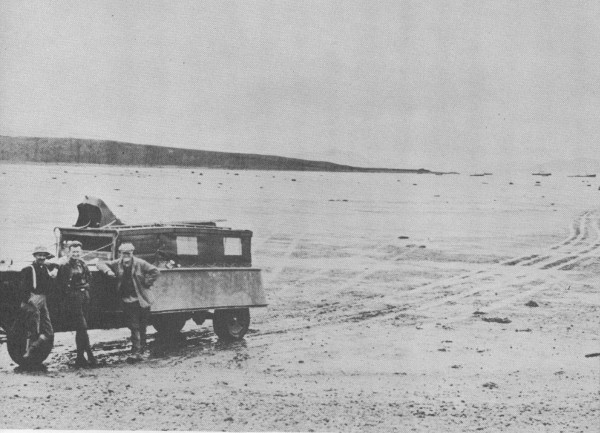
In 1928 the National Geographic Society and the USGS sent Jaggar to survey about 2,500 square miles (6,500 square kilometers) around Pavlof Volcano in Alaska, and the Society supplied a larger amphibian, which Jaggar named Honukai, Hawaiian for sea turtle [2][1]. This twin-screw steel boat was built in Chicago by George Powell, who already advertised a Ford-based mobile boat for fishermen to drive to inland lakes [1][2]. A 2013 Fountainhead Antique Auto Museum article, illustrated with a picture from Popular Science Monthly of October 1928, describes a lengthened 1926 Ford chassis on oak timbers, front disc wheels that acted as rudders, a radiator perched on the cabin roof and a cooling pipe looped around the hull below the waterline [3].
Jaggar slept aboard through the summer. Long steel mats helped the wheels grip the loose upper beach, and with the bow winch, levers and hand labor the crew could leave the shore for the tundra [2]. Over about 400 miles (650 km) of water, beach and tundra between the Shumagin Islands and King Cove, he wrote, the crew never had to pump up a tire, and the very low gears let them drive up to the snow line on Mount Dana to bring out a bear he had shot [2][1].
Later years
Jaggar brought the Honukai back to Hawaii and kept it in Kona [1]. A 2013 Kona Historical Society article shows a photograph of the Ohiki, still with its paddle wheels and outboard, on the beach at Keauhou Bay, which it dates to February 1938 [4]. No source consulted says what finally became of either boat.
In World War II, Jaggar wrote, he set to work on twelve monographs for the Navy on amphibians and beach conditions, and a photograph of the Ohiki became the frontispiece of a secret report on amphibians for the joint army staffs in London [2]. The USGS credits him with helping the U.S. Army design wartime amphibious vehicles and notes his 1945 Franklin L. Burr Prize from the National Geographic Society for this work [1]. According to the Fountainhead museum, a November 1945 Popular Mechanics article traced the Army's DUKW and Weasel back to the Honukai [3].
Photos
Related entries
Sources
- Thomas A. Jaggar, Jr., and the Hawaiian Volcano Observatory, by Russell A. Apple (Volcanism in Hawaii, USGS Professional Paper 1350, chapter 61), U.S. Geological Survey (1987). pubs.usgs.gov/pp/1987/1350/pdf/chapters/pp1350_ch61.pdf
- My Experiments with Volcanoes, by Thomas A. Jaggar (Hawaiian Volcano Research Association, 1956), eBook 69830, Project Gutenberg (1956). www.gutenberg.org/ebooks/69830
- Amphibious Vehicles in Alaska, by Nancy DeWitt, Fountainhead Antique Auto Museum (2013-01-28). www.fountainheadmuseum.com/fountainheadauto/2013/01/amphibious-vehicles-in-alaska.html
- Dr. Thomas Jaggar and `Ohiki (Sand Crab), by Maile Melrose, Kona Historical Society (2013-02-19). konahistorical.org/mailes-meanderings/dr-thomas-jaggar-and-ohiki-sand-crab
- Volcano Watch: He's back! Thomas Jaggar returns to the Whitney Vault, U.S. Geological Survey, Hawaiian Volcano Observatory (2006-06-01). www.usgs.gov/observatories/hvo/news/volcano-watch-hes-back-thomas-jaggar-returns-whitney-vault
Last reviewed November 2026. Spotted something to correct or add? Tell us and include a source.
About the Amphibious Encyclopedia
WaterCar has designed and built amphibious vehicles in Southern California for more than 25 years. We keep this encyclopedia so anyone curious about vehicles that cross between land and water has one place to start, with the sources listed for every fact.
Browse all entries → · The WaterCar machines → · How a WaterCar works →