
History
The Volgograd Tractor Plant designed the BMD-1 as Ob'yekt 915 between 1965 and 1969 [1]. Trials began in 1967, limited production followed in 1968, and the vehicle was commissioned on 14 April 1969 [1]. Army Recognition dates serial production to 1970, which matches the text of Wikipedia, though its infobox gives 1968 [1][5]. It replaced the ASU-57 in Soviet airborne forces [3]. Western observers first saw it at the Dvina exercise in 1970 and again at the Moscow parade of November 1973, and they called it the M1970 until its Soviet name was known [3][5].
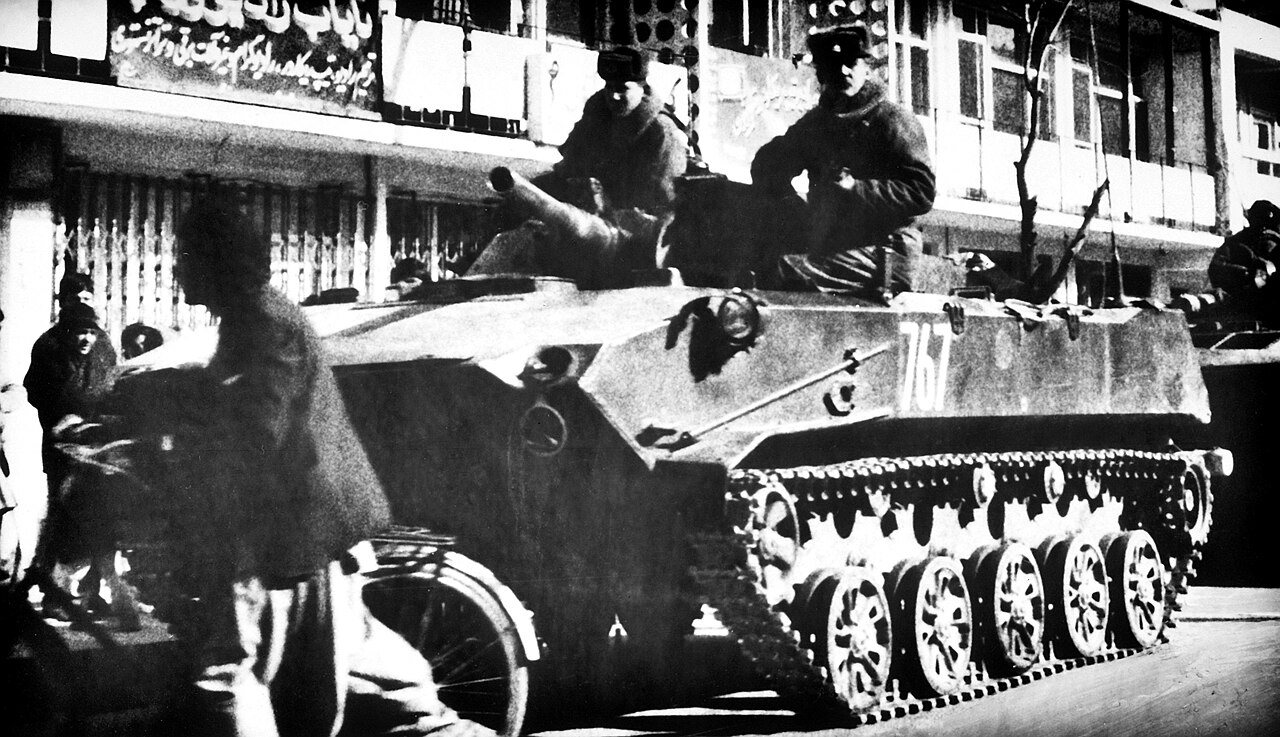
Wikipedia reports that Cuban-operated BMD-1s took part in the 1978 Ogaden War, and that the Soviet army used the type widely in Afghanistan, where it proved poorly suited to the terrain [1]. A modernized BMD-1P entered service in 1977 [1][5].
The BMD-2 came from experience in Afghanistan, where the BMD-1's 73 mm gun proved weak against armor and could not elevate far enough [2]. Developed between 1981 and 1985, it keeps a slightly modernized BMD-1 hull and adds a new turret with the 30 mm 2A42 cannon and an anti-tank missile launcher used on the BMP-2 [2][4]. Production and service began in 1985, and the engine and suspension are unchanged [2].
Design, swimming and airdrop
The BMD-1 is fully amphibious [1][5]. Two water jets move it, and Wikipedia says one sits on each side of the hull, steered by the rear exit lids, while FAS and Army Recognition place two jets at the rear [1][3][5]. Before entering the water, the crew raises a trim vane stowed on the front plate, which improves stability and keeps water from the bow [1][5]. Two electric bilge pumps, with a manual backup, remove water that gets in [1]. Swim speed is given as 10 km/h (6 mph), with a range of 116 km (72 mi) afloat, and FAS lists 7 in its specification table without units [1][3][5].
The hydro-pneumatic suspension lets the crew change ground clearance from 100 mm to 450 mm (4 to 18 in), and it squats to fit inside transport aircraft [1][3]. The type can be carried by An-12, An-22, Il-76 and An-124 aircraft and by heavy Mi-6 and Mi-26 helicopters [1]. Early airdrops were made without a crew, the PRSM-915 rocket-parachute system with retrorockets for a soft landing entered service in 1975, and tests in 1976 showed the vehicle could be dropped with the driver and gunner inside [1].
Sources disagree on crew and weight. Wikipedia lists a two-person crew carrying six troops in its infobox and four crew with five troops in its text, while Army Recognition gives three crew and four troops [1][5]. FAS gives a 7.5 t weight in its text and 13.3 t combat weight in its table [3].
Users
Wikipedia lists current BMD-1 operators including Azerbaijan (20), Moldova (44), Uzbekistan (120 in 2024), Turkmenistan (8 in 2024) and Armenia (10), and says Russia holds about 150 in storage after replacing the type with the BMD-2 [1]. For the BMD-2, Wikipedia gives Russia about 849 in active service and over 1,500 in storage as of 2013, and lists Ukraine as the other current operator [2].
Related entries
Sources
- BMD-1, Wikipedia. en.wikipedia.org/wiki/BMD-1
- BMD-2, Wikipedia. en.wikipedia.org/wiki/BMD-2
- BMD-1 Airborne Combat Vehicle, Federation of American Scientists. man.fas.org/dod-101/sys/land/row/bmd-1.htm
- BMD-2 Airborne Combat Vehicle, Federation of American Scientists. man.fas.org/dod-101/sys/land/row/bmd-2.htm
- BMD-1 (Russia), Army Recognition. www.armyrecognition.com/military-products/army/infantry-fighting-vehicles/airborne-vehicles/bmd-1-russia-uk
Last reviewed November 2026. Spotted something to correct or add? Tell us and include a source.
See how to register a low-speed vehicle or boat in your state.
About the Amphibious Encyclopedia
WaterCar has designed and built amphibious vehicles in Southern California for more than 25 years. We keep this encyclopedia so anyone curious about vehicles that cross between land and water has one place to start, with the sources listed for every fact. New to the subject? Start with our guide, What is an amphibious vehicle?
All amphibious vehicles → · The WaterCar machines → · How a WaterCar works →