
History
The Soviet armored forces' main directorate issued the requirement at the end of the 1950s, and several design bureaus competed [2]. Pavel Isakov's team at the Chelyabinsk Tractor Plant won with its Obiekt 765, chosen for its front-mounted engine, rear infantry exits and troop compartment layout [1][2]. Wikipedia says design ran from 1961 to 1965, prototypes were tested by the 120th Guards Division in 1965, and production began in 1966 [1]. Historyofwar.org puts prototype production at 1966 to 1967 and service entry at 1969 [2]. Westerners first saw the vehicle at the Moscow parade of 7 November 1967 [1][3].
Production totals vary by source. Wikipedia lists more than 20,000 built in the Soviet Union and says production there ended in 1982 or 1983 [1]. Historyofwar.org says over 55,000 had been built since 1966 [2]. Czechoslovakia built the vehicle as the BVP-1, and Poland uses the name BWP-1 [1][2].
Design and how it works
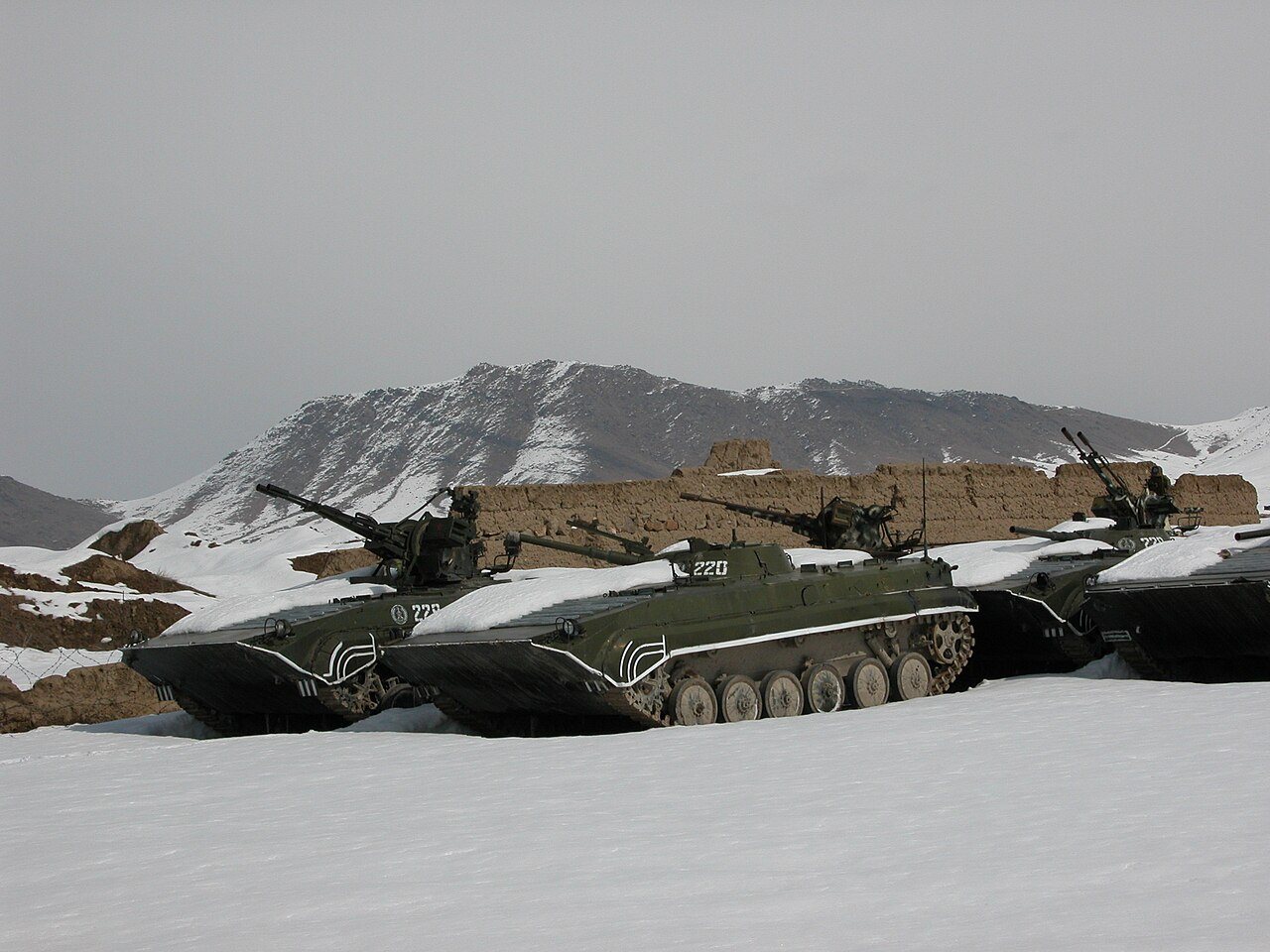
The BMP-1 carries a crew of three (commander, driver and gunner) and eight infantry [1][2][3]. Its main gun is a 73 mm smoothbore, supplemented by a coaxial 7.62 mm machine gun and a rail launcher for the 9M14 Malyutka anti-tank missile [1][2]. A 300 hp (224 kW) UTD-20 diesel gives a top road speed of 65 km/h (40 mph) and a road range of about 600 km (370 mi) [1][2][3]. Wikipedia lists the weight as 13.2 tonnes (29,100 lb) and the length as 6.735 m (22 ft 1 in) [1].
The vehicle is fully amphibious and swims by turning its tracks, not with water jets [1][2][3]. Wikipedia gives a water speed of 7 to 8 km/h (4 to 5 mph) [1]. Before entering the water the crew must erect a trim vane and close the rear doors, and the vehicle is meant to carry a full load of eight passengers or the equivalent in ballast, because an empty one is front-heavy and can sink [1]. An overpressure air filtration system protects the crew from chemical, biological and nuclear contamination [1][2].
Service
Egypt and Syria used the BMP-1 in the October 1973 war. Historyofwar.org says both valued its low silhouette, low ground pressure and mobility, and notes that it became very hot with the hatches closed and that its 73 mm gun was effective mainly at close range [1][2]. It was later used by Soviet forces in Afghanistan, by Iraq, Libya and Cuba in their wars [2]. Wikipedia says Russia, India, Poland and China each operate more than 1,000 [1].
Legacy
Historyofwar.org lists Russian variants for command, reconnaissance, radar and repair roles, and foreign versions including the BMP-1F of Hungary, the BWP of Poland, the BVP-1 of the Czech Republic and the MLI-84 built in Romania [2]. Historyofwar.org also notes that the early weight imbalance from the front engine was fixed by lengthening the hull [2].
Related entries
Sources
- BMP-1, Wikipedia. en.wikipedia.org/wiki/BMP-1
- BMP-1 Infantry Fighting Vehicle (Russia), Historyofwar.org. www.historyofwar.org/articles/weapons_bmp1.html
- BMP-1, Federation of American Scientists (DOD 101). man.fas.org/dod-101/sys/land/row/bmp-1.htm
Last reviewed November 2026. Spotted something to correct or add? Tell us and include a source.
See how to register a low-speed vehicle or boat in your state.
About the Amphibious Encyclopedia
WaterCar has designed and built amphibious vehicles in Southern California for more than 25 years. We keep this encyclopedia so anyone curious about vehicles that cross between land and water has one place to start, with the sources listed for every fact. New to the subject? Start with our guide, What is an amphibious vehicle?
All amphibious vehicles → · The WaterCar machines → · How a WaterCar works →