
History
In the 1950s the Soviet Central Auto and Tractor Directorate looked for a new generation of vehicles to replace its AT-P artillery tractors [1]. The result was the MT-L, a light carrier built on the chassis of the PT-76 amphibious light tank, and the MT-LB is its armored version [1]. FAS describes the MT-L as an unarmored, turretless vehicle first developed for geological work in the far north [2]. One commercial reference says the MT-LB was designed in Ukraine in the early 1960s, so the exact design dates vary by source [3].
Production began in the early 1970s, and the design was cheap to build because it used many existing parts, including a truck-derived engine [1]. Western analysts first identified it in 1970 and called it the M1970 [2]. The Kharkiv Tractor Plant in Soviet Ukraine built it, Bulgaria also produced it (the MT-LB VM version from 1971 to 2012), and Poland built it under license at Huta Stalowa Wola from 1976 [1]. FAS reports a modernization in 1995 that brought improved steering and a new engine [2].
Design and how it swims
The MT-LB carries a crew of two and up to 11 passengers in the rear compartment, although FAS text mentions 10 infantrymen in one place [1][2][3]. Its armor is at most 14 mm thick, and the usual weapon is a 7.62 mm PKT machine gun in a small front turret [1]. It can carry 2,000 kg (4,400 lb) of cargo or tow 6,500 kg (14,300 lb), which suits its role as an artillery tractor [1][2]. A V-8 diesel of 240 hp drives it to about 61 km/h (38 mph) on roads [1][3].
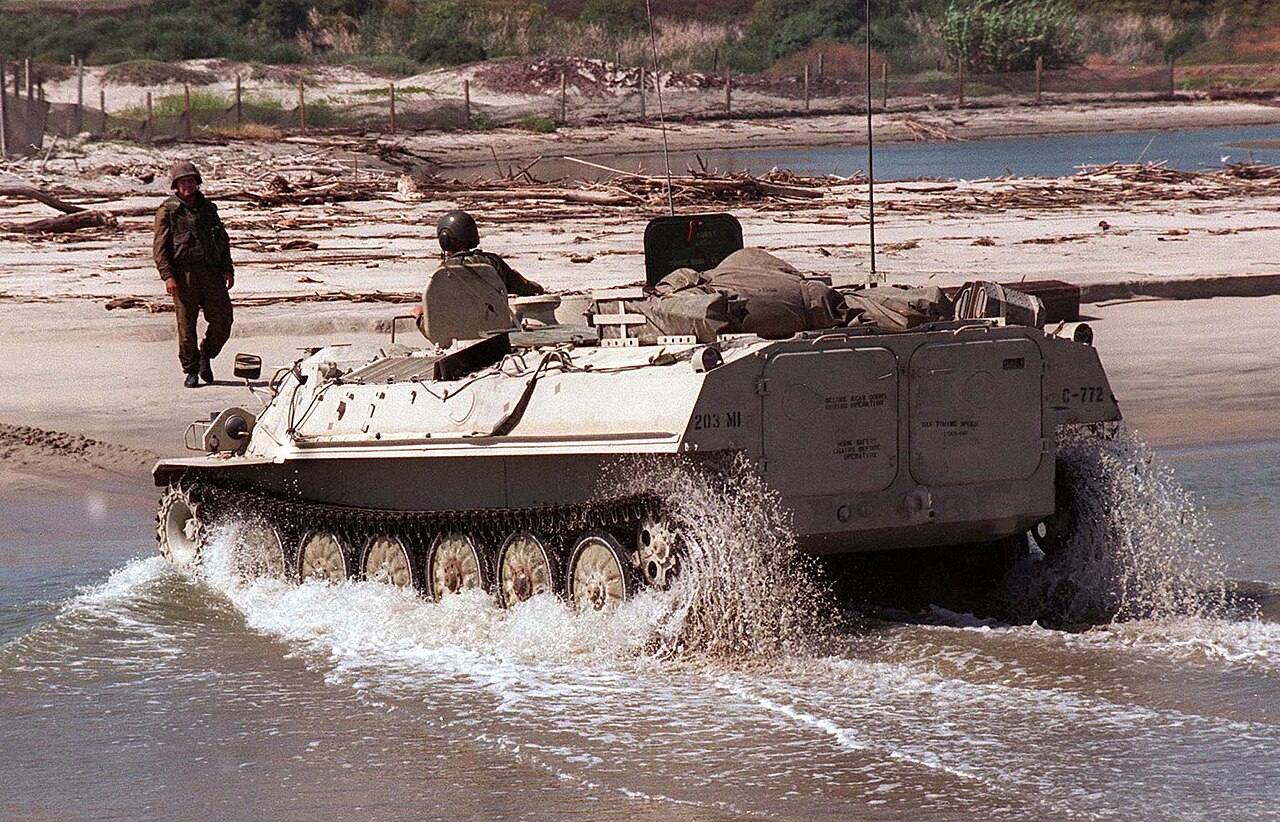
In water the vehicle is propelled by its tracks [1][2][3]. Water speed is given as 5 to 6 km/h (about 3 to 4 mph) in one source, and FAS lists 3 to 4 without units [1][2]. Before entering the water, crews raise a trim vane at the front and switch on the bilge pumps, according to Army Recognition [3]. None of the sources opened here gives a full water-entry procedure.
Variants and users
The wide-track MT-LBV appeared in 1972 with 670 mm tracks instead of 350 mm, for use on snow and swamp [1]. The MT-LBu is a larger, unarmored version with a longer hull and seven road wheels per side [1]. FAS lists howitzer, anti-tank missile, radar, chemical reconnaissance and engineer versions built on the same chassis [2].
FAS says the type serves in at least nine countries, and Army Recognition lists users from Armenia and Azerbaijan to Finland, Iraq, Russia and Ukraine [2][3]. Sweden bought 460 as the Pbv 401 in 1993 and sold the last 147 to Finland in 2011, according to Wikipedia [1]. Wikipedia also lists combat use from the Soviet-Afghan War to the Syrian civil war and the Russo-Ukrainian War [1].
Related entries
Sources
- MT-LB, Wikipedia. en.wikipedia.org/wiki/MT-LB
- MT-LB Multipurpose Armoured Vehicle, Federation of American Scientists. man.fas.org/dod-101/sys/land/row/mt-lb.htm
- MT-LB (Russia), Army Recognition. armyrecognition.com/military-products/army/armoured-personnel-carriers/tracked-vehicles/mt-lb-russia-uk
Last reviewed November 2026. Spotted something to correct or add? Tell us and include a source.
See how to register a low-speed vehicle or boat in your state.
About the Amphibious Encyclopedia
WaterCar has designed and built amphibious vehicles in Southern California for more than 25 years. We keep this encyclopedia so anyone curious about vehicles that cross between land and water has one place to start, with the sources listed for every fact. New to the subject? Start with our guide, What is an amphibious vehicle?
All amphibious vehicles → · The WaterCar machines → · How a WaterCar works →