
History
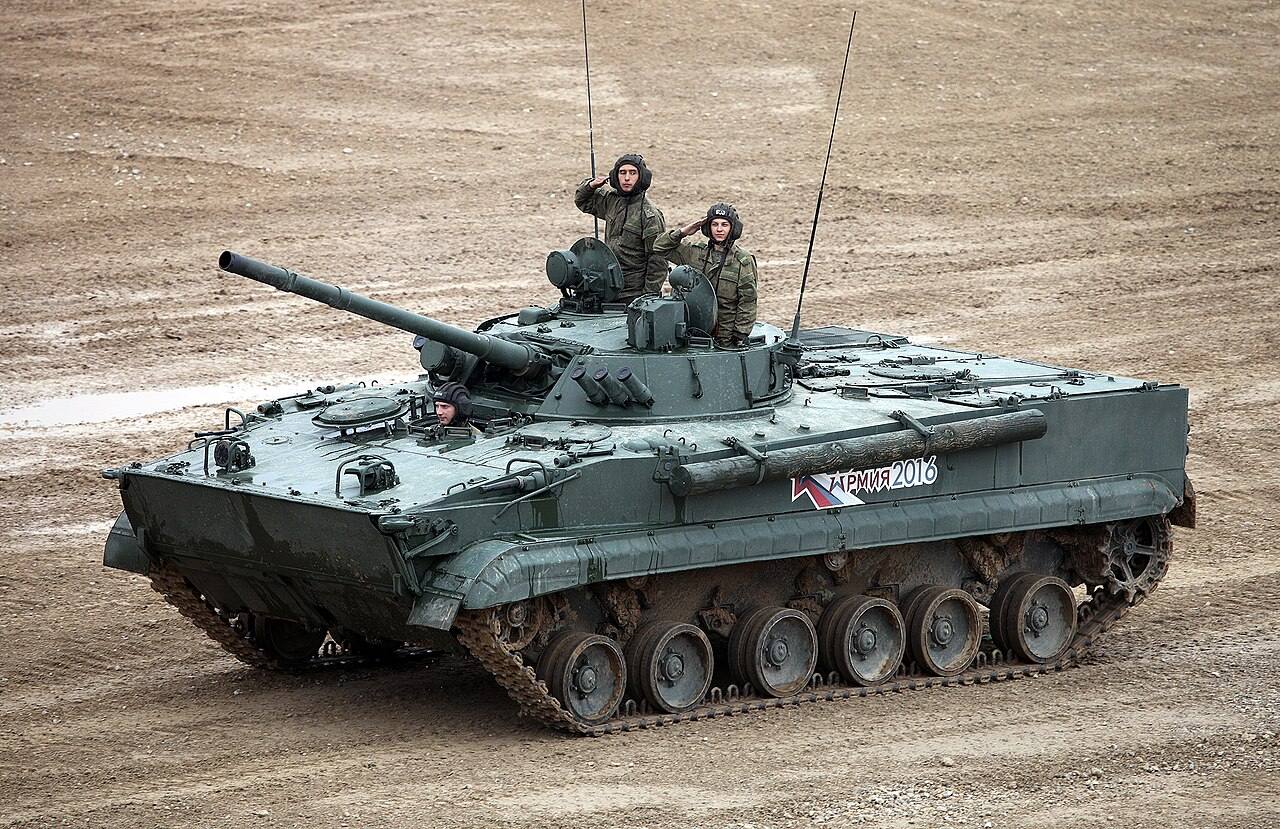
The BMP-3 is a Soviet and Russian infantry fighting vehicle made by Kurganmashzavod in Kurgan [2]. Wikipedia gives its design period as 1975 to 1987 and says it has been in service since 1987, a date Army Technology also gives for Russian Army service [1][2]. Army Recognition places its entry into Soviet service in 1990 instead [3]. Wikipedia reports that more than 2,000 have been built [1].
Several armies bought it. The United Arab Emirates took 390 vehicles between 1992 and 1997 according to Wikipedia, while Army Technology puts the Emirati total at 600 [1][2]. Indonesia received 54 of the BMP-3F marine version, 17 in 2010 and 37 in 2014, in Wikipedia's count, against 30 in Army Technology's [1][2]. Greece ordered 450 BMP-3 as part of a deal worth 1.7 billion euros and canceled the order in 2011 [1]. The differing totals probably reflect different dates.
Design and how it works
The BMP-3 carries a crew of three and seven troops [1][2][3]. It weighs 18.7 metric tons (41,200 lb) and is about 7.14 m (23 ft 5 in) long [1][3]. A rear-mounted UTD-29M diesel of 500 hp (373 kW) drives it to about 45 mph (72 km/h) on roads and 28 mph (45 km/h) off road, according to Wikipedia; the other two sources give 70 km/h on paved roads [1][2][3]. Its armament is a 100 mm gun that fires shells or guided missiles, a 30 mm cannon and 7.62 mm machine guns [1][2].
On water the vehicle moves on water jets at the rear of the hull, powered through a power takeoff from the engine [2]. Army Technology and Army Recognition describe two jets, while Wikipedia describes a single-stage axial auger-type unit and does not give a count [1][2][3]. All three sources give a swimming speed of 10 km/h (6 mph) [1][2][3]. It is a tracked hull that swims at displacement speed and does not plane.
The BMP-3F marine version
The BMP-3F is the naval infantry version, built with improved buoyancy and stability [1]. It can move afloat in sea state 3 and fire with the needed accuracy in sea state 2 [1][2]. It can run for up to seven hours of continuous amphibious operation with the engine running [1][2].
Legacy
Variants include a BMP-3K command vehicle and a BRM-3K reconnaissance vehicle [2]. The BMP-3M adds a new turret and fire control and a UTD-32 engine rated at 660 hp (492 kW) [2]. Operators listed across the sources include Azerbaijan, Cyprus, Indonesia, Iraq, Kuwait, Russia, South Korea, Turkmenistan, the United Arab Emirates and Venezuela [1][2][3].
Related entries
Sources
- BMP-3, Wikipedia. en.wikipedia.org/wiki/BMP-3
- BMP-3 Infantry Fighting Vehicle, Army Technology. www.army-technology.com/projects/bmp-3
- BMP-3 IFV Infantry Fighting Vehicle, Army Recognition. www.armyrecognition.com/military-products/army/infantry-fighting-vehicles/tracked-vehicles/bmp-3-russia-uk
Last reviewed November 2026. Spotted something to correct or add? Tell us and include a source.
See how to register a low-speed vehicle or boat in your state.
About the Amphibious Encyclopedia
WaterCar has designed and built amphibious vehicles in Southern California for more than 25 years. We keep this encyclopedia so anyone curious about vehicles that cross between land and water has one place to start, with the sources listed for every fact. New to the subject? Start with our guide, What is an amphibious vehicle?
All amphibious vehicles → · The WaterCar machines → · How a WaterCar works →