
History
The BTR-80 is the diesel development of the BTR-70, built by the Gorky Automobile Plant, now the Arzamas Machine-Building Plant, in Nizhny Novgorod [1][2]. Wikipedia gives 1984 as the production start, 1985 for adoption and 1986 for service entry [1]. The FAS table also lists 1984, while its text mentions the early 1980s and the late 1980s, and Army Technology says the late 1980s [2][3]. Wikipedia reports about 5,000 built [1]. The BTR-80A, with a 30 mm cannon, followed in 1994 [1][3].
Wikipedia says the BTR-82 prototype was shown in November 2009 and that the Russian Ministry of Defense adopted the BTR-82A in early 2013 [1]. The BTR-82 has a 300 hp engine and more armor [1].
Design and how it works
The BTR-80 weighs 13.6 metric tons (30,000 lb) [1][2][3]. Length is 7.7 m (25 ft 3 in) in Wikipedia, 7.55 m in FAS and 7.76 m in Army Technology [1][2][3]. A KamAZ-7403 diesel of 260 hp (194 kW) gives a road speed of 80 to 90 km/h (50 to 56 mph) and a range of 600 km (370 mi) [1][3]. FAS says the single diesel gives better performance and lower fire risk than the twin gasoline engines of the BTR-70 [2].
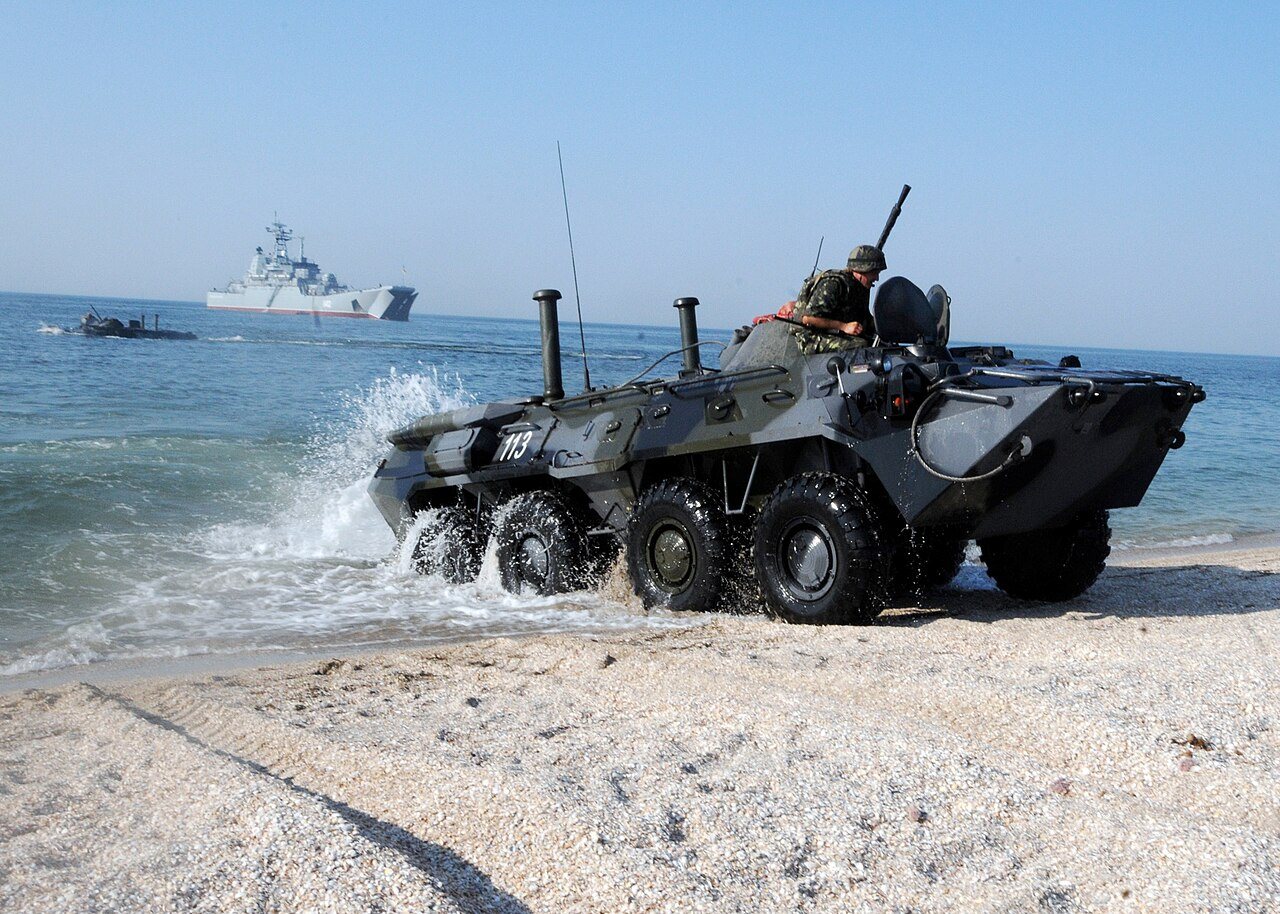
Wikipedia says the BTR-80 swims on hydrojets at 10 km/h (6 mph) [1]. FAS and Army Technology both give 9 km/h in text [2][3]. Army Technology reports 12 hours afloat and bilge pumps [3]. Neither of those two pages names the water drive [2][3]. The BTR-80 does not plane.
Service and sea trials
Wikipedia lists more than 25 current operators, including Russia with 1,200 BTR-80 and BTR-82 vehicles and Ukraine with 350 [1]. Russia gave Hungary 200 BTR-80s to reduce a debt [2]. Wikipedia also lists former operators, including Turkey with 214 vehicles and Romania with 70 [1]. Bangladesh finished an order of 60 for UN peacekeeping in April 2006, and Iraq contracted in July 2005 for 98 reconditioned ex-Hungarian vehicles [3].
In the Kavkaz-2020 exercise, a crane on the ship WTR-79 lowered BTR-82AM carriers into the Caspian Sea, and they reached the beach under their own power, according to the Polish outlet Defence24, which cites Russian Ministry of Defense footage published on 25 September 2020 [4].
Related entries
Sources
- BTR-80, Wikipedia. en.wikipedia.org/wiki/BTR-80
- BTR-80 (FAS Military Analysis Network), Federation of American Scientists. man.fas.org/dod-101/sys/land/row/btr-80.htm
- BTR-80 Armoured Personnel Carrier, Army Technology. www.army-technology.com/projects/btr80
- Kaukaz-2020: Morski desant transporterow z uzyciem zurawia, Defence24 (2020-10-03). defence24.pl/sily-zbrojne/marynarka-wojenna/kaukaz-2020-morski-desant-transporterow-z-uzyciem-zurawia-wideo
Last reviewed November 2026. Spotted something to correct or add? Tell us and include a source.
See how to register a low-speed vehicle or boat in your state.
About the Amphibious Encyclopedia
WaterCar has designed and built amphibious vehicles in Southern California for more than 25 years. We keep this encyclopedia so anyone curious about vehicles that cross between land and water has one place to start, with the sources listed for every fact. New to the subject? Start with our guide, What is an amphibious vehicle?
All amphibious vehicles → · The WaterCar machines → · How a WaterCar works →