
History
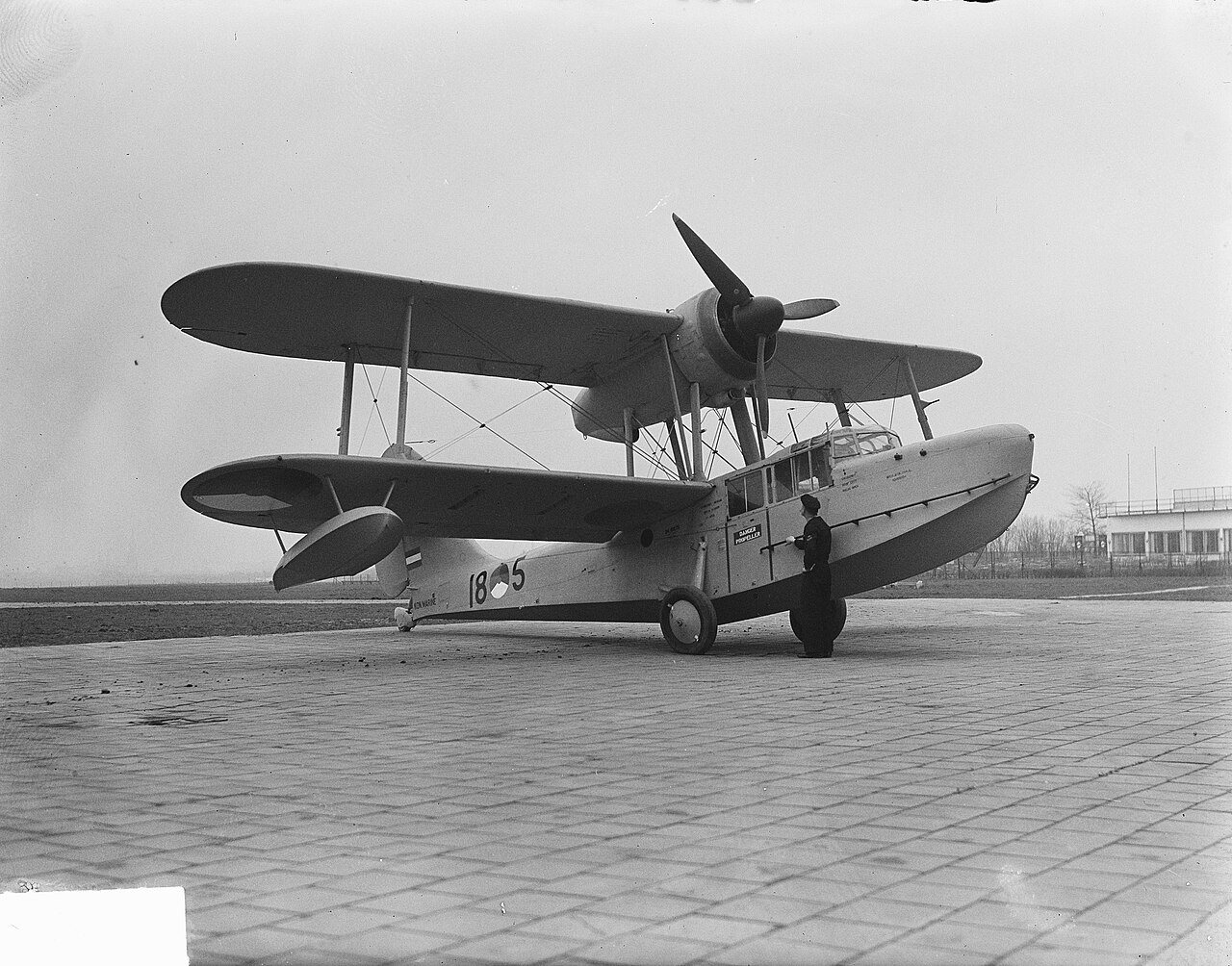
Supermarine began work on the design in February 1936 to meet an Air Ministry wish for a more powerful, longer-range aircraft [2]. Its original name was Stingray, and it was renamed Sea Otter after the prototype's third flight [1]. The prototype first flew in September 1938, a date given as the 23rd by Wikipedia and the 29th by Historyofwar.org [1][2]. It was tested with HMS Pegasus at Felixstowe, and the bow was altered afterward [2].
Production came late. Supermarine and Blackburn were both busy with other work, so the contract went to Saunders-Roe in January 1942 [2]. The first production aircraft flew in January 1943 [1][2]. In all, 592 were ordered but only 292 were built [1][2].
Design and how it works
The Sea Otter is a biplane amphibian with a boat hull [1]. Historyofwar.org describes a single tractor engine layout [2]. Production aircraft used a Bristol Mercury radial, which replaced the Perseus because of cooling problems [1]. Wikipedia lists 805 hp (600 kW) at takeoff and 855 hp at 4,500 ft (1,370 m), while Historyofwar.org lists a Mercury XX of 965 hp, so the figures differ by source [1][2].
Top speed was 163 mph (262 km/h) [1][2]. Range was about 565 to 725 mi (909 to 1,167 km) in Wikipedia and 690 mi (1,110 km) in Historyofwar.org [1][2]. Crew was three or four [1][2]. Early aircraft carried up to three 0.303 in machine guns, and from the eighth production aircraft the guns were removed for the rescue role [2]. Historyofwar.org says its longer range and greater load made it a better rescue aircraft than the Walrus [2].
Service
Historyofwar.org says 241 aircraft went to the RAF, equipping six squadrons, and that No. 277 Squadron began receiving them in November 1943 [2]. Wikipedia lists Nos. 277, 278, 279, 281, 282 and 292 Squadrons and puts the start of operational service in November 1944 [1]. The Fleet Air Arm began using the type with No. 1700 Squadron in November 1944 [2].
An Imperial War Museums film made on 9 January 1945 shows Sea Otter JM882 of the RAF Air Sea Rescue Service in Burma, flying, landing on the water and taxiing, and a wrecked Sea Otter that had been shot down over Akyab Island [3].
After the war the type served in other countries. Wikipedia lists Denmark (8), the Netherlands (8) and French colonial forces in Indochina (6, 1947 to 1952), and the Royal Australian Navy's No. 723 Squadron received three in 1948 and flew them until 1953 [1]. On 19 July 1950, during the Korean War, Lieutenant P. Cane rescued a downed US Corsair pilot and returned to HMS Triumph, and was later awarded the US Air Medal [1]. Many surplus aircraft were converted for civil use with seats for four passengers [1].
Legacy
Wikipedia calls the Sea Otter the last biplane to enter service with both the Royal Navy and the RAF, a statement it does not support with further sourcing [1]. No complete example is displayed in a museum; the Fleet Air Arm Museum at Nowra in Australia holds the nose section of JN200 [1].
Related entries
Sources
- Supermarine Sea Otter, Wikipedia. en.wikipedia.org/wiki/Supermarine_Sea_Otter
- Supermarine Sea Otter, Historyofwar.org. www.historyofwar.org/articles/weapons_supermarine_sea_otter.html
- Amphibious Aircraft of the RAF Air Sea Rescue Service in Burma (film ABY 148), Imperial War Museums (1945-01-09). film.iwmcollections.org.uk/record/3873
Last reviewed November 2026. Spotted something to correct or add? Tell us and include a source.
See how to register a low-speed vehicle or boat in your state.
About the Amphibious Encyclopedia
WaterCar has designed and built amphibious vehicles in Southern California for more than 25 years. We keep this encyclopedia so anyone curious about vehicles that cross between land and water has one place to start, with the sources listed for every fact. New to the subject? Start with our guide, What is an amphibious vehicle?
All amphibious vehicles → · The WaterCar machines → · How a WaterCar works →