
History
Grover Loening designed an amphibian meant to perform like a land-based airplane [2]. The Army's version began in 1923 as the COA-1, powered by a 400 hp Liberty V-12 engine, and the type first flew that year [2][3]. The Navy ordered two as the OL-1, with a third cockpit and a 440 hp Packard engine [2]. In 1925 the Navy bought five Liberty-powered aircraft, listed as OL-2, for an Arctic expedition [2].
Later Navy versions changed the engine and equipment. The OL-8 used a Pratt & Whitney Wasp radial, and the OL-8A added arresting gear for carrier use [2]. The OL-6, with 28 built, was the largest single variant [2]. The Coast Guard ordered the OL-5 in 1926 and received three, with a reinforced hull, modified wingtip floats and extra fuel; two were lost in crashes and the last was retired in 1935 [2]. Wikipedia gives a total of 165 aircraft across all Army, Navy and Coast Guard variants [3].
The Pan-American Goodwill Flight
Ten Army pilots flew five OA-1A amphibians on the Pan-American Goodwill Flight, which started at San Antonio, Texas, on December 21, 1926, and ended at Bolling Field in Washington, D.C., on May 2, 1927 [1]. The aim was to improve relations with Latin American countries, encourage commercial aviation and train Air Corps personnel [1]. The aircraft were named New York, San Antonio, San Francisco, Detroit and St. Louis [1].
The route covered about 22,000 miles (35,200 km) and took 59 flying days and 74 days of delay [1]. During the approach to Buenos Aires, the Detroit and the New York collided in the air. The crew of the Detroit was killed and both aircraft were destroyed [1].
Design and how it works
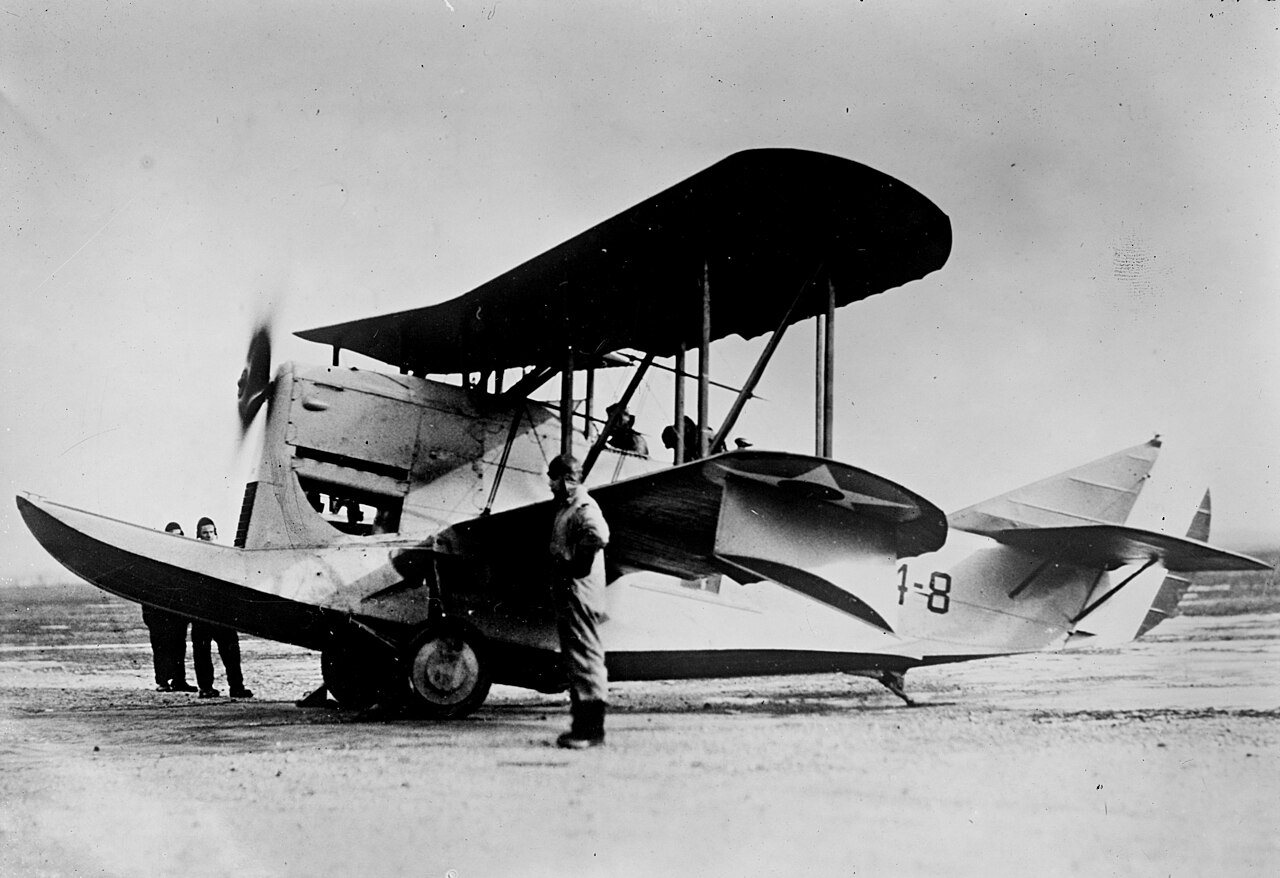
The Loening has one main float under the fuselage instead of a full flying-boat hull, with stabilizing floats under the lower wings [2][3]. The hull is duralumin over a wooden frame, and the wheels are raised by a hand crank in the cockpit [1][3]. The engine is mounted inverted on the Army aircraft so the propeller clears the hull [1].
The OA-1A San Francisco is 45 ft 7 in (13.9 m) wide across the wings and 35 ft 1 in (10.7 m) long, and it weighs nearly three tons fully loaded [1]. It cruised at 85 to 90 mph (136 to 144 km/h) on the goodwill flight [1]. The OL-9 had a maximum speed of 122 mph (196 km/h) and a range of 625 miles (1,006 km), according to Wikipedia [3].
Legacy
The same type of main float was later used on the Grumman JF and J2F Duck, and the Grumman company began as a firm that maintained Loening aircraft, with Leroy Grumman a former Loening employee [2]. The War Department transferred the San Francisco to the Smithsonian in December 1927, the museum restored it in 1964 and 1965, and it is displayed at the Steven F. Udvar-Hazy Center [1].
Related entries
Sources
- Loening OA-1A San Francisco (Pan-American Goodwill Flight), National Air and Space Museum, Smithsonian. airandspace.si.edu/collection-objects/loening-oa-1a-san-francisco/nasm_A19280010000
- Loening OL, HistoryofWar.org (Rickard). www.historyofwar.org/articles/weapons_loening_OL.html
- Loening OL, Wikipedia. en.wikipedia.org/wiki/Loening_OL
Last reviewed November 2026. Spotted something to correct or add? Tell us and include a source.
See how to register a low-speed vehicle or boat in your state.
About the Amphibious Encyclopedia
WaterCar has designed and built amphibious vehicles in Southern California for more than 25 years. We keep this encyclopedia so anyone curious about vehicles that cross between land and water has one place to start, with the sources listed for every fact. New to the subject? Start with our guide, What is an amphibious vehicle?
All amphibious vehicles → · The WaterCar machines → · How a WaterCar works →