
History
The S-43 was a smaller, twin-engine counterpart to Sikorsky's four-engine S-42 Clipper flying boat, and it first flew in 1935 [3]. Airlines called it the Baby Clipper [2][3]. Unlike a pure flying boat, it had retractable wheels, which let it land on water or on a runway [1][3]. On April 14, 1936, Wikipedia reports, pilot Boris Sergievsky flew an S-43 to 27,950 ft (8,520 m) over Stamford, Connecticut, with Igor Sikorsky aboard, an altitude record for amphibious aircraft [3].
About 53 were built between 1937 and 1941, according to the Pima Air and Space Museum, for civilian customers and the US Navy [2]. Pan American Airways flew it on routes to Cuba and within Latin America, and Inter-Island Airways in Hawaii was the launch customer, with four [3]. Other airline operators included Panair do Brasil (seven), Aeromaritime of France (five, 1937 to 1945), Det Norske Luftfartselskap of Norway (one) and Reeve Aleutian Airways (two, in the 1950s) [3]. The Chilean Air Force bought two in 1936, and Howard Hughes and William K. Vanderbilt II owned examples privately [3].
Military service
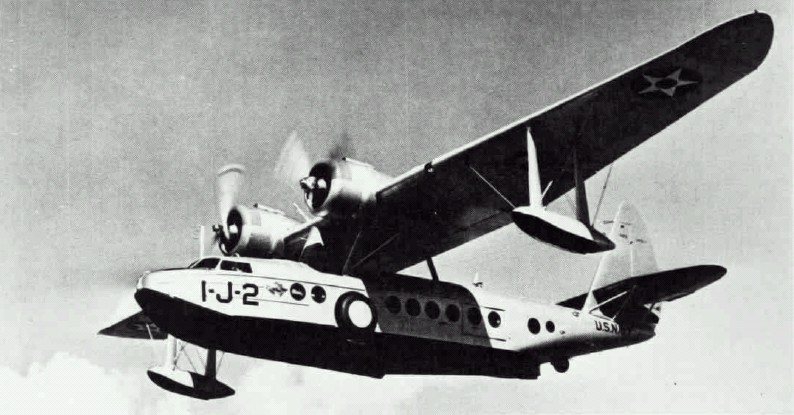
The US Navy took 17 between 1937 and 1939 as the JRS-1, and two of them served with the Marine Corps [2][3]. The US Army Air Corps bought five in 1937 as the OA-8 for freight and passenger transport [3]. The Smithsonian's aircraft was delivered to the Navy on July 28, 1938, as the thirteenth built, and served with Utility Squadron One at San Diego before flying to Pearl Harbor in July 1940 [1].
Ten JRS-1s were at Pearl Harbor during the attack of December 7, 1941, and all survived [1]. They carried only depth charges until modified afterward, and were used at once for patrols and searches [1]. The Smithsonian aircraft was struck from service on August 31, 1944, with 1,850 flying hours [1].
Design and how it works
The S-43 is a high-wing monoplane with a boat-shaped hull, two radial engines mounted on the wing, and wheels that retract into the hull [1][3]. The Smithsonian lists its two Pratt & Whitney Hornet engines at 750 hp (559 kW) each, an empty weight of 13,749 lb (6,236 kg) and a gross weight of 19,500 lb (8,845 kg) [1]. Wikipedia gives a maximum speed of 178 mph (286 km/h), a cruise speed of 166 mph (267 km/h) and a range of 775 miles (1,247 km) [3]. Sources disagree on seating: Wikipedia gives 11 passengers in its specification and 18 to 25 in its text, and Pima lists 15 passengers or 24 troops [2][3].
Accidents and survivors
Wikipedia lists several fatal accidents between 1937 and 1947. They include the loss of a Pan American S-43 in Guanabara Bay, Rio de Janeiro, on August 13, 1939, in which 14 of the 16 aboard died [3].
Three S-43 or JRS-1 aircraft survive, according to Pima [2]. The Smithsonian calls its JRS-1 the sole surviving JRS-1 amphibian, and it moved to the Udvar-Hazy Center in 2011 [1]. A civil S-43 at the Pima Air and Space Museum in Tucson, Arizona, is painted in Marine Corps markings at the request of its owner, the National Museum of the Marine Corps [2]. Wikipedia reports that the S-43 once owned by Howard Hughes, which crashed into Lake Mead on May 17, 1943, was later restored and belongs to Kermit Weeks [3].
Related entries
Sources
- Sikorsky JRS-1, National Air and Space Museum, Smithsonian. airandspace.si.edu/collection-objects/sikorsky-jrs-1/nasm_A19610112000
- Sikorsky S-43 (Designation: S-43), Pima Air and Space Museum. pimaair.org/designation/s-43
- Sikorsky S-43, Wikipedia. en.wikipedia.org/wiki/Sikorsky_S-43
Last reviewed November 2026. Spotted something to correct or add? Tell us and include a source.
See how to register a low-speed vehicle or boat in your state.
About the Amphibious Encyclopedia
WaterCar has designed and built amphibious vehicles in Southern California for more than 25 years. We keep this encyclopedia so anyone curious about vehicles that cross between land and water has one place to start, with the sources listed for every fact. New to the subject? Start with our guide, What is an amphibious vehicle?
All amphibious vehicles → · The WaterCar machines → · How a WaterCar works →