
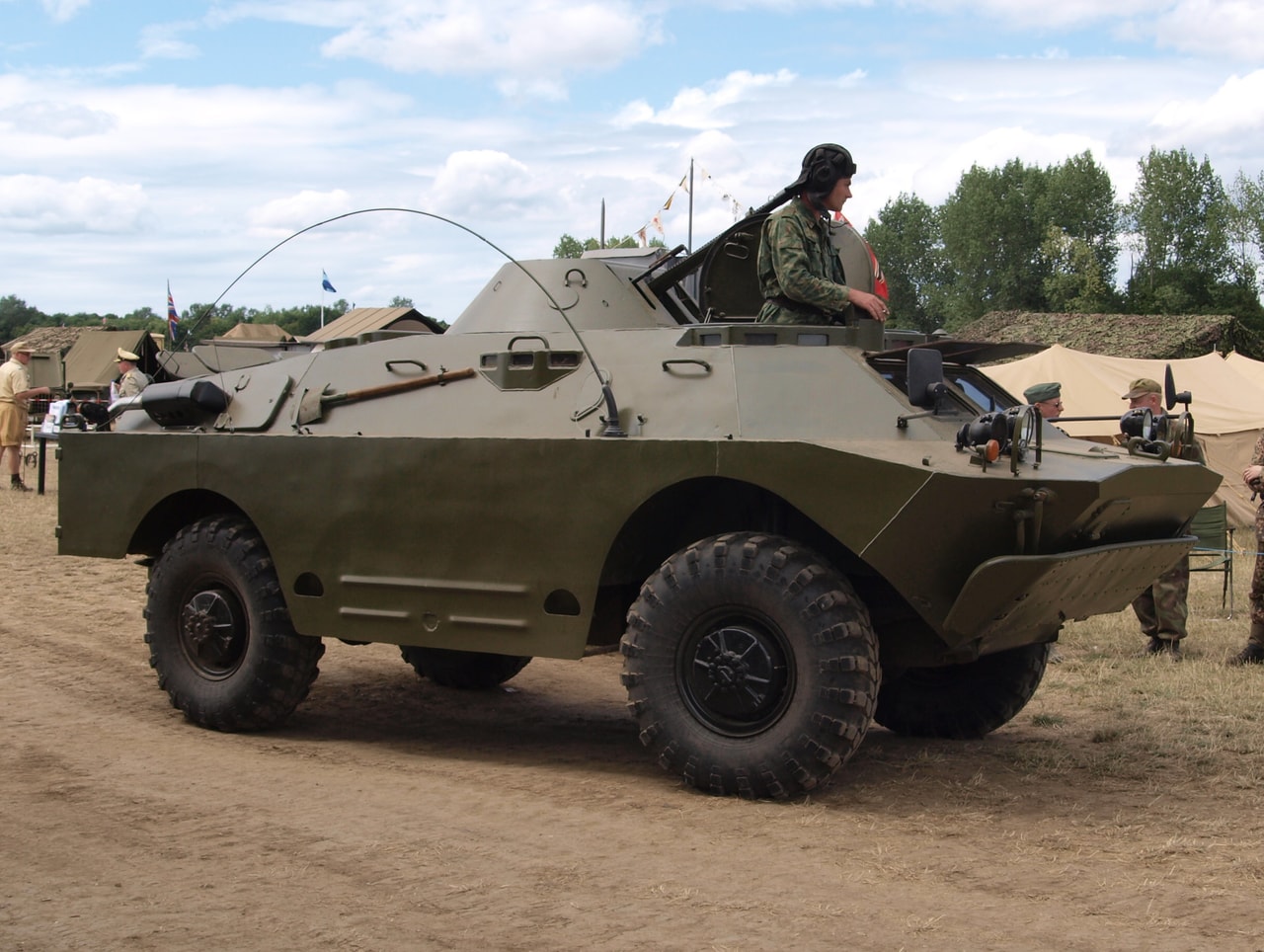
History
GAZ, the Gorky Automobile Plant in Nizhny Novgorod, built the BRDM-2, and Wikipedia credits the design to Vsevolod Rubtsov [1]. It replaced the original BRDM, which appeared in 1959, and by the mid-1980s it was rapidly displacing that vehicle in Soviet and Warsaw Pact armies [2]. Wikipedia gives its Soviet service start as 1962, public showing as 1966 and production as 1962 to 1989 [1]. The Federation of American Scientists (FAS) lists 1963 as the introduction year, and Army Recognition says production began in 1963 [2][3]. All three agree on the 1966 public showing [1][2][3].
Wikipedia reports about 7,200 built, mostly for export [1]. FAS says at least 45 countries operate it, and Army Recognition says more than 50 [2][3].
Design and how it works
The BRDM-2 has four-wheel drive and a boat-shaped hull, and it carries a crew of four [1][2]. It weighs about 7 metric tons (15,400 lb) and is 5.75 m (18 ft 10 in) long [1][2]. A rear GAZ-41 gasoline V-8 of 140 hp (104 kW) gives a road speed of about 62 mph (100 km/h) in Wikipedia and 95 km/h (59 mph) in FAS, with a road range of about 750 km (470 mi) [1][2][3].
Two pairs of chain-driven belly wheels sit between the main axles. The driver lowers them to help the vehicle cross trenches [1][2]. Some later Polish and Ukrainian rebuilds removed them [1].
On the water
A single water jet with a four-bladed propeller drives the vehicle afloat. It sits at the rear and is covered by an armored shutter on land [1]. A trim vane at the front is raised before the vehicle enters water [3]. Wikipedia and FAS give a swimming speed of 10 km/h (6 mph) [1][2]. Army Recognition gives both 7 km/h and 10 km/h on the same page [3]. Wikipedia adds that it can keep up that speed for 17 to 19 hours [1].
Wikipedia notes that the BRDM-2 is sometimes confused with the Hungarian FUG and PSzH, which have two water jets, not one [1]. The BRDM-2 does not plane.
Service
Wikipedia lists use by Egypt and Syria in the 1973 Yom Kippur War, by Syria in the 1982 Lebanon War, and in the Soviet-Afghan War, the Iran-Iraq War, the 1990 to 1991 Gulf War, the Yugoslav Wars, the Syrian Civil War and the Russo-Ukrainian War [1].
Related entries
Sources
- BRDM-2, Wikipedia. en.wikipedia.org/wiki/BRDM-2
- BRDM-2 (BTR-40P-2) Armored Vehicles, Federation of American Scientists, Military Analysis Network. man.fas.org/dod-101/sys/land/row/brdm-2.htm
- BRDM-2 Armoured Reconnaissance Vehicle, Army Recognition. armyrecognition.com/military-products/army/armoured-personnel-carriers/wheeled-vehicles/brdm-2-russia-uk
Last reviewed November 2026. Spotted something to correct or add? Tell us and include a source.
See how to register a low-speed vehicle or boat in your state.
About the Amphibious Encyclopedia
WaterCar has designed and built amphibious vehicles in Southern California for more than 25 years. We keep this encyclopedia so anyone curious about vehicles that cross between land and water has one place to start, with the sources listed for every fact. New to the subject? Start with our guide, What is an amphibious vehicle?
All amphibious vehicles → · The WaterCar machines → · How a WaterCar works →