
History
The Republic of Korea Army asked for a new infantry fighting vehicle around 1981, and development ran from 1980 to 1984 according to Wikipedia [1]. The Agency for Defense Development led the work, with Daewoo Heavy Industries as prime contractor [1]. FAS describes the K200 as based on the American AIFV, while Wikipedia says the Korean design was meant to cost less than the AIFV without giving up much capability [1][2].
Sources disagree on when series production started: FAS says 1984, and Wikipedia and Army Guide say 1985 [1][2][3]. The K200A1, with a more powerful engine and automatic transmission, followed in 1994 [1][3]. Wikipedia estimates about 2,500 K200 and K200A1 vehicles, about 1,700 standard and 800 specialized, while Army Guide reports over 2,000 by mid-2007 [1][3]. Army Guide puts South Korean holdings at about 1,900 [3].
Design and how it swims
The K200 has an aluminum hull with an added layer of spaced laminate steel, weighs 13.2 tons in combat trim, and measures 5.49 m (18 ft) long, 2.85 m (9 ft 4 in) wide and 2.52 m (8 ft 3 in) high [1]. The K200 used a 280 hp diesel, and the K200A1 uses a 350 hp diesel with an Allison automatic transmission [1][3]. Its main weapon is a 12.7 mm M2 machine gun, with a 7.62 mm gun as secondary [1]. It carries a crew of three and nine passengers, and FAS counts 12 people in the K200A1 [1][2][3].
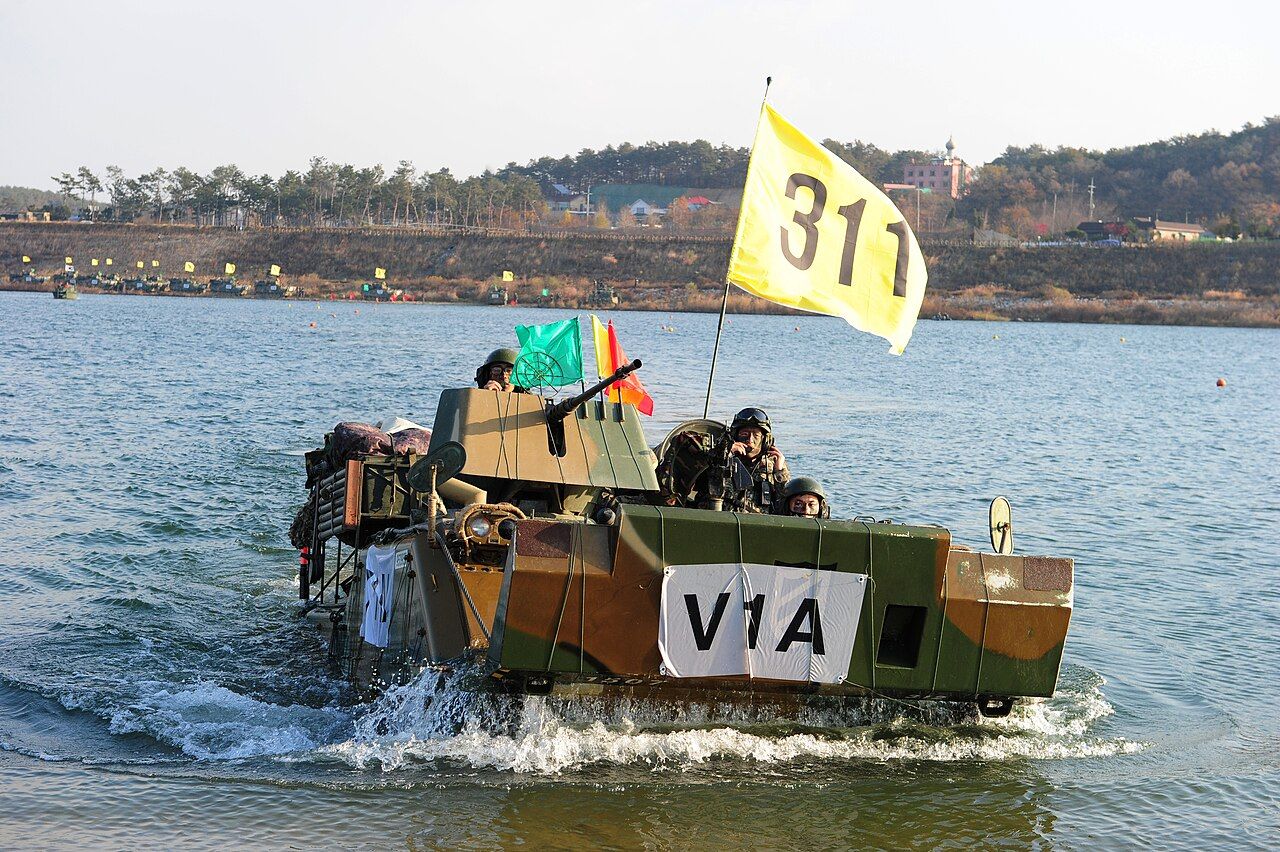
The vehicle is fully amphibious and moves in water by turning its tracks, so FAS says it needs no supporting unit to cross water [2][3]. Before entering the water, the crew raises a trim vane at the front and switches on two bilge pumps, according to Army Guide [3]. Water speed is given as 6 km/h (3.7 mph) by Wikipedia and about 7 km/h (4.3 mph) by FAS and Army Guide [1][2][3]. Range on land is 480 km (300 mi) [1].
Variants and users
Variants of the K200 include the K216 NBC reconnaissance vehicle, the K242 and K281 mortar carriers, the K263 20 mm anti-aircraft gun carrier, the K277 command post and the K288 recovery vehicle [1]. In January 2025, South Korea's arms procurement agency announced standardization of the K200A2, with upgrades to 1,100 vehicles planned by 2031 [1].
Malaysia received 111 K200s between 1993 and 1995, and all were upgraded to the K200A1 standard between 2000 and 2008 [1][3]. Haiti received three K200A1 vehicles for its national police on 5 February 2026, and Thailand signed an agreement on 27 August 2024 with Hanwha Aerospace covering upgrades of used K200s [1].
Related entries
Sources
- K200 KIFV, Wikipedia. en.wikipedia.org/wiki/K200_KIFV
- K-200 Korean Infantry Fighting Vehicle, Federation of American Scientists. man.fas.org/dod-101/sys/land/row/kifv.htm
- K200 KIFV, Army Guide. army-guide.com/eng/product1014.html
Last reviewed November 2026. Spotted something to correct or add? Tell us and include a source.
See how to register a low-speed vehicle or boat in your state.
About the Amphibious Encyclopedia
WaterCar has designed and built amphibious vehicles in Southern California for more than 25 years. We keep this encyclopedia so anyone curious about vehicles that cross between land and water has one place to start, with the sources listed for every fact. New to the subject? Start with our guide, What is an amphibious vehicle?
All amphibious vehicles → · The WaterCar machines → · How a WaterCar works →