
History
FMC Corporation developed the M113, and the US Army adopted an improved version, the T113E1, as the M113 in 1960 [1]. HistoryNet says it entered production in April 1960 and was meant to be both amphibious and air transportable [2]. Wikipedia describes it as the first aluminum-hull combat vehicle put into mass production [1]. The first batch of 32 reached South Vietnam on 30 March 1962 [1].
A diesel version, the M113A1, followed. HistoryNet dates it to April 1963, while Wikipedia says the diesel version entered production in 1964 [1][2]. The Fort Donelson Museum says the change from gasoline to diesel was made to reduce the risk of catastrophic fires [3]. The M113A2 arrived in 1979 with improved suspension, cooling and exhaust [1][3].
Production moved to United Defense in 1994 and to BAE Systems after it bought United Defense in 2005. Production ended in 2007 [1]. Wikipedia puts the total at about 80,000 vehicles of all variants, and the Fort Donelson Museum says over 70,000 [1][3]. Wikipedia says more than 50 countries have used it and that Israel is the second largest operator after the United States [1].
Design and how it swims
The hull is welded 5083 aluminum alloy, 28 to 44 mm (1.1 to 1.75 in) thick, and the vehicle weighs 12.3 tonnes [1][3]. It carries a crew of two and 11 soldiers, with Wikipedia giving a range of 11 to 15 passengers [1][2]. The original M113 used a Chrysler 75M gasoline V-8, and the A1 used a Detroit Diesel engine [1][2].
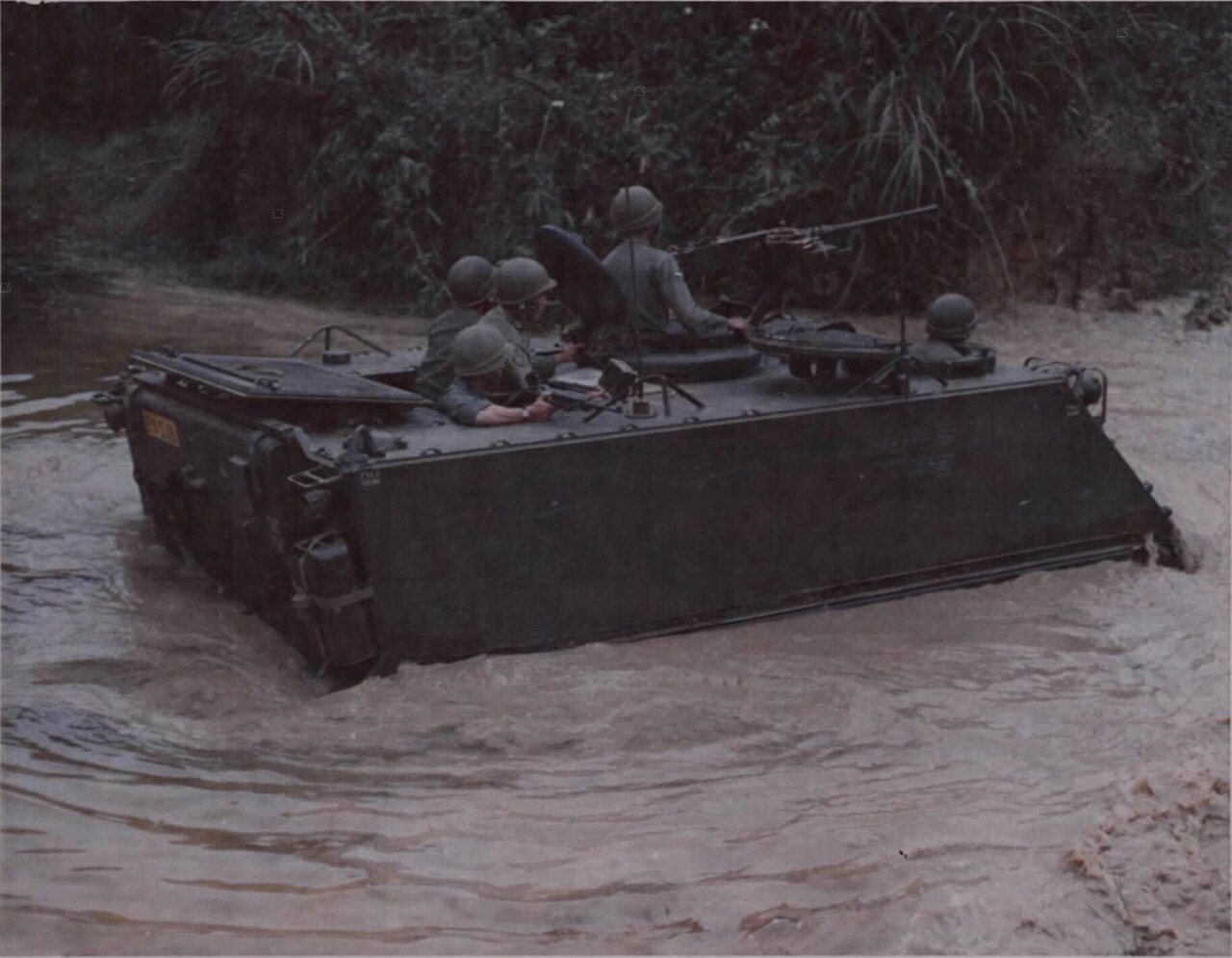
Wikipedia says the original production M113 can swim without flotation curtains, using a trim vane at the front and propulsion from its tracks [1]. HistoryNet says its 14 inches (36 cm) of freeboard from waterline to roof limited it to crossing rivers with slow currents, at about 4 mph (6.4 km/h) [2]. Wikipedia gives 3.6 mph (5.8 km/h) [1].
The extra weight of the M113A2 meant it was no longer required to be amphibious [1]. An Army technical manual still lists water operation for the M113A2, with a plywood trim vane and bolt-on buoyancy pods that must be extended and locked before entering the water. It warns that skipping this step, or leaving drain plugs and covers loose, could cause the vehicle to sink [4].
Related entries
Sources
- M113 armored personnel carrier, Wikipedia. en.wikipedia.org/wiki/M113_armored_personnel_carrier
- Arsenal: M113A1 personnel carrier, HistoryNet. historynet.com/arsenal-m113a1-personnel-carrier
- M113A2 APC, Fort Donelson Museum. www.fdmuseum.org/exhibit/m113a2-apc
- TM 9-2350-261-10, preparation for water operations, US Army technical manual (copy on tpub.com). personnelcarrier.tpub.com/TM-9-2350-261-10/css/TM-9-2350-261-10_383.htm
Last reviewed November 2026. Spotted something to correct or add? Tell us and include a source.
See how to register a low-speed vehicle or boat in your state.
About the Amphibious Encyclopedia
WaterCar has designed and built amphibious vehicles in Southern California for more than 25 years. We keep this encyclopedia so anyone curious about vehicles that cross between land and water has one place to start, with the sources listed for every fact. New to the subject? Start with our guide, What is an amphibious vehicle?
All amphibious vehicles → · The WaterCar machines → · How a WaterCar works →