
First experiments, 1918 to 1924
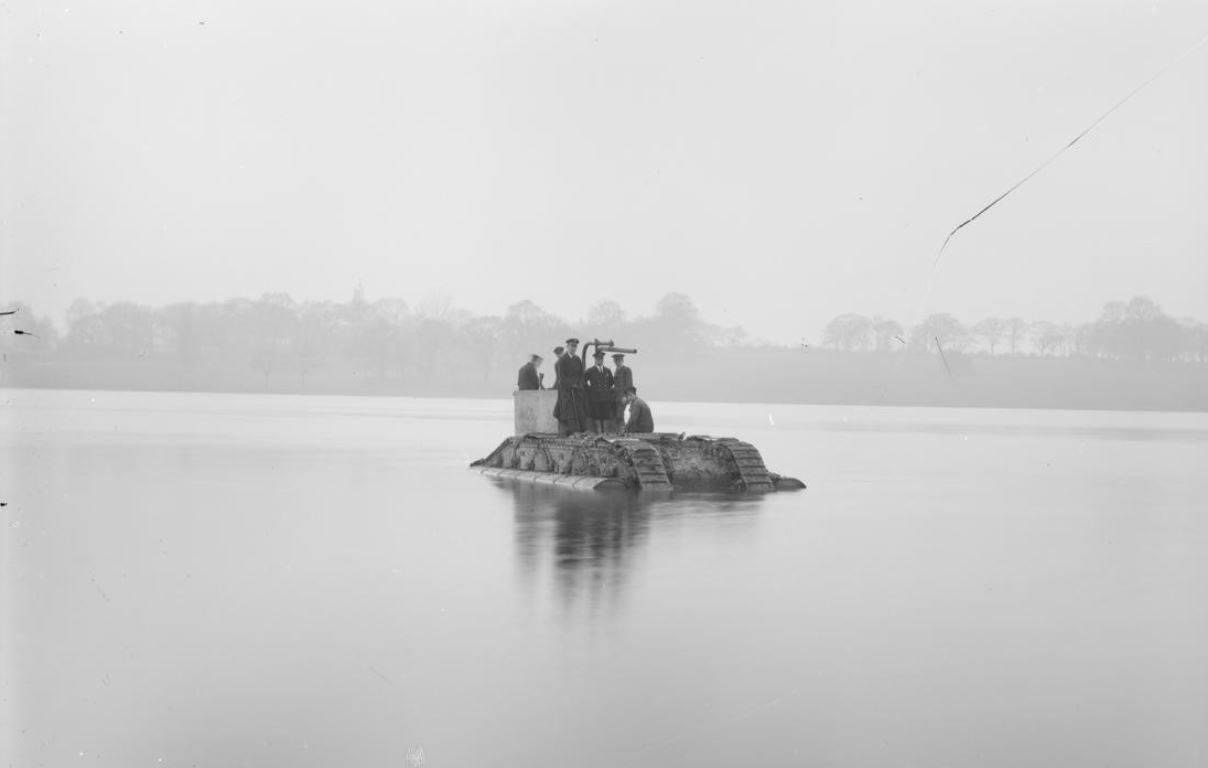
In Britain a Mark IX, a tracked infantry carrier of which only 34 were built, was turned into a rough amphibian [1][2]. On Hendon Reservoir in north London, also called the Welsh Harp, reputedly on Armistice Day, November 11, 1918, it floated on air-filled drums of the kind the Royal Navy called camels and pushed itself along with paddles fitted to its tracks [1]. The Tank Museum reports that it is said to have broken down mid-reservoir and been hauled ashore before it sank [1]. The nickname Duck rests on oral tradition [2].
After the war J. F. C. Fuller, then at the War Office, added a requirement for amphibious use to the fast Medium D [3]. A widened version, the D**, swam well in a river trial, near Christchurch according to the historian David Fletcher [3][4]. The Tank Museum describes the 1919 Medium D tanks as able to swim but unsteady afloat and very unreliable; none reached regimental service [1].
In the United States, J. Walter Christie built an amphibious light tank that the Marine Corps tried during its 1924 winter maneuvers at Culebra, Puerto Rico [5][6]. Designated Marine Corps Tank GC-2, it was hoisted onto a submarine to be launched toward the shore, could not get through the heavy surf, and landed the next day, after the exercise had officially ended [6]. Twin propellers gave it a rated 7 knots (8 mph, 13 km/h) afloat; on land it made 15 mph (24 km/h) on tracks or 35 mph (56 km/h) on its wheels with the tracks taken off [5]. The Marine Corps history judged it adequate on land and on sheltered rivers, but it coped so poorly with the open sea that the Corps looked to other designs [5].
The Vickers tank and its Soviet descendants
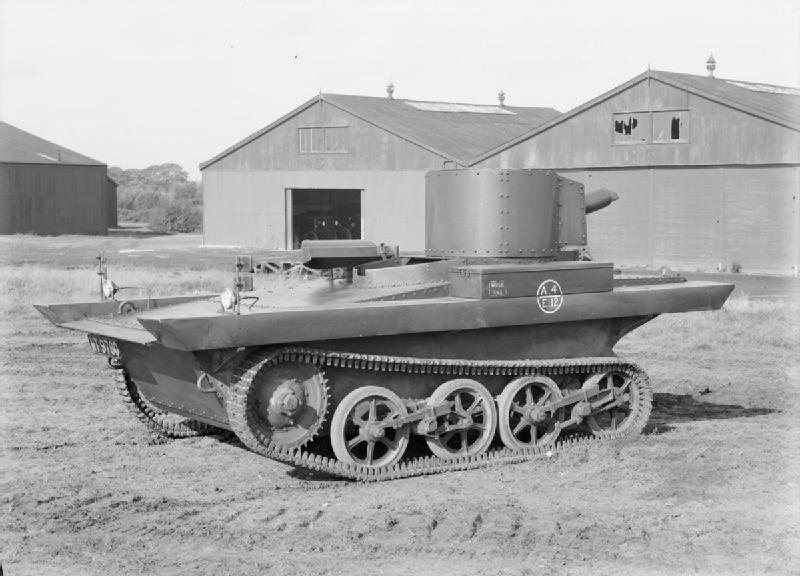
From 1931 Vickers-Armstrongs built a light amphibious tank designed by Carden-Loyd Tractors; the War Office designated the trial tanks A4E11 and A4E12 [7][10]. The 2.2 t (2.4 short ton) tank floated on its own hull, because its armor was kept thin enough to need no outside buoyancy aids, and it reached 27 mph (43 km/h) on roads and about 3.7 mph (6 km/h) in water [4][7]. The British Army turned it down, but Tank Encyclopedia lists sales of 8 to the Soviet Union, 29 to China and 2 to Siam (Thailand), with 2 ordered for the Dutch East Indies [8]. A 1944 US Army handbook says Japan also bought the Vickers amphibious tank [9]. Poland could not afford the Vickers tank, and its own PZInż 130 prototype of 1937, with a propeller whose retractable cover doubled as a rudder, was judged unnecessary [8].
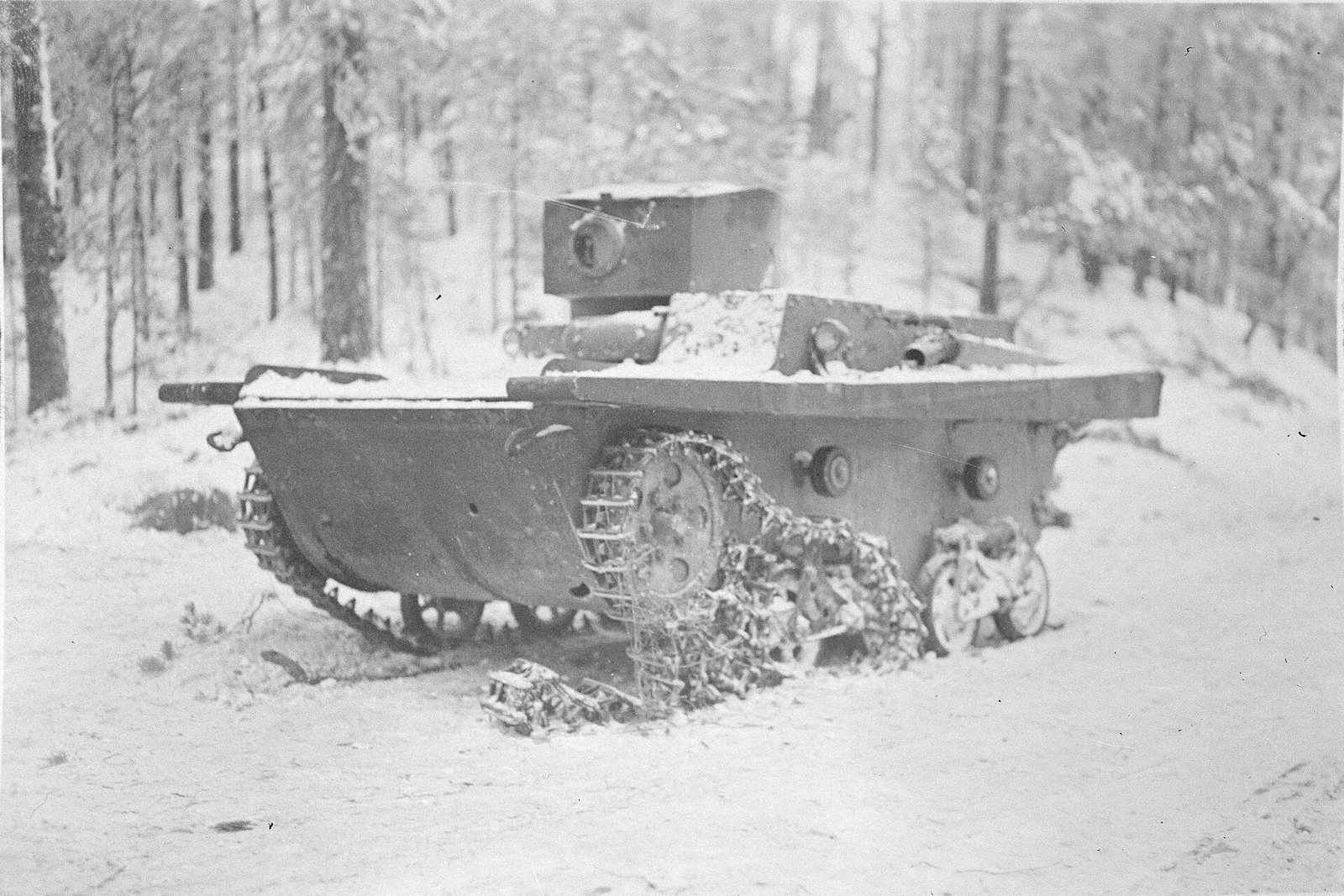
The Soviet Union put the idea into mass production. After studying the British tanks and building trial designs such as the T-33 and T-41, Factory No. 37 in Moscow began building the T-37A in 1933; one account argues that it was strongly influenced by the Vickers tank rather than copied from it [10]. The 3.2 t (3.5 short ton) T-37A carried two men and a machine gun. Its fenders doubled as floats, which one published account says were filled with cork until 1934, and a rear propeller drove it through the water while a rudder steered [10][11]. Totals for its 1933 to 1936 run range from about 1,200 to more than 2,500 [7][10][11]. One published account describes trials in which the tank was carried under a TB-3 heavy bomber, and a 1939 test at the Medvezhi Lakes near Moscow in which an uncrewed T-37A dropped onto the water sank because its vision slits had not been sealed [11].
The T-38, built from 1936, sat lower and wider, which made the cork floats unnecessary [12]. A three-bladed rear propeller and a rudder moved and steered it [13][14]. Its margin was thin: an extra 120 to 150 kg (265 to 330 lb) could flood the commander's hatch and sink it [12]. TB-3 bombers carried T-38s under their fuselages during the 1936 Kiev maneuvers [12]. Totals range from 1,300 to 1,415 [12][13][14]. The thinly armored tank fared badly in the Winter War with Finland, and large numbers were captured in 1941 [12].
The T-40 of 1940 and 1941 had a boat-shaped welded hull, a 12.7 mm machine gun and a propeller tucked into a recess in the rear of the hull, where it was safer than the T-38's exposed one [15][16]. One published account says it could still operate in waves up to sea state 3 [16]. In the second half of 1941 a land-only version replaced it in production. One count gives 356 amphibious T-40s, while another gives about 940 for the whole run without separating the two [15][16].
Wheels, floats and screens: Straussler and Germany
Nicholas Straussler, a Hungarian-born engineer who worked in Britain, came at the problem several times. By his own account he designed collapsible floats for fighting vehicles in 1927 and 1928 [17]. In Hungary the Manfréd Weiss works built prototypes of his V-3 and V-4 light tanks from 1934. The V-3 was designed for 60 km/h (37 mph) on its wheels, 40 km/h (25 mph) on its tracks and 8 km/h (5 mph) in water; the heavier V-4 was slower on land [18]. The V-4 was rejected in June 1938, mainly for poor reliability and mobility [18].
About 1934, by his account, he dropped that approach and turned to a waterproof screen raised around an ordinary tank, so that hull and screen together formed a boat [17]. First tried on a Tetrarch light tank in June 1941 and fitted to the Sherman by April 1943, his Duplex Drive (DD) system used two rear propellers to reach about 4 knots (4.6 mph, 7.4 km/h) [19]. Straussler put the number converted at about 2,000 in Britain and 300 in the United States; another count gives 693 Sherman DDs built in Britain in 1944 [17][19]. Their D-Day story is told in the Sherman DD entry.
Germany prepared swimming tanks for the planned invasion of Britain in 1940. The Schwimmpanzer II was an 8.9 t (9.8 short ton) Panzer II with an aluminum float on each side, through which the tracks drove a propeller shaft; it swam at 5.7 km/h (3.5 mph), and 52 were converted before the invasion was called off [19].
Japan's pontoon tanks
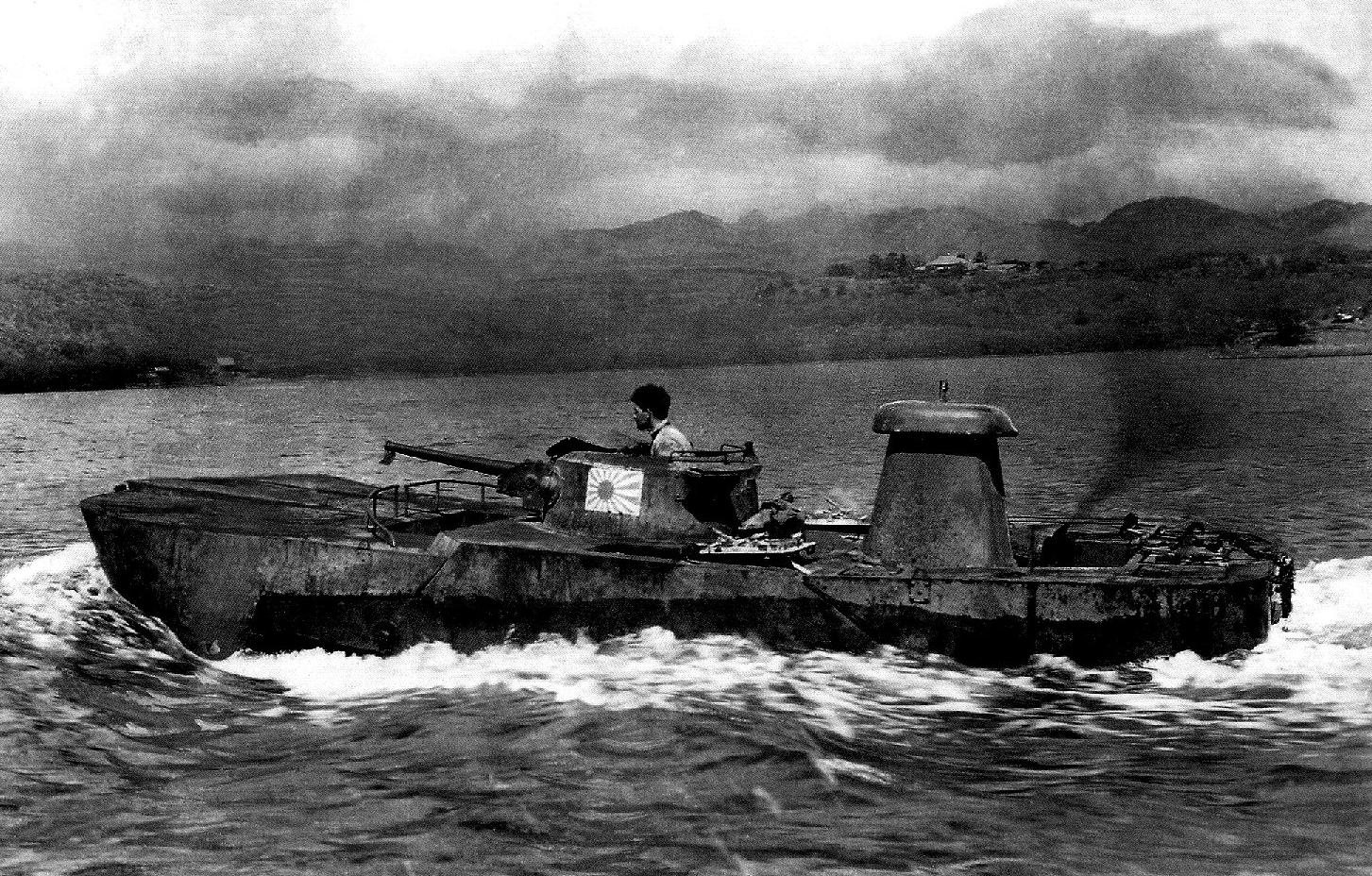
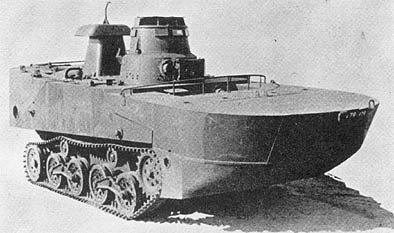
Japan's navy took over amphibious tank work from the army in 1940, and Mitsubishi drew on the army's SR prototypes and the Type 95 Ha-Go light tank to design the Type 2 Ka-Mi; 182 to 184 were built in 1942 and 1943 [20]. Its welded hull was sealed with rubber, and hollow steel pontoons on the bow and stern, filled with kapok, kept it afloat [20]. US Army studies of one found on Kwajalein described the pontoons as held by pincer clamps that a handwheel inside the tank could release; with them fitted the tank grew from 15 ft 8 in (4.8 m) to 24 ft 7 in (7.5 m) long [9][21]. Two propellers drove it at about 6 mph (10 km/h), and the commander steered from the turret by cables running to a pair of rudders [20][21]. It fought from Guadalcanal in late 1942 to the Marshalls, Saipan and Leyte [20].
The larger Type 3 Ka-Chi of 1943, on the Type 1 Chi-He chassis, weighed 28.7 t (31.6 short tons) with pontoons, carried seven men and a 47 mm gun, and had a tall snorkel behind the turret that fed air to the engine and kept water out [22][27]. It was meant to be carried by submarine to reinforce island garrisons, but only 12 to 19 were built, 19 by Tank Encyclopedia's count, and none saw combat [22][27].
American amphibian tanks
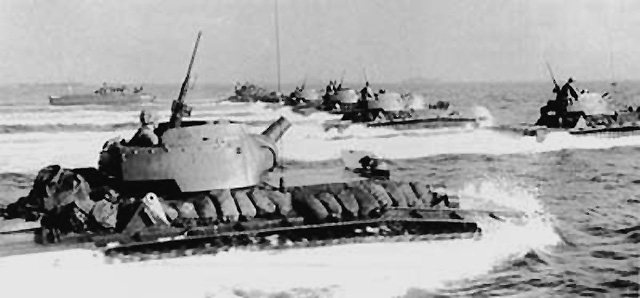
The United States armed its amphibious tractors instead. The LVT(A)-1 put a 37 mm gun in a turret of the Stuart light tank type on an armored LVT, to give the landing waves close fire support as they neared the beach; 509 were built [23][25]. From March 1944 the LVT(A)-4 carried a 75 mm howitzer in a turret taken from the M8 howitzer motor carriage; 1,890 were built, and 1,307 of them went to the US Army [23][24]. It weighed about 40,000 lb (18 t) and swam at about 6.8 mph (11 km/h) [23][24]. Like every LVT, it moved in water as on land by its tracks, whose cleats came from Donald Roebling's Alligator rescue vehicle [23][25]. The LVT family has its own entry.
Speeds and types at a glance
The table lists these tanks oldest first. Water speeds stay between roughly 3.5 and 8 mph (6 and 13 km/h), and none is reported to plane, so all are land-first under this encyclopedia's types test [5][7][19].
| Tank | Country | First built | Weight | Road speed | Water speed | Swims by | Type |
|---|---|---|---|---|---|---|---|
| Mark IX Duck conversion | United Kingdom | 1918 [1] | about 27 t (30 short tons), standard Mark IX [2] | about 4.3 mph (6.9 km/h), standard Mark IX [2] | no figure found | paddles on the tracks, floated by air-filled drums [1] | Land-first |
| Medium Mark D (D** swimming version) | United Kingdom | 1919 [1][3] | no figure found; Fuller's 1918 plan called for no more than 20 tons [3] | 20 mph (32 km/h), Medium D [3] | no figure found | not stated in the cited sources | Land-first |
| Christie amphibious tank (Marine Corps Tank GC-2) | United States | tested 1924 [5][6] | no figure found | 15 mph (24 km/h) on tracks, 35 mph (56 km/h) on wheels [5] | rated 7 knots (8 mph, 13 km/h) [5] | twin propellers [5] | Land-first |
| Vickers-Carden-Loyd A4E11 and A4E12 | United Kingdom | 1931 [7] | 2.2 t (2.4 short tons) [7] | 27 mph (43 km/h) [7] | 3.7 mph (6 km/h) [7] | buoyant thin-armored hull [4]; drive not stated in the cited sources | Land-first |
| T-37A | Soviet Union | 1933 [10][11] | 3.2 t (3.5 short tons) [10][11] | 22 to 25 mph (35 to 40 km/h) [10][11] | about 3.7 mph (6 km/h), one published figure [11] | rear propeller and rudder, with fenders that doubled as floats [11] | Land-first |
| Straussler V-3 and V-4 | Hungary | V-3 prototypes 1934 to 1935, V-4 1937 [18] | about 10 t (11 short tons), V-4 [18] | up to 37 mph (60 km/h) on wheels and 25 mph (40 km/h) on tracks, V-3 design figures [18] | 5 mph (8 km/h) [18] | not stated in the cited source | Land-first |
| T-38 | Soviet Union | 1936 [12][14] | 3.3 t (3.6 short tons) [12][14] | 25 mph (40 km/h) [12][13] | about 3.7 mph (6 km/h), one published figure [14] | three-bladed rear propeller and rudder [13][14] | Land-first |
| PZInż 130 | Poland | 1937 [8] | 3.92 tons as published [8] | 37 mph (60 km/h) [8] | 4 to 5 mph (7 to 8 km/h) [8] | propeller in a retractable cover that also served as a rudder [8] | Land-first |
| Schwimmpanzer II | Germany | 1940 [19] | 8.9 t (9.8 short tons) [19] | no figure found for the float version | 3.5 mph (5.7 km/h) [19] | propeller shafts through the side floats, driven by the tracks [19] | Land-first |
| T-40 | Soviet Union | 1940 [15][16] | 5.5 to 5.9 t (6.1 to 6.5 short tons) [15][16] | 28 mph (45 km/h) [15][16] | about 3.7 mph (6 km/h), one published figure [16] | rear propeller in a recess, with water rudders [15][16] | Land-first |
| Sherman DD (Duplex Drive) | United Kingdom and United States | screen fitted to the Sherman by April 1943 [19] | no separate figure in the cited sources | no separate figure in the cited sources | up to about 4 knots (4.6 mph, 7.4 km/h) [19] | two rear propellers, floated by a raised canvas screen [17][19] | Land-first |
| Type 2 Ka-Mi | Japan | 1942 [20] | 12.3 t (13.6 short tons) with pontoons, 9.15 t (10.1 short tons) without [20] | 23 mph (37 km/h) [20][21] | about 6 mph (10 km/h) [20][21] | two rear propellers, detachable bow and stern pontoons [20][21] | Land-first |
| Type 3 Ka-Chi | Japan | 1943 [22][27] | 28.7 t (31.6 short tons) with pontoons [22][27] | 20 mph (32 km/h) [22][27] | about 6 mph (10 km/h) [22][27] | twin propellers, detachable pontoons [22][27] | Land-first |
| LVT(A)-1 and LVT(A)-4 | United States | in action 1944; LVT(A)-4 from March 1944 [23] | about 40,000 lb (18 t), LVT(A)-4 [23][24] | 25 mph (40 km/h) [23] | 5.4 knots (6.2 mph, 10 km/h) for the LVT(A)-1, 6.8 mph (11 km/h) for the LVT(A)-4 [23] | cleated tracks [25] | Land-first |
Speeds are published maximums from the sources cited in each cell. Weight and road speed for the Mark IX and Medium D are for the standard tanks, because no figure was found for the swimming versions. Where sources differ, the range is given. First built is the year of the first trial, prototype or production named by the cited source. None of these tanks is reported to plane, so all are Land-first under this encyclopedia's types test.
After 1945
Most of these designs disappeared with the war. The Soviet Union kept the swimming light tank and adopted the PT-76 on August 6, 1951; it swims with two water jets at about 10 km/h (6 mph) and has its own entry [26]. Later swimming armor has its own overview entries.
Photos
Related entries
Sources
- Experimental WWI Tanks, Part III (David Fletcher), The Tank Museum (2017-05-26). tankmuseum.org/article/experimental-tanks-part-three
- Mark IX tank, Wikipedia. en.wikipedia.org/wiki/Mark_IX_tank
- Medium Mark D, Wikipedia. en.wikipedia.org/wiki/Medium_Mark_D
- Amphibious tank, Wikipedia. en.wikipedia.org/wiki/Amphibious_tank
- History of U.S. Marine Corps Operations in World War II, Volume I, Part I, Chapter 3: Development of Landing Craft, US Marine Corps (HyperWar Foundation transcription). ibiblio.org/hyperwar/USMC/I/USMC-I-I-3.html
- J. Walter Christie, Wikipedia. en.wikipedia.org/wiki/J._Walter_Christie
- Vickers-Carden-Loyd light amphibious tank, Wikipedia. en.wikipedia.org/wiki/Vickers-Carden-Loyd_light_amphibious_tank
- PZInż. 130 (Bernard Baker), Tank Encyclopedia (2020-04-15). tanks-encyclopedia.com/ww2-poland-pzlnz-130
- TM-E 30-480, Handbook on Japanese Military Forces, Chapter IX, Section IV: Tanks and Armored Cars, US War Department (Lone Sentry transcription) (1944-10-01). lonesentry.com/manuals/handbook-japanese-military/japanese-tanks.html
- T-37A tank, Wikipedia. en.wikipedia.org/wiki/T-37A_tank
- Т-37А (in Russian), Wikipedia (Russian). ru.wikipedia.org/wiki/%D0%A2-37%D0%90
- T-38 tank, Wikipedia. en.wikipedia.org/wiki/T-38_tank
- T-38 Amphibious Light Tank, Military Factory (2020-11-11). www.militaryfactory.com/armor/detail.php?armor_id=375
- Т-38 (in Russian), Wikipedia (Russian). ru.wikipedia.org/wiki/%D0%A2-38
- T-40 tank, Wikipedia. en.wikipedia.org/wiki/T-40_tank
- Т-40 (танк) (in Russian), Wikipedia (Russian). ru.wikipedia.org/wiki/%D0%A2-40_(%D1%82%D0%B0%D0%BD%D0%BA)
- How to Invent a DD Tank, The Tank Museum (2024-05-24). tankmuseum.org/article/how-to-invent-a-dd-tank
- Straussler V-4, Wikipedia. en.wikipedia.org/wiki/Straussler_V-4
- DD tank, Wikipedia. en.wikipedia.org/wiki/DD_tank
- Type 2 Ka-Mi, Wikipedia. en.wikipedia.org/wiki/Type_2_Ka-Mi
- Japanese Tanks and Tank Tactics, Special Series No. 26, Chapter III, Section 3: Light Tanks, US Military Intelligence Service (Lone Sentry transcription) (1944-11-15). www.lonesentry.com/manuals/japanese-tanks/japanese-light-tanks.html
- Type 3 Ka-Chi, Wikipedia. en.wikipedia.org/wiki/Type_3_Ka-Chi
- Landing Vehicle Tracked, Wikipedia. en.wikipedia.org/wiki/Landing_Vehicle_Tracked
- LVT(A)-4, Landing Vehicle Tracked, American Heritage Museum. www.americanheritagemuseum.org/jml/lvta-4-landing-vehicle-tracked
- WWII Innovations: From Hurricane Rescue to Armored Landing (Rob Wallace), The National WWII Museum (2020-05-18). www.nationalww2museum.org/war/articles/wwii-innovations-landing-vehicle
- PT-76, Wikipedia. en.wikipedia.org/wiki/PT-76
- Type 3 Ka-Chi (Mark Nash), Tank Encyclopedia. tanks-encyclopedia.com/ww2/jap/type-3-ka-chi.php
Last reviewed November 2026. Spotted something to correct or add? Tell us and include a source.
About the Amphibious Encyclopedia
WaterCar has designed and built amphibious vehicles in Southern California for more than 25 years. We keep this encyclopedia so anyone curious about vehicles that cross between land and water has one place to start, with the sources listed for every fact.
Browse all entries → · The WaterCar machines → · How a WaterCar works →