
The well-known five
Five wartime amphibians have their own entries. Germany's Volkswagen Type 166 Schwimmwagen, a small car whose propeller folded down from the rear deck and coupled to the crankshaft, was built from 1942 to 1944, 15,584 in all [1]. Hans Trippel's SG6 was sold to civilians and the army, and from 1941 its military version was built at the Bugatti works in occupied Alsace; output stopped in 1943, and the lighter and cheaper Schwimmwagen took its place [2]. Estimates of the total run from about 800 to about 1,000 [2][22]. In the United States, Ford built between 12,774 and 12,781 GPA amphibious jeeps in 1942 and 1943, by different counts [3][4][26]. The GMC DUKW wrapped a boat hull around a 2.5-ton six-wheel-drive truck and reached 21,147 by 1945 [5]. More than 18,000 tracked LVT amtracs, descended from Donald Roebling's Alligator rescue vehicle, carried troops and cargo over reefs and beaches [6][7].
Around them worked a less familiar cast: a German river tug on tracks, a British eight-wheeler with two engines, a Japanese army truck sealed inside a boat, a Japanese navy tractor that was to be carried by submarine, and an American snow carrier that learned to swim [8][10][12][14][20].
Germany's Land-Wasser-Schlepper
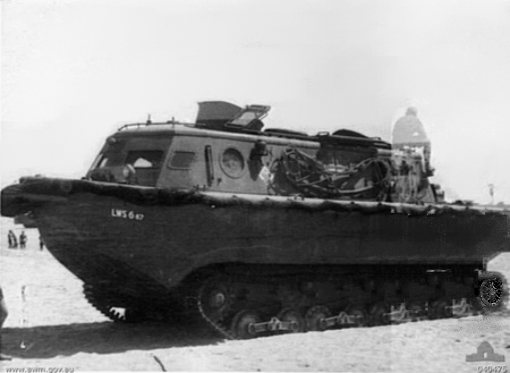
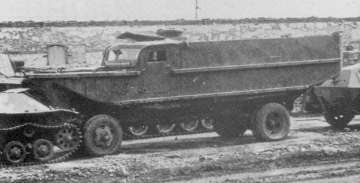
The Land-Wasser-Schlepper (LWS, land-water tug) was a tracked tractor ordered for German Army engineers as a light river tug that could also travel overland, with Rheinmetall-Borsig as contractor; two accounts date the order to 1935 and one to 1936 [8][9][23]. It was in effect a boat hull on tank tracks: 13 t (14.3 short tons), a 300 hp Maybach V12, room for 20 passengers besides two crew, and twin propellers in tunnels at the stern with twin rudders [8][9][23]. It could tow a Kässbohrer amphibious trailer carrying 10 to 20 t (11 to 22 short tons) [8][23].
For the planned invasion of Britain in 1940, the tugs were to pull unpowered barges ashore and tow vehicles over the sand [8][23]. General Franz Halder watched a demonstration on the island of Sylt on August 2, 1940. The tall hull bothered him, but he saw its value; a scheme to give one or two to every invasion barge came to nothing because the vehicle was hard to build in quantity [8][9][23]. Counts of how many were made differ: one published figure is 21, Tank AFV gives 7 by July 1940 and 14 more by March 1941 in its text but about 100 in its heading, and another account says only that small numbers were built [8][9][23]. The LWS served instead on the Eastern Front, by one account in the capture of the Baltic islands of Muhu, Saaremaa and Hiiumaa in September 1941, and in North Africa, and stayed in use until May 1945 [8][9][23].
Britain's Terrapin
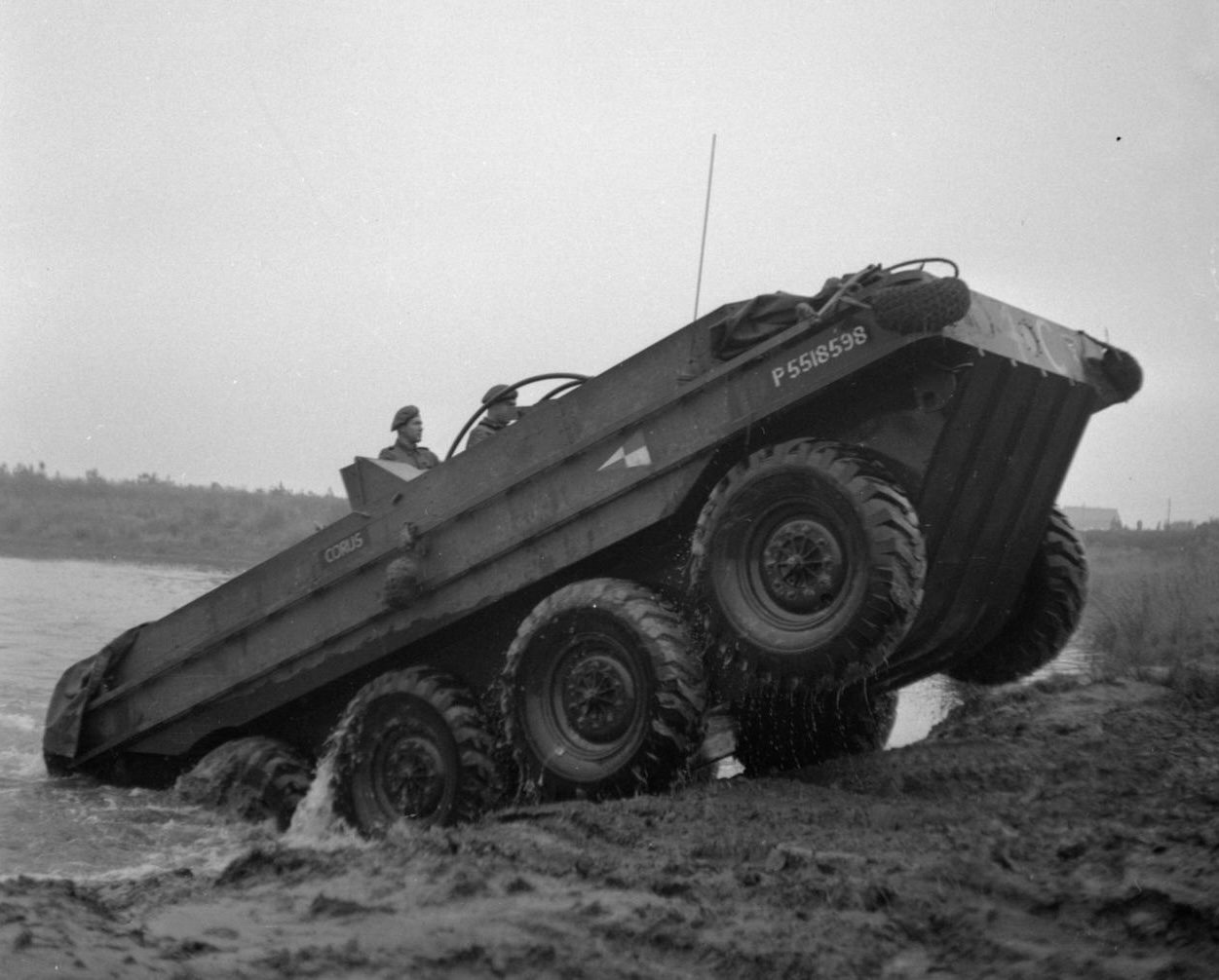
The Ministry of Supply ordered the Terrapin because American DUKWs were scarce; Thornycroft designed it, and Morris Commercial built about 500 of the Mark I in 1943 and 1944 [10][11]. It was an eight-wheeled boat rated as a 4-ton carrier, with two Ford V8 engines side by side, each driving the four wheels on one side; on firm ground only the middle four wheels touched [10][11]. It steered by braking one side, like a tracked vehicle, and Truck Encyclopedia says losing one engine could throw it into violent swerves or even tip it over [11].
The driver sat in the middle with so poor a view that a crewman often stood behind him to give directions, and the engines split the cargo space in two [10][11]. Slow and easily swamped in a seaway, it was kept out of the Normandy landings [10][11]. On the flooded Scheldt estuary it found its work: in October 1944 Terrapins and Buffalo LVTs carried the 9th Canadian Infantry Brigade across a mile-wide inlet, and on October 26 they carried the British 52nd (Lowland) Division across the Scheldt [10][11]. After the war Terrapins and DUKWs ran as public transport on flooded Walcheren until about 1946 [10].
Japan: the Su-Ki and the Ka-Tsu
Japan's struggle to supply Guadalcanal in 1942 pushed both its services toward amphibians [13][14]. For the army, Toyota sealed its To-Ki (KCY) 4x4 truck inside a boat hull of 5 mm (0.2 in) steel to make the Su-Ki, which carried 2 t (2.2 short tons) and was loaded from the rear; 198 were delivered between November 1943 and August 1944 [12][13]. A propeller at the rear drove it in the water, but it had no rudder, so the driver steered by turning the front wheels [13]. Truck Encyclopedia gives it about 10 knots afloat, a figure not found in other sources checked [13]. Su-Kis served on Pacific islands, including the Solomons and Gilberts [12][13].
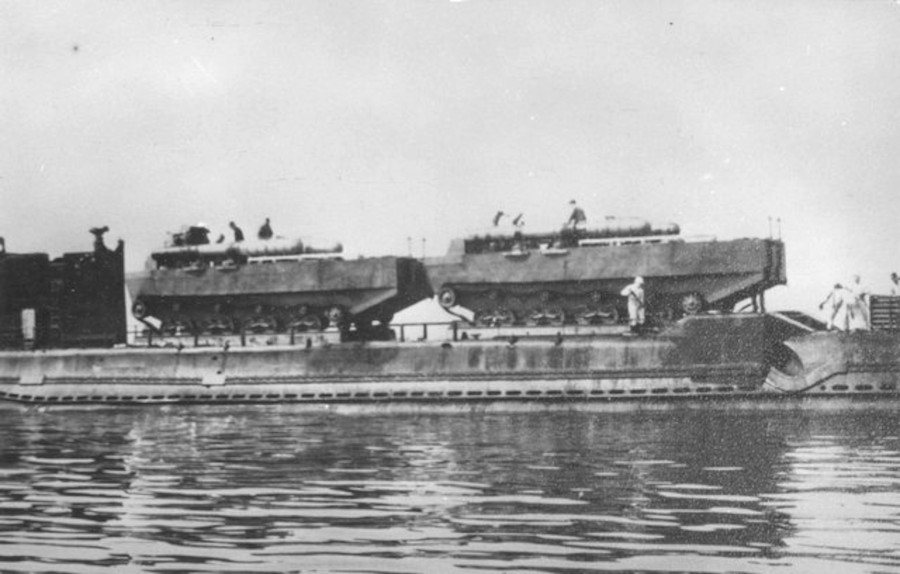
The navy's Type 4 Ka-Tsu was a 16 t (17.6 short ton), 11 m (36 ft) tracked tractor meant to ride to an island on a submarine and drive itself ashore with troops or cargo [14]. Its engine and electric final drives were sealed against the sea, and its twin propeller shafts pulled back into ducts once it reached the beach [14]. The first prototype was finished in late 1943 and tried off Kure in March 1944 [14]. One published account says launching one took about 20 minutes and that submarine captains flatly opposed the scheme [15]. In 1944 the navy planned Operation Tatsumaki, in which submarines would carry Ka-Tsu armed with two torpedoes each to Majuro atoll; the vehicles were to cross the atoll overland into the lagoon and attack American ships, but the plan was canceled [14][16]. Sources give 49 built, or 18, and none saw combat [14][15].
Lend-Lease amphibians in the Red Army
The Soviet Union received most of the Ford GPAs sent abroad. US Lend-Lease records list 3,520 of 4,486 quarter-ton amphibians going to the USSR, 852 to the British Empire and 40 to China [17]. The same records list 723 of 3,974 shipped 2.5-ton amphibians going to the USSR, while another count gives 586 DUKWs [5][17]. By one account the GPA was the Red Army's main amphibious scout vehicle of the war; many of its T-38 amphibious tanks had been captured in 1941 [18]. Little is recorded about how Soviet crews rated the GPA, but after the war the Soviet Union built its own version, the GAZ-46, from 1952 [19].
An American snow carrier that swam
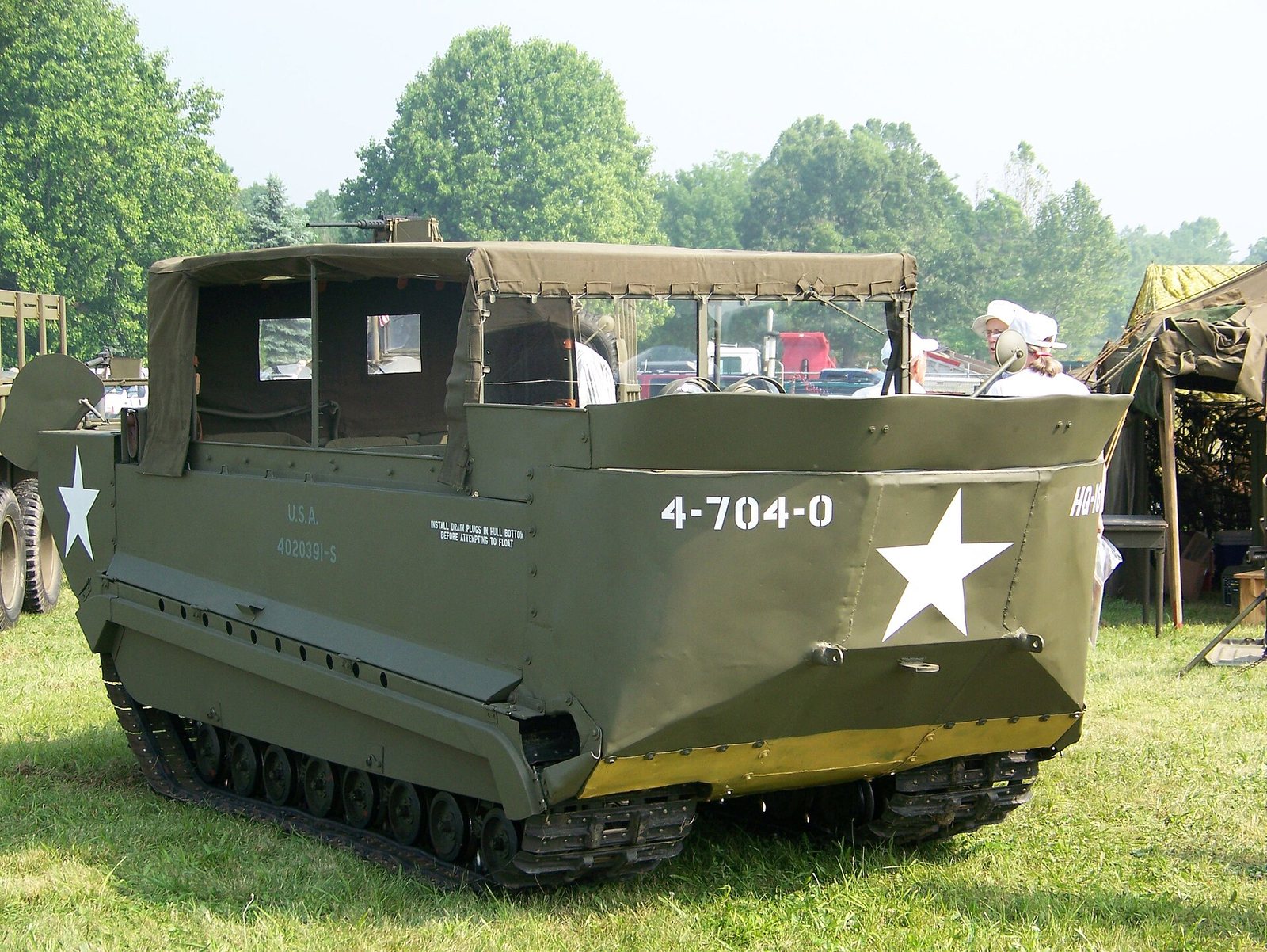
The M29 Weasel, built by Studebaker, began as a proposal by the British inventor Geoffrey Pyke for Project Plough, a planned operation in German-occupied Norway that was later canceled [20][24][25]. The basic M29 floated with very little freeboard, so the M29C Water Weasel added buoyancy cells at the bow and stern and twin rudders, though it was still meant mainly for inland waters [20][25]. From September 1943 to August 1945, 10,647 M29Cs were built alongside 4,476 M29s, according to one count; the US Army Transportation Museum says more than 15,000 Weasels had been built by VJ Day, and Tank Encyclopedia gives 15,892 [20][24][25]. The Canadian Army used Weasels in the flooded Scheldt estuary from the fall of 1944, and amphibious Weasels supported British commandos at Walcheren [20][24].
Speeds and numbers at a glance
The table compares the vehicles in this entry, oldest first. None is reported to plane; even the Su-Ki's disputed 10 knots is well under the 25 mph (40 km/h) planing mark, so all are land-first under this encyclopedia's types test [13].
| Vehicle | Country | First built | Number built | Road speed | Water speed | Type |
|---|---|---|---|---|---|---|
| Trippel SG6 | Germany | 1937 [2]; 1934 in another account [22] | about 800 [2] to about 1,000 [22] | 59 mph (95 km/h), SG6/41 [2]; 50 mph (80 km/h) for the military models in another account [22] | 9 mph (14.5 km/h), SG6/41 [2] | Land-first |
| Land-Wasser-Schlepper (LWS) | Germany | three by 1939 [9] or by autumn 1940 [8][23] | 21 by one count [9]; about 100 by another [23] | 22 mph (35 km/h) [8][23]; 25 mph (40 km/h) in another source [9] | 7.5 mph (12 km/h) [8][23]; 7.8 mph (12.5 km/h) in another source [9] | Land-first |
| LVT amtrac (LVT-1 figures) | United States | July 1941 [7][21] | more than 18,000 of all versions [6][21] | 15 mph (24 km/h), LVT-1 [21] | 4 knots (4.6 mph, 7.4 km/h) laden, LVT-1 [21] | Land-first |
| Volkswagen Type 166 Schwimmwagen | Germany | 1942 (some sources say 1941) [1] | 15,584 [1] | 50 mph (80 km/h) [1] | 6 mph (10 km/h) [1] | Land-first |
| Ford GPA | United States | 1942 [3][4] | 12,774 to 12,781 [3][4][26] | 50 mph (80 km/h) [3] | 5.5 mph (8.9 km/h) [3] | Land-first |
| GMC DUKW | United States | 1942 [5] | 21,147 [5] | 50 mph (80 km/h) [5] | 5.5 knots (6.3 mph, 10.2 km/h) [5] | Land-first |
| Terrapin Mark I | United Kingdom | 1943 [10][11] | about 500, plus five Mark II [10][11] | 15 mph (24 km/h) [10][11] | about 5 mph (8 km/h) [10][11] | Land-first |
| M29C Water Weasel | United States | production from September 1943, M29 family [20] | 10,647 M29C, plus 4,476 M29 [20]; 15,892 Weasels in all by another count [24] | 36 mph (58 km/h) [20][24] | no figure found | Land-first |
| Toyota Su-Ki | Japan | November 1943 [12][13] | 198 [12][13] | 40 mph (65 km/h) [12][13] | about 10 knots (11.5 mph, 18.5 km/h), Truck Encyclopedia only [13] | Land-first |
| Type 4 Ka-Tsu | Japan | prototype late 1943 [14] | 49 [14], or 18 [15] | 12 mph (20 km/h), one published figure [15] | 5 knots (5.8 mph, 9.3 km/h) [14]; 5 mph (8 km/h) in another source [15] | Land-first |
Speeds are published maximums from the sources cited in each cell; where sources differ, both are given. The LVT row uses the speeds of the first production model, the LVT-1; production covers all LVT versions. First built is the year of first production or first prototype named by the cited source. None of these vehicles is reported to plane, so all are Land-first under this encyclopedia's types test.
Photos
Related entries
Sources
- Volkswagen Schwimmwagen, Wikipedia. en.wikipedia.org/wiki/Volkswagen_Schwimmwagen
- Trippel SG6, Wikipedia. en.wikipedia.org/wiki/Trippel_SG6
- Ford GPA Seep (1942-1943), Museum of the American G.I.. americangimuseum.org/collections/restored-vehicles/ford-gpa-seep-1942-1943
- Ford GPA, Wikipedia. en.wikipedia.org/wiki/Ford_GPA
- DUKW, Wikipedia. en.wikipedia.org/wiki/DUKW
- WWII Innovations: From Hurricane Rescue to Armored Landing (Rob Wallace), The National WWII Museum (2020-05-18). www.nationalww2museum.org/war/articles/wwii-innovations-landing-vehicle
- LVT(A)-4, Landing Vehicle Tracked, American Heritage Museum. www.americanheritagemuseum.org/jml/lvta-4-landing-vehicle-tracked
- Landwasserschlepper, Wikipedia. en.wikipedia.org/wiki/Landwasserschlepper
- Land-Wasser-Schlepper (in German), Wikipedia (German). de.wikipedia.org/wiki/Land-Wasser-Schlepper
- Terrapin (amphibious vehicle), Wikipedia. en.wikipedia.org/wiki/Terrapin_(amphibious_vehicle)
- Terrapin (1942), Truck Encyclopedia. truck-encyclopedia.com/ww2/uk/terrapin.php
- Su-Ki, Wikipedia. en.wikipedia.org/wiki/Su-Ki
- IJN ww2 Type 2 Su-Ki, Truck Encyclopedia. truck-encyclopedia.com/ww2/japan/toyota-type-2-su-ki.php
- Type 4 Ka-Tsu, Wikipedia. en.wikipedia.org/wiki/Type_4_Ka-Tsu
- 特四式内火艇 (Type 4 Ka-Tsu, in Japanese), Wikipedia (Japanese). ja.wikipedia.org/wiki/%E7%89%B9%E5%9B%9B%E5%BC%8F%E5%86%85%E7%81%AB%E8%89%87
- IJN Submarine I-53: Tabular Record of Movement, Combined Fleet (combinedfleet.com). www.combinedfleet.com/I-53.htm
- Lend-Lease Shipments, World War II, Section III-B: Ordnance, Motor Transport Vehicles, US War Department (HyperWar Foundation transcription). www.ibiblio.org/hyperwar/USA/ref/LL-Ship/LL-Ship-3B.html
- T-38 tank, Wikipedia. en.wikipedia.org/wiki/T-38_tank
- The Ford GPA (Steve Turchet), Military Trader (2023-10-11). www.militarytrader.com/mv-101/the-ford-gpa
- M29 Weasel, Wikipedia. en.wikipedia.org/wiki/M29_Weasel
- Landing Vehicle Tracked, Wikipedia. en.wikipedia.org/wiki/Landing_Vehicle_Tracked
- EXCLUSIVE: Wheatcroft Collection's Tripple goes for a swim, War History Online (The Wheatcroft Collection). warhistoryonline.com/military-vehicle-news/exclusive-wheatcroft-collections-triple-goes-for-a-swim.html
- Rheinmetall-Borsig LWS (Landwasserschlepper) 1941, Tank AFV (tank-afv.com). tank-afv.com/ww2/germany/Landwasserschlepper.php
- Cargo Carrier M29 Weasel (Mark Nash), Tank Encyclopedia. tanks-encyclopedia.com/ww2/US/cargo-carrier-m29-weasel
- Artifact of the Month, May 2019: the M29 Weasel, U.S. Army Transportation Museum. transportation.army.mil/museum/AOTM/2019/may_2019.html
- Ford GPA Amphibious Jeep, 1943, The Henry Ford. www.thehenryford.org/collections/explore/artifact/33777
Last reviewed November 2026. Spotted something to correct or add? Tell us and include a source.
About the Amphibious Encyclopedia
WaterCar has designed and built amphibious vehicles in Southern California for more than 25 years. We keep this encyclopedia so anyone curious about vehicles that cross between land and water has one place to start, with the sources listed for every fact.
Browse all entries → · The WaterCar machines → · How a WaterCar works →