
The idea
A conventional floating bridge arrives on trucks and has to be launched, joined and pushed into place; the Soviet PMP ribbon bridge company, for example, used six power boats to help emplace its bridge or drive its rafts [1]. Self-propelled amphibious bridge vehicles fold all of that into one machine. Each drives to the water, swims out under its own power and couples to its neighbors to make a raft or a continuous bridge [2][4].
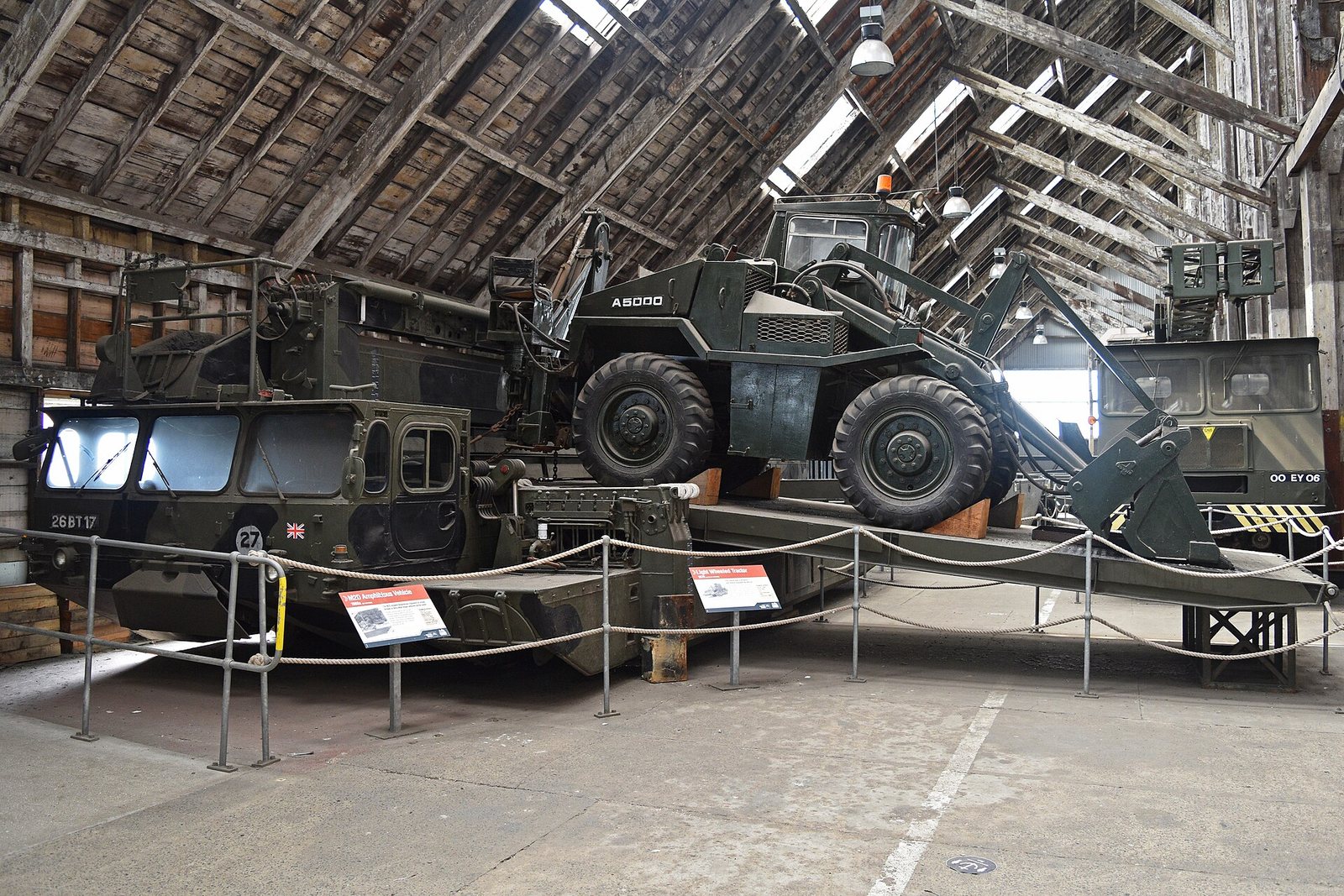
The Gillois began with Jean Gillois, a lieutenant in a heavy bridging battalion of the French First Army at the end of the Second World War, who proposed a floating truck that carried its own piece of bridge [2]. In 1954, by then a major serving with the French engineers in West Germany, he found a builder in Eisenwerke Kaiserslautern (EWK), and a 1955 contract covered an amphibious ferry and bridge units [2]. The first version floated on inflatable rubber pontoons [17]. About 250 were built for the French Army, which used them from 1963 to 1997; another source gives 264 Gillois-EWK vehicles built in all [2][17]. Each bridge vehicle carried a span about 9 m (30 ft) long with a 4 m (13 ft) roadway, ramp vehicles linked the bank to the end of the chain, and, by one account, a 100 m (330 ft) bridge took about 65 minutes and could pass about 250 vehicles an hour [2]. West Germany, a US Army engineer company at Darmstadt and a British field squadron also used the Gillois, and Israel, which called it Timsach, used it to cross the Suez Canal in 1973 [2].
From the Gillois to the M2 and M3
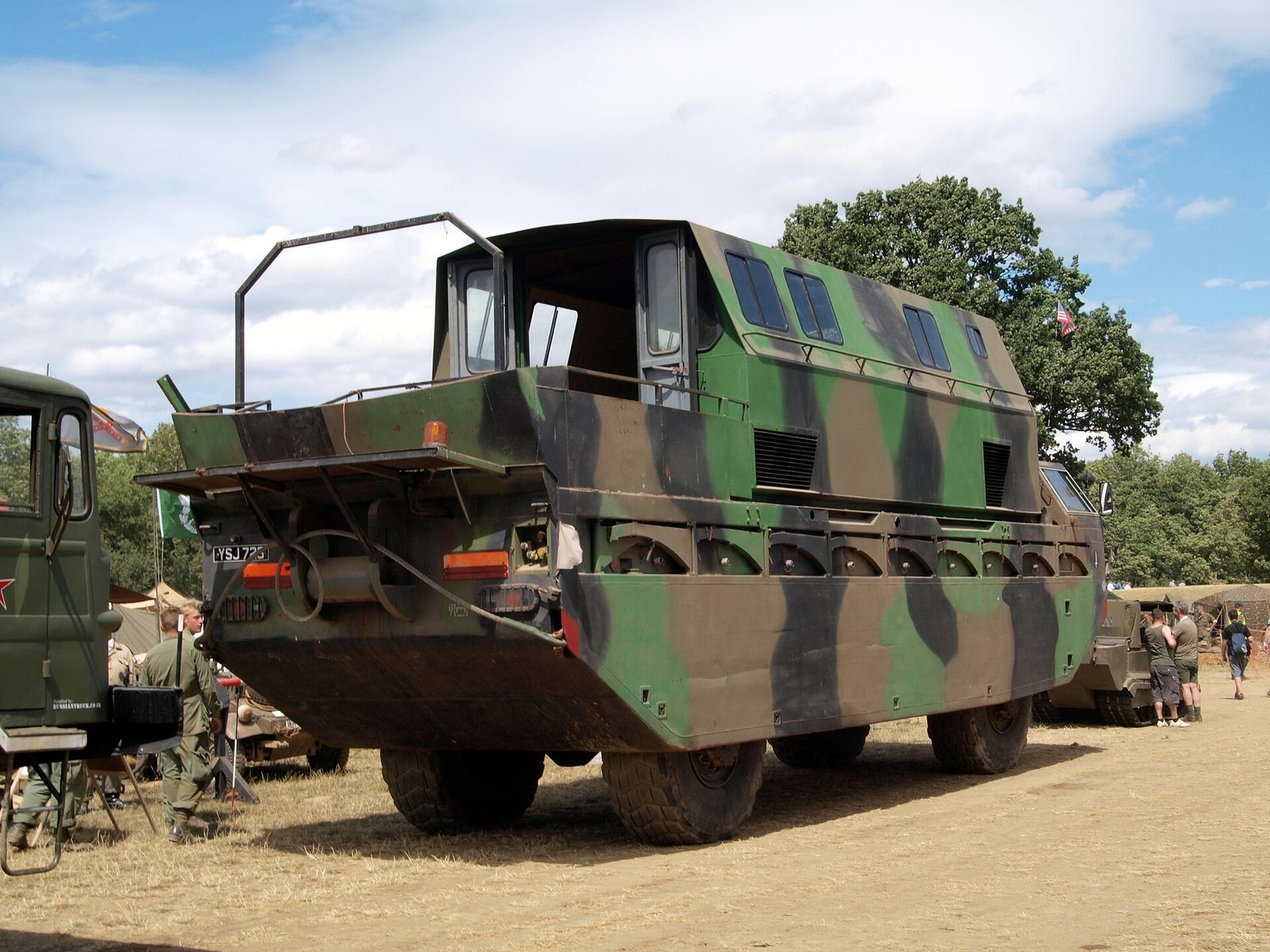
West Germany asked industry in 1958 for an aluminum amphibious bridge; EWK's M2 beat a rival from MAN and Krupp, and the Bundeswehr took delivery from 1967 [3][4][18]. Counts differ: one account gives 235 built, 114 of them for the Bundeswehr in 1967 to 1970; the Panzerbär site says EWK delivered 235 to the Bundeswehr by 1982; and another source gives 385 M2s in all [3][4][17][18]. Britain and Singapore also used it [3][4]. Nicknamed the Alligator, the 21.5 t (23.7 short ton) M2 had two engines. One drove a steerable rudder propeller, without which it could not be steered afloat, and the other drove two side propellers, for 15 km/h (9 mph) in the water [3][4][18]. A single M2 ferried 8 t or 12 t by different accounts and three coupled carried 60 t; one account gives 15 to 20 minutes for a 100 m (330 ft) bridge [3][4][18].
Its successor, the M3, entered German and British service in 1996 and has its own entry. It needs a crew of three instead of four, can swing out its pontoons on the move, and is driven by two pump jets that turn through 360 degrees [5][17]. Eight M3s form a 100 m (330 ft) heavy-load bridge, in about 15 minutes according to Army Technology or under 10 minutes according to the maker, as reported by the defense writer Christopher F. Foss [5][6].
Soviet tracked ferries
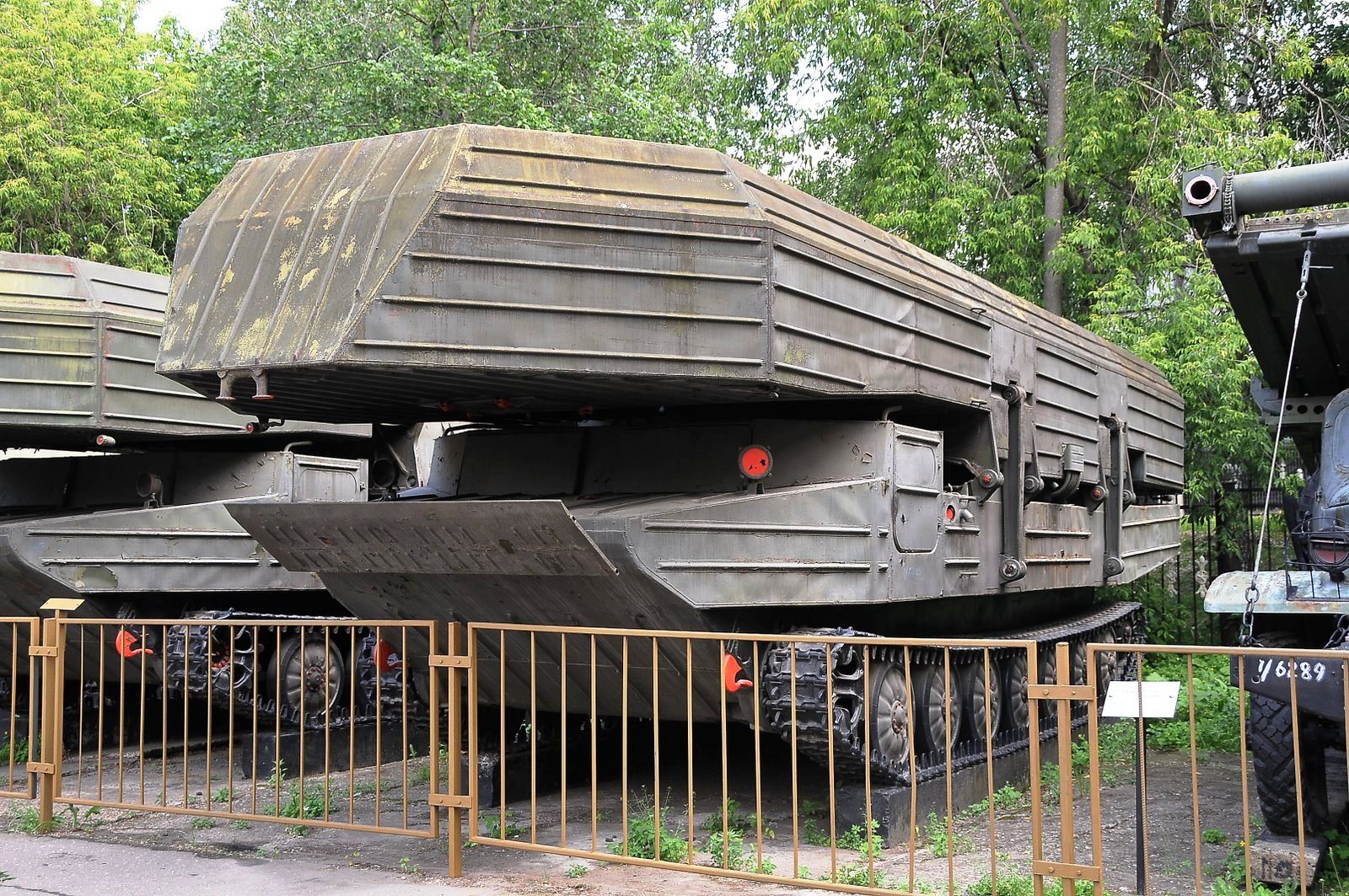
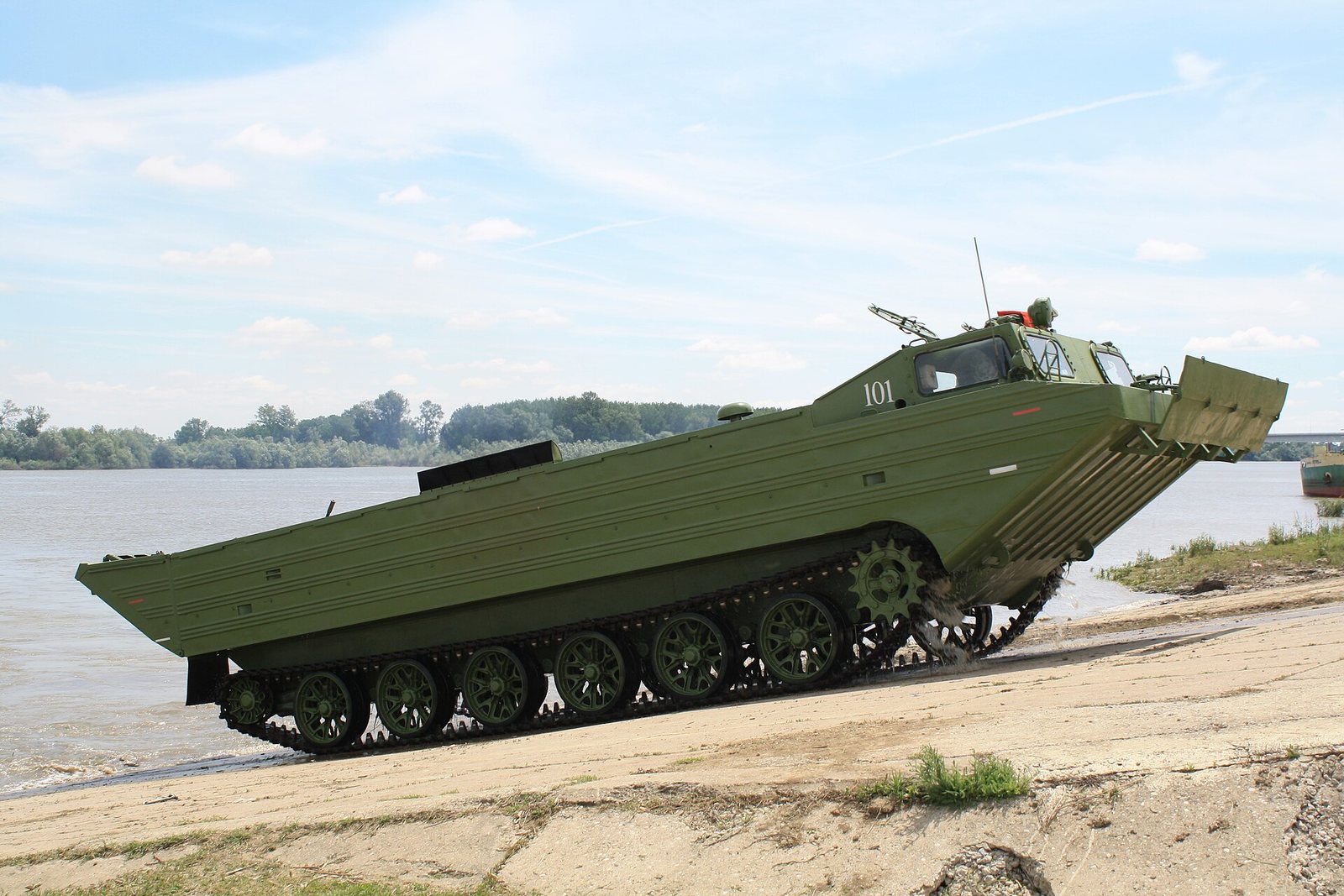
The Soviet Army put its ferries on tracks. A 1984 US Army manual describes the division of labor in a Soviet division's engineer battalion: GSP ferries carried tanks over rivers too deep to ford or snorkel, one medium tank per ferry, while tracked amphibians such as the K-61 and PTS carried artillery, air defense and supply units [1]. The GSP, which uses the tracks and road wheels of the PT-76 amphibious tank, comes as a left half and a right half that one account calls not interchangeable; each 17 t (19 short ton) half swims out on its own, and joined they carry 52 t (57 short tons) [7][8]. Czechoslovakia received four from 1963 [8].
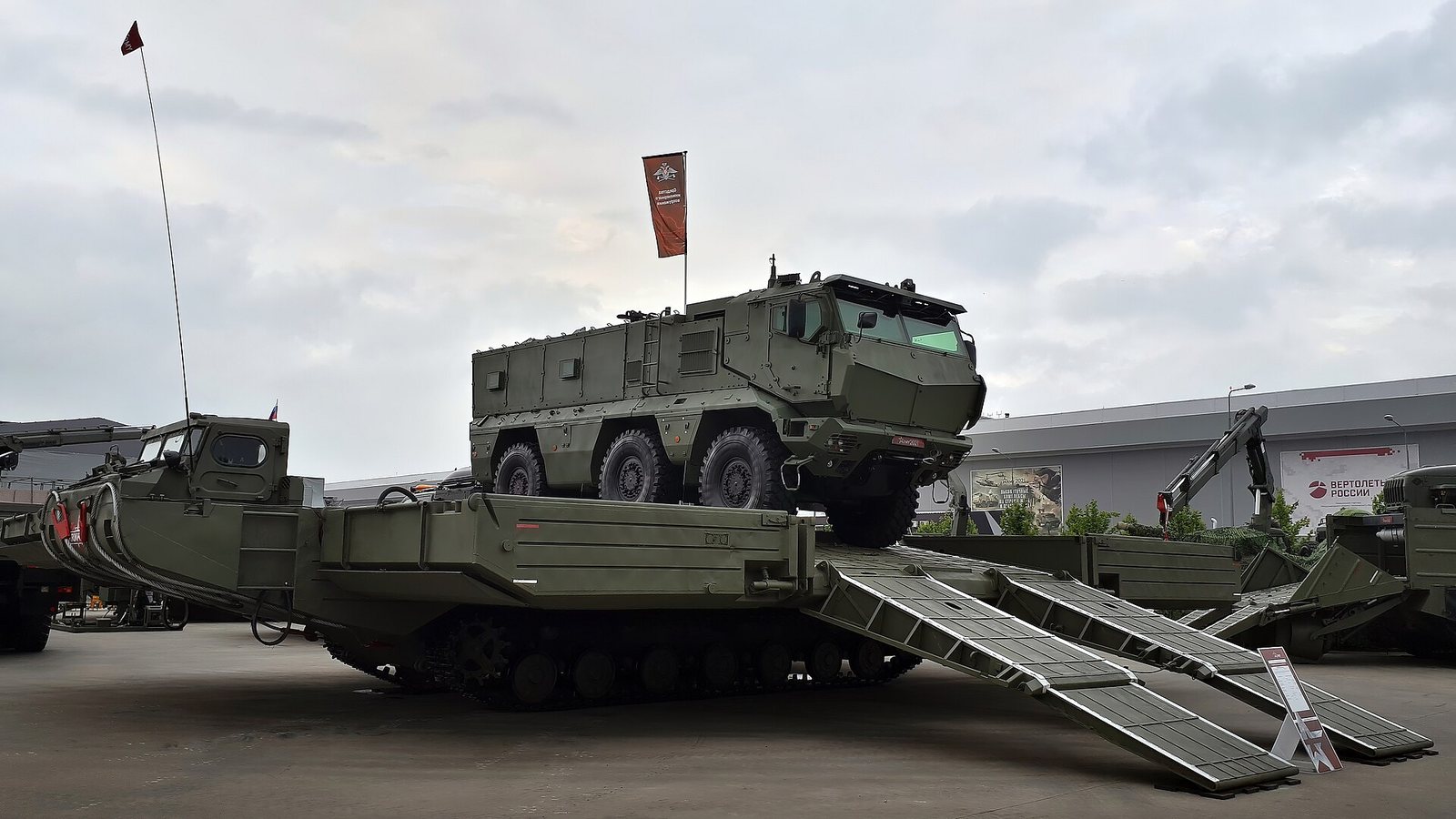
The PTS, introduced in 1965, is a large tracked carrier with a rear ramp that takes 10 t (11 short tons) afloat or about 70 troops; with a PKP amphibious trailer, the PTS-M can carry a 122 mm howitzer and its truck in one crossing [11][12]. The PMM-2, developed from the mid-1970s on the chassis of the later PTS-2 to replace the GSP and the wheeled PMM Volna, carries two hinged pontoons folded on its roof [9]. Published load ratings are 40 or 42.5 t (44 or 46.8 short tons) for one vehicle, 80 or 85 t for two coupled in about 8 minutes and 120 or 127.5 t for three in about 10; one account says the improved PMM-2M's rating was raised by 2.5 t [9][10]. Egypt used GSP ferries and PTS-M transporters when its army crossed the Suez Canal in October 1973 [7][8][12].
How a vehicle becomes a bridge section
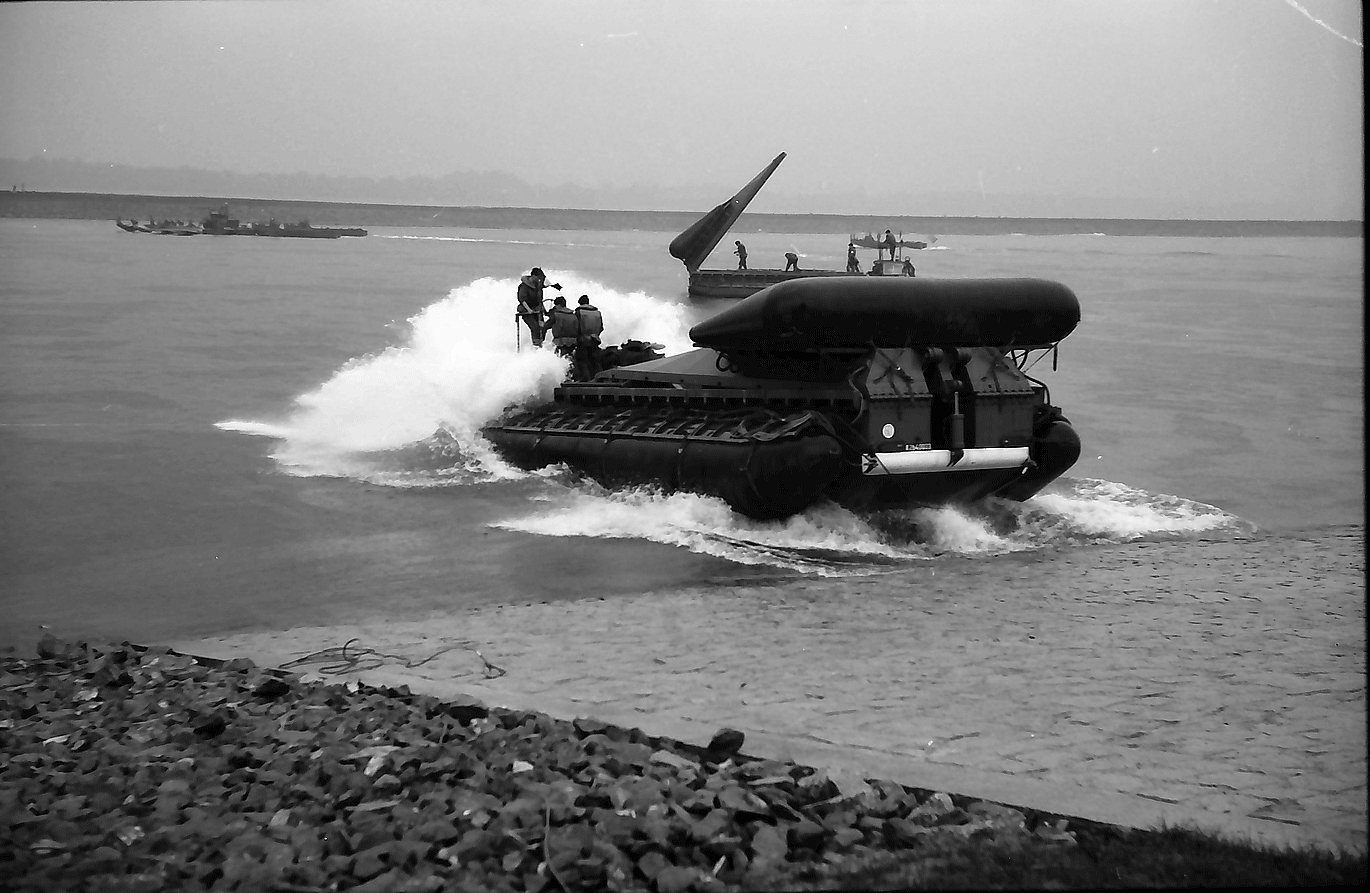
The German M2 shows the routine. On the bank the crew swung out and locked the side floats, raised splash plates and pulled out exhaust extensions; the driver then took it into the water cab first, and once it floated the wheels were drawn up into the hull [3][4]. A crane on the vehicle then lifted ramp plates stowed under the floats, turned them 90 degrees and bolted them to the side of the hull [3][4]. The same plates served as entry ramps at the bank and as connecting plates between vehicles, so a line of M2s became one roadway from shore to shore [3].
Other designs vary the steps. The two GSP halves are drawn together in the water with a rope, a hand winch and a coupling device, and hydraulics worked from the drivers' seats then tip out the pontoons and ramps [8]. The PMM-2 unfolds its pontoons from its roof, and one account says a single vehicle is ready as a ferry in about 5 minutes [9][10]. The M3 needs no prepared launch site and does not have to stop: it can open its pontoons while driving, on land or afloat, and the maker says two M3s couple into a ferry in about three minutes [5][6].
Newer designs
France replaced the Gillois with the EFA, built by Chaudronnerie et Forges d'Alsace (CEFA) since 1989 and in French service since 1993; 39 went to the French Army and 10 to the United Arab Emirates [6][13]. Vehicles drive on and off it forward, one EFA can carry a 70 t (77 short ton) tank, and four units can bridge 100 m (330 ft) in about 10 minutes or less [6][13]. According to one published account, France announced in September 2023 that eight used EFAs would go to Ukraine [13].
Turkey's FNSS delivered its first four Samur amphibious bridge vehicles, as training sets, in September 2011 after six years of development; two linked Samurs carry tracked vehicles up to military load class (MLC) 70, three carry wheeled vehicles up to MLC 100, and two pump jets drive each at about 10 km/h (6 mph) [14][16]. In 2022 Foss described FNSS's OTTER 4x4 system, of which the Turkish Army had 32; twelve coupled units make a 150 m (490 ft) bridge [6]. In September 2017 Russian forces built a 210 m (690 ft) bridge across the Euphrates near Deir ez-Zor in Syria; a TASS report said PMM-2Ms were sent for the operation, though it also called the structure a small panel road bridge, and another account describes it as a pontoon bridge of PMM-2M ferries [9][15].
Capacities and speeds at a glance
The table compares the vehicles above, oldest first. Water speeds are for a single unladen vehicle unless stated; a loaded ferry is slower [5][7].
| Vehicle | Country | Introduced | Carries or bridges | Water speed | Road speed |
|---|---|---|---|---|---|
| Gillois | France, built with EWK of West Germany | contract 1955; French service 1963 [2] | about 25 t as a ferry and 50 t as a bridge; 100 m (330 ft) bridge in about 65 minutes [2] | 7.5 mph (12 km/h) [2] | 40 mph (64 km/h) [2] |
| GSP | Soviet Union | in Czechoslovak service from 1963 [8] | two halves join to carry 52 t (57 short tons) [7][8], one medium tank [1] | 6.6 mph (10.6 km/h) per half; 4 to 5 mph (6 to 8 km/h) with a 52 t load [7] | 25 mph (40 km/h) [7]; 25 to 28 mph (40 to 45 km/h) [8] |
| PTS and PTS-M | Soviet Union | 1965 [11][12] | 10 t (11 short tons) afloat or about 70 troops; a 122 mm howitzer on the PKP trailer [11] | 6.6 mph (10.6 km/h) [11] | 26 mph (42 km/h) [11] |
| EWK M2 | West Germany | Bundeswehr deliveries from 1967 [4][18] | 8 t [4] or 12 t [3][18] alone, 60 t with three coupled [4]; 100 m (330 ft) bridge in 15 to 20 minutes by one account [4] | 9 mph (15 km/h) [4][18] | 37 mph (60 km/h) [4][18] |
| PMM-2 and PMM-2M | Soviet Union, then Russia | developed from the mid-1970s [9] | 40 to 42.5 t (44 to 46.8 short tons) alone, 120 to 127.5 t with three coupled, by different accounts [9][10] | 6 mph (10 km/h), one published figure [9] | 34 mph (55 km/h) [9][10] |
| EFA | France | production 1989, French service 1993 [13] | one 70 t (77 short ton) tank; four units bridge 100 m (330 ft) [6][13] | no figure found | no figure found |
| M3 | Germany | 1996 [5][17] | a Class 70 tracked vehicle on one two-bay M3; eight form a 100 m (330 ft) bridge [5] | 9 mph (14 km/h) unladen, 5.6 mph (9 km/h) laden [5] | 50 mph (80 km/h) [5][6] |
| FNSS Samur | Turkey | first four delivered 2011 [14][16] | MLC 70 tracked with two units, MLC 100 wheeled with three [14][16] | 6 mph (10 km/h) [14] | 31 mph (50 km/h) [14] |
| FNSS OTTER | Turkey | 32 in Turkish service by 2022 [6] | MLC 85 tracked with two units; twelve units bridge 150 m (490 ft) [6] | 6 mph (10 km/h) [6] | no figure found |
Speeds are published maximums from the sources cited in each cell; where sources differ, both are given. Water speeds are for a single unladen vehicle unless a load is stated. MLC is military load class. Loads are as published, in metric tonnes unless a class is given. Introduced is the earliest contract, delivery, service or development date named by the cited source; no Soviet service date was found for the GSP or PMM-2.
Photos
Related entries
Sources
- FM 100-2-2, The Soviet Army: Specialized Warfare and Rear Area Support, Headquarters, Department of the Army (copy on Wikimedia Commons) (1984-07-16). commons.wikimedia.org/wiki/File:Fm100-2-2_-_The_Soviet_Army,_Specialized_Warfare_and_Rear_Area_Support.pdf
- Pont Gillois (in French), Wikipedia (French). fr.wikipedia.org/wiki/Pont_Gillois
- Schwimmschnellbrücke M2B (Bw) (in German), Panzerbär (panzerbaer.de). www.panzerbaer.de/helper/bw_amphfz_m2-a.htm
- Amphibisches Brücken- und Übersetzfahrzeug M2 (in German), Wikipedia (German). de.wikipedia.org/wiki/Amphibisches_Br%C3%BCcken-_und_%C3%9Cbersetzfahrzeug_M2
- M3 Amphibious Bridging and Ferrying System, Army Technology (2010-07-05). www.army-technology.com/projects/m3amphibiousbridging
- Bridging and Gap-Crossing Options (Christopher F. Foss), European Security & Defence (2022-05-30). euro-sd.com/2022/05/articles/exclusive/26313/bridging-and-gap-crossing-options
- ГСП (паром) (GSP ferry, in Russian), Wikipedia (Russian). ru.wikipedia.org/wiki/%D0%93%D0%A1%D0%9F_(%D0%BF%D0%B0%D1%80%D0%BE%D0%BC)
- GSP, caterpillar self-propelled ferry (Martin Smíšek and Miroslav Hlavatý), Armed Conflicts (Valka.cz). www.armedconflicts.com/topic/view/13544
- PMM-2 (in German), Wikipedia (German). de.wikipedia.org/wiki/PMM-2
- ПММ-2 (PMM-2, in Russian), Wikipedia (Russian). ru.wikipedia.org/wiki/%D0%9F%D0%9C%D0%9C-2
- PTS (vehicle), Wikipedia. en.wikipedia.org/wiki/PTS_(vehicle)
- Soviet Amphibious Tractor PTS-M (1965), Tank AFV (tank-afv.com). tank-afv.com/coldwar/ussr/PTS.php
- Engin de franchissement de l'avant (in French), Wikipedia (French). fr.wikipedia.org/wiki/Engin_de_franchissement_de_l%27avant
- FNSS Samur, Wikipedia. en.wikipedia.org/wiki/FNSS_Samur
- Russia has deployed PMM-2M amphibious bridging ferry in Syria, Army Recognition (from TASS) (2017-09-27). www.armyrecognition.com/archives/archives-land-defense/land-defense-2017/russia-has-deployed-pmm-2m-amphibious-bridging-ferry-in-syria
- FNSS AAAB Armored Amphibious Assault Bridge, Defence Turkey. defenceturkey.com/tr/i%CC%87cerik/fnss-aaab-armored-amphibious-assault-bridge-950
- M3, Armoured vehicle-launched bridge, Army Guide (army-guide.com). www.army-guide.com/eng/product2072.html
- Amphibie M2 Alligator, Armed Conflicts (Valka.cz). www.armedconflicts.com/Amphibie-M2-Alligator-t63993
Last reviewed November 2026. Spotted something to correct or add? Tell us and include a source.
About the Amphibious Encyclopedia
WaterCar has designed and built amphibious vehicles in Southern California for more than 25 years. We keep this encyclopedia so anyone curious about vehicles that cross between land and water has one place to start, with the sources listed for every fact.
Browse all entries → · The WaterCar machines → · How a WaterCar works →