
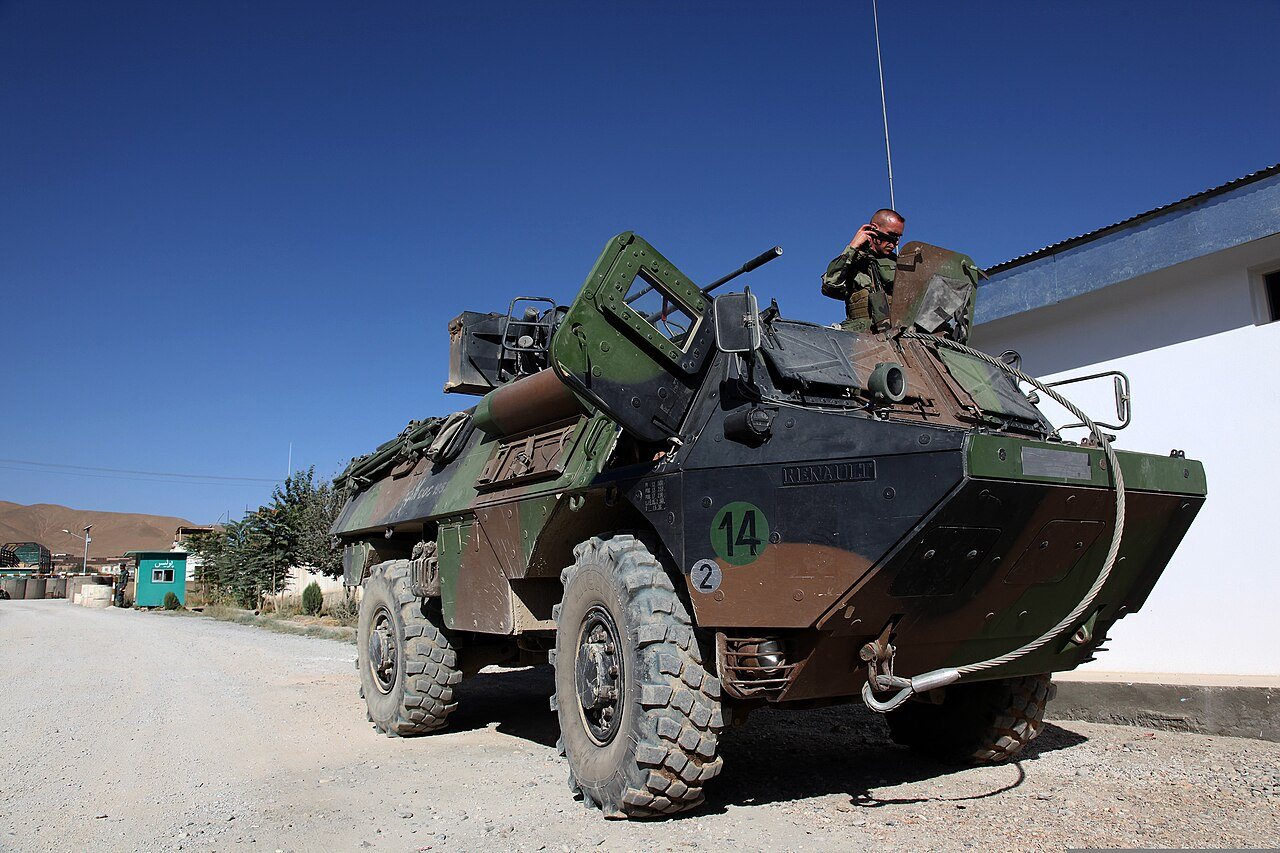
History
France designed the VAB in the 1970s as a wheeled armored carrier for infantry [1]. Wikipedia gives the development period as 1970 to 1977, with a first delivery in 1976 and service entry in 1979 [1]. Army Recognition says production has run since 1976 [3].
The vehicle was built by Renault Trucks Defense, which is now called Arquus [3]. A 1999 US Federation of American Scientists page said more than 5,000 had been built and that 15 armies used it [2]. Wikipedia cites a February 2024 report that France supplied about 250 to Ukraine [1].
The basic 4x4 carrier has been built in many versions. Army Recognition counts about 30, and Wikipedia says more than 30 variants and sub-variants exist, including mortar, anti-tank, ambulance and command vehicles [1][3]. A 6x6 version, the VAB Mk 3, is described by Wikipedia as part of the family [1].
Design and how it swims
The VAB is about 5.98 m (19 ft 7 in) long, 2.49 m (8 ft 2 in) wide and weighs 13 tonnes in combat order [1][3]. It carries a crew of two and ten soldiers [1][3]. Army Recognition lists a water-cooled turbocharged six-cylinder diesel of 220 bhp, while Wikipedia gives the current engine as 235 kW (320 hp), so the power figure depends on the engine fitted [1][3].
Afloat, the VAB is pushed by two water jets at the rear of the hull. Each jet has a deflector for steering and reverse thrust, controlled hydraulically from a joystick on the dashboard [3]. The Federation of American Scientists page describes the same arrangement [2]. Before entering the water the crew switches on the bilge pumps and raises the trim vane at the front [3]. Wikipedia says the VAB can swim by its wheels or by its twin jets [1].
Reported speeds differ. Water speed is given as 7.92 km/h (4.3 knots) by Wikipedia, 8 km/h by Army Recognition and 2.2 m/s (about 7.9 km/h) by the Federation of American Scientists [1][2][3]. Road speed is 90 km/h (56 mph) in two sources and 110 km/h (68 mph) in Wikipedia [1][2][3]. Army Recognition also notes that not every export customer has water jets fitted [3].
Armor upgrades and swimming
Added armor can remove amphibious capability. Wikipedia says the MEXAS composite armor upgrade added about two tonnes and removed the vehicle's amphibious capability [1]. The same page lists the heavier VAB Ultima at 13.8 tonnes empty [1].
Related entries
Sources
- Véhicule de l'Avant Blindé, Wikipedia. en.wikipedia.org/wiki/V%C3%A9hicule_de_l%27Avant_Blind%C3%A9
- VAB, Federation of American Scientists (1999-06-19). man.fas.org/dod-101/sys/land/row/vab.htm
- VAB Renault 4x4 armoured personnel carrier, France, Army Recognition. armyrecognition.com/military-products/army/armoured-personnel-carriers/wheeled-vehicles/vab-renault-france-uk
Last reviewed November 2026. Spotted something to correct or add? Tell us and include a source.
See how to register a low-speed vehicle or boat in your state.
About the Amphibious Encyclopedia
WaterCar has designed and built amphibious vehicles in Southern California for more than 25 years. We keep this encyclopedia so anyone curious about vehicles that cross between land and water has one place to start, with the sources listed for every fact. New to the subject? Start with our guide, What is an amphibious vehicle?
All amphibious vehicles → · The WaterCar machines → · How a WaterCar works →