
History
The French VBL program began in 1978, seeking a light reconnaissance vehicle to work alongside the AMX-10 RC [1]. Renault and Panhard each proposed a prototype, and trials began in 1982 [1]. Mexico ordered the Panhard design in 1984, France chose it in 1985 and production started that year at Marolles-en-Hurepoix, south of Paris [1]. French Army service began in 1990, according to both Wikipedia and the French defense ministry [1][3].
The French Army ordered 569 vehicles in 1990, 330 more between 1994 and 1997, and 700 of the lengthened VB2L version before 2004 [1]. The 1,500th vehicle was built in 2001 and the last of about 2,600 left the plant in 2010 [1]. The defense ministry reports 1,446 in French Army service, including the VB2L [3]. Army Technology says more than 2,300 were operational in 16 armies, about 1,600 of them French [2].
Users
Export users include Greece, which received 242 from 1997 to 2002, Oman with 132 from 1997 to 2004, Nigeria with 72, and Botswana, which had 64 in 2024 [1]. Kuwait's Ministry of the Interior ordered 20 VBL Mk2 vehicles for its special forces [2].
Design and how it works
The VBL was meant to weigh under 3.5 t but grew to about 4 t with added armor, weapons and equipment [1]. It is 2.02 m (6.6 ft) wide and 1.70 m (5.6 ft) high [1]. A Peugeot XD3T turbo-diesel of about 95 hp drives it, with a top road speed of 95 km/h (59 mph) per Wikipedia and Army Technology, or 90 km/h (56 mph) per the French defense ministry [1][2][3]. It can be slung under a helicopter and dropped by parachute [1][3].
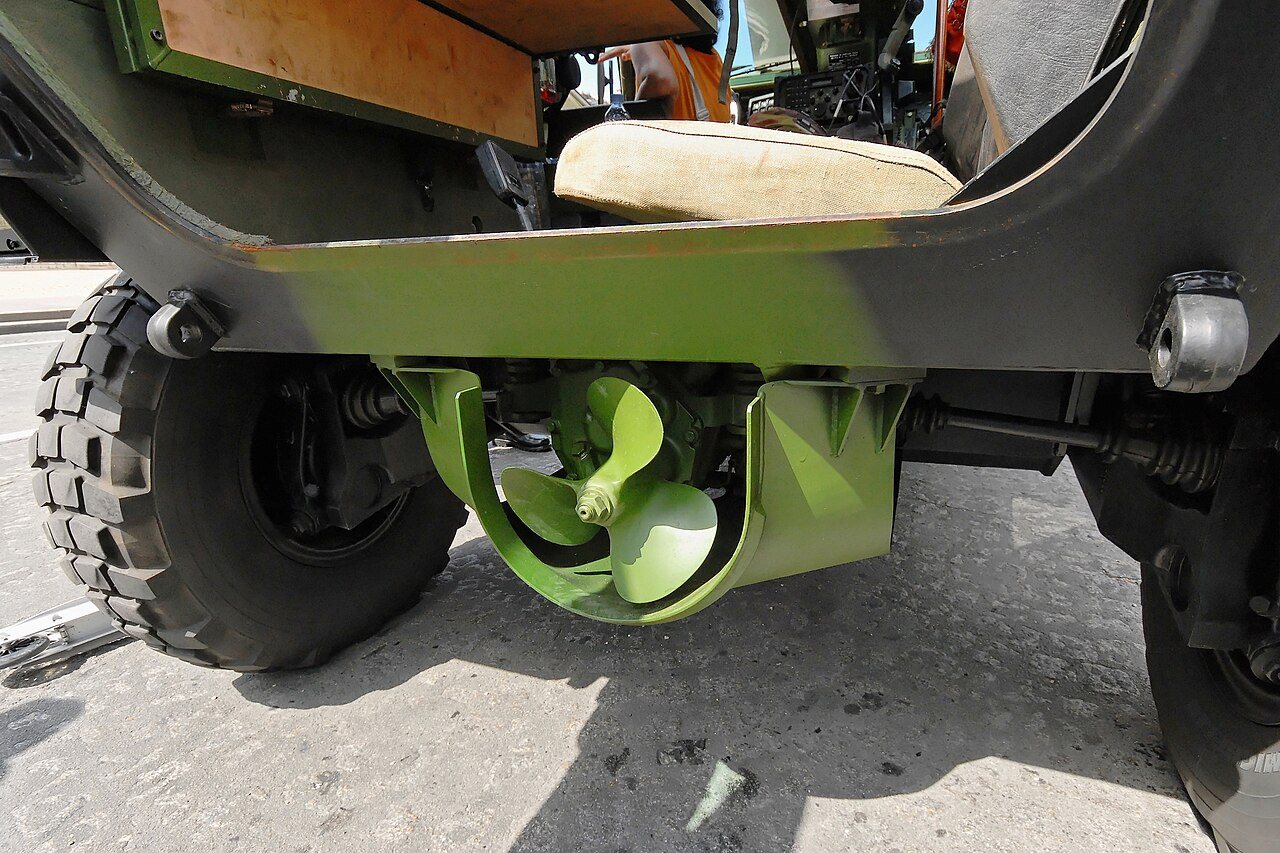
Sources agree on its swimming speed but differ on how standard the capability is. Wikipedia calls it fully amphibious with a propeller, at 5.4 km/h (3.4 mph) [1]. Army Technology says the speed comes from an optionally fitted amphibious kit and that a trim vane at the front must be raised by hand before entering water [2]. A reference page from the Federation of American Scientists also lists propellers as optional [4]. The defense ministry describes the VBL as amphibious and gives a fording depth of 0.90 m (3 ft) without preparation, which is a wading figure [3]. The later VBL Ultima has no amphibious ability [1].
Legacy
The VBL remains in service in France and with many export customers: the French defense ministry counts 1,446 in the Army, and Wikipedia cites 1,380 in French service per the IISS in 2024 [1][3].
Related entries
Sources
- Véhicule Blindé Léger, Wikipedia. en.wikipedia.org/wiki/V%C3%A9hicule_Blind%C3%A9_L%C3%A9ger
- Panhard VBL, Army Technology. www.army-technology.com/projects/panhard-vbl
- VBL : Véhicule Blindé Léger, French Ministry of the Armed Forces. www.defense.gouv.fr/terre/nos-materiels/nos-equipements-terre/vehicules-larmee-terre/vehicules-reconnaissance/vbl-vehicule-blinde
- VBL, Federation of American Scientists (DoD 101). man.fas.org/dod-101/sys/land/row/vbl.htm
Last reviewed November 2026. Spotted something to correct or add? Tell us and include a source.
See how to register a low-speed vehicle or boat in your state.
About the Amphibious Encyclopedia
WaterCar has designed and built amphibious vehicles in Southern California for more than 25 years. We keep this encyclopedia so anyone curious about vehicles that cross between land and water has one place to start, with the sources listed for every fact. New to the subject? Start with our guide, What is an amphibious vehicle?
All amphibious vehicles → · The WaterCar machines → · How a WaterCar works →