
History
TREKOL is a company from Lyubertsy, near Moscow. Russian Wikipedia says its project began in the late 1980s with specialists who had worked at the research institutes NAMI and the tire industry, and that the company was registered on 15 April 1993 [3]. The maker's own site says it has built all-terrain vehicles since 1988 and reports 6,416 vehicles built across all its models [4].
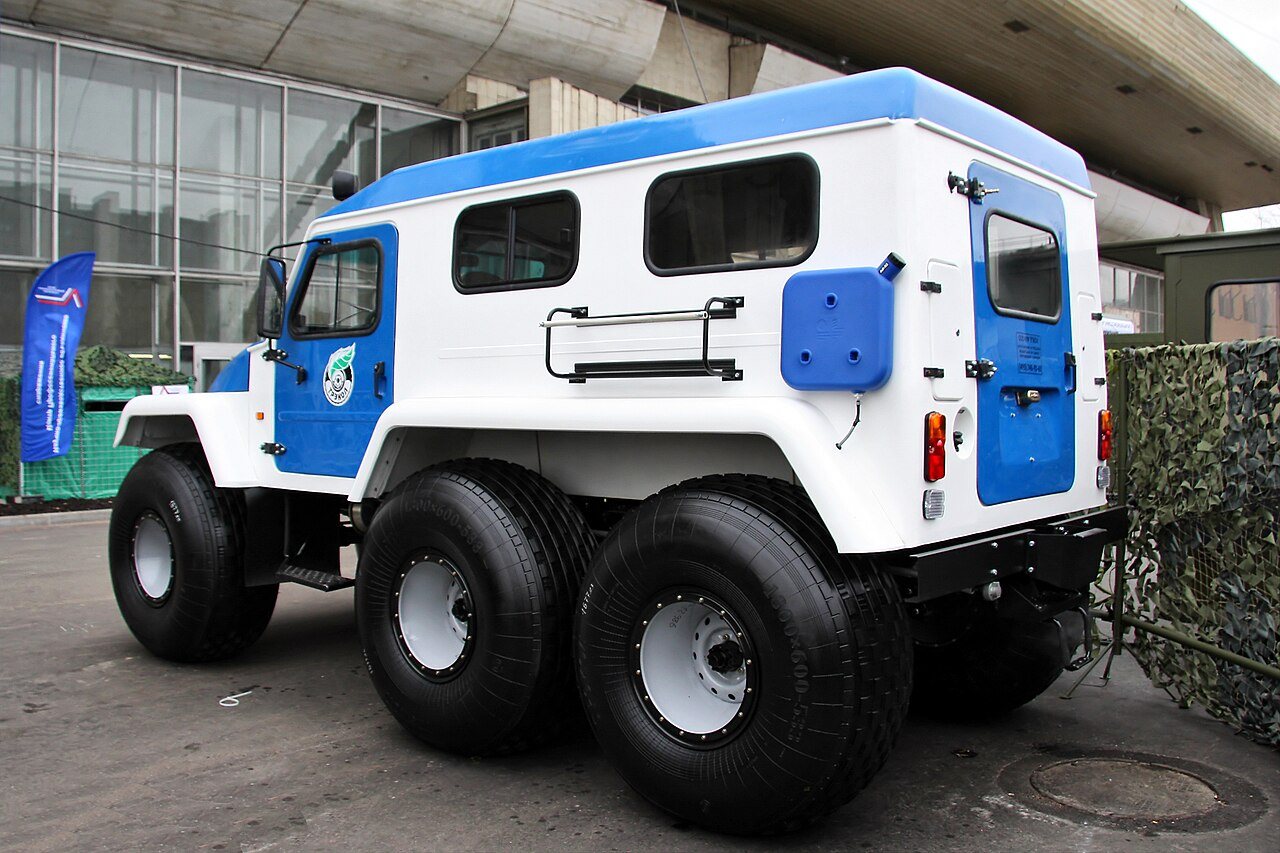
The 39294 is the company's three-axle model with a 6x6 layout and an original fiberglass body [3]. Za Rulem says the maker first showed it in 2005 and has updated it since, and counted about 1,800 sold by 2018, with 172 built in the previous year [1]. The magazine called it Russia's most mass-produced vehicle of this kind, which is its own claim [1].
Buyers named in the 2018 test include drilling operations, the Russian Emergency Ministry and customers in Kazakhstan, Uzbekistan and Luxembourg, and the magazine says Doctors Without Borders ordered one for work in Africa [1]. Russian Wikipedia adds geologists, oil and gas workers and medical services, and says a road enterprise in Yakutia used TREKOL vehicles in 2025 to survey winter roads [3].
Design and how it works
The 39294 rides on tubeless tires about 1,350 mm (53 in) tall and 700 mm (28 in) wide in the 2018 test, with 490 mm (19 in) of ground clearance [1]. Tire pressure is set low for soft ground, about 0.3 atm, and a little higher, about 0.4 atm, for water [1]. English Wikipedia lists slightly smaller tires, 1300 x 600 mm, so tire size varies by source and year [2].
The body is fiberglass, which Wikipedia says works from minus 45 to plus 45 degrees Celsius (minus 49 to 113 degrees Fahrenheit) [2]. The vehicle floats with the waterline at the wheel rims and sealed doors keep water out of the cabin [1]. It moves on water by turning its wheels, which the Za Rulem tester found very slow and hard to steer [1]. The maker offers a water jet (about 135,000 rubles in 2018) or a transom for an outboard motor (about 7,000 rubles) [1]. English Wikipedia lists a water speed of about 10 km/h (6 mph) with an outboard motor [2].
In 2018 the vehicle was offered with a 2.7-liter ZMZ petrol engine of 128 hp (94 kW) or one of two Hyundai 2.5-liter diesels, all with a five-speed manual gearbox and full-time all-wheel drive [1]. Some other sources list a 2.3-liter petrol engine as standard, which suggests the engine changed between versions [2]. Passenger versions seat eight [2][4].
Legacy
The 39294 led to later TREKOL models, among them the aluminum-bodied Vega, the Husky and an eight-wheeled Arktika [3]. The vehicle also appears in the video game SnowRunner under the name Yar 87 [2].
Related entries
Sources
- Большой болотный тест вездехода Трэкол-39294, Za Rulem (zr.ru) (2018-09-07). www.zr.ru/content/articles/913643-vezdekhod-trehkol-39294-test-drajv
- TREKOL-39294, Wikipedia (English). en.wikipedia.org/wiki/TREKOL-39294
- ТРЭКОЛ, Wikipedia (Russian). ru.wikipedia.org/wiki/%D0%A2%D0%A0%D0%AD%D0%9A%D0%9E%D0%9B
- TREKOL maker website, TREKOL. www.trecol.ru
Last reviewed November 2026. Spotted something to correct or add? Tell us and include a source.
See how to register a low-speed vehicle or boat in your state.
About the Amphibious Encyclopedia
WaterCar has designed and built amphibious vehicles in Southern California for more than 25 years. We keep this encyclopedia so anyone curious about vehicles that cross between land and water has one place to start, with the sources listed for every fact. New to the subject? Start with our guide, What is an amphibious vehicle?
All amphibious vehicles → · The WaterCar machines → · How a WaterCar works →