
History
The Burlak came from engineer Alexey Makarov of Yekaterinburg, who had built a six-wheeled vehicle called Makar in 2010 [1]. Maxim Belonogov paid for the first Burlak 6x6 in 2015, and the prototype was tested in the Subpolar Urals and on the Arctic Ocean in 2016 [1]. Serial production began in 2018, and a 4x4 version followed in 2019 [1]. The company, first called Vezdekhody Makarova, was renamed Vezdekhody Burlak on 15 April 2021 and moved its legal address to Kurgan that July [1].
In 2016 the prototype made a long test trip. It left Ivdel on 16 March 2016 and reached the Kara Sea on 25 March after more than 1,500 km (930 mi) [5]. The whole trip covered about 2,800 km (1,740 mi), including about 120 km (75 mi) over ice and water, and the report says ice at least 40 cm (16 in) thick carried the 4-ton vehicle [5].
Output rose over time. The Kurgan plant built six vehicles a month in 2022, and a new workshop opened in 2024 with a stated capacity of up to 30 a month, according to Russian Wikipedia [1]. A magazine test in 2024 gave a different figure, up to 200 a year [2]. By the time of that test, the company had built nearly 200 vehicles in five years [2].
Design and how it works
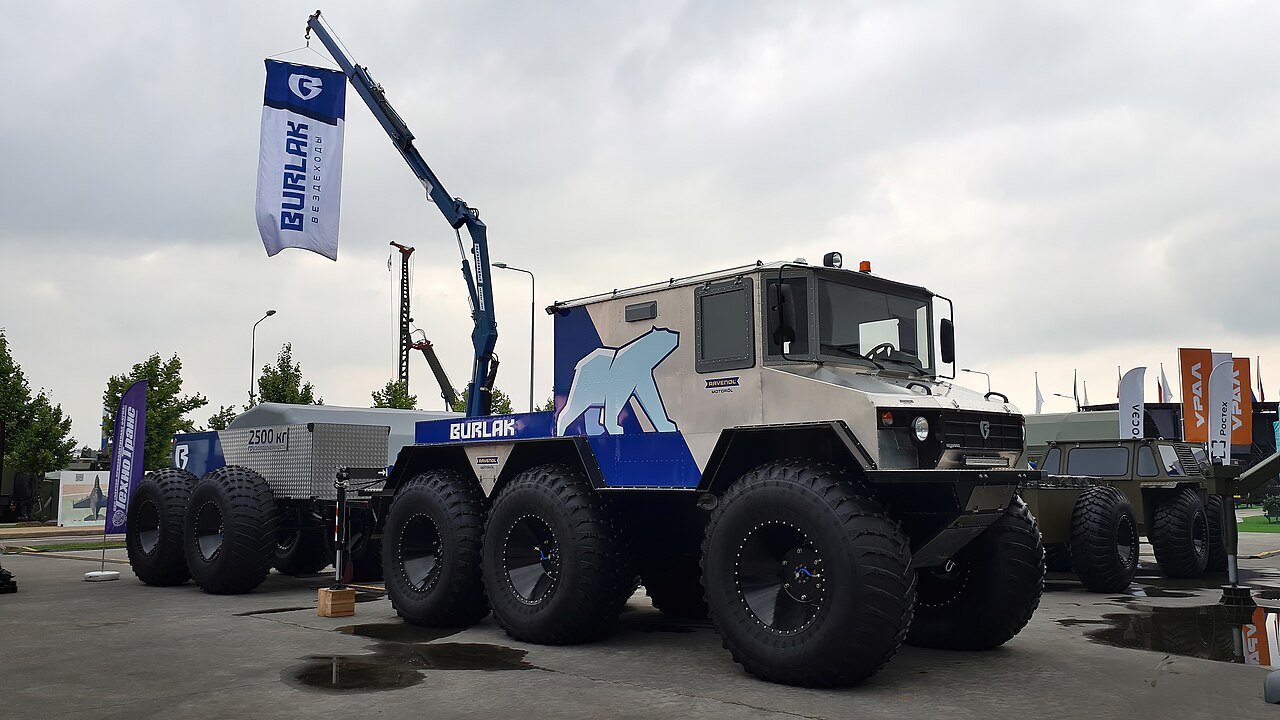
The Burlak has three axles, six driven wheels and a sealed welded hull. The tires are about 1,750 mm (69 in) tall and 750 mm (30 in) wide, run at very low pressure, and give 700 to 750 mm (28 to 30 in) of ground clearance [4]. Russian Wikipedia puts the buoyancy at about 1,200 kg (2,650 lb) per wheel [1]. The 2016 prototype was described as following the concept of the Soviet BTR-60 armored carrier [5].
A Cummins 2.8-liter diesel of 150 hp (112 kW) drives through a five-speed manual gearbox [4]. A 2024 magazine test found that the driver's seat and the gearbox come from a GAZelle Next van, and that the first half turn of the steering wheel does almost nothing because the tires slip [2]. Russian Wikipedia gives payload as 3,000 kg (6,600 lb) on hard ground and 1,500 kg (3,300 lb) on soft ground [1]. In 2020 the maker listed a range of up to 2,500 km (1,550 mi) on its own tanks [4].
In the water the Burlak is slow. The maker's 2020 figures are 3 km/h (1.9 mph) by turning the wheels and 6 km/h (3.7 mph) with an automatic propeller system [4]. The expedition version carries up to 15 people, with eight bunks, a kitchen and a 20-liter (5.3 US gal) snow melter [4]. Other versions include 6x6 cargo, industrial, crane, medical and fire-fighting models, and an 8x8 prototype was shown at the Army-2023 exhibition [1].
Use and expeditions
TASS reported in 2023 that the Burlak covered about 1,350 km (840 mi) from Progress station to Vostok-1 station in Antarctica in 2.5 days, and the article calls it a speed record [3]. Russian Wikipedia says three Burlaks drove more than 6,000 km (3,700 mi) from Novy Urengoy to Anadyr in 2019 [1]. The same page says the Emergencies Ministry received 14 vehicles and 7 trailers in 2023, spread across seven northern regions [1].
The maker lists scientific expeditions, construction, geological exploration, freight, tourism and rescue among its uses, and says vehicles work in the Arctic, the Far North, Kazakhstan and Antarctica [6]. TASS reports about 80 percent local content, with the engine the main part not made in house [3].
Related entries
Sources
- Бурлак (вездеход), Russian Wikipedia. ru.wikipedia.org/wiki/%D0%91%D1%83%D1%80%D0%BB%D0%B0%D0%BA_%28%D0%B2%D0%B5%D0%B7%D0%B4%D0%B5%D1%85%D0%BE%D0%B4%29
- Вездеход Бурлак: тест за рулём, Za Rulem (2024-11-06). www.zr.ru/content/articles/961906-vezdehod-burlak-test-za-rulem
- Burlak all-terrain vehicle maker interview, TASS. tass.com/economy/1869525
- Бурлаки в камуфляже и полной боевой готовности, Za Rulem (2020-08-25). www.zr.ru/content/news/924799-burlaki-v-kamuflyazhe-i-poln
- Российский вездеход-амфибия «Бурлак» проверен Арктикой, TechInsider (2022-11-01). www.techinsider.ru/technologies/237521-rossiyskiy-vezdekhod-amfibiya-burlak-proveren-arktikoy
- About, Burlak Offroad (maker). burlakoffroad.com/en/about
Last reviewed November 2026. Spotted something to correct or add? Tell us and include a source.
See how to register a low-speed vehicle or boat in your state.
About the Amphibious Encyclopedia
WaterCar has designed and built amphibious vehicles in Southern California for more than 25 years. We keep this encyclopedia so anyone curious about vehicles that cross between land and water has one place to start, with the sources listed for every fact. New to the subject? Start with our guide, What is an amphibious vehicle?
All amphibious vehicles → · The WaterCar machines → · How a WaterCar works →