
Origins
The Office of Naval Research began working with Navatek, a Honolulu naval architecture and hydrodynamics firm, on a new kind of heavy amphibious connector in 2008 [5][6]. The aim was a vehicle that could move very heavy loads from ships to shore while pressing so lightly on the ground that it could cross soft mud where a person would sink [6]. In 2014 ONR program officer Frank Leban said the effort had produced a one-fifth-scale model, then a one-quarter-scale model and then a half-scale vehicle, each adding features on the way to a full-size design [1].
The same captured-air track idea appeared in the Captive Air Amphibious Transporter (CAAT), a one-fifth-scale demonstrator of about four tons that the Defense Advanced Research Projects Agency (DARPA) showed in 2012 as a way to bring shipping containers ashore after disasters [8]. ONR helped fund it because of its potential as transport for the Navy and Marine Corps, and Wikipedia lists Navatek as its designer [8][9]. In the year before the 2014 trials, the Marine Corps Warfighting Laboratory joined the UHAC effort to work out how the vehicle could be used in real operations [1].
RIMPAC 2014 demonstration
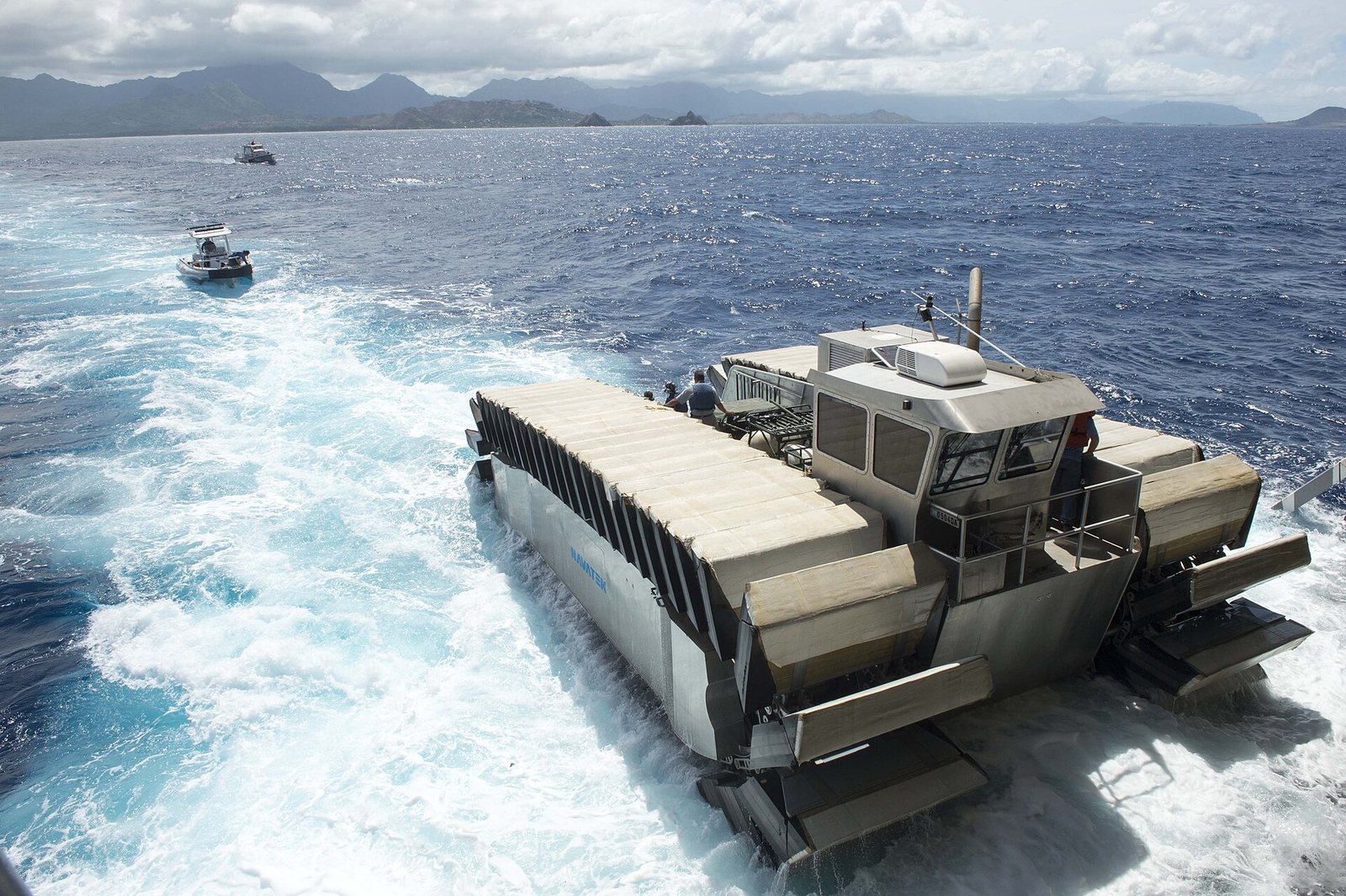
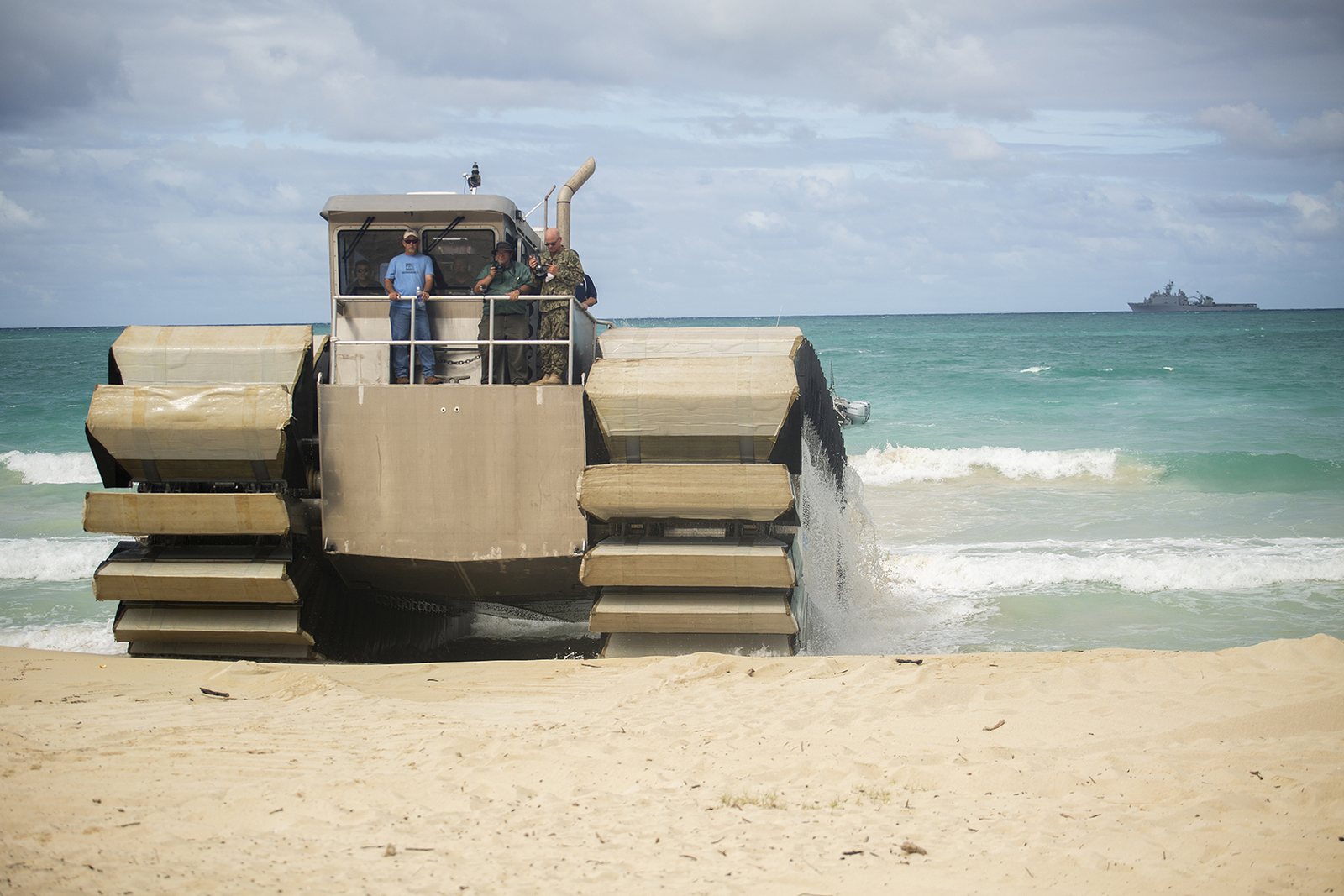
The half-scale UHAC was featured in an Advanced Warfighting Experiment that the Warfighting Laboratory held during RIMPAC 2014, the large multinational naval exercise around Hawaii [1][3]. On 9 July it drove over sand dunes and rough ground at Marine Corps Training Area Bellows on Oahu [3]. On 11 July it left the beach, paddled about 2 miles (3 km) out to the dock landing ship USS Rushmore (LSD 47), entered the ship's well deck, took on an Internally Transportable Vehicle and carried it back to shore [1][2][3].
A project officer at the laboratory said sea conditions were better than expected and the craft still made it into the well deck [1]. The commander of Amphibious Squadron 3, Capt. Clint Carroll, said the data collected in the well deck would feed follow-on studies and design improvements [1].
Design and how it works
Each of the UHAC's two tracks carried dozens of durable foam blocks containing captured air cells [1][4]. Afloat, the blocks gave buoyancy and pushed against the water like paddles; ashore, they flattened out under the vehicle and spread its weight [4][5]. Stars and Stripes reported that the prototype crossed a tar road without leaving a mark [4]. The half-scale vehicle weighed 38 tons and had a ground pressure of about 1 psi, roughly a tenth of a combat-loaded AAV7's 9.7 psi [3][4]. Wikipedia describes its hull as aluminum with a small pilothouse at the bow [9].
The prototype was slow in the water: about 4 knots (7.4 km/h) according to a Marine Corps photo caption, or about 5 mph (8 km/h) according to the laboratory's commander, Kevin Killea [3][4]. Its size was given as 42 ft (13 m) long, 26 ft (8 m) wide and 17 ft (5 m) high, and other reports put its height at just under or about 18 ft (5.5 m) [3][4][5].
Planned full-size vehicle
A full-size UHAC was meant to carry about three times as much as the Landing Craft Air Cushion (LCAC), up to three main battle tanks, at up to 20 knots (23 mph, 37 km/h), with a range of 200 miles (320 km) [1][3]. Once ashore it was to keep driving inland, over obstacles such as 10 ft (3 m) sea walls and through marsh or mud [1][3]. New Atlas put the payload at up to 190 tons, and Popular Science reported about 2,500 sq ft (230 square meters) of deck space and a possible mix of diesel engines and gas turbines making 12,000 hp [5][6].
Killea expected the full-size vehicle to reach about 25 mph (40 km/h), about half the speed of the LCAC, and said it would have a lower profile without the prototype's raised cab [4]. Operational versions were expected to be armed and armored and to work alongside the LCAC as a complement to it [3]. Planners also pointed to disaster relief, such as carrying heavy supplies to typhoon-damaged coasts [4][6].
What became of the program
After RIMPAC 2014 no decision on building a full-scale UHAC was announced [5][6]. In 2024 Naval News reported that the vehicle had not been tested publicly since 2014 [7]. A former Navatek contact told the outlet that the Navy and Marine Corps had no further use for the half-scale prototype when the program ended and that it was eventually scrapped, while a small-scale vehicle still existed and had served as a stand-in amphibian in other ONR programs [7]. Naval News also reported that Navatek stopped operating around 2020 and continued as a different company under another name [7].
The Marine Corps did not answer Naval News' questions about the program, pointing instead to its Force Design plans for light, mobile forces, and ONR did not respond [7]. Mark Cancian of the Center for Strategic and International Studies, a retired Marine colonel, told Naval News he saw no chance of a revival and that the Marines appeared to have chosen, with the Navy, to keep the LCAC in service longer [7].
Photos
Related entries
Sources
- The Marine Corps Warfighting Lab showcases the UHAC during RIMPAC 2014 (Mass Communication Specialist 2nd Class Amanda R. Gray, USS Rushmore Public Affairs), DVIDS (2014-07-12). www.dvidshub.net/news/135941/marine-corps-warfighting-lab-showcases-uhac-during-rimpac-2014
- Huge paddle boat makes ship-to-shore connection [Image 8 of 8] (Cpl. Matthew J. Bragg, US Marine Corps), DVIDS (2014-07-11). www.dvidshub.net/image/1445595/huge-paddle-boat-makes-ship-shore-connection
- Ultra Heavy-lift Amphibious Connector (UHAC) at RIMPAC (Chuck Oldham), Defense Media Network (2014-07-15). www.defensemedianetwork.com/stories/ultra-heavy-lift-amphibious-connector-uhac-at-rimpac
- UHAC: Marines' amphibious craft propels, paddles in prototype trial (Wyatt Olson), Stars and Stripes (2014-07-13). www.stripes.com/theaters/asia_pacific/uhac-marines-amphibious-craft-propels-paddles-in-prototype-trial-1.293168
- US Marines demonstrate Ultra Heavy-lift Amphibious Connector prototype (Colin Jeffrey), New Atlas (Gizmag) (2014-07-16). newatlas.com/half-scale-uhac-concept-demonstration/32966
- How It Works: An Amphibious Vehicle That Can Carry Three Tanks (Jeremy Hsu), Popular Science (2014-11-10). www.popsci.com/article/technology/how-it-works-amphibious-vehicle-can-carry-three-tanks
- What Happened to the U.S. Marine Corps' Ultra Heavy-Lift Amphibious Connector (UHAC)? (Peter Ong), Naval News (2024-10-16). www.navalnews.com/naval-news/2024/10/what-happened-to-the-u-s-marine-corps-ultra-heavy-lift-amphibious-connector-uhac
- DARPA's new amphibious tank walks on water to deliver disaster relief, Army Technology (2012-08-22). www.army-technology.com/features/featurecaptive-air-amphibious-transport-darpa-landing-vehicle
- DARPA Captive Air Amphibious Transporter, Wikipedia. en.wikipedia.org/wiki/DARPA_Captive_Air_Amphibious_Transporter
Last reviewed November 2026. Spotted something to correct or add? Tell us and include a source.
About the Amphibious Encyclopedia
WaterCar has designed and built amphibious vehicles in Southern California for more than 25 years. We keep this encyclopedia so anyone curious about vehicles that cross between land and water has one place to start, with the sources listed for every fact.
Browse all entries → · The WaterCar machines → · How a WaterCar works →