
Military uncrewed amphibians
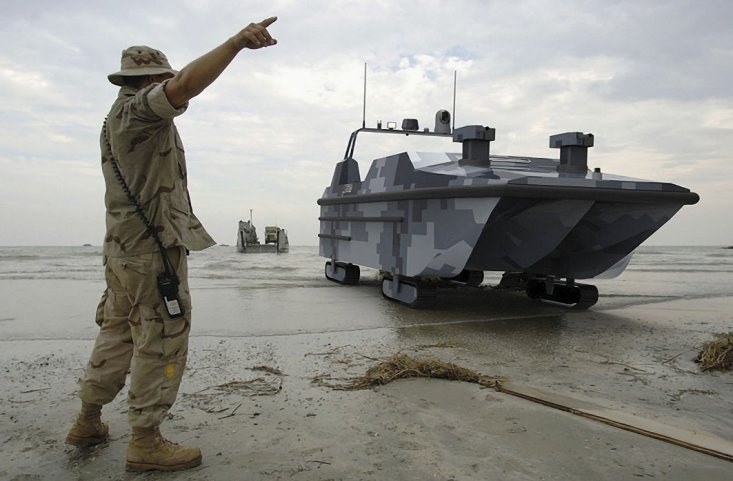
China's Marine Lizard is an uncrewed aluminum trimaran about 12 to 13.5 m (39 to 44 ft) long and 4.14 m (13.6 ft) wide, built by the Wuchang Shipbuilding arm of the state-owned China Shipbuilding Industry Corporation (CSIC) in Wuhan [1][2]. It was shown at Airshow China in Zhuhai in November 2018, and in April 2019 the prototype passed factory acceptance tests after trials on the Yangtze River [2]. Two diesel generators power water jets at the stern and four retractable crawler track units under the hull, which let it climb out of the water onto a beach [1][2]. Maritime Executive reported claimed top speeds of 50 knots (58 mph, 93 km/h) on water and about 12 mph (19 km/h) on land; Janes gave no speeds [1][2]. According to the state-owned Global Times, as reported by Maritime Executive, it is armed with two machine guns and launchers for anti-aircraft and anti-ship missiles, and the Hubei Daily said it could sit on an empty island for months before being activated by remote command [1]. Maritime Executive described it as meant to go ahead of troops in beach assaults [1]. Citing Janes, Maritime Executive reported that only the hull had been completed, and Janes said an industry partner, Qingdao Wujiang Technology, would carry out systems integration [1][2].
A second Chinese design, shown by China South Industries Group (CSGC) at the 2022 Zhuhai Airshow, has a boat-shaped hull on four triangular rubber track units that fold up out of the way to cut drag in the water [3]. In the water it appears to rely mainly on a water jet, and the display model carried a small turret with two apparent anti-tank missiles [3]. The War Zone reported that speed and range figures were not available [3].
In the United States, the Louisiana boat builder Metal Shark introduced the Prowler at the Sea-Air-Space exhibition in April 2024 [4]. It is a 30 ft (9.1 m) aluminum planing boat with a 300 hp Volvo Penta diesel and sterndrive, for which the maker claims a sprint speed of 35 knots (40 mph, 65 km/h) and a range of 500 nautical miles (575 miles, 926 km) [4]. Hydraulic rams lower front and rear wheels, which have their own drive and steering motors and give it a slow crawl on land, letting it drive itself into and out of the water at a boat ramp or an amphibious ship's well deck [4]. When stopped, it can flood built-in ballast tanks and settle low in the water so that little more than its communications mast stays visible, and Metal Shark says it can loiter for up to a week [4]. Because its rear wheels carry road tires, brakes and lights, it can be towed on the highway without a trailer [4].
Turkey's FNSS unveiled the U-MAV, also called İ-ZAHA, at the TEKNOFEST Mavi Vatan event in August 2026 [5]. It is a four-wheeled uncrewed vehicle of about 8 tonnes (8.8 short tons), designed to work alongside the crewed ZAHA and take crews out of the first and most dangerous wave of a beach landing [5]. FNSS gives it a water speed of 7 knots (8 mph, 13 km/h) and a land speed of 70 km/h (43 mph), and its mission kits for fire support, mine clearance, electronic warfare and drone defense can be swapped in the field in about 40 minutes [5].
Robots that crawl, walk and swim
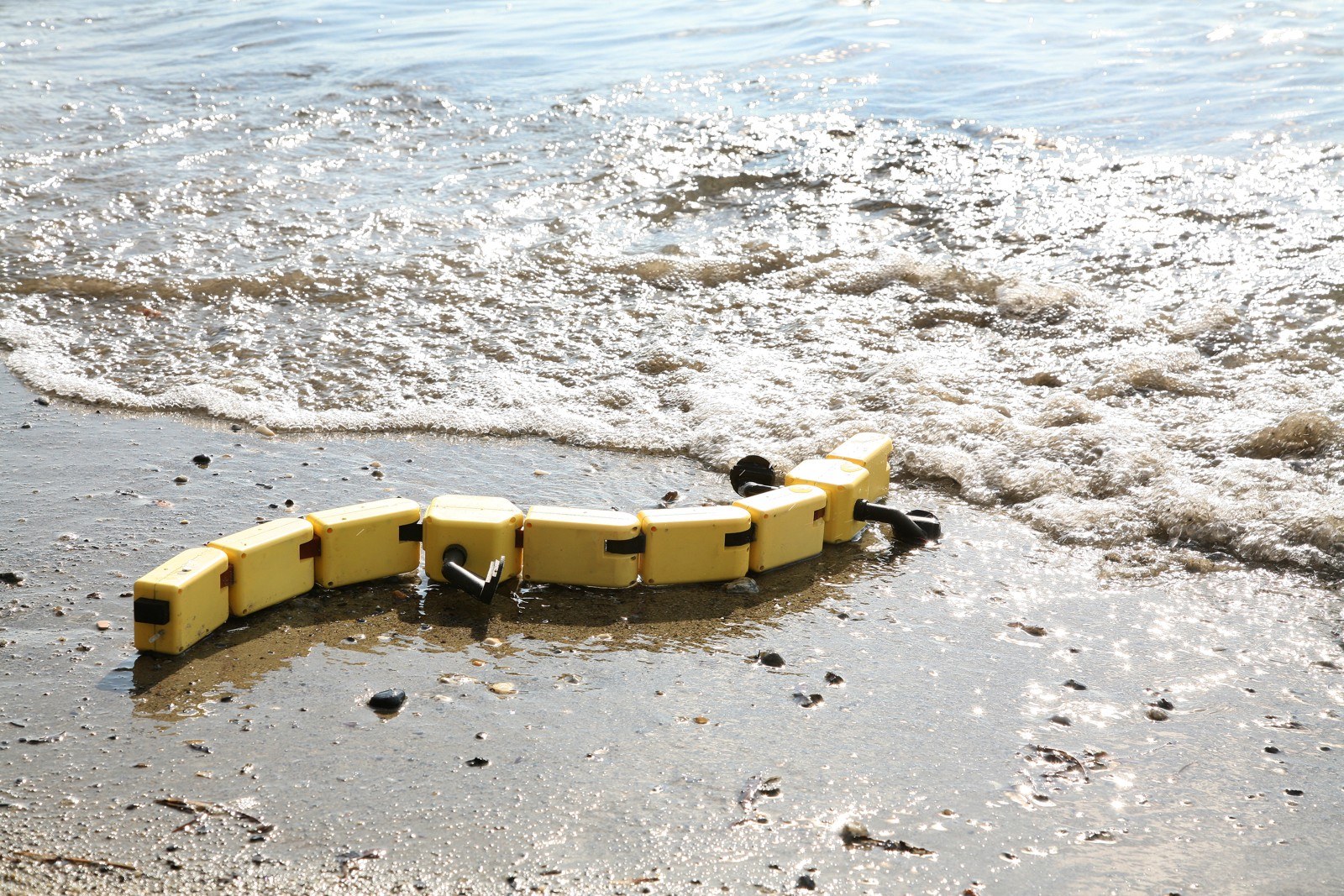
University laboratories build amphibious robots mainly to learn how bodies and nervous systems produce movement. At the Biorobotics Laboratory of EPFL in Lausanne, Switzerland, Auke Ijspeert's group built AmphiBot, a robot modeled on snakes and lampreys that can both crawl and swim; the earliest paper on it in the laboratory's list dates from March 2004 [6]. Its rhythm comes from a central pattern generator, a controller modeled on the nerve networks that drive swimming and walking [6][7]. The laboratory says its third version, AmphiBot III, swims about as fast as a person, and it filmed a friendly race between the robot and a human swimmer [6].
The group then added legs. Salamandra robotica, reported in the journal Science on March 9, 2007, could swim, crawl like a snake and walk [7]. Simple drive signals sent wirelessly from a laptop control how it moves, an idea taken from salamanders, which switch between swimming and walking as the level of stimulation from the brainstem changes [7]. Its successor, Salamandra robotica II, has folding legs and is made of modules, each with its own microcontroller, battery and motors, so that, the laboratory says, it could lose parts of its body and still walk [7]. Pleurobot, published in 2016, was designed from 3D X-ray videos of a salamander species, Pleurodeles waltl, following as many as 64 points on the animal's skeleton; it has 27 degrees of freedom and a waterproof skin for swimming [8].
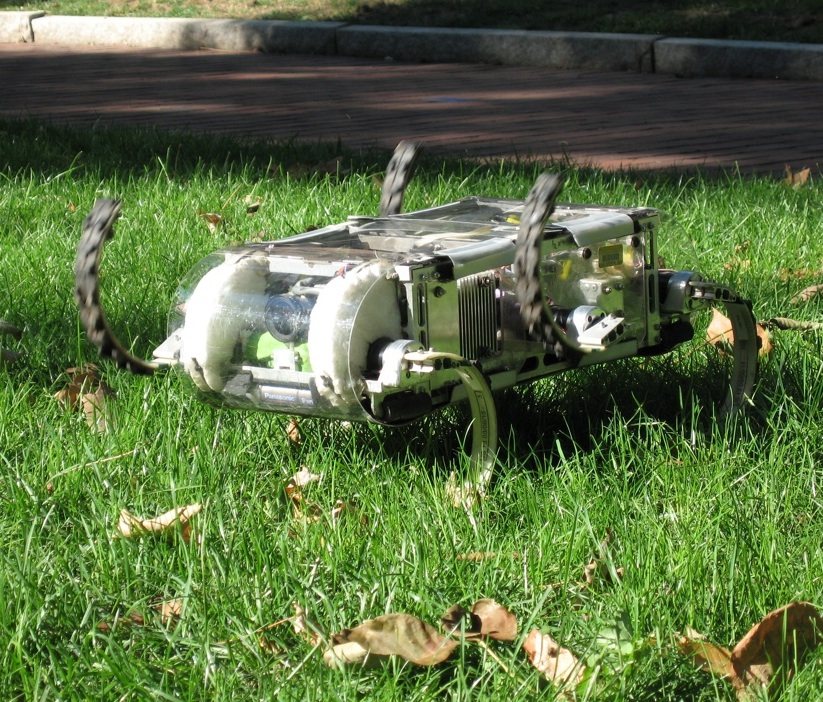
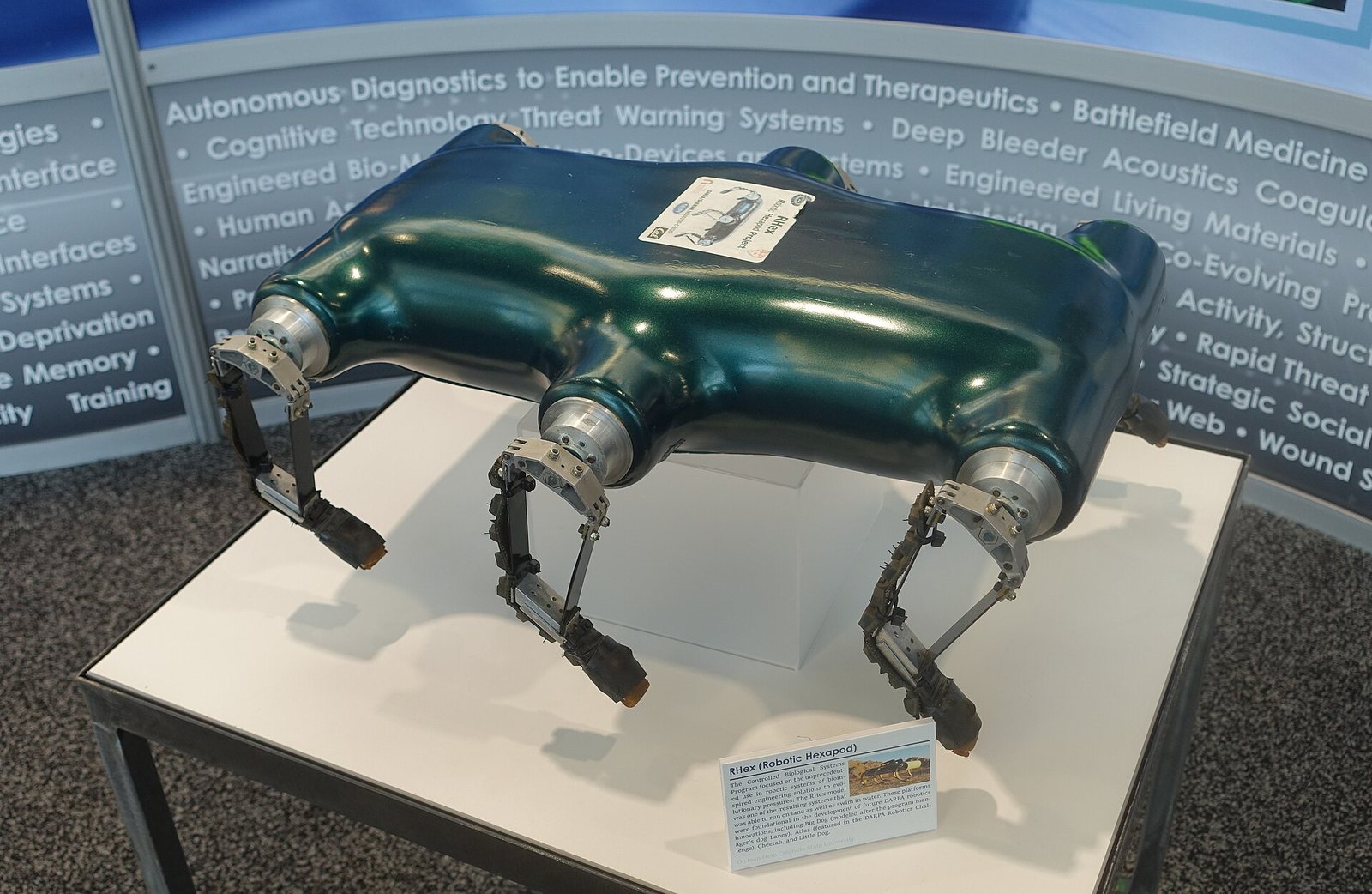
RHex, a six-legged robot whose flexible legs are each driven by a single motor, came out of a DARPA-funded program begun in 1998 at several universities, among them McGill and the University of Michigan [9][10]. Wikipedia reports that versions of RHex could swim as well as climb stairs and steep slopes, and the RHex that Boston Dynamics lists under 2007 was a 30 lb (14 kg) robot for rough terrain [9][14]. At McGill, working with York and Dalhousie universities, RHex became the basis for AQUA, which uses six flippers as paddles and control surfaces in the water and as legs on land [10][11]. It is built to cross a beach on foot, swim in open water at the surface and crawl over the bottom [10]. Published figures for the roughly 65 cm (26 in) robot vary: its team reported swimming at 0.4 m/s (0.9 mph) at depths of up to 14 m (46 ft) in Barbados trials in 2006, while a 2007 paper gave speeds of up to 1.0 m/s (2.2 mph) and diving to 30 m (98 ft) [10][11].
Drones that fly, float and dive
Some flying drones are built to come down on water as well as land. Oakland University in Rochester, Michigan, developed the Loon Copter, a quadcopter whose first prototype was tested in 2014 [13]. After landing it floats; filling an internal ballast chamber with water makes it sink and turn about 90 degrees, so the same propellers then push it through the water [12][13]. Emptying the chamber brings it back to the surface to take off again [12]. Its developers reported about 10.5 minutes of flight outdoors, about 22 minutes underwater at 0.5 m/s (1.1 mph), and the ability to hang in the water for about 11 hours on its ballast alone [13]. The 2016 version weighed 2.7 kg (6 lb) with its payload [13].
New Atlas listed search and rescue, bridge and pipeline inspection and marine life studies among its possible uses, and the team's 2018 paper says the Loon Copter won the 2016 UAE Drones for Good competition in Dubai [12][13]. A related design from Rutgers University, the Naviator, uses eight propellers to push itself under the surface instead of a ballast tank [12][13].
Examples compared
The table lists the machines described above, with the way each one moves in each medium as given by its maker, laboratory or the press [1][4][10].
| Machine | Maker or lab | Year | Moves on land by | Moves in water by | Purpose |
|---|---|---|---|---|---|
| Marine Lizard | Wuchang Shipbuilding (CSIC), China | 2018 [2] | Four retractable crawler track units [1][2] | Water jets [2] | Armed craft to go ahead of troops in beach assaults, per Maritime Executive and Chinese press reports [1] |
| Unnamed amphibious uncrewed ground vehicle | China South Industries Group (CSGC), China | 2022 [3] | Four retractable triangular rubber tracks [3] | Mainly a water jet [3] | Not stated; shown with two apparent anti-tank missiles [3] |
| Prowler | Metal Shark, United States | 2024 [4] | Retractable wheels with drive and steering motors [4] | Diesel engine and sterndrive [4] | Surveillance, loitering and launching smaller drones [4] |
| U-MAV (İ-ZAHA) | FNSS, Turkey | 2026 [5] | Four wheels [5] | Swimming at up to 7 knots (8 mph, 13 km/h); method not stated [5] | First wave of a beach assault: fire support, mine clearance, electronic warfare [5] |
| AmphiBot | EPFL Biorobotics Laboratory, Switzerland | 2004 [6] | Snake-like crawling [6] | Lamprey-like swimming [6] | Research on locomotion control; outdoor tasks [6] |
| Salamandra robotica | EPFL Biorobotics Laboratory, Switzerland | 2007 [7] | Walking on legs or crawling like a snake [7] | Swimming like a salamander [7] | Testing spinal cord models of movement [7] |
| Pleurobot | EPFL Biorobotics Laboratory, Switzerland | 2016 [8] | Walking on segmented legs [8] | Swimming in a waterproof skin [8] | Studying how nervous systems coordinate movement [8] |
| RHex | DARPA-funded university team (Michigan, McGill and others) | 1998 program start [9] | Six flexible legs, one motor each [9][10] | Some versions swam [9] | Mobility on rough terrain [9][14] |
| AQUA | McGill, York and Dalhousie universities, Canada | 2004 [11] | Walking on six legs [10] | Six flippers used as paddles [10][11] | Underwater site inspection, such as coral reefs [10] |
| Loon Copter | Oakland University, United States | 2014 [13] | Not a ground vehicle; it flies [13] | Floats, then dives with a ballast system and its propellers [12][13] | Inspection and search and rescue [12] |
Year is the first showing, first publication or first prototype named by the cited source. Speeds and ranges for the military craft are maker or builder claims.
Photos
Related entries
Sources
- CSIC Develops World's First Armed Amphibious Drone Attack Boat, The Maritime Executive (2019-04-15). maritime-executive.com/article/csic-develops-world-s-first-armed-amphibious-drone-attack-boat
- China's amphibious USV emerges (Kelvin Wong), Janes (2019-04-17). www.janes.com/defence-intelligence-insights/defence-news/chinas-amphibious-usv-emerges
- China's Quad-Tracked Amphibious Unmanned Vehicle Is Fascinating (Joseph Trevithick), The War Zone (2022-11-14). www.twz.com/chinas-quad-tracked-amphibious-unmanned-vehicle-is-fascinating
- Metal Shark Debuts Versatile Prowler Military USV and Frenzy Micro USV (Metal Shark press release), The Maritime Executive (2024-04-05). maritime-executive.com/corporate/metal-shark-debuts-versatile-prowler-military-usv-and-frenzy-micro-usv
- Turkish FNSS unveils unmanned amphibious assault vehicle (Agnes Helou), Breaking Defense (2026-08-24). breakingdefense.com/2026/08/turkish-fnss-unveils-unmanned-amphibious-assault-vehicle
- AmphiBot, EPFL Biorobotics Laboratory. www.epfl.ch/labs/biorob/research/amphibious/amphibot
- Salamandra robotica, EPFL Biorobotics Laboratory. www.epfl.ch/labs/biorob/research/amphibious/salamandra
- Pleurobot, EPFL Biorobotics Laboratory. www.epfl.ch/labs/biorob/research/amphibious/pleurobot
- RHex, Wikipedia. en.wikipedia.org/wiki/Rhex
- AQUA: An Amphibious Autonomous Robot (Dudek, Jenkin, Milios, Buehler and others), IEEE Computer, January 2007, IEEE Computer Society, author copy at Dalhousie University (2007-01). web.cs.dal.ca/~eem/cvWeb/pubs/Aqua-an-amphibious-autonomous-robot-IEEE-Computer-2007-01.pdf
- Gone Swimmin' (Michelle Théberge and Gregory Dudek), IEEE Spectrum (2006-06-01). spectrum.ieee.org/gone-swimmin
- Loon Copter drone flies, floats and dives (Ben Coxworth), New Atlas (2016-01-25). newatlas.com/loon-copter-amphibious-drone/41485
- Loon Copter: Implementation of a hybrid unmanned aquatic-aerial quadcopter with active buoyancy control (Alzu'bi, Mansour and Rawashdeh), Journal of Field Robotics 35:764-778, Journal of Field Robotics (Wiley), copy hosted by nubot-uaav.github.io (2018). nubot-uaav.github.io/static/pdf/multirotor_based_aavs/Journal%20of%20Field%20Robotics%20-%202018%20-%20Alzu'bi%20-%20Loon%20Copter%20%20Implementation%20of%20a%20hybrid%20unmanned%20aquatic%20aerial%20quadcopter%20(1).pdf
- Legacy robots: RHex, Boston Dynamics. bostondynamics.com/legacy
Last reviewed November 2026. Spotted something to correct or add? Tell us and include a source.
About the Amphibious Encyclopedia
WaterCar has designed and built amphibious vehicles in Southern California for more than 25 years. We keep this encyclopedia so anyone curious about vehicles that cross between land and water has one place to start, with the sources listed for every fact.
Browse all entries → · The WaterCar machines → · How a WaterCar works →