
History
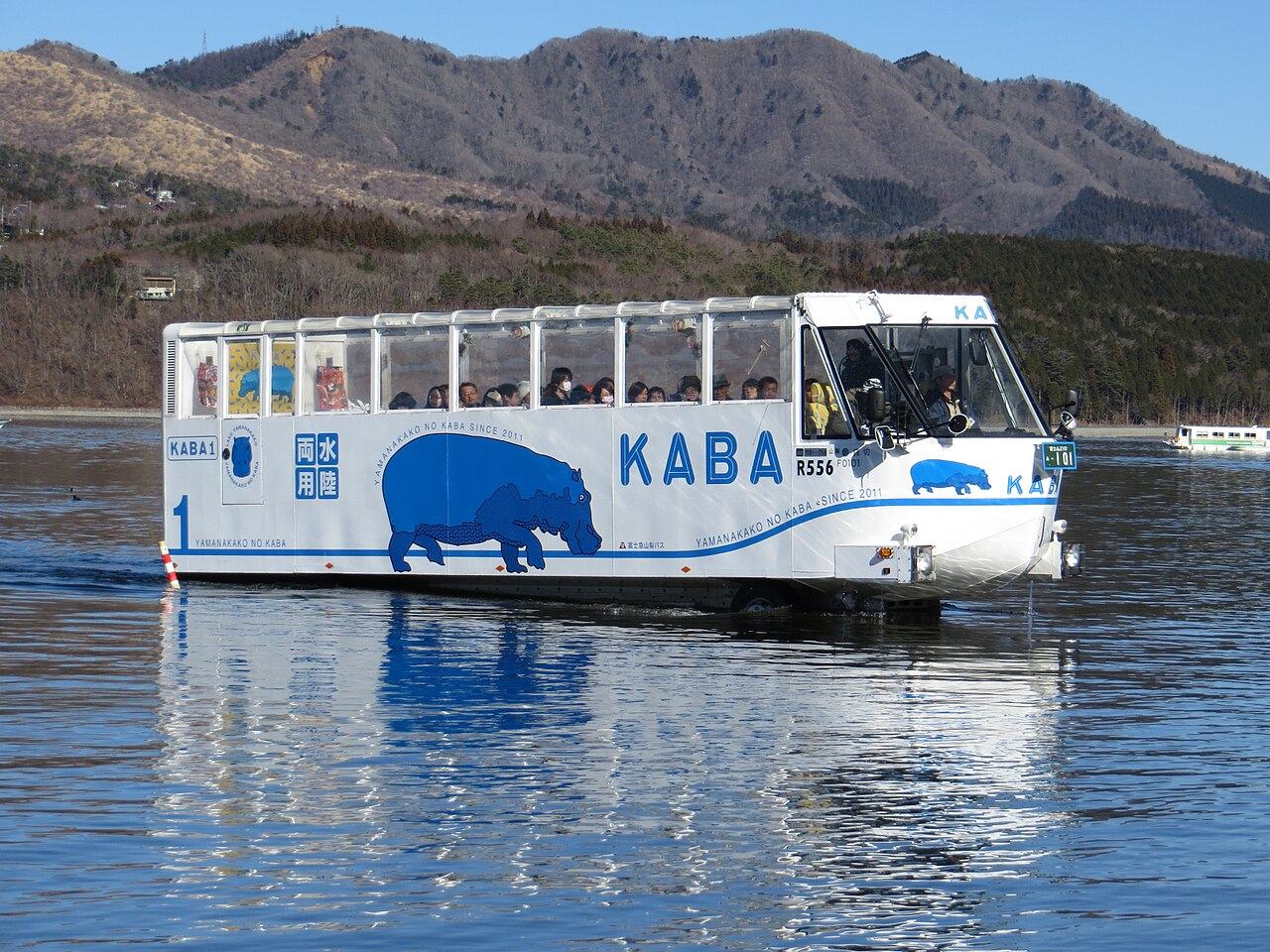
Fujikyu says its Lake Yamanaka service began in April 2011 and was the first amphibious bus in Yamanashi Prefecture, which is the operator's own description [1]. The lake sits on a plateau about 1,000 m (3,300 ft) above sea level near Mt. Fuji, and the buses leave from the Yamanaka Asahigaoka bus terminal [1].
A case study from Tokyu Techno System describes an amphibious bus remodeled for the Fujikyu group in 2010 and 2011. The work began in September 2010, and the bus was registered on 22 February 2011 [3]. The study says the vehicle was fitted out as an amphibious bus in the United States on a Hino truck body, then imported, and had to meet Japanese car registration rules and ship inspection at once [3]. Changes included lowering the center of gravity to meet a 30-degree tilt requirement, five cooling fans, a driver monitor camera and acrylic window panels [3]. A report on the second bus describes the first as having a foreign-made hull [2].
KABA2 began service on 26 April 2013 with 40 seats, six more than KABA1, and was made entirely in Japan [2]. Response.jp reported that more than 90,000 passengers had ridden since April 2011 [2]. KABA3 and KABA4 run in Odaiba, Tokyo, as TOKYO NO KABA [1]. In June 2026 the group added KABA5, and KABA6 began service on 18 July 2026, the first two with electric roofs that open [1].
Design and how it works
Fujikyu says the design is by the industrial designer Eiji Mitooka, based on the hippopotamus, an animal that lives on both land and water [1]. The buses have wheels for the road and screw propellers for the lake [1]. For a 2026 ride, the bus drives down to the water and enters the lake with a large splash, then cruises for about 30 minutes in all, including video shown on board [1]. In 2013 Response.jp described about 10 minutes on land and 20 on the lake [2].
The newest buses are not identical. KABA5 is 11.95 m (39 ft 2 in) long and 2.45 m (8 ft 0 in) wide, weighs 12,325 kg (27,171 lb) and has a cruising speed of 6.1 knots (7.0 mph) [1]. KABA6 is 11.99 m (39 ft 4 in) long and 2.48 m (8 ft 2 in) wide, weighs 13,910 kg (30,667 lb) and cruises at 5.8 knots (6.7 mph) [1]. Both seat 40 and have interior monitors and audio guides in five languages [1].
Legacy
KABA1 and KABA2 were still in service in 2026, and Fujikyu says they also appear at events and exhibitions [1]. The KABA name now covers buses in two places, at the lake resort and, as TOKYO NO KABA, in Odaiba, Tokyo [1].
Related entries
Sources
- Press release: new Open KABA (KABA6) debuts 18 July, Fuji Kyuko / Fujikyu Bus (2026-07-17). www.fujikyu.co.jp/data/news_pdf/pdf_file1_1785725926.pdf
- Yamanakako no Kaba 2 begins service, Response.jp (2013-04-26). response.jp/article/2013/04/26/196906.html
- Fujikyu amphibious bus remodeling case study, Tokyu Techno System (2010-12). www.tokyu-techno.co.jp/casestudy/bus_remodeling/201012
- KABA BUS official site, Fujikyu. www.kaba-bus.com
Last reviewed November 2026. Spotted something to correct or add? Tell us and include a source.
See how to register a low-speed vehicle or boat in your state.
About the Amphibious Encyclopedia
WaterCar has designed and built amphibious vehicles in Southern California for more than 25 years. We keep this encyclopedia so anyone curious about vehicles that cross between land and water has one place to start, with the sources listed for every fact. New to the subject? Start with our guide, What is an amphibious vehicle?
All amphibious vehicles → · The WaterCar machines → · How a WaterCar works →