
History
A Japan Bus Association article says the company's president saw amphibious bus tours in Boston and was inspired to start the project, and that Koto Ward planned a river station in 2011 as a launch point, with Hinomaru chosen as operator [2]. The article describes a plan to begin operation in spring 2013 [2]. The operator says Sky Duck Tokyo began in March 2013, leaving from near Tokyo Skytree Station in Sumida Ward and entering the water on the Old Nakagawa canal in Koto Ward [1]. Japanese Wikipedia gives a start date of 17 March 2013 [4].
SoraNews24 reported in May 2013 that the tour was fully booked from its first day, with a Tokyo Sky Tree course and a Kameido course, and an on-board guide describing landmarks [3]. Sky Duck Yokohama began in October 2016 as a trial sponsored by the city, covering the harbor and Minato Mirai, and the operator calls it the first amphibious bus service to run at night [1]. Sky Duck Odaiba began in September 2017 and runs around the Tokyo Bay waterfront, including Toyosu and under the Rainbow Bridge [1]. No opened source gives the number of vehicles in the fleet.
Design and how it works
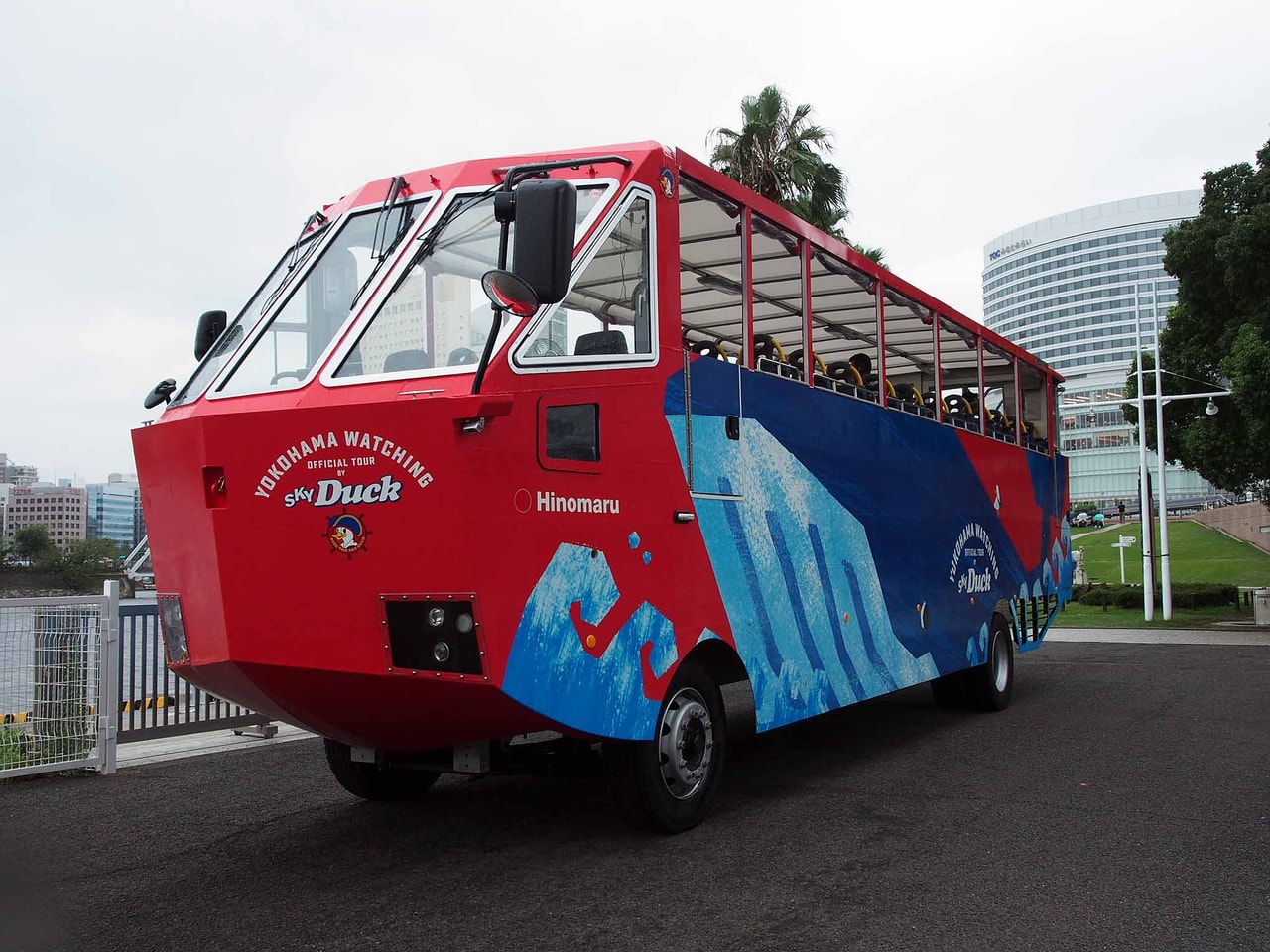
The operator says the first-generation Sky Duck was made by CAMI in the United States and imported, then passed inspections to meet Japanese vehicle registration rules [1]. The Japan Bus Association article lists two registered vehicles, SKYDuck-1 and SKYDuck-2 [2]. Each is 11.99 m (39 ft 4 in) long, 2.49 m (8 ft 2 in) wide and 3.71 m (12 ft 2 in) tall, with a draft of about 1.3 m (4 ft 3 in) [2]. A Hino J07E diesel drives it on land, and a separate Isuzu marine engine drives it on the water [2]. The article gives a maximum land speed of 100 km/h (62 mph) and a water speed of 7 knots (13 km/h) [2]. The operator gives 6.3 knots (11.7 km/h) afloat for both generations [1].
The operator attributes the second generation to Sumidagawa Shipbuilding working with a domestic shipbuilder, and says it rocks less and carries 46 passengers instead of 41 [1]. It is 11.98 m (39 ft 4 in) long and has a gross weight of 13,140 kg (29,000 lb) [1]. Japanese Wikipedia says the Sky Duck vehicles were newly built in the United States and links Sumidagawa Shipbuilding to a separate domestic bus on a Japanese truck chassis used in Yokohama, so accounts of who built which vehicle differ [4].
Legacy
By 2017 Sky Duck ran in three areas of the Tokyo region: the Sumida and Koto ward waterways, Yokohama Port and the Odaiba bay waterfront [1]. The operator says the second generation was built to improve capacity, maintenance and safety [1].
Related entries
Sources
- Sky Duck amphibious bus, Hinomaru Jidosha Kogyo. www.hinomaru-bus.co.jp/business/amphibious-bus
- Sky Duck article, magazine issue 05, Japan Bus Association. www.bus.or.jp/magazine/05
- Take a ride on Japan's new amphibious bus and see the sites of Tokyo, SoraNews24 (2013-05-21). soranews24.com/2013/05/21/take-a-ride-on-japans-new-amphibious-bus-and-see-the-sites-of-tokyo/amp
- Amphibious bus (水陸両用バス), Japanese Wikipedia. ja.wikipedia.org/wiki/%E6%B0%B4%E9%99%B8%E4%B8%A1%E7%94%A8%E3%83%90%E3%82%B9
Last reviewed November 2026. Spotted something to correct or add? Tell us and include a source.
See how to register a low-speed vehicle or boat in your state.
About the Amphibious Encyclopedia
WaterCar has designed and built amphibious vehicles in Southern California for more than 25 years. We keep this encyclopedia so anyone curious about vehicles that cross between land and water has one place to start, with the sources listed for every fact. New to the subject? Start with our guide, What is an amphibious vehicle?
All amphibious vehicles → · The WaterCar machines → · How a WaterCar works →