
History
The Marine Accident Investigation Branch (MAIB), the UK body that investigates marine accidents, reports that the London Frog Company started amphibious sightseeing tours on the Thames in 2000, the first of their kind in the UK [1]. That company ceased trading and went into liquidation in November 2001. In May 2002 Capital Frogs Ltd, which had taken over its assets, restarted the service, and in 2004 it took the trading name London Duck Tours [1].
Between 2006 and 2012 the fleet of converted DUKWs grew from 5 to 9 [1]. Wikipedia gives a later figure of 13 vessels before 2017, so the larger number may come from after the MAIB count [3]. At the time of the 2013 accident the company employed 74 people, including drivers, river masters and guides [1]. Its managing director said in 2017 that 1.8 million passengers had traveled on a London Duck Tour [2].
The Thames tours ended on 18 September 2017. Thames Water and Thames Tideway used statutory rights to acquire the company's lease from the Duchy of Cornwall for the Lacks Dock slipway, next to the MI6 building on Albert Embankment, which was a work site for the Thames Tideway sewer project [2].
The tour and the vehicles
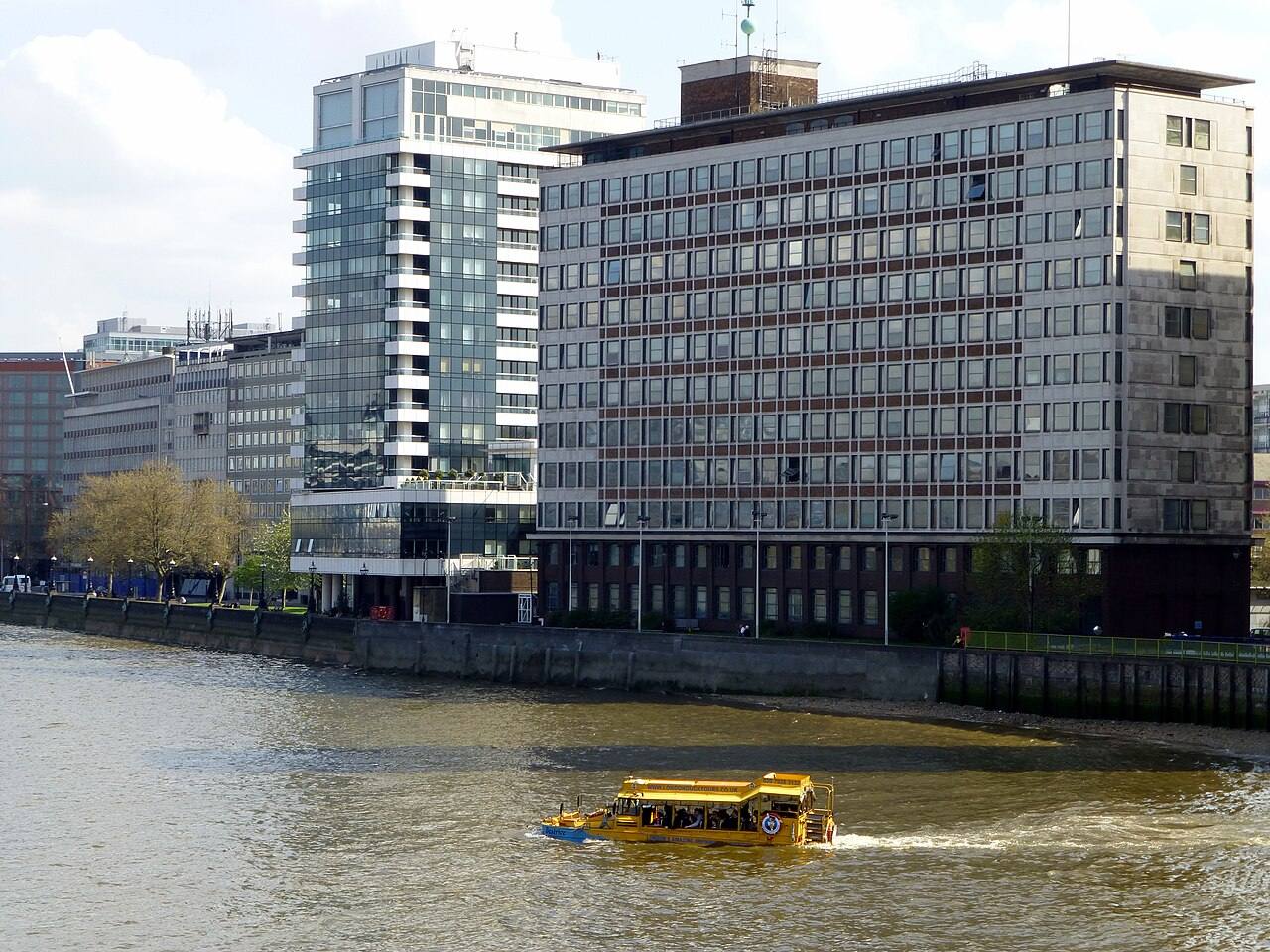
Passengers boarded on Chicheley Street, near the London Eye, and the vehicles drove through Westminster. At Lacks Dock in Vauxhall the road driver handed the vehicle to a river master, and the vehicle drove down the slipway into the Thames and cruised as far as Westminster Bridge [1]. The tour lasted about 1 hour, with about 25 minutes on the river, and the fleet was maintained at a garage in Battersea [1].
The vehicles were 1945 DUKWs converted for passengers. One of them, Cleopatra, was converted in 1999 and had an 88 kW (118 hp) Iveco diesel engine, an automatic gearbox and a single propeller [1]. The UK Maritime and Coastguard Agency certified the London vehicles as Class V passenger vessels for daylight operation on Category C waters, meaning waves not expected to exceed 1.2 m (about 4 ft) [1]. Each vehicle was crewed by two people at all times [1].
The 2013 Cleopatra fire
After a Liverpool DUKW sank in June 2013, Maritime and Coastguard Agency surveyors checked the London vehicles on 20 June 2013. They found about 5.5 to 6 cubic meters (about 195 to 210 cubic feet) of buoyancy foam in the vehicles they sampled. The operator stopped waterborne operations, and the foam was later raised to 10.6 cubic meters (about 374 cubic feet) per vehicle [1].
At about 11:50 on 29 September 2013, Cleopatra caught fire on the Thames near the Houses of Parliament with 28 passengers and 2 crew aboard [1]. The master drove the vehicle aground at Victoria Tower Gardens. Passengers left by the rear and through windows, and some jumped into the water [1]. Three inflatable boats from a tour company recovered all 30 people, a London Fire Brigade fireboat arrived at 11:59, and the fire was out by 12:01 [1]. Three passengers were taken to hospital for checks and discharged the same day [1].
The MAIB concluded that unsecured buoyancy foam packed tightly around the engine compartment and drive shafts introduced the circumstances that led to the fire, and that the most likely source of ignition was grease-contaminated foam touching an overheating universal joint [1]. London Duck Tours later modified its vehicles to meet the survivability standard another way and was allowed to resume waterborne operations [1].
Related entries
Sources
- Sinking and abandonment of DUKW amphibious passenger vehicle Wacker Quacker 1 in Salthouse Dock, Liverpool and fire and abandonment of DUKW amphibious passenger vehicle Cleopatra on the River Thames (Report 32/2014), Marine Accident Investigation Branch (GOV.UK) (2014-12). assets.publishing.service.gov.uk/media/54c1722240f0b6158d00002b/MAIBReport_32-2014.pdf
- London Duck Tours to vanish from Thames after losing slipway access, London SE1 community website (2017-08-22). www.london-se1.co.uk/news/view/9366
- Duck tour, Wikipedia. en.wikipedia.org/wiki/Duck_tour
Last reviewed November 2026. Spotted something to correct or add? Tell us and include a source.
See how to register a low-speed vehicle or boat in your state.
About the Amphibious Encyclopedia
WaterCar has designed and built amphibious vehicles in Southern California for more than 25 years. We keep this encyclopedia so anyone curious about vehicles that cross between land and water has one place to start, with the sources listed for every fact. New to the subject? Start with our guide, What is an amphibious vehicle?
All amphibious vehicles → · The WaterCar machines → · How a WaterCar works →