
History
VAZ started the Reka as a military cousin of the Niva, the 4x4 it began building in 1977 [2]. Sources disagree on when work began: first sketches in 1971 and prototypes ready in 1976 per Kolesa, 1974 per Techinsider, and 1976 per English Wikipedia [2][3][4]. The Defense Ministry's code name was Reka (River), while VAZ's paperwork described a car for fishermen and hunters [3]. Yakov Nepomnyashchy, a deputy chief designer, supervised the project, and Valery Domansky served as lead designer for about 15 years [2].
Early prototypes had trouble. They leaked, the sealed body overheated, and the transmission was overloaded by oversized tires and gearing [2]. VAZ fixed these by fully sealing the body, adding a larger radiator and fan, moving the front differential outside the sealed body, fitting standard Niva tires and lowering the final drive ratio from 4.78 to 4.44 [2]. A 1.6-liter engine overheated in the sealed body and was replaced by a 1.3-liter one [2][3].
The car completed state trials in 1983 and met all requirements, according to Kolesa [2]. Techinsider says state commissions recommended production again in 1985 and 1986 [3]. In 1985 five vehicles went to army units in central Russia, Transbaikalia and Central Asia [2]. Other tests ran on lakes near Tolyatti, in the Pamirs, in snow at Ukhta and in Turkmen deserts [2].
Design and how it works
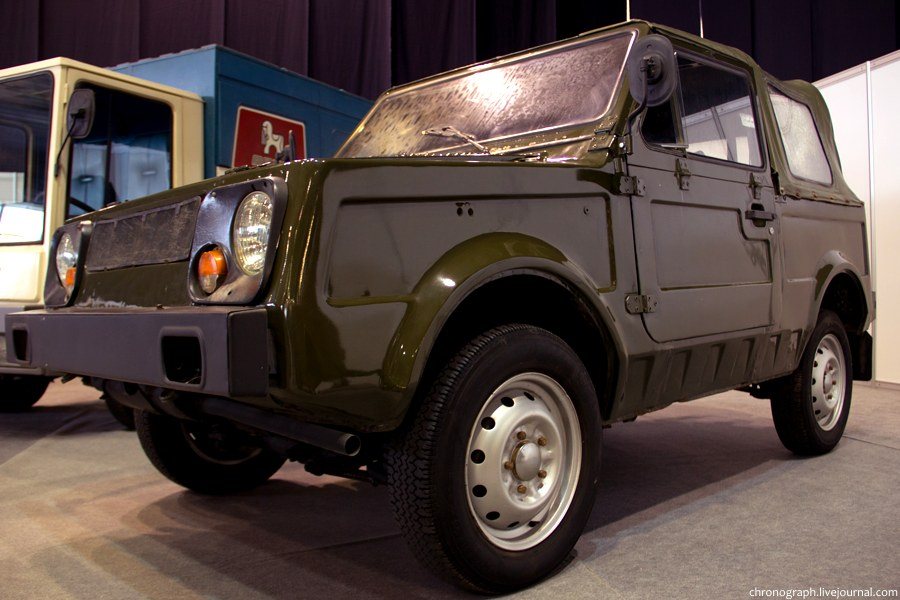
The Reka was a four-wheel-drive hatchback with a sealed steel body and Niva drivetrain parts [1][2]. It had no propeller. It swam by turning its wheels, at about 4 km/h (2.5 mph), a speed given by both Kolesa and Russian Wikipedia [1][2]. Russian Wikipedia lists a 60 hp (45 kW) 1.3-liter engine, a curb weight of 1,200 kg (2,650 lb), a payload of 360 kg (790 lb) and a length of 3,735 mm (12 ft 3 in), though that page carries a notice asking for better sources [1].
A flap controlled from the cockpit closed the front air intake and opened a slot in the hood for swimming, so the driver could enter water directly [1][2]. Techinsider adds thick steel bumpers that could push a stuck vehicle and a version with no hard roof, at the army's request [3].
Why it stopped
VAZ closed the project in 1988 [1][3]. Techinsider and Russian Wikipedia cite changed Soviet and US military thinking about a company commander's amphibious car, and say the Defense Ministry had not paid about 500,000 rubles it owed VAZ [1][3]. Kolesa says the army minister declined to fund production, which VAZ estimated at 6 million rubles for 500 vehicles a year [2]. Kolesa says Domansky used one car as a personal vehicle and another is displayed at the VAZ museum in Tolyatti [2].
Related entries
Sources
- ВАЗ-2122, Wikipedia (Russian). ru.wikipedia.org/wiki/%D0%92%D0%90%D0%97-2122
- «Река» меняет русло: проект ВАЗ-2122, Kolesa.ru (2015-01-07). www.kolesa.ru/article/reka-menjaet-ruslo-proekt-vaz2122-2015-01-07
- «Нива» для лейтенанта: загадочный ВАЗ-2122, который так и не пошел в серию, Techinsider (2025-06-22). www.techinsider.ru/vehicles/1618785-zagadochnyi-22-i-kak-na-vaze-sdelali-nivu-dlya-leitenanta
- Lada Niva (VAZ-2122 Reka section), Wikipedia. en.wikipedia.org/wiki/Lada_Niva
Last reviewed November 2026. Spotted something to correct or add? Tell us and include a source.
See how to register a low-speed vehicle or boat in your state.
About the Amphibious Encyclopedia
WaterCar has designed and built amphibious vehicles in Southern California for more than 25 years. We keep this encyclopedia so anyone curious about vehicles that cross between land and water has one place to start, with the sources listed for every fact. New to the subject? Start with our guide, What is an amphibious vehicle?
All amphibious vehicles → · The WaterCar machines → · How a WaterCar works →