
How ground effect works
Close to a flat surface, the air a wing pushes downward is squeezed against the surface, which adds lift, and the drag the wing creates while lifting drops, much as if the wing were longer and slimmer [11][12]. According to the DARPA official quoted by Breaking Defense, the benefit is lost once a craft flies higher than its own wingspan [12]. A ground-effect craft must keep moving forward to stay in the air, which a hovercraft does not need to do, although some Russian designs used extra engines to blow air under the wing at takeoff [11]. In 2005 the International Maritime Organization classified these craft as ships [11].
Because the effect needs a fairly flat surface, ekranoplans have normally been limited to large bodies of water [1]. Wikipedia notes that, unlike other Soviet ekranoplan designs, the Orlyonok was amphibious [4]. It and its half-scale test craft, the SM-6, had wheels that let them roll out of the water onto firm ground under their own power, and the VVA-14 used wheeled landing gear to take off from runways [2][9]. The sources consulted describe no wheels on the KM, the Lun or REGENT's seagliders [1][5][16].
Rostislav Alekseyev and the Caspian Sea Monster
Rostislav Alekseyev, born on December 18, 1916, was a Soviet shipbuilding engineer who was assigned in 1942 to develop hydrofoils for the navy and later led the design of passenger hydrofoils such as the Raketa and Meteor [1][10]. Working at the Krasnoye Sormovo shipyard in Gorky, he turned to ground-effect craft, and his small SM-1 first flew on July 22, 1961; the next year he began working at the Central Hydrofoil Design Bureau [1][10].
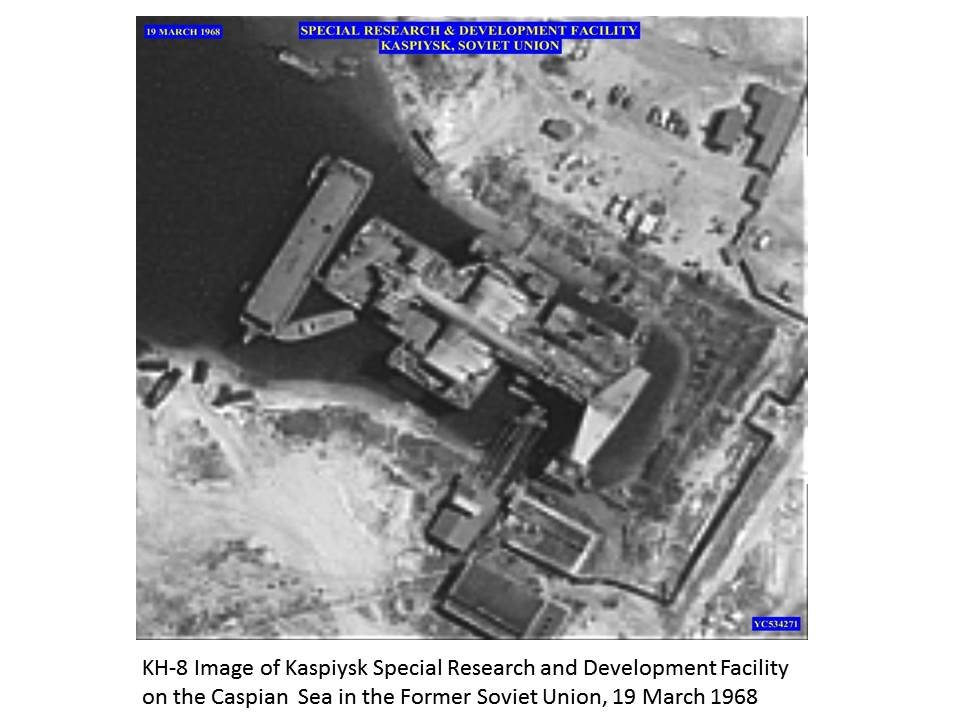
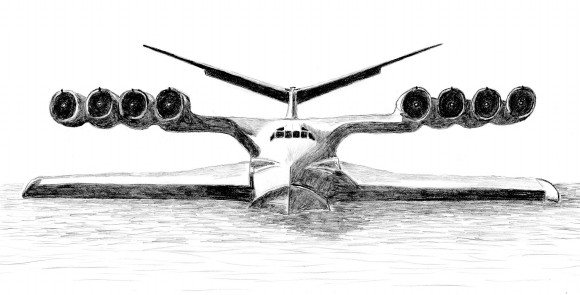
The Soviet Navy ordered a full-size experimental craft, the KM, in 1963 [1]. It was launched on the Volga on June 22, 1966, then went down the river to the Kaspiysk naval base, traveling only at night and with its wings removed to keep it secret [1][3]. At up to 544 tonnes (1.2 million lb) it carried ten turbojets: eight boost engines behind the cockpit for takeoff and two cruise engines on the tail [1][3]. It cruised 4 to 14 m (13 to 46 ft) above the waves [1]. US satellites spotted it in August 1967, and the CIA's name for it, "Kaspian Monster" after its KM designation, became the Caspian Sea Monster [1].
Though built for water, the KM was once taken by mistake about 2 km (1.2 miles) across a flat, low island [1]. In December 1980 it crashed during a takeoff; nobody was hurt, and the wreck stayed afloat for about a week before going down [1][3].
The A-90 Orlyonok, an ekranoplan that drove ashore
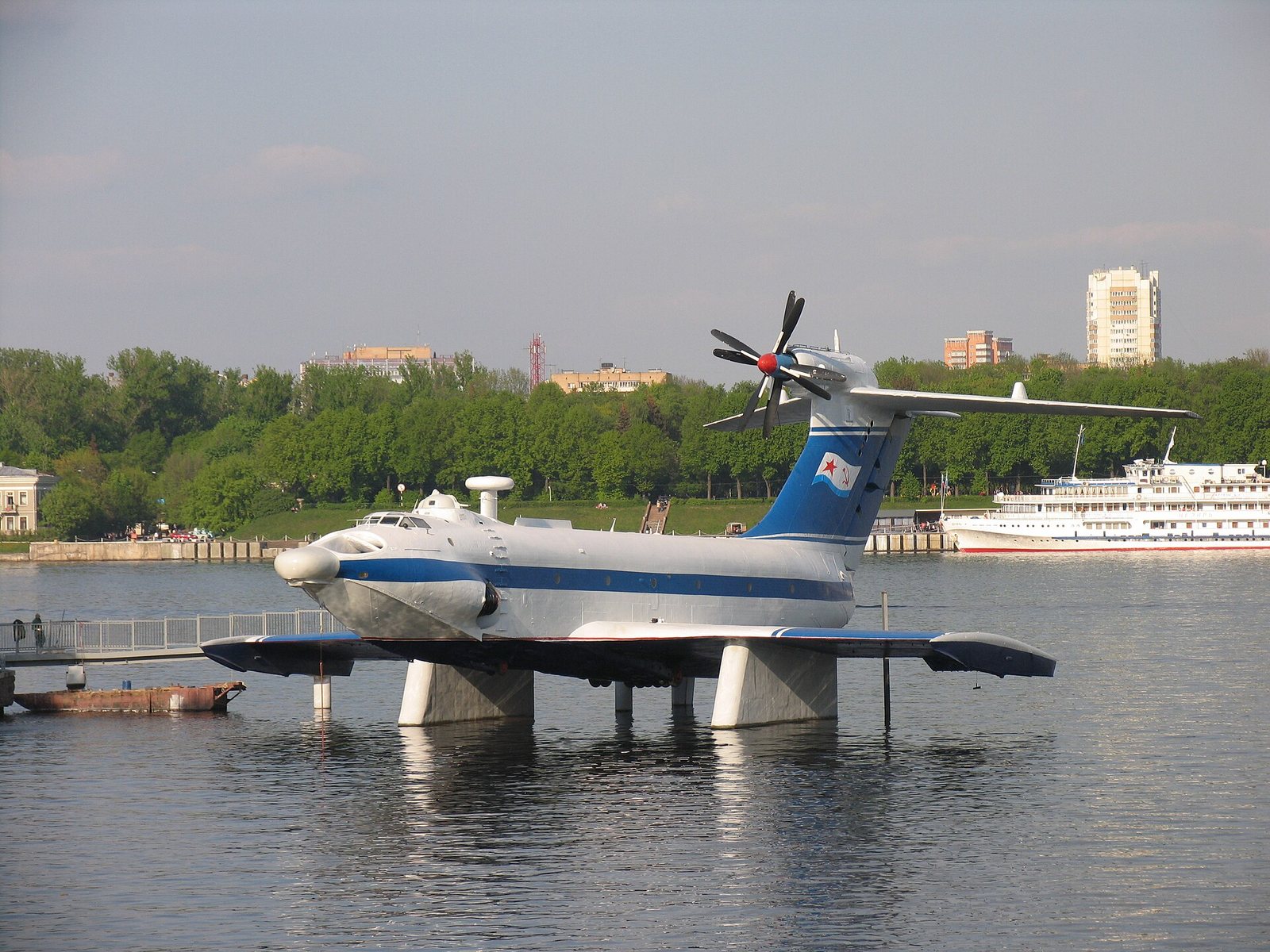
Alekseyev's bureau also designed a troop transport. A half-scale test craft, the SM-6, first flew in 1971, and in 1973 its hydro-skis were fitted with wheels that let it drive from the water up onto land and back again [2]. The full-size A-90 Orlyonok ("eaglet") first flew from the Volga in 1972 [2][4]. According to Old Machine Press, the prototype was disguised as a Tu-134 airliner fuselage when it was taken by barge to Kaspiysk [2].
The Orlyonok was 58.1 m (191 ft) long, with a 31.5 m (103 ft) wingspan and a maximum weight of 140 tonnes (308,647 lb) [2][4]. It had two jet engines in the nose and a turboprop at the top of the tail driving an eight-bladed contra-rotating propeller [2][4]. Old Machine Press gives a cruise speed of about 360 km/h (224 mph) at 0.5 to 5 m (2 to 16 ft) above the water [2]. For loading, the entire nose section, cockpit and all, hinged up to 92 degrees to the right, and folding ramps led into the hold [2]. Its beaching gear had two steerable wheels at the front and ten wheels in the main unit beneath the hull, so it could leave the water and roll onto firm ground on its own [2]. The three craft in service had logged 438 flights and 118 beachings by 1989 [2]. Sources give its capacity as 150 or 250 troops [2][4][7].
In 1975 the prototype was damaged when it ran onto a rocky sandbar, and it later lost its tail section in a rough-sea landing [2]. Alekseyev, on board, ran the nose jets at full power to hold the broken hull's open end clear of the water until it reached base, but he was then removed as chief designer [2]. He died on February 9, 1980, after being injured in a test crash of another ekranoplan that January [10]. The Orlyonok entered naval service in 1979, one was lost in 1992, and the last flights were made in 1993 [2][4][7]. One craft, S-26, is preserved at the Russian Navy museum in Moscow [2][4].
The Lun
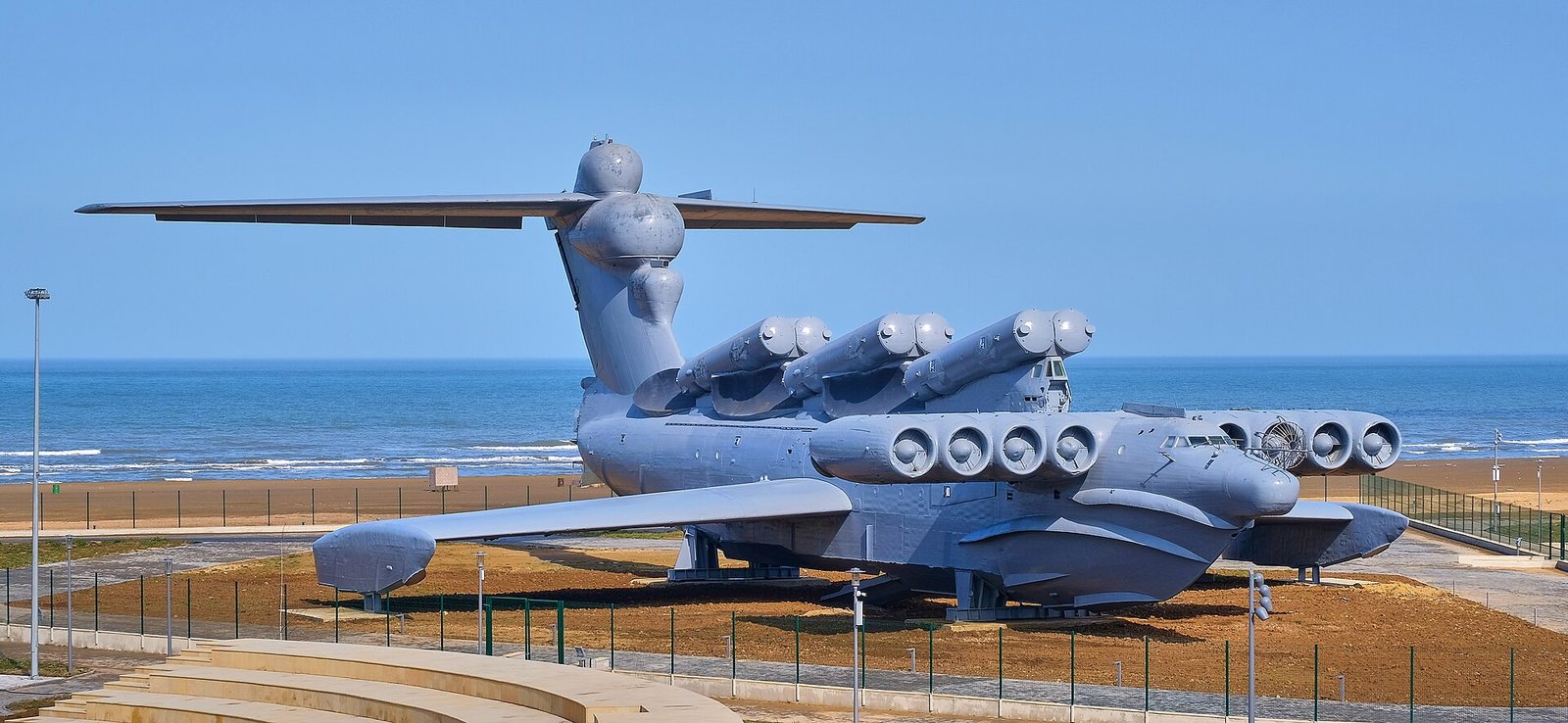
The Lun, a missile-carrying ekranoplan for the Soviet Navy, was launched on July 16, 1986 [6]. It was 73.5 to 73.8 m (241 to 242 ft) long, had eight Kuznetsov NK-87 jet engines and weighed up to 370 to 380 tonnes (816,000 to 838,000 lb), depending on the source [5][6]. It carried launchers for six Moskit anti-ship missiles [5][6]. According to Wikipedia it cruised about 2.5 m (8 ft) above the water, and only one was completed [5]. In July 2020 it was towed out of Kaspiysk toward a new home at the Patriot Park in Derbent, Dagestan, but it grounded off a beach short of its destination; it was later hauled ashore, and restoration work was announced in September 2025 [5].
Bartini's VVA-14
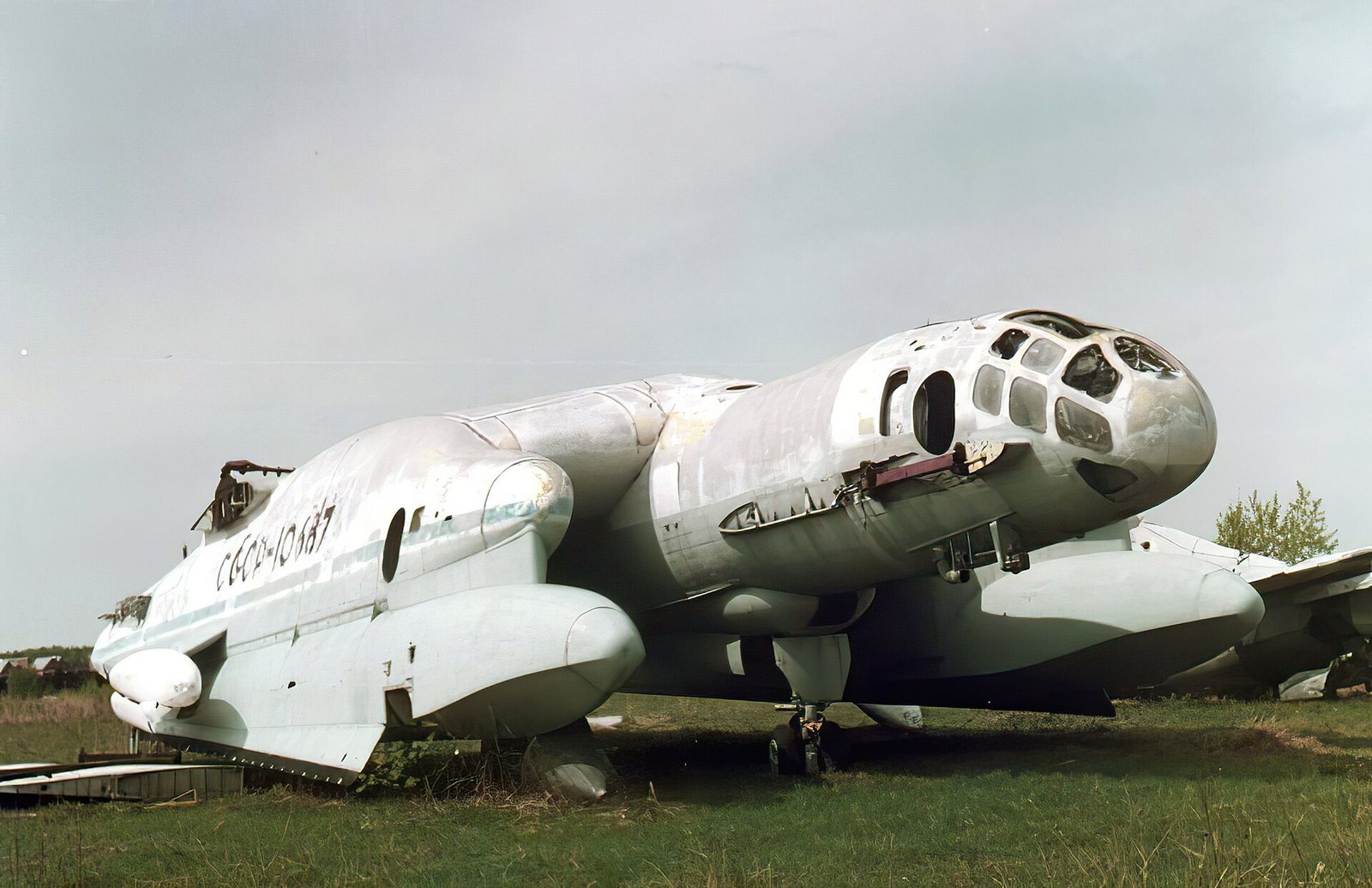
Robert Bartini's VVA-14, built with the Beriev design bureau, was an experimental anti-submarine aircraft meant to fly efficiently just above the sea using ground effect [8]. It first flew on September 4, 1972, taking off normally from a runway at Taganrog [8][9]. For use on land it rolled on a nose gear and a single main gear from a Tu-22 bomber, both on its centerline, plus outrigger wheel pods from a Myasishchev 3M bomber [9]. Inflatable pontoons added in 1974 gave a lot of trouble and limited it to 36 km/h (22 mph) on the water; flight tests as an amphibian began on June 11, 1975 [8][9].
Bartini died in 1974, and the twelve lift engines that were meant to let the aircraft rise vertically were never delivered [9]. After 107 flights totaling 103 hours, the VVA-14 that flew went to the Central Air Force Museum at Monino in 1987, where it remains in pieces [8][9].
Modern ground-effect craft
In 2022 the US agency DARPA launched Liberty Lifter, a large seaplane meant to cruise in ground effect but also climb to 10,000 ft (3,000 m) [13][15]. Breaking Defense reported a goal of a craft about the size of a C-17 transport that could carry two Marine Corps Amphibious Combat Vehicles of about 35 tons (32 tonnes) each, and quoted the DARPA official in charge as saying the Soviets had shown "how not to do this" [12]. It was to take off and land on water rather than runways and unload vehicles onto a beach through an upward-opening nose [15]. In 2024 DARPA dropped General Atomics' design, kept Aurora Flight Sciences' and scaled the planned demonstrator down to about C-130 size, but in June 2025 it closed its work without building one [13][14].
REGENT, which opened a factory in North Kingstown, Rhode Island, in September 2026, builds seagliders that float on a hull, rise onto hydrofoils and then fly in ground effect [16][17]. Its Viceroy carries 12 passengers and two crew, has a 65 ft (19.8 m) wingspan and a maker-stated cruise speed of 180 mph (290 km/h) [16]. The full-size prototype flew in ground effect over Narragansett Bay at the factory opening on September 30, 2026 [17]. REGENT says its seagliders operate only over water [16].
| Craft | Country | First flight or launch | Weight or size | Cruise speed | Could it go on land? |
|---|---|---|---|---|---|
| KM (Caspian Sea Monster) | Soviet Union | Launched June 22, 1966 [1] | Up to 544 tonnes (1.2 million lb); 92 to 97.4 m (302 to 320 ft) long [1][3] | about 430 km/h (267 mph) [1][3] | No wheels reported; it once flew over a low island [1] |
| SM-6 | Soviet Union | 1971 [2] | Up to 26,500 kg (58,422 lb); 31 m (102 ft) long [2] | about 300 km/h (186 mph) [2] | Yes, from 1973: wheels on its hydro-skis let it drive itself ashore and back [2] |
| A-90 Orlyonok | Soviet Union | 1972 [2][4] | Up to 140 tonnes (308,647 lb); 58.1 m (191 ft) long [2][4] | about 360 km/h (224 mph) [2] | Yes: wheeled beaching gear let it drive itself out of the water onto a hard surface [2][4] |
| Bartini Beriev VVA-14 | Soviet Union | September 4, 1972 [8][9] | Up to 52 tonnes (114,640 lb); 26 m (85 ft) long [8][9] | about 640 km/h (400 mph) [8][9] | Yes, as an aircraft: wheeled landing gear for runways [9] |
| Lun | Soviet Union | Launched July 16, 1986 [6] | Up to 380 tonnes (837,757 lb); 73.8 m (242 ft) long [5] | about 450 km/h (280 mph) [5] | No wheels reported [5][6] |
| DARPA Liberty Lifter | United States | Never built; program closed June 2025 [13] | Planned near C-17 size, later a C-130-size demonstrator [12][14] | No figure published by DARPA [13] | Not described; a seaplane meant to take off and land on water [13][15] |
| REGENT Viceroy seaglider | United States | Prototype flying in ground effect by September 2026 [17] | Up to 15,000 lb (6,800 kg); 65 ft (19.8 m) wingspan [16] | about 180 mph (290 km/h), maker figure [16] | No; the maker says it operates only over water [16] |
"Could it go on land?" means moving on the ground under its own power, not flying over flat land. Speeds are cruise figures from the sources cited; weights are maximum weights.
Photos
Related entries
Sources
- Alexeyev KM Ekranoplan "Caspian Sea Monster" (William Pearce), Old Machine Press (2019-11-05). oldmachinepress.com/2019/11/05/alexeyev-km-ekranoplan-caspian-sea-monster
- Alexeyev SM-6 and A-90 Orlyonok Ekranoplans (William Pearce), Old Machine Press (2019-11-20). oldmachinepress.com/2019/11/20/alexeyev-sm-6-and-a-90-orlyonok-ekranoplans
- Caspian Sea Monster, Wikipedia. en.wikipedia.org/wiki/Caspian_Sea_Monster
- A-90 Orlyonok, Wikipedia. en.wikipedia.org/wiki/A-90_Orlyonok
- Lun-class ekranoplan, Wikipedia. en.wikipedia.org/wiki/Lun-class_ekranoplan
- Small Missile Ship-Ekranoplan, Project 903, RussianShips.info. russianships.info/eng/warships/project_903.htm
- Small landing wing-in-ground-effect craft, Project 904, RussianShips.info. russianships.info/eng/warships/project_904.htm
- Bartini Beriev VVA-14, Wikipedia. en.wikipedia.org/wiki/Bartini_Beriev_VVA-14
- VVA-14 experimental VTOL amphibian (Bartini and Beriev), Testpilot.ru. testpilot.ru/en/rossiya-e/bartini/vva
- Rostislav Alexeyev, Wikipedia. en.wikipedia.org/wiki/Rostislav_Alexeyev
- Ground-effect vehicle, Wikipedia. en.wikipedia.org/wiki/Ground-effect_vehicle
- DARPA's revolutionary seaplane wants to change how the Pentagon hauls cargo (Justin Katz), Breaking Defense (2022-05-27). breakingdefense.com/2022/05/darpas-revolutionary-seaplane-wants-to-change-how-the-pentagon-hauls-cargo
- Liberty Lifter, DARPA (Defense Advanced Research Projects Agency). www.darpa.mil/research/programs/liberty-lifter
- DARPA taps Aurora to keep designing heavy cargo seaplane in $8.3M deal (Stephen Losey), Defense News (2024-05-10). www.defensenews.com/air/2024/05/10/darpa-taps-aurora-to-keep-designing-heavy-cargo-seaplane-in-83m-deal
- Cargo-hauling ekranoplan X-plane is being developed by DARPA (Thomas Newdick), The War Zone (2022-05-19). www.twz.com/cargo-hauling-ekranoplan-x-plane-is-being-developed-by-darpa
- Viceroy Seaglider, REGENT Craft. www.regentcraft.com/seagliders/viceroy
- REGENT marks opening of world's first Seaglider Manufacturing Facility with ribbon-cutting ceremony and flight demonstration (press release), REGENT Craft (2026-09-30). www.regentcraft.com/news/regent-opening-worlds-first-seaglider-manufacturing-facility-ribbon-cutting-ceremony-flight-demonstration
Last reviewed November 2026. Spotted something to correct or add? Tell us and include a source.
About the Amphibious Encyclopedia
WaterCar has designed and built amphibious vehicles in Southern California for more than 25 years. We keep this encyclopedia so anyone curious about vehicles that cross between land and water has one place to start, with the sources listed for every fact.
Browse all entries → · The WaterCar machines → · How a WaterCar works →