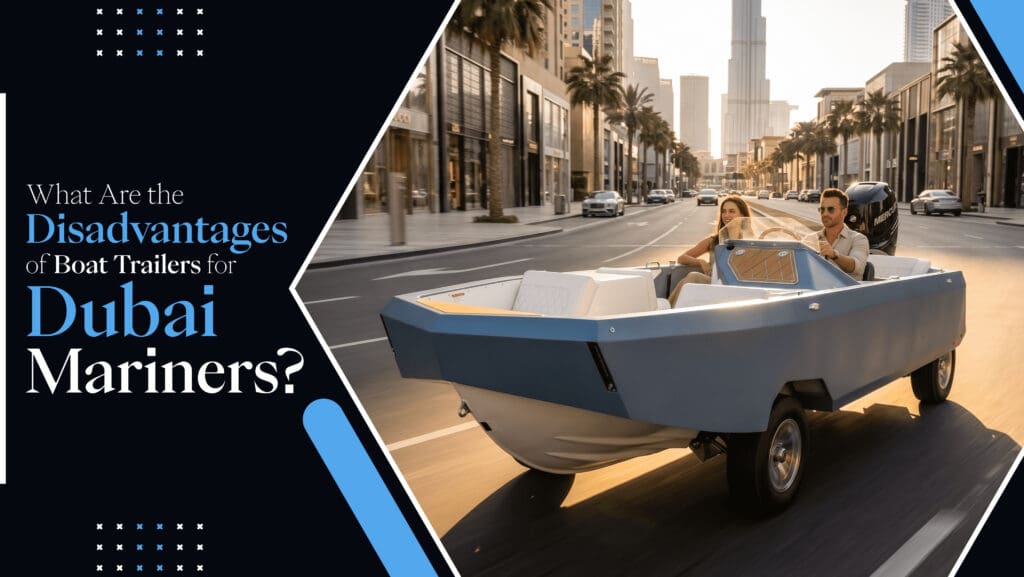
But what if you didn’t need a boat trailer? What if your boat could drive itself to and from the beach from your own driveway?
Here is a detailed look at why traditional trailers are holding Dubai mariners back, and how a new category of mobility deletes the hassle entirely.
What Are the Biggest Disadvantages of Boat Trailers in Dubai?
The boat may bring the freedom of the coast into your life, but investing in a conventional boat trailer comes with an unending chain of physical labor and machinery aggravation, especially in the harsh environmental conditions found here in Dubai.
Why Does Boat Trailer Maintenance Become a Constant Chore?
The first and most persistent problem with the boat trailer is the destructive combination of saltwater, extreme heat, and fine desert sand. When you back a traditional trailer into the sea to launch your boat, you are submerging sensitive mechanical hardware into highly saline water.
This makes boat trailer maintenance a non-stop, frustrating task:
Saltwater Corrosion: The Arabian Gulf has some of the highest salinity levels in the world. Every immersion coats the leaf springs, axle shafts, and structural welds in a salt bath, leading to rapid saltwater corrosion.
The Rust-Prone Trailer Frame: A standard galvanized trailer is zinc-coated. This may keep rust at bay temporarily, but eventually debris from roads scratches away at the zinc and exposes bare metal to air and water. The frame rusts away from the inside out.
Seized Wheel Bearings: Trailer wheels must be completely submerged during launch. If the watertight seals leak even a fraction, salt water penetrates the hubs, washes away the grease, and corrodes the bearings. This leads to wheel bearing failure on the highway – a dangerous scenario when towing thousands of kilograms.
Sanding and Grit Intrusion: Frequent sandstorms in Dubai drive fine silica particles into the trailer’s working parts. Together with grease, it acts as a lapping compound, wearing down the brake calipers, couplers, and winch gears at an accelerated rate.
Electrical Failures: Putting the trailer’s electrical wiring in saltwater is just asking for short circuits. Eventually, even the tinned wires will corrode through the plug ends, and you will have no working taillights, signal failures, and fail your RTA.
Why Do Towing and Launching Make Boating More Stressful?
The emotional tax of traditional boating is paid at the boat ramp and on the highway. Instead of relaxing, the captain spent the morning performing high-stress logistics.
What Makes Towing a Boat Trailer Risky?
Boat trailer towing on Dubai’s fast-moving, multi-lane highways – such as Sheikh Zayed Road or the E11 – demands absolute concentration and a heavy tow vehicle.
Highway Instability: A strong crosswind or the slipstream from a passing heavy transport truck can cause dangerous trailer sway. If the driver is inexperienced, this sway can quickly escalate into a jackknife.
Extreme Thermal Loads: Towing a multi-ton boat and trailer across the summer in Dubai puts a huge amount of stress on your tow vehicle’s engine, transmission, and braking systems. Brake fade on the trailer will greatly increase your stopping distance.
Tight Urban Maneuvering: Driving a long, wide trailer through narrow residential roads in prime coastal neighborhoods like Jumeirah or the Palm Jumeirah isn’t fun. You can quickly lose your cool while trying to make it through roundabouts, U-turns, or tight parking spaces.
Why Is Launching at a Ramp So Frustrating?
The “theatre of the boat ramp” is a universally recognized source of boating anxiety. Launching a boat is rarely a safe or easy job for a single operator. The typical routine highlights the extreme boat trailer hassle:
The Queue: On a perfect winter weekend, public launch ramps are highly congested. You must wait in line idling your tow vehicle, surrounded by impatient boaters.
The Reverse Maneuver: You must back your heavy trailer down a narrow, algae-slick concrete ramp while spectators watch. One wrong turn of the steering wheel can damage your hull, the trailer, or nearby vehicles.
The Physical Separation: Once the trailer is wet, you must wade into the water, unhook the safety chains, release the winch strap, and physically push the boat off the trailer bunks.
The Parking Hunt: While your family holds the boat against a crowded dock, you must jump back into the tow vehicle, drive away, and search for a trailer-length parking space in a lot that is almost always full.
The Return Chore: When the day is done, you must perform this entire exhausting sequence in reverse, cleaning sand and salt off the trailer before driving home.
What Safety Checks Does a Trailer Add Before Every Trip?
To prevent a catastrophic failure on the road, every towing journey requires a tedious list of boat trailer safety checks before you can even leave your driveway:
Verify the trailer coupler is fully locked onto the tow ball, and the safety pin is secure.
Attach both safety chains in a crisscross pattern under the coupler.
Connect the electrical harness and verify that all brake lights, running lights, and turn signals are working perfectly.
Test the mechanical break-away cable and verify the trailer’s independent braking system functions.
Check tire pressure on all trailer tires, including your spare tire, as Dubai’s strong UV rays will age these quite quickly.
Inspect the wheel hubs for grease leakage or signs of water intrusion.
Ensure the winch strap is ratcheted tight and the safety bow chain is locked.
If you skip even one of these checks, you risk a mechanical failure that could strand your vessel on the side of the road, far from the water.
How Do Storage, Marina, and Compliance Issues Add to the Trailer Hassle?
Beyond the highway and the ramp, the logistics of trailer ownership introduce severe spatial and regulatory challenges within Dubai’s master-planned communities.
Where Do You Keep a Boat Trailer When It Is Not in Use?
One of the biggest headaches for waterfront homeowners is boat trailer storage. Premium residential areas in Dubai are highly manicured and governed by strict community associations (HOAs).
Driveway Restrictions: Most high-end villa communities – especially on Palm Jumeirah or inside gated developments – expressly prohibit parking boat trailers, jet skis, or large recreational vehicles on driveways or in front of houses.
The Garage Space Conflict: A traditional boat on a trailer is extremely tall and long. It rarely fits inside a standard residential garage, forcing you to park your daily cars outside or find off-site storage.
The Off-Site Compromise: This forces owners to pay for commercial outdoor boat storage yards. These gravel yards are often located in industrial zones far from the water. Left exposed, your boat and trailer suffer severe UV damage, are blanketed in dust from sandstorms, and endure constant humidity, requiring heavy cover wraps and regular maintenance even when unused.
Are Dubai Boat Storage Options Convenient Enough to Replace Owning a Trailer?
To escape the nightmare of the trailer, some owners turn to alternative storage systems. However, these options introduce their own set of compromises:
Dry Stack Storage / Indoor Boat Storage: Keeping your vessel in a climate-controlled storage facility or a dry stack storage building protects the boat from the elements. However, to use your boat, you must call the facility hours—or sometimes days—in advance to schedule a launch.
Valet Launching: Most dry berthages also offer valet launch, pick up and drop off service. While a service to many dry berth holders, it is only operated during specific hours, and if you’re planning to catch the sunset, then you could find yourself without launch service at night!
The Fee Illusion: They incorporate docking assistance, hull cleaning, and engine flushing with their monthly subscriptions. That can add up to a substantial chunk of the boat’s initial cost in five years and will yield you nothing more than a stack of receipts.
How Does WaterCar Launch Without a Traditional Boat Trailer?
The WaterCar eliminates the need for a trailer by integrating its wheels directly into its structural design. At the core of this seamless land-to-water transition is LaunchMode™, a patented hydraulic system that operates at the push of a single cockpit button:
The Approach: You drive the vehicle directly down a sandy beach or any standard boat ramp.
The Transition: Once the hull floats, you press the transition button. The front wheels retract hydraulically in seconds into the sides of the hull.
Pure Performance: You are instantly up on plane, cruising the Arabian Gulf at speeds of up to 35 mph.
Wheel retraction and hull details: Review the actual configuration and operating and maintenance instructions with WaterCar. Do not assume that a design detail eliminates corrosion or servicing needs.
How Does TowLink™ Remove Separate Trailer Ownership?
For longer journeys, assess the specified WaterCar towing setup with a properly rated tow vehicle. Confirm the actual equipment, compatibility, operating instructions and applicable transport requirements before use. Do not assume compatibility with any hitch or vehicle, automatic wheel operation, or an exemption from registration and insurance requirements. Related reading: Fujairah or Musandam.
How Does WaterCar Change Storage for Dubai Owners?
Home storage may offer an alternative to a marina berth where the delivered vehicle, actual space and access route are suitable. Measure dimensions and clearances and confirm local storage and transport requirements:
The Standard Garage Fit: The vehicle fits comfortably inside a standard residential garage. This allows you to store your boat securely on land, completely eliminating off-site storage costs and marina fees.
Complete Protection: Parking the WaterCar in your own dry, climate-controlled garage keeps it shielded from Dubai’s intense sun, heavy humidity, and abrasive sandstorms.
Saltwater care: Dry storage may change exposure, but does not eliminate corrosion, marine growth or maintenance. Follow the vehicle and outboard care instructions.
Standard Charging: The power comes from an on-site LiFePO4 lithium iron phosphate battery pack that recharges overnight on a regular 110- or 220-volt household outlet, so there’s no complicated marine electrical systems required.
A WaterCar may change the transport and launch routine for an owner with suitable, permitted access. Compare the specified towing setup, storage, maintenance and complete costs before deciding whether it fits your boating plans.
Disadvantages of Boat Trailers in Dubai: FAQ
Can a boat trailer reduce a boat’s resale appeal?
Yes. A degraded trailer signals neglect and forces buyers to budget for a replacement, tanking resale value. WaterCar eliminates this entirely by removing the trailer from the equation.
Is dry stack storage better than keeping a boat on a trailer?
Not necessarily. Dry stack protects against the elements but is expensive and restrictive. A WaterCar offers the same environmental protection in your residential garage for free, with instant spontaneity.
Do Dubai boaters still need a marine license if they do not use a trailer?
Yes. You need a Dubai Maritime Authority (DMCA) license for the water, and a standard RTA driver’s license for the road.
Can WaterCar be used on any beach in Dubai?
No. Motorized vessels are banned on public swimming beaches (e.g., JBR, Kite Beach). You must launch from public ramps, private waterfronts, or designated marine access points.
What should Dubai buyers ask before importing or registering an amphibious vehicle?
Confirm the documents and approvals required for the particular vehicle and intended road and marine use with the relevant local authorities. A VIN or HIN identifies the vehicle or vessel; neither establishes international certification or automatic registration eligibility.
Is a trailer-free boat still useful if I already have marina access?
Absolutely. Marina slips tie you to one location. WaterCar offers geographic freedom—you can tow it on its own wheels via TowLink™ to explore new waters without trailer logistics.
What type of buyer benefits most from a trailer-free boat?
Affluent coastal homeowners, luxury collectors, and active families who want spontaneous recreation without the physical labor, queues, and headaches of traditional towing.
Does WaterCar eliminate all boating maintenance?
No. It eliminates trailer upkeep and hull fouling, and the electric land drivetrain is virtually maintenance-free. However, the Mercury outboard still requires standard seasonal marine servicing.
Can a trailer-free boat help families or older passengers board more easily?
Yes. Instead of navigating rocking docks or slippery ramps, passengers can board safely and buckle up while the vehicle is parked on solid ground in your driveway.