
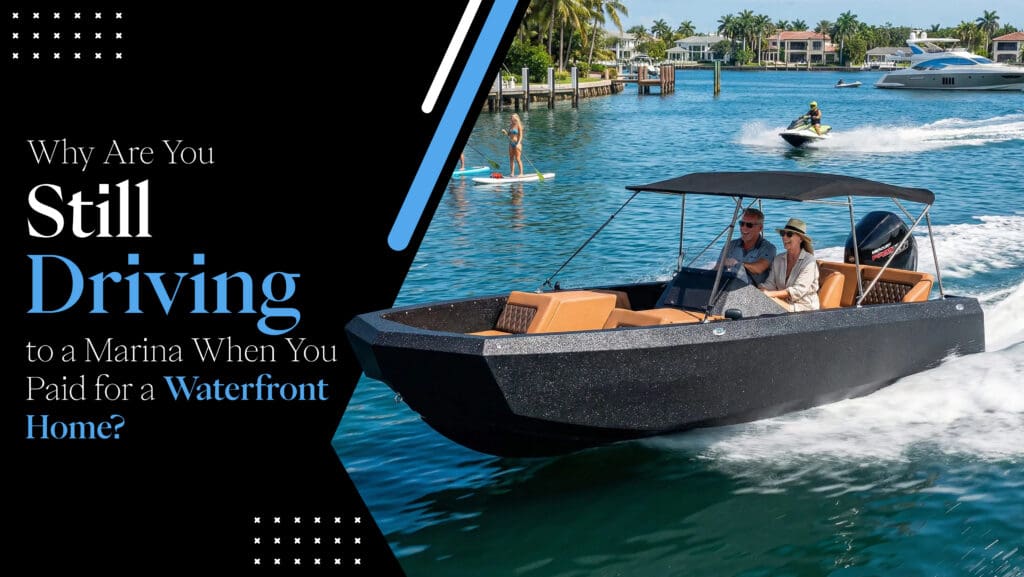
A WaterCar combines boating with low-speed land mobility. For a waterfront property with suitable storage and permitted road and water access, it may simplify the trip from home to a launch point. Check the actual route, terrain, clearances and local requirements before planning to launch from the property.
The most critical question for any waterfront property owner is whether their real estate is truly serving their lifestyle. The benefits of waterfront property ownership are often constrained by hidden logistical and regulatory barriers.
When evaluating the true value of your real estate, consider these common realities:
Despite the immense boating lifestyle advantages of living on the water, many homeowners remain tethered to traditional marinas. This happens because traditional boats are single-environment machines. Because they cannot navigate land, owners are forced into a permanent reliance on expensive third-party infrastructure.
If you cannot secure a private dock, your boat storage options as a homeowner are historically limited to commercial marinas or dealing with the extreme frustration of trailering your boat to public ramps. This introduces heavy trailer maintenance, crowded launch queues, and endless marina maintenance costs.
That doesn’t have to be the case, though. The modern world of marine engineering has made great advancements. By adopting a vessel that has the ability to operate in two environments, you no longer need a marina to have easy access to water. Turn your home into a launchpad to instant adventure.
For many premium properties, building a traditional dock is simply not an option.
Conventional dock systems fail because most homes don’t have deep enough water drafts. Typically, a 25-foot sport boat needs plenty of water; otherwise, it runs aground. Tidal estuaries or shallow bay areas offer nothing for the traditional dock during low tide. More importantly, environmental agencies now refuse permits for dock systems to protect fragile marine habitats, and homeowners find themselves looking at the water.
A WaterCar may connect suitable property storage with permitted water access. Check the actual terrain, route, launch conditions and property requirements rather than assuming any waterfront home can launch without a dock or other facilities.
Superior To Docks in 5 Critical Ways
Utilizing an amphibious vehicle is structurally and financially superior to building a traditional dock:
The removal of the dock and marina frees up your time; you transition smoothly from riding along the coast to skimming the open water in one fell swoop. Thanks to the amphibious vehicle advantages, your family can decide they want to watch the sunset over the water and be skimming the waves at 35 mph minutes later; that’s freedom.
The WaterCar EV has been expertly crafted to deliver a frictionless ride while maintaining the utmost craftsmanship and refinement.
Local journeys: The road-drive system is intended for low-speed use rather than highway travel. Confirm the delivered configuration, registration, permitted route and suitable launch access. A convenient home-to-water journey depends on those conditions; it is not a guarantee of unrestricted access or no waiting.
Home storage may offer a different starting point for an outing. Check suitable access, conditions and permissions for any waterfront destination before planning to visit.
Flotation and safety: Review the applicable model-year flotation, stability, capacity and equipment documentation. Flotation material does not guarantee that a vessel cannot sink or replace safe operation, weather assessment, life jackets or required safety equipment.
The financial impact of withdrawing your boat from the marina ecosystem is vast.
| Expense Category | Traditional 25-Foot Boat (Annual Expenses) | WaterCar EV (Annual Cost) |
| Annual dock/slip cost | Obtain a local quotation for the actual service, storage or access arrangement. | Obtain a local quotation for the actual service, storage or access arrangement. |
| Seasonal storage | Obtain a local quotation for the actual service, storage or access arrangement. | Obtain a local quotation for the actual service, storage or access arrangement. |
| Fuel surcharges | High (Marina gas premiums) | Obtain a local quotation for the actual service, storage or access arrangement. |
| Pump-out services | Obtain a local quotation for the actual service, storage or access arrangement. | Obtain a local quotation for the actual service, storage or access arrangement. |
| Marina amenities | Obtain a local quotation for the actual service, storage or access arrangement. | Obtain a local quotation for the actual service, storage or access arrangement. |
| Access convenience | Low (30+ min commute + traffic) | High (Instant launch from home) |
| 5-Year Total Cost | Obtain a local quotation for the actual service, storage or access arrangement. | Obtain a local quotation for the actual service, storage or access arrangement. |
(NOTE: The above are typical costs, provided as an industry standard. All of the infrastructure costs outlined are eliminated by the WaterCar EV on your own private land.)
A WaterCar may suit a waterfront property with appropriate storage and lawful road and water access. Discuss the model, configuration and current pricing with WaterCar and assess the actual property.
Waterfront real estate of tomorrow is not about who can afford the biggest wooden dock; it is about who has the most fluid transportation. The WaterCar EV is the ultimate in amphibious mobility. Advanced Tri-hull V-bottom design, reverse chine, and accurate dead rise geometry.
Once you depart the dock, the boat can cut through water traffic like a much larger luxury boat, blending the best of the marine and automotive worlds.
By eliminating the need for expensive slip fees, complex dock permitting, and frustrating trailer logistics, the WaterCar EV allows you to reclaim the true boating lifestyle advantages.
Discover the future of amphibious vehicles with WatercarEV.