
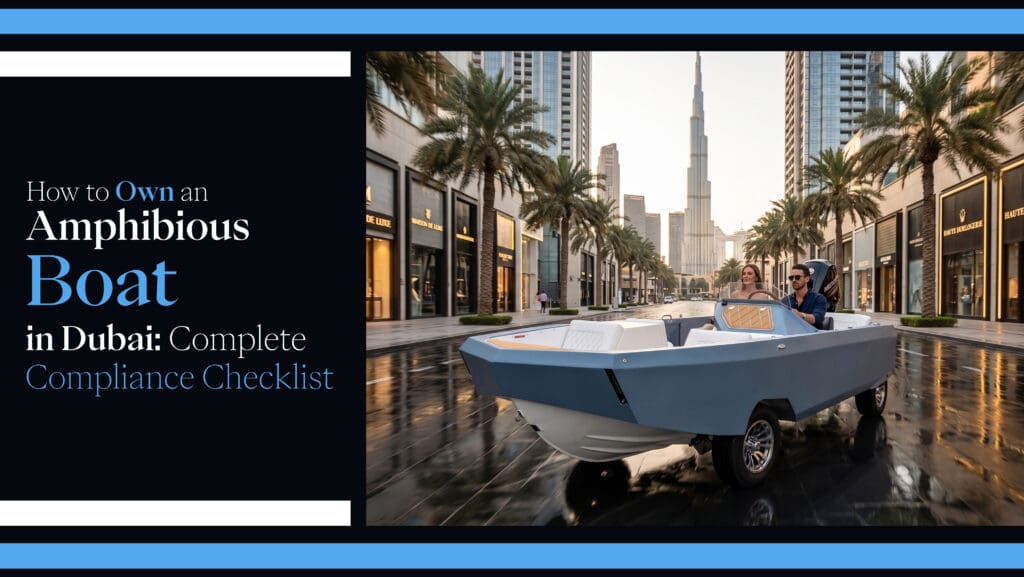
A WaterCar combines boating with land mobility and may offer a different way to plan a waterfront outing in Dubai. Before purchase or import, confirm that the particular vehicle, intended road route, launch location and marine use can meet the applicable requirements. This article outlines questions to investigate rather than a confirmed approval pathway.
This guide highlights matters to confirm before owning and operating a WaterCar in Dubai, including import, road approval, marine use and insurance.
Eligibility must be confirmed for the particular vehicle, configuration and use before purchase or import. Do not assume approval for Dubai roads, including major roads, from a U.S. low-speed vehicle classification or marine capability. Related reading: amphibious car.
Ask the relevant authorities to confirm who may apply and which identity, residency or business documents are required for the intended registration and use:
A conventional boat is designed for water use and needs a separate arrangement for land transport. An amphibious design adds land mobility, with capabilities and permissions that depend on the vehicle.
Review the particular vehicle documentation for its marine and land systems:
Road and marine permissions need separate consideration. Ask the relevant authorities which classifications and approvals apply to the particular vehicle and intended use; do not assume a U.S. LSV or NEV pathway applies in Dubai. Related reading: Low-Speed Vehicle (LSV).
Before arranging import or registration, identify the authorities responsible for the particular vehicle and proposed road and marine use. Ask them to confirm the current process and required documents.
Identify the current authorities responsible for each part of the proposed use:
Ask the relevant authorities to confirm the order of applications and required approvals for the particular vehicle. Do not assume marine approval must come first or establishes road eligibility.
Confirm the required process for both operating environments:
Document preparation: Obtain the current document checklist from the relevant authorities for the actual vehicle, applicant, import arrangements and intended use. Keep road and marine documentation distinct where required.
Use the table as topics to ask about, not a complete or confirmed document checklist:
| Category | Document | Purpose |
|---|---|---|
| Buyer & Ownership | Emirates ID | Ask the relevant authority whether this applicant document is required and which current form it accepts. |
| UAE Pass Credentials | Ask the relevant authority whether this applicant document is required and which current form it accepts. | |
| UAE Residency Proof | Ask the relevant authority whether this applicant document is required and which current form it accepts. | |
| Trade License | Ask the relevant authority whether this applicant document is required and which current form it accepts. | |
| Vessel & Manufacturer | Proof of Ownership (MCO/Title) | Manufacturer’s Certificate of Origin (MCO) or equivalent title confirming legal ownership of the vessel. |
| Purchase Invoice | Official stamped invoice showing the purchase details, buyer information, and manufacturer. | |
| Bill of Sale | Signed agreement confirming the transfer of ownership from WaterCar to the buyer. | |
| Marine Craft Builder Certificate | Ask which manufacturer or inspection records are required for this particular vessel and intended use. | |
| Import & Customs | Customs Clearance Certificate | Confirms all UAE import duties, VAT, customs charges, and port fees have been paid. |
| Bill of Lading | Shipping document showing the transport of the vehicle from California to Port Rashid or Jebel Ali Port. | |
| Marine Compliance | Technical Inspection Certificate | Ask which manufacturer or inspection records are required for this particular vessel and intended use. |
| Insurance documents | Confirm the required cover, policy period and documentation with the relevant authority and a licensed insurance agent or carrier. |
Confirm road and marine operator requirements separately for the intended activity:
Operator requirements: Confirm the required road and marine licences or qualifications for the intended vehicle, location and activity. A speed limit or U.S. low-speed vehicle classification does not establish which Dubai driving licence is sufficient.
Ask the relevant local authority which marine operator qualification is required for the particular vessel and intended activity.
Review the delivered vehicle specifications and model-year documentation with WaterCar and the relevant local authorities. General references to international standards do not establish approval for a particular market or operating use.
Owning a piece of handcrafted, limited-production engineering requires a premium investment. However, compared to the continuous, compounding fees of traditional boat ownership, the WaterCar offers surprising long-term value.
Assess storage, transport, charging and launch access as parts of the complete setup. Amphibious capability does not make an outing infrastructure-independent.
For waterfront homeowners on Palm Jumeirah, coastal villa owners in Jumeirah, and yacht collectors, the WaterCar represents the absolute pinnacle of recreational mobility.
Instead of dealing with:
A suitable setup may make some outings more convenient. Preparation, maintenance, operating limits and road and water permissions remain part of ownership.
Explore the custom amphibious vehicle, and book yours today!
Tourist operation: Confirm eligibility and required road and marine qualifications directly with the responsible authorities before operating. Do not infer permission or prohibition from visitor status alone.
Commercial use: Confirm the vehicle approval, applicant eligibility, operating permissions, insurance and passenger-transport requirements for the proposed activity before offering a service. Personal-use approval should not be assumed to cover commercial operations.
Beach access: Confirm permissions and restrictions for the exact landing site. Private ownership or the presence of a public ramp does not itself establish permission or operating suitability.
Navigation areas: Obtain current local navigation restrictions, notices and equipment requirements for the intended route. Do not assume a GPS or a general product description establishes compliance.
Flotation and safety: Review the applicable model-year flotation, stability, capacity and equipment documentation. Flotation material does not guarantee that a vessel cannot sink or replace safe operation, weather assessment, life jackets or required safety equipment.
A company considering a WaterCar should confirm purchase, import, registration and operating requirements for its proposed use. Obtain the current corporate-document checklist from the relevant authorities rather than assuming easy or automatic registration.
Financing: Ask a provider about availability and terms for the particular vehicle, applicant and use. Financing approval or a particular loan product should not be assumed.
Resale: Confirm the current ownership-transfer, registration, outstanding-obligation and document requirements with the relevant authorities before a sale.
Export: Confirm export, transport and destination-country import and approval requirements for the actual vehicle. U.S. standards references do not establish eligibility elsewhere.
Electrical requirements: Confirm the delivered battery, charger and electrical documentation, local approval requirements and operating-temperature limits for the intended use. Do not assume automatic climate or market suitability.