
The bus and its tours
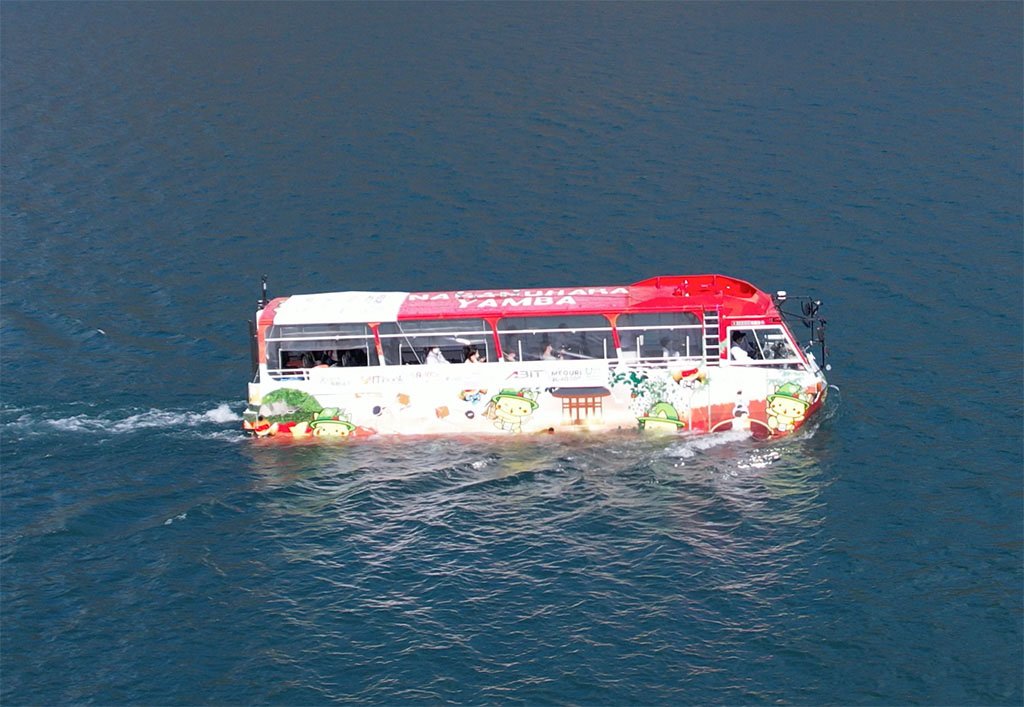
Yamba Dam stands on the Agatsuma River in Naganohara and officially opened on April 1, 2020; its reservoir is called Lake Yamba-Agatsuma [12]. The town bought the amphibious bus for about 130 million yen, paid for with money from the Tone River basin prefectures that benefit from the dam, and crewed tourist trips were set to begin at the end of July 2020 [3]. By late August, IEEE Spectrum reported that the bus was making daily tourist trips [4]. Response reported that the bus was built by Kowatec and that the Japan Amphibious Vehicle Association would run the tours [3].
The bus seats 40 passengers and carries two crew [8]. It drives on the road with a truck diesel engine and uses a separate marine engine on the water, where IEEE Spectrum gave its speed as 3.6 knots (about 4 mph, 7 km/h) [4][8]. A 2023 technical paper describes hydraulic steering and pneumatic brakes for road use, and a water-cooled marine engine that runs only when the bus is afloat [10].
The self-driving project
In July 2020 a consortium led by ITbook Holdings announced the Yamba Smart Mobility Project to make the bus drive and navigate itself [3]. The town owned the bus and managed the lake, the Japan Amphibious Vehicle Association operated it, Saitama Institute of Technology supplied the self-driving software, and ABIT provided local 5G communications [3][6]. The project was one of five backed by the Nippon Foundation's MEGURI2040 unmanned ship program, launched in February 2020, and its first-year budget was 250 million yen, just over 200 million of it from the foundation [1][3].
Because the bus carried tourists about nine months of the year, the team fitted and tuned the system during the winter off-seasons, starting in December 2020 [4]. The software was based on Autoware, an open-source self-driving platform, and used satellite positioning with a gyroscope, cameras, lidar and sonar [1][4][5]. Sonar was added because cameras and lidar work poorly underwater. The team also had to plan for driftwood and for a reservoir whose level can change by as much as 30 m (98 ft), with buildings and trees left in place when the valley was flooded [4].
The March 2022 demonstration
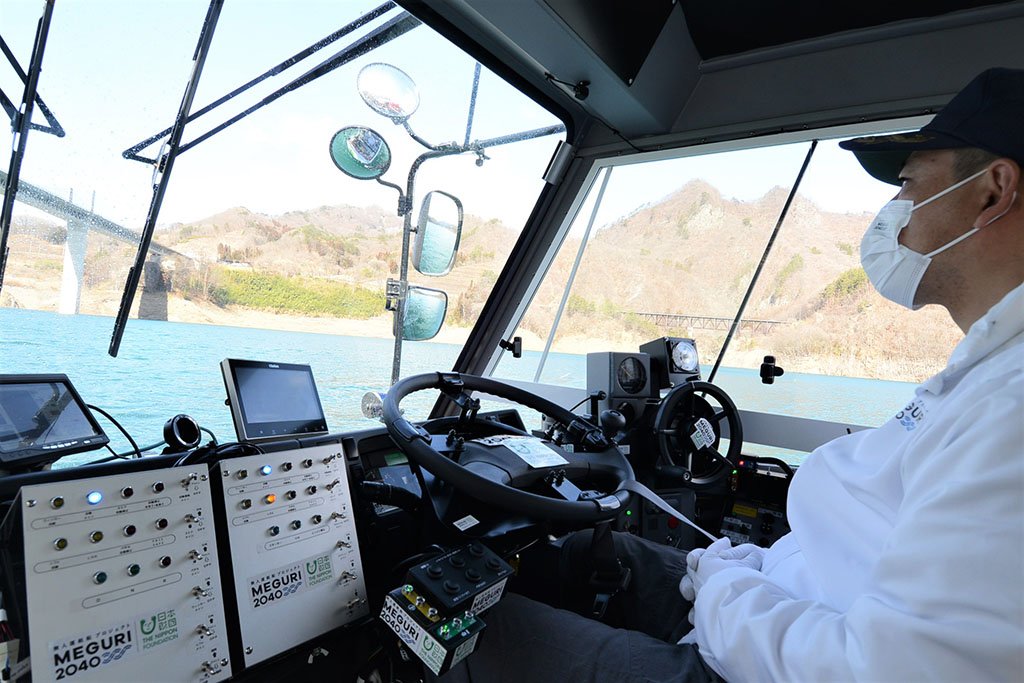
On March 14, 2022, the bus drove from land into the reservoir, followed a planned route near Fudo Bridge for about 2 km (1.2 miles) over roughly 30 minutes and climbed back onto land, all under automatic control [1][5]. A driver sat at the wheel without touching the controls, and a crew member stayed aboard to comply with Japanese maritime law [2][5][9]. Along the way the system detected a small boat about 2.5 m (8 ft) long sent toward it as a test obstacle and steered around it [5].
Reporters rode on three automated runs that day [5]. Because the shore was shallow, the bus entered the water at about 30 km/h (19 mph) so its wheels would not snag, then slowed to about 6.2 km/h (3.9 mph) [5]. Remote control over local 5G and LTE links was also tested [5]. The run was the last of six MEGURI2040 trials held between January and March 2022 [1][2].
Passengers and later years
The self-driving runs were demonstrations, with project staff and reporters aboard. Published accounts describe no fare-paying trips under autonomous control, and the ticketed tours are driven by a crew [5][8][9]. The partners aimed for practical use by 2025, and the Nippon Foundation said the next challenges included rougher water, with possible uses in disaster relief and deliveries to Japan's roughly 400 inhabited outlying islands [1][5][9].
The crewed tours continued. After the town's contract with its earlier operator expired, the local company Dts creation took over on August 10, 2023, shortening each trip from 70 to 50 minutes and lowering the adult fare from 3,500 yen to 2,500 yen [7]. The town organizes the tour and Dts creation runs it, with departures from Yamba Lake Station Maruiwa and a lake cruise whose route depends on the water level [8][11].
Photos
Related entries
Sources
- 6th Demonstration Test of Fully Autonomous Ship Navigation Successfully Completed, The Nippon Foundation (2022-03-14). en.nippon-foundation.or.jp/news/articles/2022/20220314-68745.html
- Japanese Consortium Conducts the World's First Demonstration of a Self-Driving Amphibious Vessel Supported by The Nippon Foundation, TNF Scholars Association (The Nippon Foundation) (2022-03-29). tnfsa.nippon-foundation.or.jp/news/715716
- 八ッ場ダムを水陸両用バスで行く…自動運転・運航めざす勝機や課題 (By amphibious bus at Yamba Dam: prospects and challenges for self-driving operation; in Japanese), Response (2020-07-05). response.jp/article/2020/07/05/336252.html
- Small Japanese Town to Test First Autonomous Amphibious Bus, IEEE Spectrum (2020-08-27). spectrum.ieee.org/small-japanese-town-to-test-first-autonomous-amphibious-bus-2650280386
- 水陸両用船「八ッ場にゃがてん号」が世界初の自動運航に成功 (Amphibious vessel Yamba Nyagaten succeeds in world-first autonomous navigation; in Japanese), Saitama Institute of Technology (2022-04-29). www.sit.ac.jp/media/yanbareport.pdf
- 埼玉工業大学、世界初の水陸両用船の無人運転・運航技術の開発に成功 (Saitama Institute of Technology press release; in Japanese), PR TIMES (2022-03-22). prtimes.jp/main/html/rd/p/000000050.000021794.html
- 八ッ場ダム水陸両用バス「にゃがてん号」8月10日(木)より運行開始 (Dts creation press release; in Japanese), Zaikei Shimbun (2023-08-03). zaikei.co.jp/releases/2142883
- 八ッ場にゃがてん号ツアー (Yamba Nyagaten tour; in Japanese), Dream Tourist Service / Dts creation. dtsline.jp/lp_nyagaten
- The world's first unmanned amphibious ship, JStories (2022-05-25). jstories.media/article/the-worlds-first-unmanned-amphibious-ship
- World's first self-driving amphibious bus, International Robotics & Automation Journal (MedCrave) (2023-01-09). medcraveonline.com/IRATJ/worldrsquos-first-self-driving-amphibious-bus.html
- 八ッ場ダム (Yamba Dam), Infrastructure Tourism Portal (in Japanese), Ministry of Land, Infrastructure, Transport and Tourism (MLIT). www.mlit.go.jp/sogoseisaku/region/infratourism/infralist/gunma/index01.html
- Yamba Dam, Wikipedia. en.wikipedia.org/wiki/Yamba_Dam
Last reviewed November 2026. Spotted something to correct or add? Tell us and include a source.
About the Amphibious Encyclopedia
WaterCar has designed and built amphibious vehicles in Southern California for more than 25 years. We keep this encyclopedia so anyone curious about vehicles that cross between land and water has one place to start, with the sources listed for every fact.
Browse all entries → · The WaterCar machines → · How a WaterCar works →