
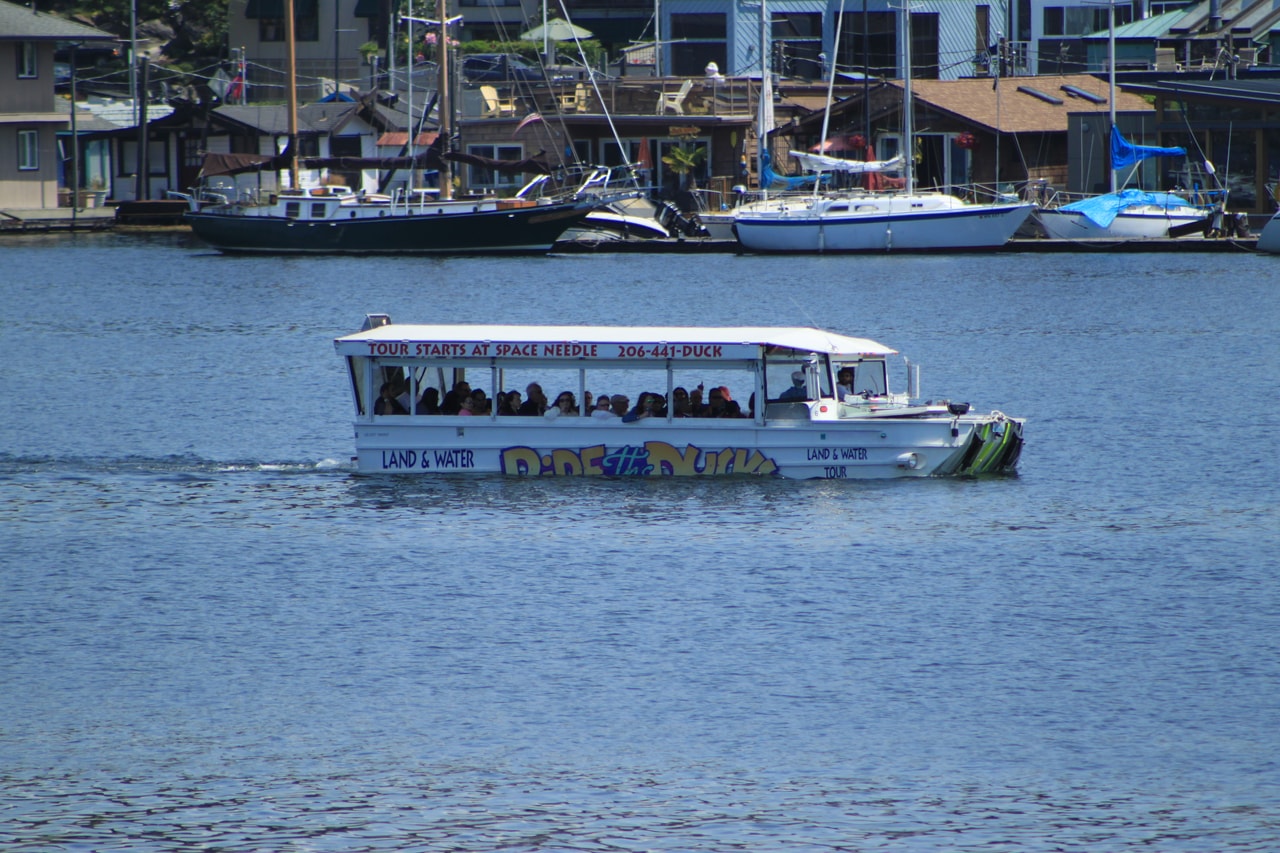
History
Tour companies began converting military DUKWs to carry passengers in Branson, Missouri, in 1971 [3]. Stretch ducks came from a later change. Between 1996 and 2005, several manufacturers updated and converted a total of 56 fleet ducks into stretch ducks or master jig ducks, according to the National Transportation Safety Board (NTSB) [3]. Before 2005 they were made by Amphibious Vehicle Manufacturing of Branson, which merged into Ride the Ducks International (RTDI) that year [1].
Ride the Ducks International also made a patented truck duck, a newly designed vehicle with no original DUKW parts that received Coast Guard approval in 2005 and was built until 2014 [1][3]. RTDI built its last vehicle in 2008, then contracted construction to Chance Rides Manufacturing of Wichita, Kansas, which kept building truck ducks [1][3]. When the NTSB reported in 2016, 46 of the 142 amphibious passenger vehicles operating in the United States were stretch vehicles [1].
Design
A stretch duck starts with a 1945 General Motors DUKW chassis. One example, DUCK 6, had that chassis cut in the middle and lengthened by 15 in (38 cm). It also had a 2005 hull with 10-gauge steel on the bottom and 12-gauge steel on the sides, and its stated maximum road speed was 55 mph (89 km/h) [1]. Its engine drove through an Allison AT-545 automatic transmission, and hydraulic disc brakes replaced the original drum brakes on three axles [1].
Stretch Duck 7 was built on a 1944 DUKW chassis, was acquired by Ozark Scenic Tours in 1982, and was modified in 1996, with most of its hull and mechanical systems replaced [3]. Changes included moving to a 6x4 road drive, adding 15 in (38 cm) of length, moving the captain's station 18 in (46 cm) forward and deepening the hull at the stern [3]. It measured 33 ft (10.1 m) long by 8 ft (2.4 m) wide and used a 235 hp Chevrolet gasoline engine [3]. Later master jig stretch ducks had completely new hulls, about 6 in (15 cm) wider and with gunwales about 6 in higher, close to the dimensions of a truck duck [3]. Another report on DUKW 34, built in 2003, describes its stretch as about 2 ft (0.6 m), a different figure from the 15 in given elsewhere [2].
Accident findings
The NTSB has investigated several accidents involving stretch ducks. On 7 July 2010 a tugboat and barge struck DUKW 34 of Ride the Ducks Philadelphia on the Delaware River, and two passengers died [2]. On 24 September 2015, Ride the Ducks of Seattle vehicle DUCK 6 crossed lanes on the Aurora Bridge and collided with a motorcoach. The NTSB found that the probable cause was failure of the left front axle housing, due to improper manufacturing by RTDI and inadequate maintenance by the operator, and five people died [1].
On 19 July 2018, Stretch Duck 7 of Ride the Ducks Branson sank on Table Rock Lake in a severe storm with 31 people aboard, and 17 died [3]. The NTSB found that the probable cause was the operator's continued waterborne tours after a severe thunderstorm warning, with waves flooding through a bow air intake hatch that was not weathertight. It listed as contributing factors the Coast Guard's failure to require sufficient reserve buoyancy and its ineffective action on emergency exits for vessels with fixed canopies [3]. The report notes the vessel had no internal subdivision or flotation, as originally built DUKWs did not, and that the newer master jig Stretch Duck 54, which was on the lake the same evening, exited the water [3].
Related entries
Sources
- Amphibious Passenger Vehicle DUCK 6 Lane Crossover Collision With Motorcoach on State Route 99, Aurora Bridge, Seattle, Washington, September 24, 2015 (NTSB/HAR-16/02), National Transportation Safety Board (2016-11-15). www.ntsb.gov/investigations/AccidentReports/Reports/HAR1602.pdf
- Collision of Tugboat/Barge Caribbean Sea/The Resource with Amphibious Passenger Vehicle DUKW 34, Philadelphia, Pennsylvania, July 7, 2010 (NTSB/MAR-11/02), National Transportation Safety Board (2011-06-21). www.ntsb.gov/investigations/AccidentReports/Reports/MAR1102.pdf
- Sinking of Amphibious Passenger Vessel Stretch Duck 7, Table Rock Lake, near Branson, Missouri, July 19, 2018 (NTSB/MAR-20/01), National Transportation Safety Board (2020-04-28). www.ntsb.gov/investigations/AccidentReports/Reports/MAR2001.pdf
Last reviewed November 2026. Spotted something to correct or add? Tell us and include a source.
See how to register a low-speed vehicle or boat in your state.
About the Amphibious Encyclopedia
WaterCar has designed and built amphibious vehicles in Southern California for more than 25 years. We keep this encyclopedia so anyone curious about vehicles that cross between land and water has one place to start, with the sources listed for every fact. New to the subject? Start with our guide, What is an amphibious vehicle?
All amphibious vehicles → · The WaterCar machines → · How a WaterCar works →